
Engine Smells: What Every Driver Needs to Know
A sweet, burning, or chemical odor from your car after driving usually signals one of six systems: coolant, engine oil, belts/hoses, brakes, fuel, or electrical wiring. Some of these are minor. Others require you to stop the car right now.
Here is the short version: if you smell smoke, melting plastic, or raw gasoline, pull over safely and shut off the engine. If the temperature gauge is climbing, same answer. A faint rubbery smell after heavy braking or a one-off burn-off after a fresh oil change? You can usually drive a short distance to a shop, but keep watching the gauges. According to Jalopnik, a burning smell after driving can come from oil leaks onto hot exhaust, slipping belts, overheated brakes, electrical faults, or debris on the exhaust, and the timing of the odor is your best clue about where to look first.
ASE-certified technicians can narrow most of these down in minutes with a visual inspection and an OBD-II scan. If you are in the Lynnwood area, Tom’s B & M Auto offers same-day appointments and backs every repair with a 24-month / 24,000-mile warranty.
Key Takeaways
Identifying the smell and when it occurs is the fastest way to judge urgency and get the right repair the first time.
| Point | Details |
|---|---|
| Match smell to system | Sweet means coolant, greasy means oil, rubber means belt, plastic means electrical, sulfur means catalytic converter. |
| Stop immediately for these | Smoke, burning plastic, raw gasoline smell, or a rising temperature gauge all require pulling over and shutting off the engine. |
| Cool-down inspection | Wait at least 30 minutes, then check for drips, scorched hoses, low fluid levels, and belt condition before driving further. |
| Describe it precisely | Tell your technician the smell type, when it happens, dashboard lights, and temperature gauge behavior to cut diagnostic time. |
| Tom’s B & M Auto | Same-day appointments, ASE-certified technicians, and a 24-month / 24,000-mile warranty on all repairs in the Lynnwood area. |
Table of Contents
- What do different engine smells actually mean?
- What should you do the moment you smell something burning?
- How to inspect the car yourself after it cools down
- Can you keep driving, or do you need to stop right now?
- What will a mechanic check, and what does it typically cost?
- Simple maintenance that prevents most burning smells
- How to describe the smell to your mechanic for a faster diagnosis
- Tom’s B & M Auto: fast diagnosis when your car smells wrong
- Sources
What do different engine smells actually mean?
Car engine odors are not random. Each one has a chemical signature tied to a specific fluid, material, or component reaching a temperature it should not reach. The table below maps the most common odors to their likely causes so you can match what you smelled to a starting point for diagnosis.
| Smell | Likely cause(s) | Urgency | When you notice it |
|---|---|---|---|
| Sweet/syrupy | Coolant leak (radiator, hose, heater core) | High | After parking, from vents with heat on |
| Heavy, greasy | Oil on hot exhaust (valve cover gasket, drain plug) | Medium | After acceleration, after parking |
| Acrid rubber | Slipping serpentine belt, hose on hot surface | Medium–High | During acceleration, at idle |
| Burning plastic/chemical | Overheating wiring, melted insulation, short circuit | Very High | At any time; often from vents |
| Metallic/hot | Overheated brakes or clutch | Medium | After heavy braking or downhill driving |
| Raw gasoline | Fuel line crack, failed injector, EVAP leak | Very High | After parking, during idle |
| Rotten egg/sulfur | Failing catalytic converter, rich-running engine | Medium–High | During acceleration, at highway speed |
Sweet or syrupy: coolant is the culprit
A sweet, maple-syrup smell almost always means ethylene glycol, the main ingredient in engine coolant, is escaping somewhere it should not be. The leak could be a cracked radiator hose, a loose clamp, a weeping water pump, or a failing heater core. NIOSH’s emergency response guidance notes that ethylene glycol is toxic to pets and people if ingested, so a puddle under the car is not just a mechanical problem. If the sweet smell is strongest inside the cabin when the heat is on, a leaking heater core is the likely source. TC Auto Service points out that heater core leaks can also fog the windshield from the inside, which is a second warning sign to watch for.
Left unaddressed, any coolant leak leads to overheating. That is where a minor repair becomes an engine replacement. Check the engine overheating guide for more on what happens when coolant levels drop.
Heavy and greasy: burning oil
Oil leaks most often originate at valve cover gaskets, the oil filter seal, or the drain plug. When oil drips onto a hot exhaust manifold or catalytic converter, it produces a sharp, acrid smell that can linger for several minutes after you park. The smell may not trigger a warning light, but you will often see a thin haze near the engine bay or find oily residue on the exhaust pipe. For a deeper look at where leaks start, the oil leak causes guide covers the most common failure points.
One common false alarm: a fresh oil change. Residual oil on the filter or drain plug often burns off over the first few drives. Check for fresh drips under the car before assuming a new leak.
Acrid rubber: belts and hoses
A burning rubber smell that comes on during acceleration or at idle, often preceded by a squeal, usually points to a slipping serpentine belt or a coolant/vacuum hose resting against a hot surface. TorqueBot’s analysis confirms that belt slip generates enough heat to produce a rubbery odor and can lead to accessory failures (power steering, alternator, AC) if the belt breaks. The serpentine belt guide explains what the belt drives and why a snap at highway speed is a much bigger problem than catching it early.
Burning plastic or chemical: electrical emergency
This one does not get a “monitor and see” response. A sharp, acrid smell like melting plastic or burning insulation means wiring or an electrical component is overheating. Possible causes include a short circuit, a failing alternator, or a wire chafing against a hot surface. The fire risk is real and fast-moving. Pull over, shut off the ignition, and do not restart the car until a technician has checked it.
Metallic and hot: brakes or clutch
A hot metallic smell after long downhill driving, heavy stop-and-go traffic, or towing is often just overheated brake pads doing their job under sustained load. That smell usually fades once the brakes cool. If it happens during normal driving with no obvious cause, a seized caliper is more likely. Manual transmission drivers who notice this smell during gear changes should check the clutch for wear. Jalopnik notes that a burning smell after long highway runs or steep downhill braking is often brake- or driveline-related due to sustained heat rather than an immediate engine failure.
Raw gasoline: treat it as a fire hazard
A strong fuel smell after parking, especially near a hot exhaust system, is a serious situation. Cracked fuel lines, a failed injector O-ring, or an EVAP system leak can all put raw gasoline vapor close to ignition sources. Do not dismiss this as a “gas station smell.” Get the car inspected the same day.
Rotten egg or sulfur: catalytic converter
A sulfur smell during acceleration or at highway speed usually points to a failing catalytic converter, often triggered by an engine running rich (too much fuel) or contaminated by oil or coolant. Rocky Mountain Auto Repair’s guide notes that a failing converter often triggers the check engine light and can cause emissions test failures. A rich-running condition that is not addressed will destroy a new converter quickly, so the root cause matters as much as the part. The engine misfiring guide explains how misfires contribute to this problem.
Pro Tip: Place a sheet of white cardboard under your car overnight. The color and location of any drip tells you a lot: green or orange is coolant, dark brown or black is oil, clear is water (usually normal AC condensate). Bring the cardboard to your appointment.
What should you do the moment you smell something burning?
Speed matters here. The right response in the first 60 seconds can prevent a small problem from becoming a dangerous one.
- Stay calm and assess. Note whether you see smoke, whether the temperature gauge is rising, and whether any warning lights are on.
- Signal and pull over safely. Find a parking lot or wide shoulder. Do not stop in traffic or on a narrow bridge.
- Shut off the engine if you see smoke, smell burning plastic or electrical insulation, or notice a strong gasoline odor. Do not restart it.
- Do not open the hood if heavy smoke is coming from the engine bay. Introducing oxygen to a smoldering fire makes it worse. Step away from the vehicle.
- Check for visible flames. If you see fire, get everyone out immediately and call 911. Do not attempt to drive the car.
- Look for fluid under the car from a safe distance. A spreading puddle of coolant or fuel is a sign the problem is active.
- Call for a tow if you smell gasoline, see smoke, or the temperature gauge is in the red. A $150 tow is far cheaper than a seized engine or a fire.
- Call 911 if there are flames, the car will not start and you are in a hazardous location, or you smell gas and cannot safely exit the vehicle.
For a faint rubber smell with no smoke, no warning lights, and normal temperature, you can drive carefully to a shop, but keep the windows down and watch the gauges the entire way.
Pro Tip: Keep a small fire extinguisher rated for Class B and C fires in your trunk. A 2.5 lb dry-chemical unit fits under most seats and can contain a small electrical or fuel fire long enough to get clear.
How to inspect the car yourself after it cools down
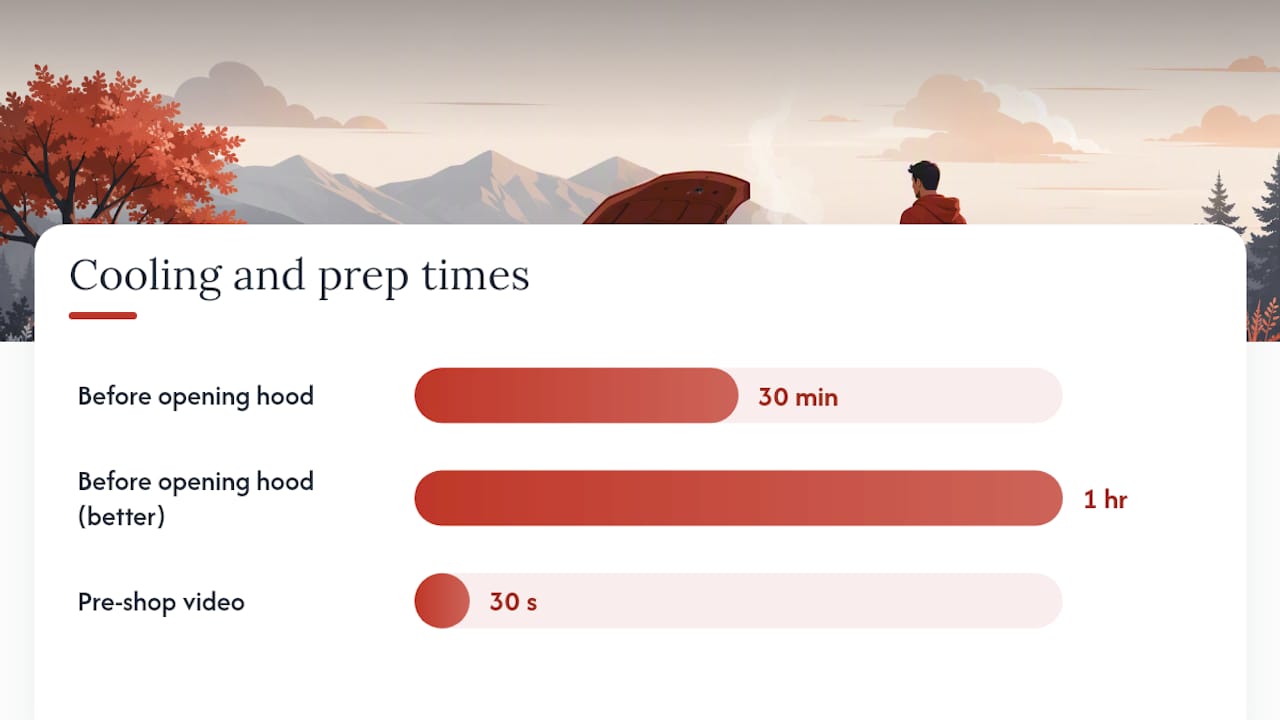
Wait at least 30 minutes after shutting off the engine before opening the hood. An hour is better. The cooling system stays pressurized and scalding hot long after the engine stops running. NIOSH’s coolant safety guidance is explicit: never open a pressurized radiator cap when the engine is hot.
Once the engine is cool, work through these checks in order:
- Look under the car first. Crouch and scan for puddles or drips. Note the color (see the cardboard tip above) and where the drip is coming from, front, middle, or rear.
- Open the hood and do a visual sweep. Look for oil residue on the exhaust manifold, scorched or cracked hoses, a belt that looks glazed or frayed, and any wiring with melted insulation.
- Check fluid levels. Pull the oil dipstick and look at the coolant reservoir (never the radiator cap). Low coolant with a sweet smell confirms a leak somewhere in the system.
- Smell the vents. Start the car briefly with the heat on and note whether the sweet smell is stronger inside the cabin than outside. That pattern points toward the heater core.
- Gently feel the wheel hubs after a drive where you noticed a metallic smell. A hub that is noticeably hotter than the others suggests a seized brake caliper on that corner. Use the back of your hand and be careful.
- Check the serpentine belt. With the engine off, look for cracks, glazing, or fraying along the belt’s edges. A belt that has slipped will often leave a dusty rubber residue on nearby components.
For the oil-related checks, the burning oil guide walks through exactly where to look for residue and what healthy versus leaking components look like.
Pro Tip: Before your shop visit, shoot a short video panning slowly across the engine bay, then a second clip showing any puddle or residue under the car. A 30-second video often tells a technician more than a five-minute verbal description.
Car Care Total’s diagnostic guide also recommends the overnight cardboard test as a low-effort way to capture drip color and location before you drive the car again.
Can you keep driving, or do you need to stop right now?
The answer depends almost entirely on what you smell, when you smell it, and what the gauges say. Here is a practical breakdown:
Stop immediately and arrange a tow:
- Smoke from the engine bay or cabin, any amount
- Burning plastic or electrical insulation smell
- Strong raw gasoline odor
- Temperature gauge in the red or climbing fast
- Check engine light on alongside any of the above
- Visible fluid actively dripping or spraying
Drive carefully to a shop (short distance only, watch gauges):
- Faint rubber smell after heavy braking or a long downhill run, no smoke, normal temp
- Mild burning smell immediately after an oil change that fades after a few miles
- Sulfur smell with no other symptoms and a stable temperature gauge (schedule same day)
- Mild oil smell with no warning lights and normal oil level (do not delay more than a day)
Timing tells you a lot. A smell that appears only during braking points to brakes or clutch. One that shows up during hard acceleration suggests fuel delivery, turbocharger, or engine oil on a hot surface. A smell that only appears after you park, with the engine off, usually means a fluid is dripping onto a hot component and burning off as it cools. That last pattern is easy to miss because the car seems fine while driving.
Electric and hybrid vehicles are not immune. They do not have the same oil and belt systems, but they can still produce burning odors from brakes, wiring, or cooling system faults. The same logic about stopping or driving applies.
If a check engine light came on alongside the smell, the check engine light guide explains what the codes mean and which ones warrant immediate action.
What will a mechanic check, and what does it typically cost?
A technician’s first job is to confirm the smell is not an immediate safety risk, then narrow down the source systematically. Here is what that process looks like:
- Visual inspection: oil residue on exhaust components, scorched hoses, belt condition, wiring integrity, fluid levels
- Pressure tests: cooling system pressure test to find coolant leaks; fuel system pressure test for suspected fuel leaks
- Smoke test: used to find vacuum leaks and EVAP system failures that produce fuel smells
- OBD-II scan: reads stored and pending codes for misfires, emissions faults, and sensor failures that contribute to catalytic converter and fuel smell issues
- Brake and wheel temperature check: identifies seized calipers or dragging pads
- Electrical testing: checks for shorts, overloaded circuits, and failing components like alternators or relays
Most shops can complete the initial diagnostic sweep in under an hour. What they find determines the repair.
These are ballpark figures. Actual costs vary by make, model, and labor rate in your area. A Toyota Camry valve cover gasket is a different job than the same repair on a European vehicle with a tight engine bay.
Larger repairs like a heater core or catalytic converter can add up quickly. Financing is available at Tom’s B & M Auto for repairs over a certain threshold, so cost does not have to mean delay.
Simple maintenance that prevents most burning smells
Most of the smells in this guide are preventable with routine checks. None of them require mechanical skill.
Monthly (takes about 10 minutes):
- Check engine oil level and color. Dark, gritty oil past its change interval is more likely to leak and burn.
- Check coolant level in the reservoir (cold engine only). Top off with the correct type for your vehicle.
- Glance under the car for fresh spots or drips.
- Look at the serpentine belt for visible cracking or fraying.
At every oil change interval:
- Ask the shop to inspect all hoses and belts for wear.
- Have brake fluid and brake pad thickness checked.
- Inspect the battery terminals for corrosion, which can cause electrical smells.
- Clear any debris (leaves, plastic bags) from the undercarriage and exhaust heat shields.
Every 30,000 miles or per manufacturer schedule:
- Replace the serpentine belt if it has not been done (many manufacturers recommend this proactively).
- Flush and replace coolant per the vehicle’s service interval.
- Have the brake calipers inspected for sticking, especially on older vehicles.
Manual transmission drivers: avoid riding the clutch in stop-and-go traffic. Partial engagement generates heat and produces the same metallic burning smell as a worn clutch, and it accelerates wear significantly.
How to describe the smell to your mechanic for a faster diagnosis
A precise description of the odor and when it happens is often the fastest diagnostic tool a technician has. Vague descriptions (“it smells weird”) lead to broader, more time-consuming inspections. Specific ones let a technician go straight to the likely system.
Use these comparisons when describing the smell:
- Sweet, like maple syrup or antifreeze: coolant leak (radiator, hose, heater core)
- Greasy, like cooking oil burning on a stove: engine oil on a hot exhaust surface
- Sharp rubber, like a burning eraser: slipping belt or hose on a hot component
- Melting plastic or burning insulation: electrical fault, overheating wiring
- Hot metal, like a brake rotor after a hard stop: overheated brakes or clutch
- Raw gasoline, like standing at a pump: fuel system leak or EVAP failure
- Rotten eggs or sulfur: catalytic converter or rich-running engine
Beyond the smell itself, give the technician these details:
- When it happens: at idle, during acceleration, only after parking, only when braking
- How strong: faint and fading, or persistent and getting worse
- Dashboard lights: any warning lights on, especially check engine, temperature, or oil pressure
- Temperature gauge behavior: normal, climbing, or in the red
- Recent service history: oil change, brake work, any recent repairs
- Visible evidence: smoke, fluid spots, anything you noticed under the hood or under the car
- Photos or video: even a 20-second clip of the engine bay or a puddle under the car helps
Car Care Total confirms that smell type combined with timing and simple visual evidence often identifies the cause before any deeper diagnostic work begins. Bringing that information to your appointment can cut diagnostic time significantly.
Coolant smell deserves a specific note here. If you describe a sweet smell and mention that it is strongest inside the cabin with the heat running, a technician will immediately check the heater core rather than starting with the radiator. That single detail can save an hour of labor.
Pro Tip: Write down your observations in your phone’s notes app right after you notice the smell, while the details are fresh. Include the time, recent driving conditions (highway, stop-and-go, towing), and any sounds that came with it. That note is worth more than trying to remember the details two days later at the shop.
A mechanic’s honest take on burning smells
The first thing a technician does when a car comes in for a smell complaint is not run a scan. It is stand next to the car, open the hood, and use their nose. Smell is a faster first filter than any code reader.
The most common finding? Oil on the exhaust. It accounts for a large share of burning smell complaints and is almost always a minor repair caught early. The second most common is brake-related, especially after a customer has been driving mountain roads or towing. Neither of those is an emergency if you catch them before the fluid runs low or the caliper fully seizes.
What actually costs people money is waiting. A small coolant leak that gets ignored becomes an overheated engine. A slipping belt that gets ignored snaps on the highway and takes out the power steering and alternator at the same time. The smell is the warning. The repair at that stage is cheap. The repair after the warning is ignored is not.
When a car comes into the shop, the first priority is safety: check for active leaks, check fluid levels, run the OBD-II scan for stored codes, and do a visual sweep of the belts, hoses, and wiring. Most of the time, the cause is obvious within the first 15 minutes. Customers who bring photos and a written description of when the smell happened get a faster answer, every time.
Tom’s B & M Auto backs every repair with a 24-month / 24,000-mile warranty. ASE-certified technicians handle the diagnosis. Same-day appointments are often available for smell complaints because most of them need to be looked at the same day.
Tom’s B & M Auto: fast diagnosis when your car smells wrong
Burning or unusual car engine odors are exactly the kind of problem that gets worse the longer you wait. Tom’s B & M Auto has been diagnosing and repairing these issues for drivers in Lynnwood, Kenmore, Shoreline, Edmonds, and Mountlake Terrace since 1985.
ASE-certified technicians run a full visual inspection, OBD-II scan, and fluid check on arrival. Services covering the most common smell causes include engine diagnostics, engine repair in Kenmore, coolant and radiator repair in Shoreline, brake service, and electrical diagnostics. A free check engine light review is available for drivers who noticed a warning light alongside the smell. Same-day appointments are often available. Bring your photos, your notes on when the smell happened, and the cardboard from under the car if you used it. The 24-month / 24,000-mile warranty covers all work. Call or book online at Bandmautocare to get your car checked today.
Sources
The following sources were used to build this guide. Each one covers a specific aspect of engine smell diagnosis and safety.
- Ethylene glycol — NIOSH Emergency Response Card
- Why does my car smell like burning after driving? — Jalopnik
- How to diagnose strange car smells (and what they mean) — Car Care Total
- What does that strange smell from my engine mean? — TC Auto Service
- Burning smell from engine — TorqueBot Blog
Recommended
- Why Your Car Burns Oil: Causes, Checks, and Fixes – Tom’s B & M Auto Blog
- Check Engine Sign in Car: What to Do Right Now – Tom’s B & M Auto Blog
- Check Engine Light Meaning: What Drivers Need to Know – Tom’s B & M Auto Blog
- What Is Engine Misfiring? Causes, Signs, and Fixes – Tom’s B & M Auto Blog
Leave a Reply