

Audi Oil Consumption: 2026 Warranty Coverage Depends on Testing
If your Audi needs a quart of oil between changes, that can fall within documented OEM ranges for several engine families, but “probably normal” isn’t the same as confirmed. The only way to know for sure is to run the measurement and documentation steps below, or book a formal oil consumption test, especially since a 2024 settlement ties warranty coverage to proper testing.
TL;DR:
- Consumption that rises past roughly a quart per 1,000 miles warrants formal testing; acceptable limits vary by engine code and driving conditions.
- Audi’s dealer test uses two documented measurements about 630 miles apart; do not add oil during the interval unless the low oil warning appears.
- Technicians generally check the PCV valve or oil separator and update engine software first, reserving piston or ring replacement for confirmed excessive consumption.
- A 2024 settlement may cover up to 75% of eligible repairs for as long as 9 years or 90,000 miles, subject to VIN and maintenance requirements.
- Photograph odometer and dipstick readings, save service receipts, and check for driveway leaks or blue smoke to give the shop verifiable diagnostic evidence.
Table of Contents
- Mechanical and System Causes of Oil Consumption in Audi Engines
- What Counts as Normal Oil Consumption for an Audi
- How Audi Tests for Oil Consumption: TSBs and the Two-Part Process
- How to Track Your Oil Use Before You See a Shop
- What the Piston Settlement Means for Your Warranty
- What a Reputable Independent Shop Checks for Oil Consumption
- What Owners Usually Get Wrong About Oil Consumption
- Get Your Audi’s Oil Consumption Diagnosed the Right Way
- FAQ
- Sources
Mechanical and System Causes of Oil Consumption in Audi Engines
Several things inside and outside the engine can drive up oil use, and separating them starts with knowing what each one looks and feels like.
- Worn piston rings: rings that no longer seal properly let oil slip past into the combustion chamber, where it burns off instead of lubricating.
- PCV or oil separator failure: a failing crankcase ventilation system or oil separator, a frequent subject of Audi technical service bulletins, can pull oil into the intake.
- Valve stem seals and valvetrain wear: hardened or worn seals let oil seep down into the cylinders past the valve guides.
- Turbocharger oil seals: on turbocharged TFSI engines, worn turbo seals allow oil to migrate into the intake or exhaust tract.
- External leaks: gasket or seal leaks show up as spots on the driveway or oil residue around the block, distinct from internal burning, which usually shows as blue exhaust smoke.
- Wrong oil viscosity or incomplete break-in: using an off-spec weight, or driving too gently during the first few thousand miles, can leave piston rings poorly seated, a pattern owners describe often on enthusiast forums.
Each of these points to a different repair path, so matching your symptoms to the right cause saves time and money before you ever call a shop.
What Counts as Normal Oil Consumption for an Audi
Audi’s own service documentation and owner reports describe consumption rates that can fall within an acceptable range for certain engines, though the allowed figure depends on the specific engine code. A 2.0T engine and a 3.0T engine are not held to the same standard, and ambient temperature, driving style, and even which oil weight you run can all shift where your car lands inside that range. Short trips, cold climates, and sustained high-RPM driving tend to push consumption toward the higher end.
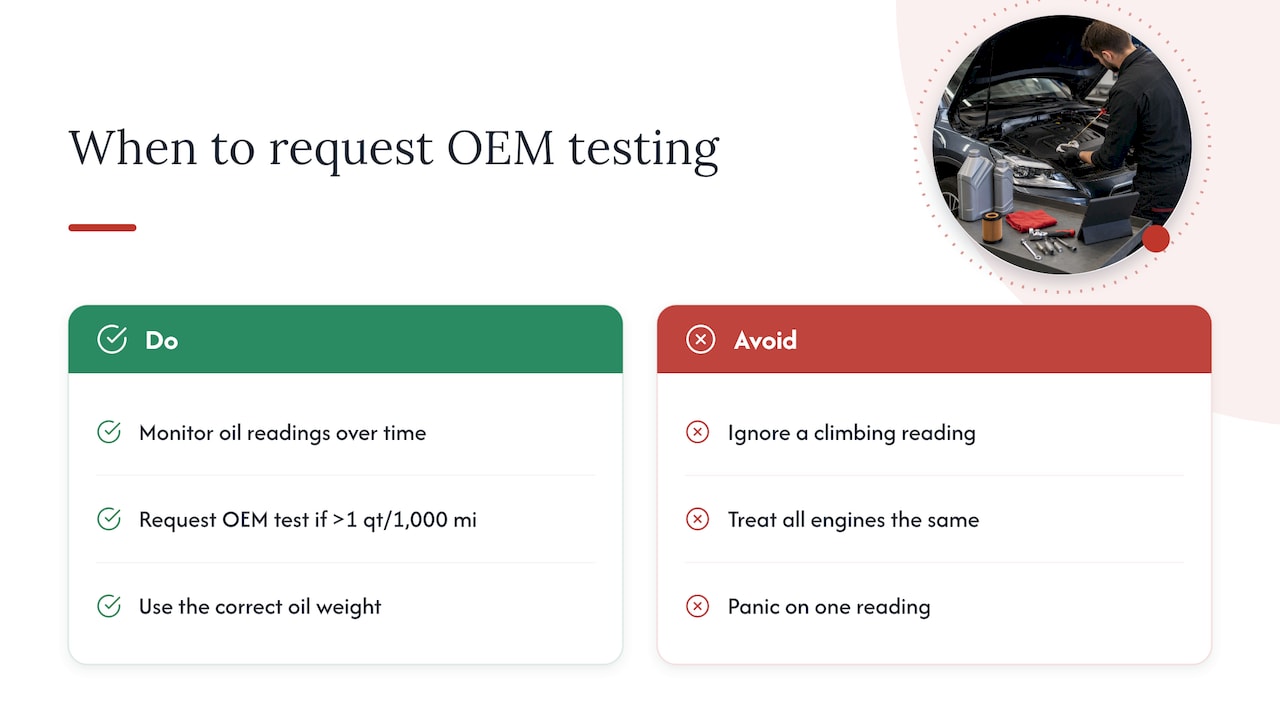
A reading that stays flat or improves after an oil change usually means nothing urgent. One that climbs, especially past a quart every 1,000 miles, is where “expected” turns into “actionable.” At that point, a formal OEM test, not a guess, is what determines whether the car qualifies for warranty-covered repair.
How Audi Tests for Oil Consumption: TSBs and the Two-Part Process
Audi dealers do not rely on a single oil check to confirm excessive consumption. The official procedure runs in two parts using the ODIS/GFF guided function or a conventional scale measurement.
- Part one: the technician fills the engine to a specified level, logs the reading through ODIS/GFF, and sends the car home.
- Owner interval: you drive normally for roughly 630 miles without adding oil, unless a low-oil warning appears first.
- Part two: the car returns to the dealer, where the technician measures how much oil was actually consumed and logs the result for a TAC (Technical Assistance Center) review.
One documented OEM oil consumption test is typically what dealers can bill or reimburse within a given warranty window, according to the relevant TSB, which makes getting the first test right worth the inconvenience of waiting out the interval.
If the numbers confirm a problem, TSBs generally point first toward replacing the crankcase pressure regulating valve or oil separator (part 06E103547H on affected engines) and applying an ECM software update before anything more invasive is attempted. Piston or piston-ring replacement, per later TSB guidance, is reserved for cases where measured consumption exceeds allowed limits and no other cause can be found.
How to Track Your Oil Use Before You See a Shop
You don’t need dealer equipment to start building a useful record. A clean, consistent log makes any later diagnostic, whether at a dealer or an independent shop, faster and more conclusive.
- Check the oil on level ground, after the engine has cooled for several minutes, and pull the dipstick the same way every time.
- Photograph the odometer and dipstick reading at each check so the dates and mileage are verifiable.
- Keep oil and fuel receipts together with your photos in case a shop or dealer needs proof of the maintenance interval.
- Run a simple cardboard test under the car overnight to catch slow external leaks before assuming it’s internal burning.
- Watch for blue exhaust smoke on startup or hard acceleration, a classic sign of oil reaching the combustion chamber.
Pro Tip: If your low-oil warning light comes on before your next scheduled check, stop driving normally and book a diagnostic test immediately rather than topping off and waiting.
Our team at Tom’s B & M Auto walks customers through the same documentation habits after routine service, since a ten-minute check right after an oil change can catch a leak before it becomes a consumption mystery.
What the Piston Settlement Means for Your Warranty
A 2024 class action settlement, Rieger et al. v. Volkswagen Group of America, extended warranty coverage for certain Audi models affected by piston-related oil consumption, offering up to 75% of repair costs for eligible vehicles for up to 9 years or 90,000 miles. The settlement site lists which model years qualify, including certain A4, A5, A6, and Q5 vehicles from 2012 through 2014 along with specific TT and A3 years, and requires a VIN lookup to confirm eligibility.
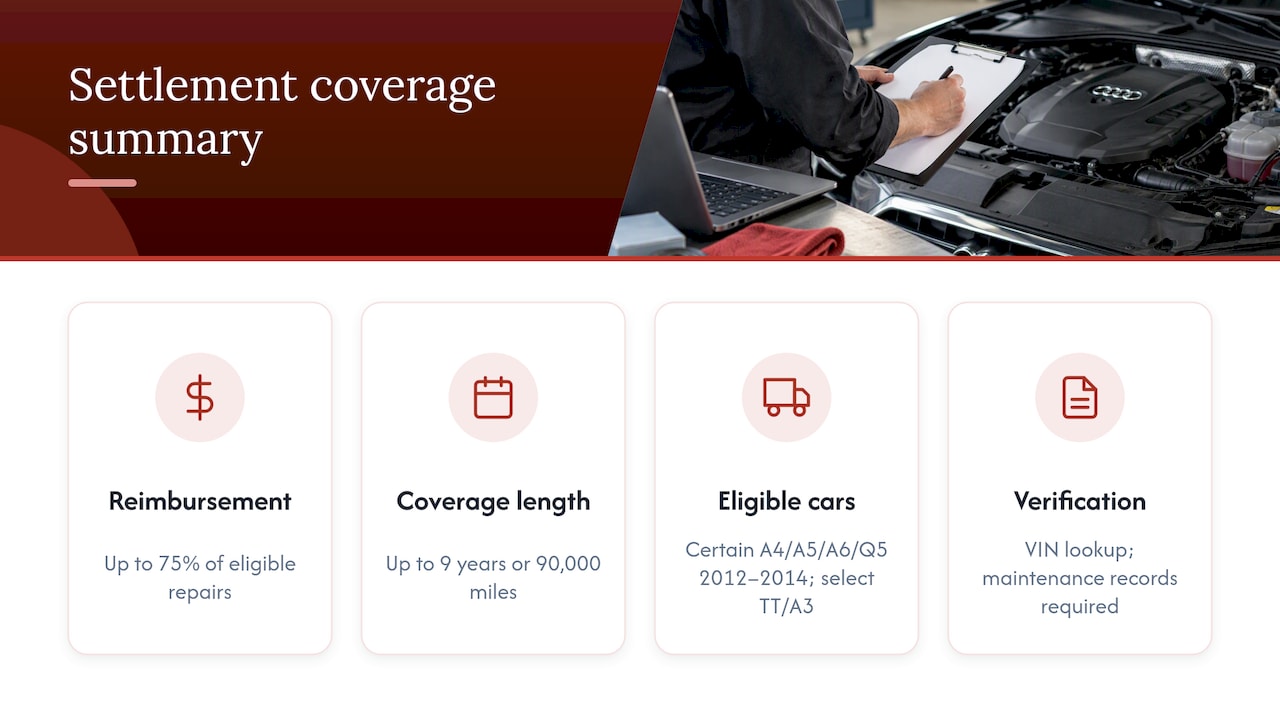
Coverage isn’t automatic. Owners need proof of adherence to Audi’s maintenance schedule, meaning service records matter as much as the oil consumption test itself. Reimbursement structures also differ depending on where the repair happens, with different caps applying to dealer repairs versus work done at an independent shop, so it’s worth checking your specific terms on the settlement portal before assuming full coverage.
What a Reputable Independent Shop Checks for Oil Consumption
When a car comes in for a suspected oil consumption issue, a thorough diagnostic goes well beyond a dipstick check.
- Pull OBD-II logs and photograph fault codes alongside oil level readings for a timestamped record.
- Inspect visually for external leaks around the valve cover, oil filter housing, and turbo lines.
- Check the PCV system and oil separator for cracks, clogging, or failed valves.
- Run a compression or leakdown test when ring wear is suspected, rather than guessing from smoke alone.
- Compile photo logs, OBD data, and receipts into a format a dealer or TAC reviewer can actually use.
Pro Tip: Ask any shop doing this diagnostic to hand over copies of every log and photo, since that documentation is what a dealer or settlement claim will actually need.
Our Audi repair services in Edmonds follow this same sequence, and same-day appointments are often available when you need answers quickly rather than waiting weeks for a dealer slot.
What Owners Usually Get Wrong About Oil Consumption
Most owners either panic at the first low reading or ignore a slow climb for too long. Neither extreme beats a measured test. The oil consumption protocol exists because anecdote is unreliable, and skipping steps, like topping off mid-test, can cost you warranty eligibility you’d otherwise have earned. A documented diagnostic from a shop that understands the TSB process gives you a real answer instead of a guess.
— Shingi
Get Your Audi’s Oil Consumption Diagnosed the Right Way
A quart low between changes might be nothing, or it might be the first sign of a PCV failure or worn rings, and the only way to tell the difference is a documented diagnostic. We handle that process directly: OBD-II logging, visual leak inspection, PCV and oil separator checks, compression testing when it’s warranted, and the engine repair work that follows if a cause is confirmed.
- Technicians handle the diagnostic and any follow-up repair under one roof.
- Same-day appointments are often available, so you’re not waiting weeks for an answer.
- Repairs carry a warranty, regardless of make or model.
If you’re already due for service, our oil change page is a simple place to start a documented oil-level check, and if testing points to something mechanical, our engine repair services pick up from there.
FAQ
Why do Audis consume so much oil?
Oil consumption on certain Audi engines, especially turbocharged TFSI models, usually traces back to worn piston rings, a failing PCV or oil separator system, or worn turbo seals letting oil migrate into the intake. Audi’s own TSBs treat these as the most common mechanical causes before considering more invasive repairs.
How can I fix my Audi’s oil consumption issue?
The fix depends on what the OEM two-part test finds: TSB guidance generally starts with replacing the crankcase pressure regulating valve or oil separator and applying an ECM software update, reserving piston or piston-ring replacement for cases where consumption still exceeds allowed limits afterward. An independent shop can run the same diagnostic sequence and refer you for warranty work if the results support it.
What is the settlement related to Audi oil consumption?
A 2024 settlement, Rieger v. Volkswagen Group of America, extended warranty protection for specific Audi models and model years, covering up to 75% of eligible repair costs for up to 9 years or 90,000 miles. Eligibility depends on a VIN lookup through the settlement site and proof that maintenance requirements were followed.
Why do I have to keep putting oil in my Audi?
Needing to top off oil between changes, within roughly a quart per 1,000 miles, can fall inside normal ranges for some engines, but a pattern that keeps repeating or worsens points to a mechanical cause worth testing. Documenting your oil checks and booking a formal consumption test is the way to confirm whether it’s expected or something that needs repair.
Sources
- Classaction
- Pistonsettlement
- 17 Electronic oil consumption measurement – Repair Authorization (Audi TSB)
- 17 Engine oil consumption – Customer complaints, 3.0T TFSI (Audi TSB)
Recommended
- Why Your Car Burns Oil: Causes, Checks, and Fixes
- 5,000–10,000 Miles? Oil Change Interval U.S. Drivers Should Follow
- Auto Repair Warranty Explained: What Car Owners Must Know
Leave a Reply