

The Role of Serpentine Belt: What Every Driver Should Know
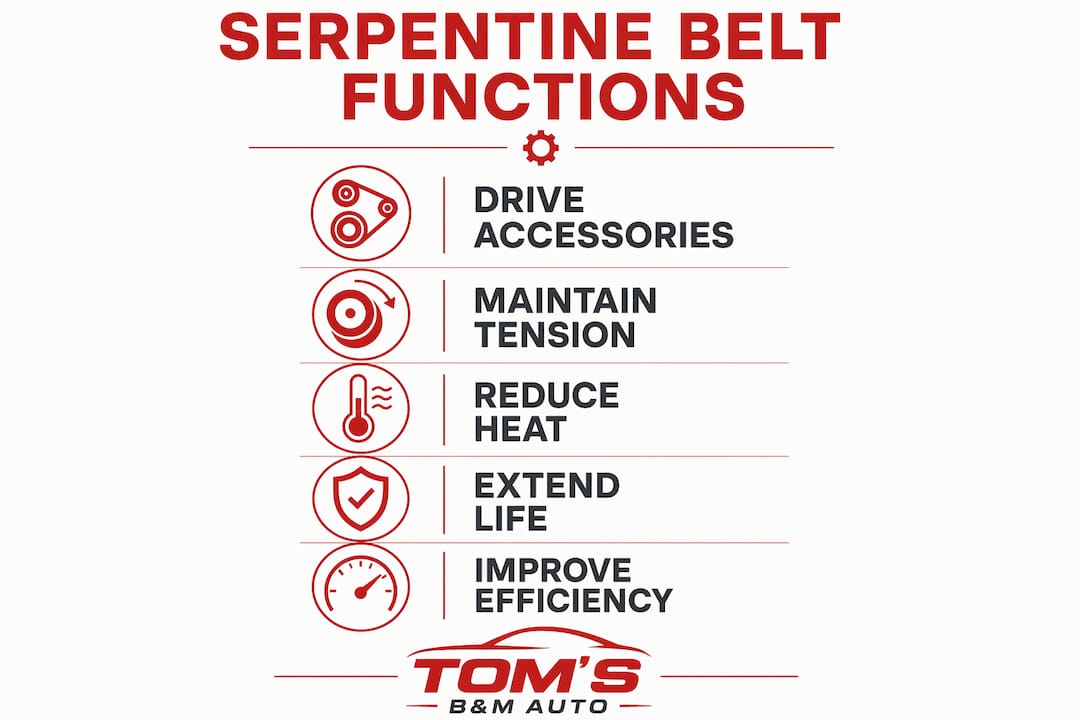
The serpentine belt is a single, continuous loop that drives multiple accessories from one crankshaft pulley, including the alternator, power steering pump, air conditioning compressor, and water pump. Without it, none of those systems run. Your engine might still fire, but you’d lose steering assist, battery charging, cabin cooling, and engine cooling almost simultaneously.
Here’s what the serpentine belt powers in a typical vehicle:
- Alternator — keeps the battery charged and powers your electrical system while driving
- Power steering pump — provides hydraulic assist so the wheel turns without a fight
- A/C compressor — circulates refrigerant for cabin cooling
- Water pump — circulates coolant to prevent engine overheating
- Idler and tensioner pulleys — guide the belt and maintain consistent tension
The belt itself is wider and thinner than the older V-belts it replaced, a design that reduces heat buildup and extends service life. Its multi-groove (poly-V) construction lets it flex around multiple pulleys without losing grip.
How does a serpentine belt differ from a timing belt?
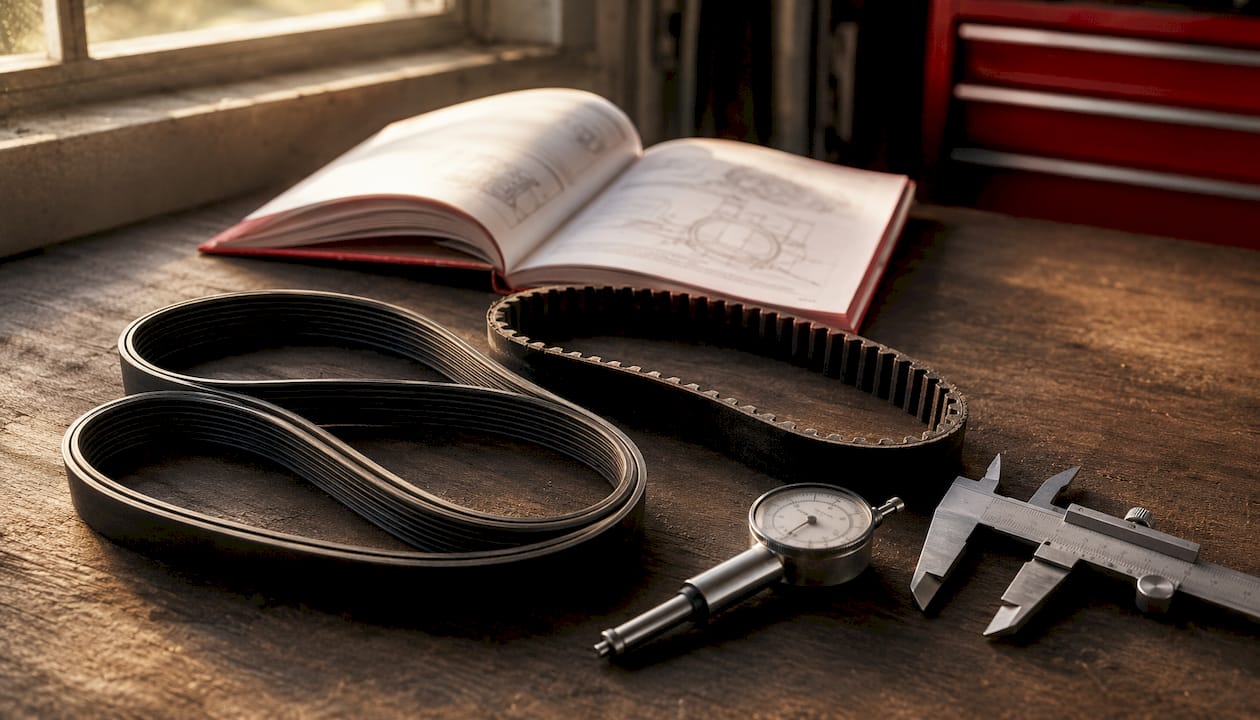
These two belts live in the same engine but do completely different jobs, and mixing them up is one of the most common mistakes car owners make.
Serpentine belt:
- Drives external accessories (alternator, power steering pump, A/C compressor, water pump)
- Located on the outside of the engine, usually visible when you open the hood
- Failure disables accessories but does not immediately destroy the engine internally
- Typically made of EPDM rubber with a ribbed, multi-groove profile
Timing belt:
- Controls the precise synchronization of the crankshaft and camshaft(s) to keep engine valves opening and closing at the right moment
- Runs inside the engine, hidden behind a cover
- Failure can cause catastrophic internal engine damage, especially in interference engines
- Usually replaced on a strict mileage schedule because there is no visible warning before it snaps
The replacement schedules differ too. Serpentine belts are often inspected visually and replaced based on wear. Timing belts follow a fixed interval set by the manufacturer, regardless of how the belt looks. Skipping a timing belt interval is a gamble most mechanics won’t recommend.
Warning signs that your serpentine belt is failing
Catching a worn belt early is far cheaper than dealing with a breakdown on the highway. The symptoms are usually hard to miss once you know what to listen and look for.
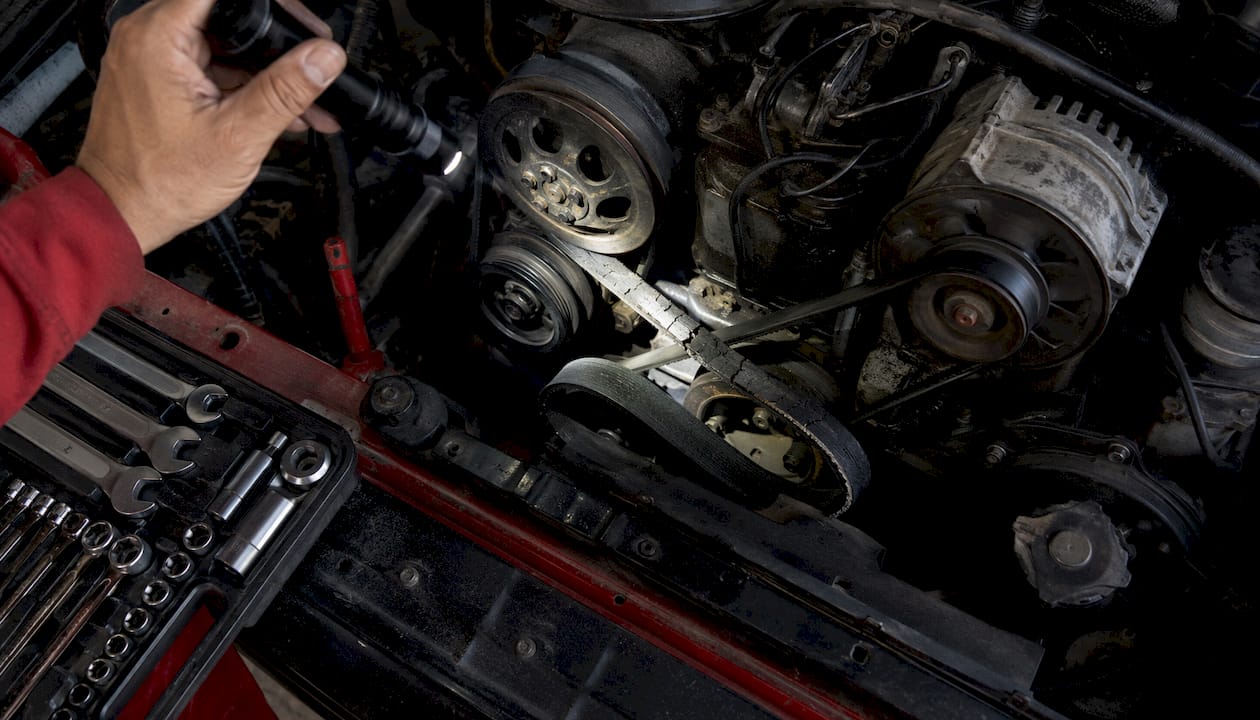
- Squealing or chirping noise — a high-pitched sound from the front of the engine, especially on startup or when turning the wheel sharply, often points to a slipping or glazed belt
- Loss of power steering assist — the wheel suddenly feels heavy, particularly at low speeds or when parking
- Battery or temperature warning lights — if the alternator or water pump stops working, the dashboard will tell you quickly
- Visible belt damage — cracks, fraying, glazing (a shiny, hardened surface), or missing ribs are all signs the belt is past its prime
- A/C stops cooling — if the compressor isn’t being driven, the cabin heats up fast
Squealing and loss of steering assist are two of the most reported early symptoms. Heat and improper tension accelerate wear, so a belt that looks fine on the outside can still be failing internally.
Pro Tip: If you hear a squeal that disappears after a few minutes of driving, don’t assume it fixed itself. That’s often a cold, glazed belt slipping until it warms up and grips again.
When should you replace your serpentine belt?
Most manufacturers recommend inspecting the serpentine belt regularly and replacing it according to the interval specified in your owner’s manual, though your owner’s manual has the definitive interval for your specific vehicle. EPDM rubber belts, which are standard on most modern cars, wear more gradually than older neoprene belts, so they may look fine long after they’ve lost structural integrity.
Replacing the belt before it fails prevents the cascade of accessory failures that follow a sudden break. The tensioner deserves equal attention. A worn tensioner damper causes the arm to oscillate with engine pulses, which risks belt slip or derailment even on a brand-new belt. Most shops replace the tensioner at the same time as the belt, and that’s the right call.
A few habits that extend belt life:
- Keep the engine bay free of oil leaks, since petroleum degrades rubber fast
- Have the belt tension checked during routine oil changes
- Address any seized accessory (like a locked-up A/C compressor clutch) immediately, since a seized pulley will shred a belt in minutes
- Check high-mileage maintenance tips if your vehicle is past 100,000 miles
What happens if the serpentine belt breaks while you’re driving?
The short answer: a lot goes wrong, fast. Think of the serpentine belt as the electrical wiring of a home. When it fails, almost every vital accessory stops at once.
Here’s the sequence of events after a belt breaks:
- Alternator stops charging — the battery begins draining immediately; you may have only minutes of electrical power left
- Power steering pump stops — the wheel becomes noticeably harder to turn, which is dangerous at highway speeds or in tight turns
- Water pump stops circulating coolant — engine temperature climbs rapidly; overheating can warp cylinder heads or crack the engine block within minutes
- Vehicle stalls — once the battery drains far enough, the engine management system loses power and the car dies
Pulling over immediately is the only safe response. A broken belt makes the vehicle unsafe and inoperable within a very short window. Driving even a mile on a failed belt risks engine damage that costs far more than the belt itself.
One detail most drivers don’t realize: even a seized power steering pump or A/C compressor, not the belt itself, can snap a belt and strand you. The single-belt design means one failed component can take down the entire accessory drive.
Why professional serpentine belt service matters
Tom’s B & M Auto has been servicing vehicles in the Lynnwood area since 1985, covering all makes including Toyota, Honda, Subaru, domestic trucks, European models, and hybrids. ASE-certified technicians inspect the full accessory drive system, not just the belt itself, because a new belt on a worn tensioner is a repair that will come back to haunt you.
- Professional diagnostics — OBD-II scanning and visual inspection catch tensioner wear, pulley misalignment, and accessory issues before they cause a failure
- Quality replacement parts — using the correct belt specification for your vehicle’s make and model prevents premature wear
- A warranty period is provided for the work completed, so you’re covered if something isn’t right — all work is backed by a written guarantee, so you’re covered if something isn’t right
- Upfront pricing — no surprises on the invoice; you know the cost before work begins
- Same-day appointments — often available for belt inspections and replacements
Serpentine belt replacement is one of the more straightforward preventive services, but the consequences of skipping it are anything but minor. Regular preventive maintenance keeps the full accessory drive healthy and avoids the kind of roadside breakdown that turns a $150 belt into a $1,500 engine repair.
Schedule your serpentine belt inspection at Tom’s B & M Auto. Book a free vehicle inspection or call (425) 776-5054 to set up a same-day appointment in Lynnwood, WA.
Key Takeaways
The serpentine belt drives every major engine accessory at once, so a single failure disables steering, charging, and cooling simultaneously.
| Point | Details |
|---|---|
| Single belt, multiple systems | One belt powers the alternator, power steering pump, A/C compressor, and water pump from the crankshaft. |
| Not the same as a timing belt | The timing belt controls valve timing inside the engine; the serpentine belt drives external accessories. |
| Early symptoms are audible | Squealing, chirping, and loss of steering assist are the most common early warning signs of belt wear. |
| Replace tensioner with the belt | A worn tensioner damper can cause belt slip or derailment even on a new belt, so replace both together. |
| Failure is fast and dangerous | A broken serpentine belt disables steering and engine cooling within minutes, requiring an immediate stop. |
Recommended
- Serpentine Belt & Hoses in Shoreline, WA | Tom’s B&M Auto
- Serpentine Belt & Hoses in Kenmore, WA | Tom’s B&M Auto
- Serpentine Belt & Hoses in Lynnwood, WA | Tom’s B&M Auto
- Serpentine Belt & Hoses in Mountlake Terrace, WA | Tom’s B&M Auto
Leave a Reply