

What Is Engine Misfiring? Causes, Signs, and Fixes
Engine misfiring is defined as the failure of one or more cylinders to complete proper combustion due to missing spark, incorrect fuel delivery, or lost compression. The result is immediate: your car shakes, loses power, and runs rough. A single-cylinder misfire in a 4-cylinder engine drops power output by 25%, which explains why even one bad cylinder makes your car feel dramatically off. The industry term is “cylinder misfire,” and it triggers a specific set of OBD-II diagnostic trouble codes in the P0300 series. Understanding what causes engine misfiring, how to spot the signs early, and what happens if you ignore it can save you hundreds or thousands of dollars in repair costs.
What is engine misfiring and why does it happen?
Engine misfiring is a combustion failure inside one or more cylinders. Every cylinder in your engine follows a four-stroke cycle: intake, compression, power, and exhaust. A misfire happens when the power stroke fails. The air-fuel mixture either does not ignite, ignites at the wrong time, or burns incompletely. Your engine control module (ECM) monitors each cylinder’s contribution to crankshaft rotation. When a cylinder underperforms, the ECM detects the irregularity and logs a fault code.
Three systems are responsible for successful combustion: the ignition system, the fuel system, and the mechanical compression system. A failure in any one of them produces a misfire. This is why diagnosing a misfire correctly requires more than swapping spark plugs. You need to know which system failed before you spend money on parts.

What are the most common causes of engine misfires?
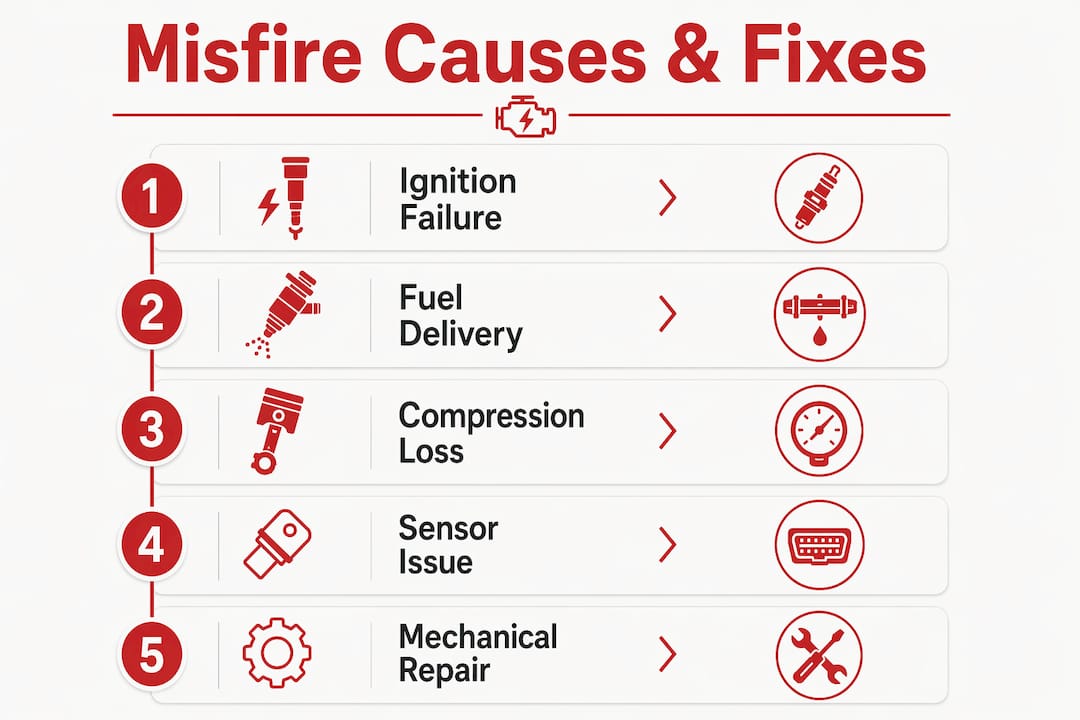
The most common causes of engine misfires are worn or fouled spark plugs and failing ignition coils, followed by clogged fuel injectors, vacuum leaks, and mechanical issues like worn piston rings. Each cause points to a different system and requires a different fix.
Here is a breakdown of the main culprits:
- Worn or fouled spark plugs. Spark plugs degrade over time. A fouled plug cannot generate a reliable spark, so combustion fails. This is the most frequent cause of misfires in high-mileage vehicles.
- Failing ignition coils. Ignition coils convert 12 volts from the battery into over 20,000 volts needed to fire the spark plug. A coil that is weakening produces an inconsistent spark, especially under load.
- Clogged or faulty fuel injectors. A dirty injector delivers too little fuel, creating a lean mixture that either misfires or burns poorly. Fuel injector issues often show up as misfires during cold starts or hard acceleration.
- Vacuum leaks. A cracked intake manifold gasket or loose vacuum hose lets unmetered air into the combustion chamber. This throws off the air-fuel ratio and triggers misfires, often in multiple cylinders.
- Low compression. Worn piston rings or damaged valves reduce the cylinder’s ability to compress the air-fuel mixture. Without adequate compression, combustion cannot happen reliably. This is a mechanical issue and the most expensive to repair. Related mechanical failures like engine knock often share the same root causes.
Pro Tip: If you replace spark plugs and the misfire returns within a few thousand miles, check for oil or coolant leaks into the plug wells. Leaks fouling new plugs are a common reason misfires keep coming back after a fresh set of plugs.
What are the signs of engine misfiring you should not ignore?
Early engine misfire symptoms appear before any warning light triggers on your dashboard. Catching them early prevents catalytic converter damage, which is far more expensive than fixing the misfire itself. Here are the most important signs to watch for:
- Rough or uneven idle. Your engine shakes or vibrates noticeably at a stoplight or in park. This is often the first physical sign that a cylinder is not firing correctly.
- Loss of power under acceleration. The car hesitates, stumbles, or jerks when you press the gas. Misfires under load often point to high-resistance ignition coils or a failing fuel pump struggling to keep up with demand.
- Rough or hesitant starting. The engine cranks longer than normal or starts and immediately runs unevenly. This is common with fouled spark plugs or a weak ignition coil on a specific cylinder.
- Increased fuel consumption. When a cylinder misfires, the engine compensates by working harder. You burn more fuel to produce less power. A noticeable drop in miles per gallon is a real symptom, not just a coincidence.
- Check engine light behavior. A steady check engine light means the ECM has logged a misfire code. A flashing check engine light means an active, severe misfire is happening right now. A flashing light requires you to stop driving immediately.
The flashing check engine light is the most urgent sign. Continuing to drive with an active severe misfire sends unburned fuel into the exhaust, which overheats and destroys the catalytic converter. That turns a $200 repair into a $1,500 or higher bill. Understanding what your check engine light means is one of the most practical things you can do as a car owner.
How do modern vehicles detect and diagnose engine misfires?
The ECM is the brain behind misfire detection. It uses input from the crankshaft position sensor and camshaft position sensor to track the rotational contribution of each cylinder. When a cylinder misfires, the crankshaft slows slightly at that point in the rotation. The ECM detects this hesitation and counts it as a misfire event.
When misfire counts exceed a threshold, the ECM stores a diagnostic trouble code. Code P0300 means random or multiple cylinder misfires. Codes P0301 through P0312 identify the specific cylinder misfiring, with the last digit matching the cylinder number. A P0304 code, for example, means cylinder 4 is the problem. That specificity matters enormously for repair.
Reading the specific code before touching anything is the single most important step in diagnosing a misfire. Misfire is a symptom, not a root cause. Without knowing which cylinder is affected and which system failed, you are guessing. Parts replacement without code reading risks unnecessary expense and repeat failure.
Pro Tip: A professional OBD-II scan does more than pull a code. ASE-certified technicians at shops like Tom’s B & M Auto use live data streams to watch cylinder misfire counts in real time, which reveals intermittent misfires that do not always trigger a stored code.
What are the dangers of ignoring a misfire, and how do you fix it?
Driving with a misfiring engine is not just uncomfortable. It causes real, escalating damage. Unburned fuel from misfires passes into the exhaust system, where it ignites inside the catalytic converter. The converter overheats and fails prematurely. A catalytic converter replacement on most vehicles costs $1,000 or more, and some Toyota and Honda models run significantly higher.
Here is a comparison of common misfire repairs by cause and typical cost range:
| Cause | Typical repair | Approximate cost |
|---|---|---|
| Worn spark plugs | Spark plug replacement | $100–$250 |
| Failing ignition coil | Coil replacement (one cylinder) | $150–$350 |
| Clogged fuel injector | Injector cleaning or replacement | $200–$500 |
| Vacuum leak | Gasket or hose repair | $100–$400 |
| Low compression (worn rings) | Engine rebuild or replacement | $2,000 or more |
The repair process follows a clear order. First, read the fault codes to identify the affected cylinder. Second, inspect the spark plug and ignition coil on that cylinder. Third, check for fuel delivery issues if the ignition system tests clean. Fourth, run a compression test if ignition and fuel checks pass, to rule out mechanical failure.
Pro Tip: Always inspect the spark plug well for oil or coolant contamination before installing new plugs. A wet or oily plug well signals a valve cover gasket leak or a cracked cylinder head. Fix the leak first, or your new plugs will foul within weeks.
Preventive maintenance reduces misfire risk significantly. Replace spark plugs on schedule, typically every 30,000 miles for standard plugs and every 60,000–100,000 miles for iridium or platinum plugs. Have your fuel injectors cleaned during major service intervals. Address any rough idle or hesitation before it escalates.
Key takeaways
Engine misfiring is a combustion failure that requires code-guided diagnosis, not guesswork, to fix correctly and affordably.
| Point | Details |
|---|---|
| Definition of a misfire | One or more cylinders fail to complete combustion due to ignition, fuel, or compression failure. |
| Most common causes | Worn spark plugs and failing ignition coils account for the majority of misfire cases. |
| Flashing light means stop | A flashing check engine light signals an active severe misfire; pull over to prevent converter damage. |
| Read codes before repairing | P0301–P0312 codes identify the exact cylinder, preventing costly trial-and-error parts replacement. |
| Early detection saves money | Catching subtle symptoms before the check engine light triggers can prevent $1,500+ converter repairs. |
What I have learned after years of watching drivers misdiagnose misfires
The most expensive mistake I see car owners make is confusing a misfire with a transmission problem. When a cylinder misfires under acceleration, the car lurches and loses power. That feels exactly like a transmission slip. Drivers misinterpreting misfire symptoms as transmission issues is one of the most common reasons people delay diagnosis and rack up bigger repair bills. The key difference: a misfire produces specific engine codes. A transmission slip does not generate a P0300 series code. If you pull codes and see P0304, the transmission is not your problem.
The second mistake is parts guessing. I have seen people replace all four ignition coils, a full set of spark plugs, and a fuel injector on a car that turned out to have a cracked intake manifold gasket. Every one of those parts was fine. A $150 diagnostic would have saved $600 in unnecessary parts. Technicians stress code reading before any replacement for exactly this reason.
My honest advice: pay attention to how your car feels at idle and during the first few seconds of acceleration. Those are the moments when misfires show up first, long before any light comes on. If something feels off, get it scanned. You can also read more about transmission slip symptoms to help you tell the two problems apart before your appointment.
— Shingi
Get your misfire diagnosed right the first time at Tom’s B & M Auto
If your car is shaking at idle, hesitating under acceleration, or showing a check engine light, Tom’s B & M Auto in Lynnwood, WA has the tools and experience to find the real cause fast.

Tom’s B & M Auto uses professional-grade OBD-II diagnostics to read live misfire data, not just stored codes. ASE-certified technicians cover all makes including Toyota, Honda, Subaru, and European vehicles. The shop has served the Lynnwood area since 1985 with upfront pricing and a 24-month / 24,000-mile warranty on all work. Same-day appointments are often available. For engine repair in Kenmore or the surrounding area, Tom’s B & M Auto is the trusted local choice. If cost is a concern, financing options are available to help you get the repair done without delay.
FAQ
What is the difference between a P0300 and a P0301 code?
P0300 means the ECM detected random or multiple cylinder misfires without isolating one cylinder. P0301 through P0312 each identify a specific misfiring cylinder, with the number matching the cylinder position.
Can I drive with a misfiring engine?
You can drive briefly with a steady check engine light and a mild misfire, but a flashing check engine light means you should stop driving immediately. Continuing to drive risks destroying the catalytic converter within just a few miles.
How do I know if my spark plugs are causing the misfire?
Pull the spark plug from the cylinder identified by your fault code and inspect it. A black, oily, or heavily worn electrode confirms the plug is the problem. Also check the plug well for oil or coolant contamination before installing a replacement.
Why does my engine only misfire during hard acceleration?
Misfires limited to hard acceleration typically point to high-resistance ignition coils or a fuel pump that cannot maintain adequate pressure under load. Both components are stressed most during full-throttle driving.
How much does it cost to fix an engine misfire?
Repair costs range from around $100 for a spark plug replacement to $2,000 or more for low-compression issues requiring engine work. Reading the fault codes first is the most reliable way to avoid paying for parts you do not need.
Recommended
- What Is Engine Knock and How to Fix It – Tom’s B & M Auto Blog
- Why Transmission Slips: Causes, Symptoms, and Fixes – Tom’s B & M Auto Blog
- Check Engine Light Meaning: What Drivers Need to Know – Tom’s B & M Auto Blog
- Engine Repair in Mukilteo, WA | Tom’s B&M Auto
Leave a Reply