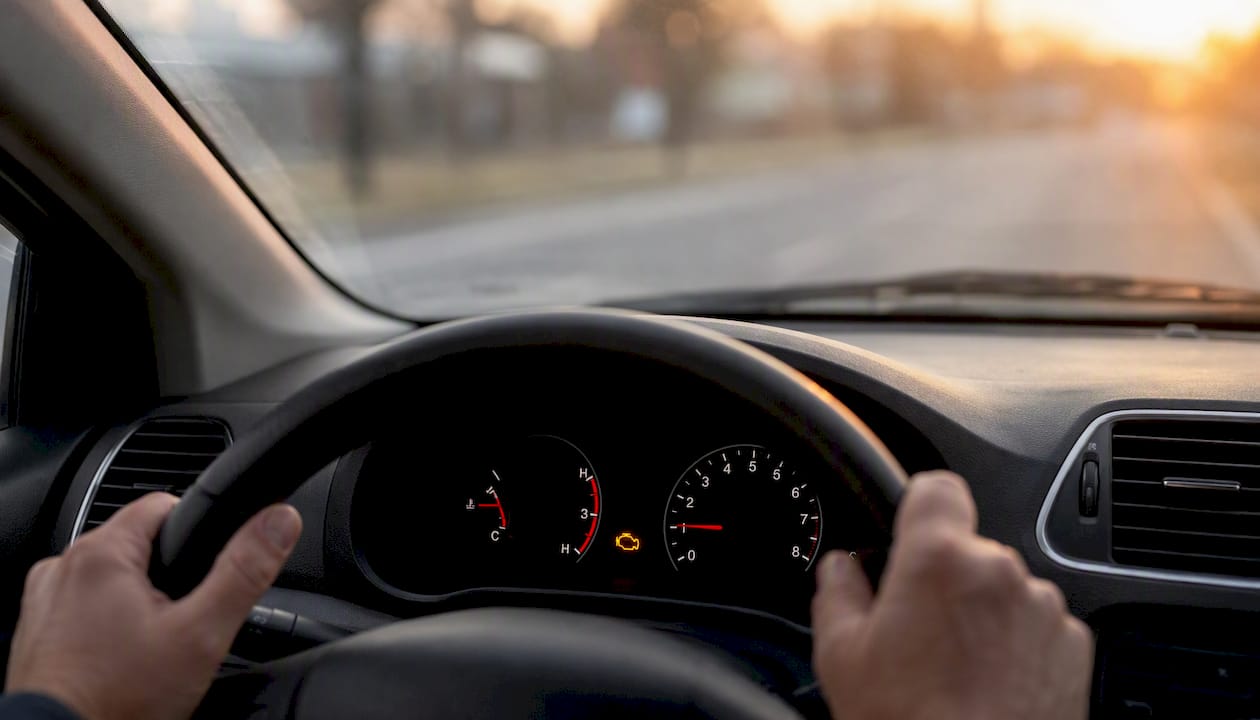
A steady “Service Engine Soon” light means your car’s computer has flagged a condition that needs attention. Schedule a diagnostic scan soon. If the light is flashing, stop driving immediately and arrange a tow.
That’s the short version. Here’s what you actually need to know to handle it correctly.
If the light just came on, do these first:
- Check your gas cap. Turn it until it clicks at least three times. A loose cap is one of the most common triggers and costs nothing to fix.
- Glance at your temperature gauge and oil pressure indicator. If either looks abnormal, pull over.
- Note whether the light is steady or flashing. That single distinction determines your next move.
- If steady with no other symptoms: drive carefully to a shop for a diagnostic scan.
- If flashing: stop as soon as it’s safe and call for a tow.
A flashing light often signals an active engine misfire. Continuing to drive can push unburned fuel into the exhaust, which damages the catalytic converter and turns a few-hundred-dollar repair into a much larger one. A steady light gives you more time, but “more time” doesn’t mean indefinitely.
Key Takeaways
A flashing “Service Engine Soon” light requires an immediate stop; a steady light allows a short, careful drive to a shop for a professional OBD-II diagnostic scan.
| Point | Details |
|---|---|
| Steady vs. flashing urgency | Steady light: drive to a shop soon. Flashing light: stop immediately and tow to avoid catalytic converter damage. |
| Gas cap first | Tighten the cap three clicks before anything else; it’s the most common, cheapest trigger. |
| Scan before clearing | Never erase codes before diagnosis; doing so destroys freeze-frame data the mechanic needs. |
| Check your owner’s manual | “Service Engine Soon” means different things on different makes; your manual is the only reliable source for your specific vehicle. |
| Early diagnosis saves money | A misfire caught early is a spark plug job; ignored, it becomes a catalytic converter replacement. |
Table of Contents
- What does “Service Engine Soon” actually mean on your car?
- What are the most common reasons the light comes on?
- When is it safe to keep driving, and when should you stop?
- How do you diagnose what triggered the light?
- What do repairs typically cost, and how long do they take?
- Should you clear the codes yourself before going to a shop?
- Why your owner’s manual is the first place to look
- What to tell your mechanic and what the shop will do
- Ready to get your light diagnosed?
- The part most drivers get wrong about this light
- Sources
What does “Service Engine Soon” actually mean on your car?
The honest answer: it depends on who built your car. That’s the source of most of the confusion around this light.
On some vehicles, “Service Engine Soon” is simply the manufacturer’s label for the federally mandated Malfunction Indicator Lamp (MIL), the same signal most drivers call the “Check Engine” light. When it illuminates, the engine control unit (ECU) has detected a fault and stored a diagnostic trouble code (DTC) in its memory. You need a scan tool to retrieve that code.
On other vehicles, particularly older GM models, some Nissans, Infinitis, and certain Toyotas, “Service Engine Soon” is a separate maintenance reminder triggered by mileage or engine runtime intervals, not an active fault. It’s closer to an oil-change reminder than an emergency. According to an 18-year mechanic’s breakdown of the light, wiring diagrams and service manuals confirm these can be entirely different lamp circuits on different makes.
The two common manufacturer approaches:
- Maintenance minder: The light triggers at a preset mileage or time interval (common on Nissan, Infiniti, some older GM). No fault code is stored.
- MIL substitute: The manufacturer uses “Service Engine Soon” as their label for the Check Engine/MIL. A fault code is stored and must be scanned.
You cannot tell which type you have by looking at the light. The label alone tells you nothing.
Pro Tip: Before assuming the worst, pull out your owner’s manual and look up “Service Engine Soon” in the index. It will tell you exactly what the light means on your specific vehicle. Then scan for codes regardless — it takes two minutes and removes all guesswork.
What are the most common reasons the light comes on?
Most triggers fall into three tiers: simple and cheap, sensor-related, and mechanical or emissions-related.
Simple causes (check these first):
- Loose or missing gas cap
- Low oil, coolant, or other fluid levels
- Routine maintenance interval reached (oil change, air filter, spark plugs)
- Dirty mass airflow (MAF) sensor from a clogged air filter
Sensor-related causes:
- Oxygen (O2) sensor failure or drift
- MAF or MAP sensor malfunction
- Coolant temperature sensor fault
- Evaporative emission (EVAP) system leak
Mechanical and emissions causes:
- Engine misfire (one or more cylinders not firing correctly)
- Failing catalytic converter
- Worn spark plugs or ignition coils
- EGR valve issues
The gas cap is worth checking every time because it’s free and takes 10 seconds. Beyond that, common check engine causes range widely in cost and urgency. An O2 sensor is a moderate repair. A catalytic converter is expensive. A misfire ignored long enough becomes a catalytic converter problem, which is why early diagnosis pays for itself.
When is it safe to keep driving, and when should you stop?
The steady-versus-flashing rule is the most important thing to understand about this light.
Steady light: Generally safe for a short drive to a shop, provided no other warning lights are on and the car feels normal. Keep the trip short, monitor your gauges, and avoid highway speeds if possible. Don’t let “safe to drive” become “I’ll deal with it next month.”
Flashing light: Stop as soon as it’s safe to do so. A flashing or blinking light typically indicates a severe misfire. The MIL’s two-stage design is intentional: steady for a minor but service-recommended fault, flashing for a severe fault requiring immediate attention. Driving on a flashing light risks permanent catalytic converter damage and can escalate to engine damage.
Stop immediately and call for a tow if you notice any of these alongside the light:
- Temperature gauge climbing toward the red zone
- Oil pressure warning light illuminated
- Sudden loss of power or rough running
- Burning smell or visible smoke
- Unusual knocking or grinding sounds
Any one of those symptoms alongside the service light changes the calculus entirely. The light alone might be a loose gas cap. The light plus overheating is a different situation.
Pro Tip: If you need to drive to a shop on a steady light, keep it under 50 mph and avoid extended idling. Watch your temperature gauge the whole way. If anything changes, pull over.
How do you diagnose what triggered the light?
Start simple, then escalate.
DIY checks (do these before spending anything):
- Tighten the gas cap until it clicks three times.
- Check oil level with the dipstick when the engine is cold.
- Look under the car for any visible fluid leaks.
- Listen for misfires, rough idle, or unusual sounds.
- Note any recent events: new fuel, recent service, changes in performance.
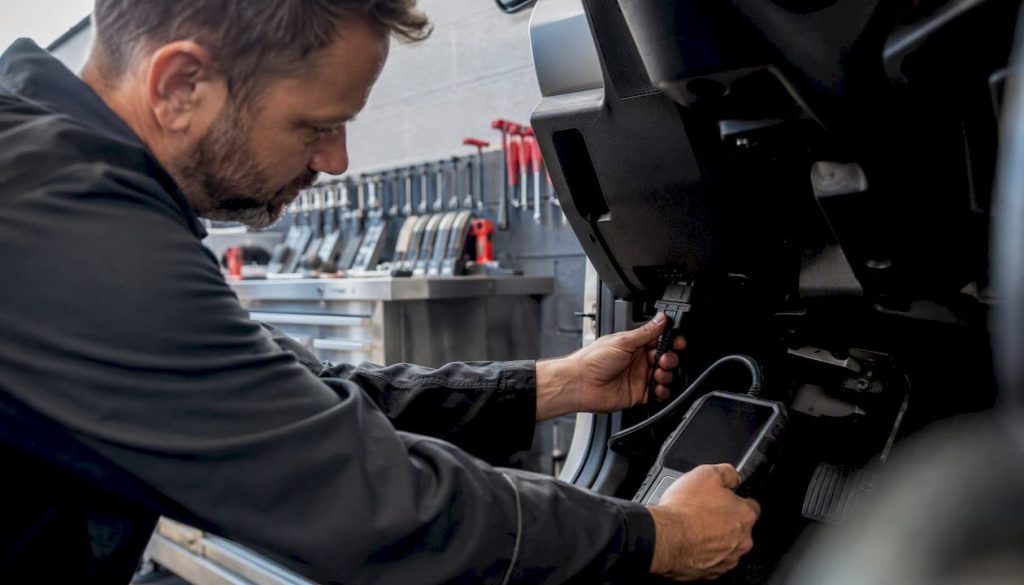
If nothing obvious turns up, the next step is reading the stored codes. An inexpensive OBD-II reader plugs into the port under your dashboard and displays stored and pending diagnostic trouble codes. That code is your starting point, not your final answer.
Common codes and what they point to:
| Code | Plain-English Meaning | Typical Next Step |
|---|---|---|
| — | System running lean (too much air, not enough fuel) | Check for vacuum leaks, MAF sensor, fuel pressure |
| — | Random/multiple cylinder misfire | Inspect spark plugs, ignition coils, fuel injectors |
| P0420 | Catalyst efficiency below threshold | Test O2 sensors, inspect catalytic converter |
| — | EVAP system leak | Check gas cap, EVAP lines, purge valve |
| — | MAF/IAT sensor high input | Inspect air filter, clean or replace MAF sensor |
A basic reader shows stored and pending codes. It won’t show live sensor data or manufacturer-specific codes, which sometimes require dealer-level tools. If your code points to something complex, or if the code clears but the light returns, that’s when a professional scan with live data becomes necessary.
What do repairs typically cost, and how long do they take?
Costs vary by region and vehicle, but U.S. shop rates give a reasonable baseline. The diagnostic scan is typically the first cost you’ll pay at any shop.
A few factors push timelines longer: parts that need to be ordered (adds 1–3 days), diagnosis that requires multiple test drives to reproduce an intermittent fault, or repairs on European or hybrid vehicles where labor rates and parts costs run higher.
The diagnostic fee is worth paying before authorizing any repair. A shop that skips the scan and replaces parts by guessing will cost you more in the long run.
Should you clear the codes yourself before going to a shop?
Short answer: no. Here’s why it matters.
When the ECU stores a fault code, it also saves freeze-frame data: a snapshot of sensor readings at the exact moment the fault occurred. That data is often the fastest path to an accurate diagnosis. Clearing the codes before a shop sees the car erases that snapshot.
How codes get cleared:
- Using an OBD-II reader’s “erase codes” function
- Disconnecting the battery (clears codes on most vehicles)
- Automatic reset after the fault condition is no longer present across multiple drive cycles
Why clearing early causes problems:
- Hides intermittent faults that may not reappear immediately
- Erases freeze-frame data the technician needs
- Resets the readiness monitors, which can delay emissions testing
The right time to clear codes is after a verified repair, not before diagnosis. Once the underlying problem is fixed, the light should stay off through several drive cycles. If it comes back, the repair didn’t fully address the fault.
Pro Tip: If you already cleared the codes before reading this, tell the shop. They’ll know the monitors need to run through a drive cycle before they can confirm the repair is complete. It’s not a disaster, but it adds time.
For more on resets and when they’re appropriate, see how to reset a service maintenance light.
Why your owner’s manual is the first place to look
Every vehicle manufacturer gets to decide what their dashboard lights say and what they mean. “Service Engine Soon,” “Check Engine,” “Maintenance Required,” and “Service Required” are not standardized labels. Two cars sitting next to each other in a parking lot can use the same phrase to mean completely different things.
What to check in your manual:
- The warning lights section, usually with a diagram of the instrument cluster
- Whether “Service Engine Soon” is listed separately from “Check Engine” or “Maintenance Required”
- The recommended service interval that triggers the light (if it’s a maintenance minder)
- Any driver information display messages that accompany the light
Some vehicles show a text message on the driver information display alongside the light, which removes the ambiguity entirely. Others have a separate “Maintenance Required” or “Oil Life” indicator that is easy to confuse with the service engine light. They are different systems with different responses required.
If you no longer have the physical manual, most manufacturers post them as free PDFs on their official websites.
What to tell your mechanic and what the shop will do
Walking into a shop with good information cuts diagnosis time and helps you get an accurate estimate faster.
Bring this information with you:
- When the light first appeared (mileage, date, driving conditions)
- Whether the light is steady or flashing
- Any symptoms: rough idle, hesitation, loss of power, unusual smells
- Recent service events: oil change, new fuel, battery replacement
- Any other warning lights that appeared at the same time
What a professional shop will do:
- Connect a professional-grade OBD-II scanner to retrieve all stored and pending codes.
- Review freeze-frame data to understand conditions at the time of the fault.
- Run live sensor data to watch how components behave in real time.
- Perform targeted component tests based on the codes retrieved.
- Road test the vehicle to confirm or reproduce the fault.
- Provide a written estimate before any repair work begins.
Tom’s B & M Auto’s ASE-certified technicians follow this workflow for every diagnostic appointment, with professional-grade OBD-II equipment and same-day availability on most days. All repairs carry a 24-month / 24,000-mile warranty.
Pro Tip: Ask the shop to show you the fault codes before they start work. A reputable shop will walk you through what was found and why the recommended repair addresses it. If a shop can’t explain the connection between the code and the repair, ask again.
Ready to get your light diagnosed?
A steady “Service Engine Soon” light rarely means disaster, but it does mean your car is asking for attention. The longer a fault goes unaddressed, the more likely a small fix becomes a large one. Tom’s B & M Auto has served Lynnwood drivers since 1985 with ASE-certified technicians, professional OBD-II diagnostics, and upfront pricing on all makes.
Book a free digital vehicle inspection and know exactly what you’re dealing with before committing to any repair. Need engine repair in Kenmore? Same-day appointments are often available. Financing options are available for larger repairs.
The part most drivers get wrong about this light
Most advice about the “Service Engine Soon” light focuses on the wrong thing. Articles spend paragraphs listing every possible cause when the real problem is that drivers either panic and overpay, or ignore it and underpay attention until the repair bill triples.
The steady-versus-flashing distinction is genuinely the most important piece of information here, and it’s underused. Drivers who understand it make better decisions at every step: they don’t tow a car that can safely drive to a shop, and they don’t drive a car that’s actively destroying its catalytic converter.
The second thing most advice gets wrong is treating the light as a diagnosis rather than a signal. A code like P0420 doesn’t tell you the catalytic converter is dead. It tells you the catalyst efficiency is below threshold, which could mean a failing converter, a bad O2 sensor, or an exhaust leak upstream. The code is the beginning of the diagnostic conversation, not the end of it.
What I’d tell any driver: tighten the gas cap, note whether the light is flashing, and get a scan done within a few days if it’s steady. The scan costs less than an hour of labor and removes all the guesswork. Everything else follows from what the codes actually say.
Sources
Recommended
- Check Engine Sign in Car: What to Do Right Now – Tom’s B & M Auto Blog
- Check Engine Light Meaning: What Drivers Need to Know – Tom’s B & M Auto Blog
- What’s Causing Your Check Engine Light to Come On? – Tom’s B & M Auto Blog
- Car Problem Sounds: What Each Noise Means and What to Do – Tom’s B & M Auto Blog