
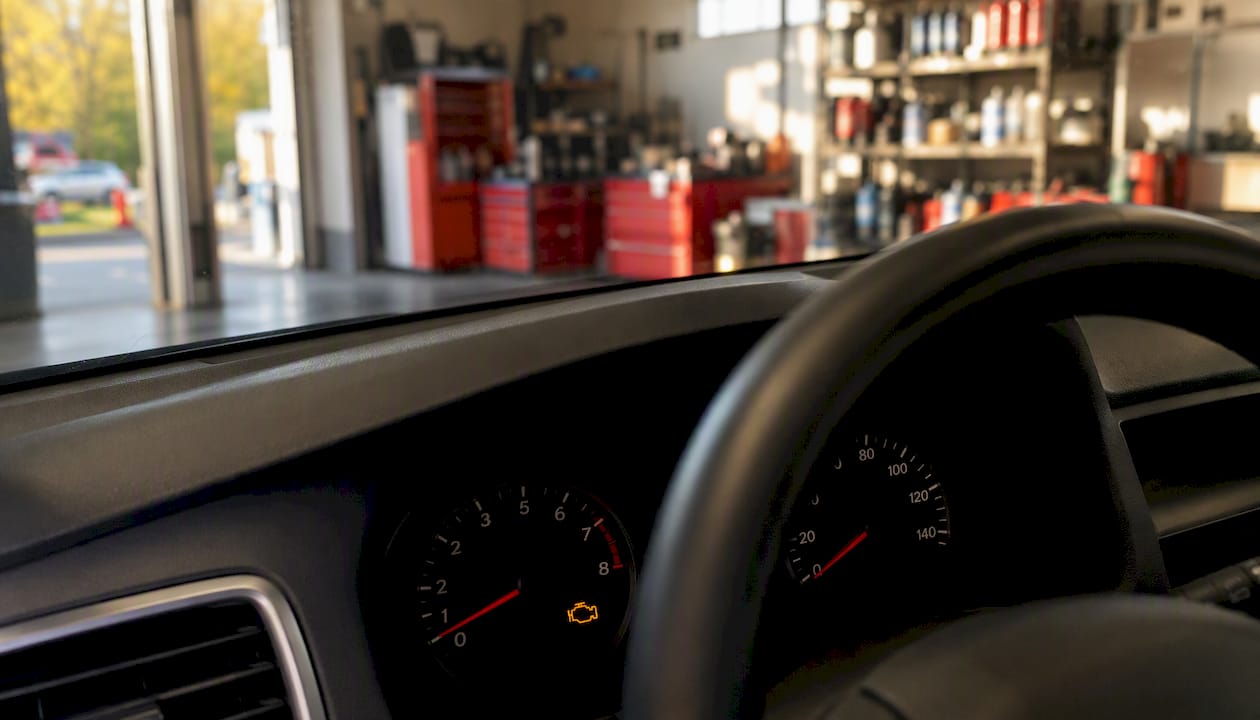
What’s Causing Your Check Engine Light to Come On?
Your check engine light means the car’s on-board computer detected a fault it can’t fix on its own. Before you panic or book a repair, check your gas cap if you just fueled up, confirm the car drives normally, and get the stored code read. That one code tells you whether you’re dealing with a $15 fix or a $1,500 repair.
The light itself is called the Malfunction Indicator Lamp (MIL). When your vehicle’s OBD-II system spots an emissions or engine-performance fault, it logs a diagnostic trouble code (DTC) and switches the MIL on. Consumer Reports confirms the computer stores that code so a scan tool can read it. The code is the starting point for everything.
Three quick steps before you do anything else:
- Check the gas cap. If you filled up recently, a loose cap is one of the most common check engine light causes. Tighten it, drive a few cycles, and see if the light clears.
- Assess drivability. Is the car idling rough, losing power, or stalling? If yes, treat it as urgent. If it drives normally, you have time to scan.
- Get the code read. Many auto parts stores offer free scans. A consumer OBD-II reader costs $25–$80 and plugs into the port under your dash. The code narrows the problem to a specific system before you spend a dollar on parts.
Pro Tip: Don’t clear the code without fixing the underlying problem. Clearing it resets the readiness monitors, which can delay an emissions test pass and mask an intermittent fault that returns within a few drive cycles.
Key Takeaways
A flashing check engine light signals an active misfire that can destroy a catalytic converter within minutes of continued driving; a steady light means diagnose soon, not necessarily stop immediately.
| Point | Details |
|---|---|
| Flashing vs. steady urgency | Flashing MIL means stop or reduce load immediately; steady means get a scan within a day or two. |
| Gas cap first | Tighten the gas cap after any fill-up before assuming a costly repair is needed. |
| Read the code first | A free scan at an auto parts store or a consumer OBD-II reader narrows the cause before you buy any parts. |
| Delay costs more | An unresolved misfire can turn a $200 coil repair into a $1,500+ catalytic converter replacement. |
| Tom’s B & M Auto | Offers a free check engine light review with professional OBD-II diagnostics, written estimates, and a 24-month/24,000-mile warranty in Lynnwood, WA. |
Table of Contents
- How does the OBD-II system actually detect and log faults?
- Solid vs. flashing check engine light: which one needs immediate action?
- What are the most common check engine light causes?
- How do you read the codes and figure out what’s actually wrong?
- What do repairs typically cost, and how long do they take?
- When should you take the car to an ASE-certified shop?
- A technician’s honest take on check engine lights
- Tom’s B & M Auto: check engine light diagnostics in Lynnwood
- Sources
How does the OBD-II system actually detect and log faults?
Every vehicle sold in the U.S. since 1996 uses the OBD-II standard. The system runs continuous and periodic self-tests on emissions-related components: oxygen sensors, fuel trims, catalytic efficiency, EVAP integrity, and more. When a monitor detects a reading outside its acceptable range, it logs a DTC and lights the MIL.
A DTC is a five-character alphanumeric code. The first character tells you the system: P for powertrain, B for body, C for chassis, U for network. The second character distinguishes generic (0) from manufacturer-specific (1) codes. The remaining three digits identify the fault. A few examples worth knowing:
- P0300–P0308: Random or cylinder-specific misfire detected
- P0420: Catalyst system efficiency below threshold (Bank 1)
- P0455: EVAP system large leak detected
- P0135: O2 sensor heater circuit malfunction (Bank 1, Sensor 1)
Alongside the DTC, the system captures freeze-frame data: a snapshot of RPM, coolant temperature, engine load, and fuel trim at the exact moment the fault triggered. A shop uses that snapshot to recreate the conditions that caused the fault, which is especially useful for intermittent problems that don’t show up during a cold-start inspection.
One thing worth knowing: EPA OBD regulations specify that the MIL may stay on for several drive cycles after a repair until the system’s readiness monitors complete their checks without finding a recurrence. So a light that stays on a day or two after a fix isn’t necessarily a sign the repair failed.
Solid vs. flashing check engine light: which one needs immediate action?
The behavior of the light is the fastest triage signal you have.
Cars that a steady light means the system detected a fault that needs attention but doesn’t usually require you to stop driving immediately. You can typically drive short distances to a shop or run a code scan at home without risking major damage, as long as the car drives normally.
A flashing or blinking light is a different situation. Per EPA OBD regulations, the MIL is required to blink when a misfire is occurring at a rate likely to damage the catalytic converter. A catalytic converter runs at very high temperatures, and unburned fuel from a misfire can overheat and damage the catalyst substrate quickly during sustained driving. That turns a $200 ignition coil repair into a $1,500+ converter replacement.
How to respond based on what you see:
- Steady light, car drives normally: Drive to a scan location within a day or two. Avoid long highway trips until you know the cause.
- Steady light with rough idle, hesitation, or power loss: Treat it as medium-urgent. Get a scan the same day and avoid hard acceleration.
- Flashing light: Reduce speed immediately, avoid heavy acceleration, and get to a shop or pull over if the misfire worsens. Don’t drive it home from a highway if the car is shaking badly.
A real-world example: a steady light that appeared after a cold start on a 2018 Honda Accord with no drivability change is almost certainly a sensor or EVAP code. A flashing light on the same car while merging onto I-5 is an active misfire. Same lamp, completely different urgency.
What are the most common check engine light causes?
AAA and O’Reilly both recommend reading the stored code before replacing any part. The table below maps the most frequent causes to their typical symptoms, common DTCs, severity, and estimated repair cost ranges.
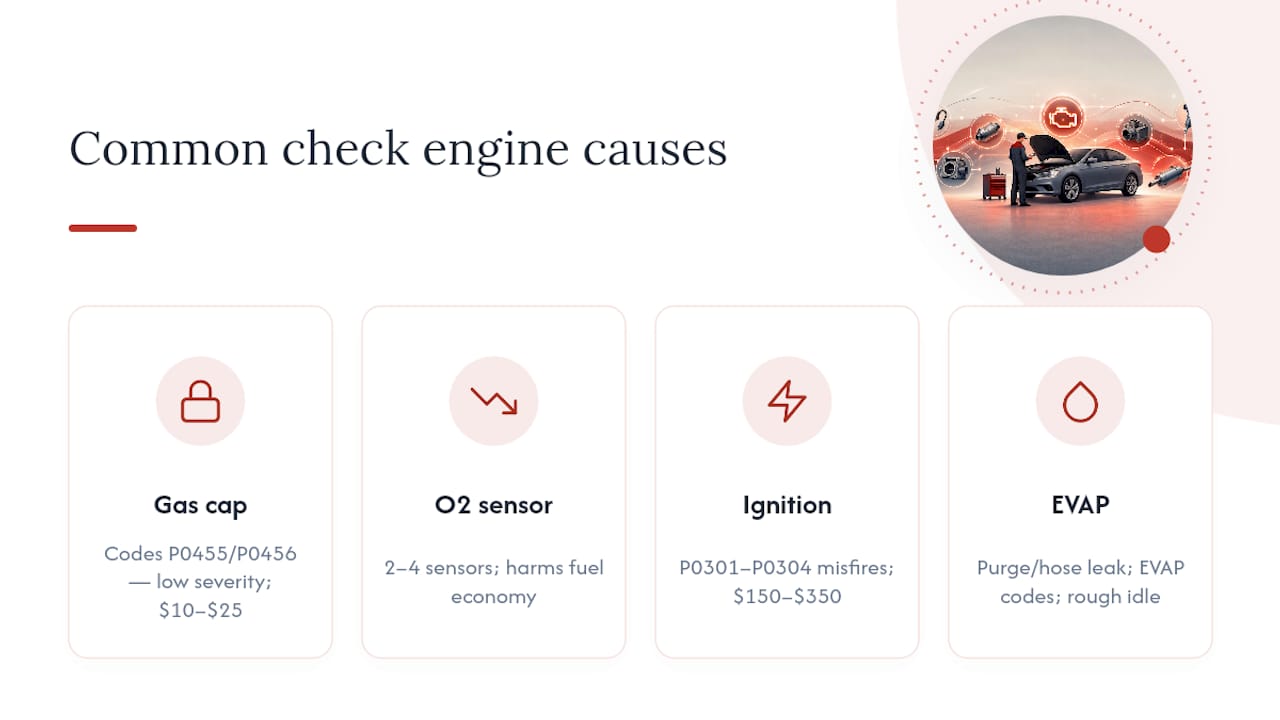
KBB notes that costs vary significantly by vehicle make, model year, and labor rates in your area. A catalytic converter on a late-model Toyota Prius with a California-spec catalyst will cost far more than one on a 2005 Ford F-150.
A few causes deserve extra detail:
Loose or faulty gas cap. This is the single easiest thing to rule out. A loose cap lets fuel vapors escape the EVAP system, triggering P0455 or P0456. Tighten it a quarter-turn past the click, drive two or three cycles, and the light often clears on its own. If it doesn’t, a replacement cap runs $10–$25.
Oxygen sensors. There are typically two to four O2 sensors per vehicle: upstream sensors that help the ECU calculate fuel trim, and downstream sensors that monitor catalytic efficiency. A failing upstream sensor causes the engine to run rich or lean, hurting fuel economy noticeably before the light even comes on. WyoTech confirms that O2 sensor failures rank among the most frequent CEL triggers across all makes.
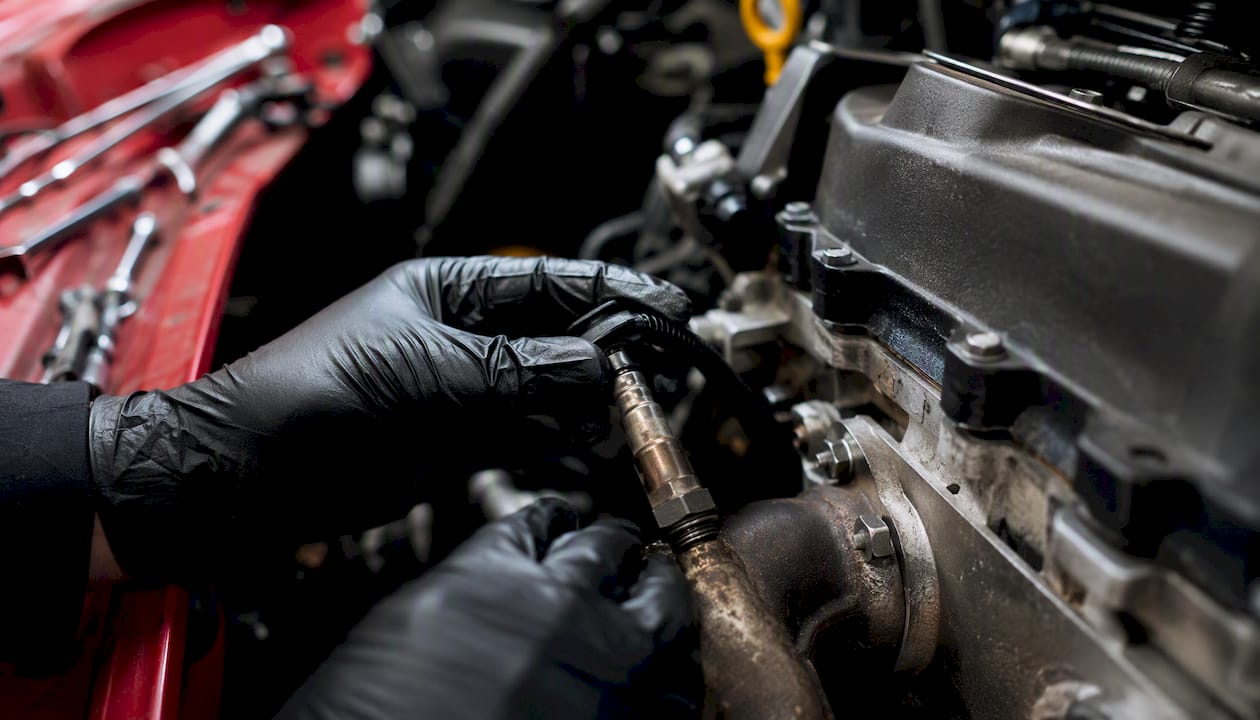
Spark plugs and ignition coils. Worn plugs or a failed coil cause cylinder-specific misfires (P0301 = cylinder 1, P0302 = cylinder 2, and so on). If the misfire is bad enough to flash the MIL, you’re already risking converter damage. On most four-cylinder engines, a full set of plugs and one coil runs $150–$350 in parts and labor combined.
EVAP system and purge valve. The EVAP system captures fuel vapors and routes them into the intake. A stuck-open purge valve or a cracked hose causes lean conditions and EVAP codes. Digital Trends notes that vacuum and EVAP leaks are among the more common causes of rough idle paired with a check engine light.
How do you read the codes and figure out what’s actually wrong?
Getting the code is the single most efficient first move, as AAA points out. Here’s the process in order:
- Check the gas cap and recent fuel. If you filled up in the last day or two and the car drives fine, start here. Tighten the cap and wait two to three drive cycles before scanning.
- Note your symptoms. Write down when the light came on, what the car was doing (highway speed, cold start, idle), and any drivability changes. This context helps a shop interpret the freeze-frame data.
- Get a free code read or use your own reader. O’Reilly Auto Parts offers free in-store scans at most locations. Consumer OBD-II readers (Autel, BlueDriver, FIXD) plug into the OBD-II port, which sits under the dashboard on the driver’s side, usually within 18 inches of the steering column. The readout gives you the DTC and often a plain-language description.
- Interpret the code category. A P03xx code points to misfires. A P04xx code points to EVAP. A P01xx or P02xx points to fuel or air metering. Match the code to the symptom before buying parts.
- Attempt low-effort fixes where appropriate. A P0456 after fueling? Check the gas cap. A P0101 with rough idle? Try cleaning the MAF sensor with MAF-safe cleaner before replacing it.
- Book a professional diagnostic when the code points to hardware or the problem persists. Codes like P0420 (catalyst efficiency) or P0300 (random misfire) often require live-data analysis, a smoke test, or cylinder balance testing to confirm the root cause.
Pro Tip: Clearing a code without fixing the problem resets the OBD-II readiness monitors. Per EPA OBD guidance, the system needs several drive cycles to re-run its monitors. If you clear codes right before an emissions test, the car may fail not because of the fault, but because the monitors haven’t completed yet.
For a deeper look at the difference between a consumer scan and a shop-level diagnostic, the types of car diagnostic tests guide from Tom’s B & M Auto covers what each level of scan actually reveals.
What do repairs typically cost, and how long do they take?
KBB’s repair cost data reinforces that the range on catalytic converters is wide because OEM converters for newer vehicles, particularly hybrids and European makes, cost significantly more than aftermarket units for older domestic trucks.
Warranty and emissions considerations. Under federal law, catalytic converters and certain emissions-related components on vehicles model year 1995 and newer carry an 8-year/80,000-mile federal emissions warranty from the manufacturer. If your vehicle is within that window and the converter failed due to a defect rather than misuse, the dealer may cover it. Check your warranty documentation before paying out of pocket.
Which repairs can you defer, and which can’t wait?
- Defer short-term (days to a week): Minor EVAP leaks (P0456), EGR codes with no drivability change, a single O2 sensor with no misfire.
- Address within a few days: MAF sensor codes with rough idle, O2 sensor codes affecting fuel trim, battery/charging codes.
- Don’t delay: Any flashing MIL, P0300-series misfires, P0420/P0430 catalyst codes with drivability symptoms. Consumer Reports warns that an unresolved misfire can destroy a catalytic converter quickly, turning a $200 repair into a $1,500+ job.
When should you take the car to an ASE-certified shop?
Some situations call for a professional scan from the start. Don’t wait on DIY checks if you’re seeing any of these:
- The MIL is flashing, especially under acceleration or load
- The car is misfiring, stalling, or losing power noticeably
- Multiple unrelated codes appeared at once (often a charging system or PCM issue)
- You’ve replaced a part based on the code and the light returned within a few drive cycles
- The code points to the catalytic converter, fuel injectors, or internal engine components
- You need the car to pass an emissions test and the light won’t clear
A professional diagnostic at a quality shop goes well beyond reading the stored code. The technician pulls freeze-frame and live-data streams, runs fuel-trim analysis, performs a smoke test on the EVAP system to find leaks invisible to the eye, and runs a cylinder balance test to isolate misfires to a specific cylinder. That process confirms the root cause rather than guessing based on the code alone.
What to expect from a reputable shop: ASE-certified technicians, a written estimate before any work begins, a clear explanation of repair priority (what’s urgent vs. what can wait), and a warranty on parts and labor. Tom’s B & M Auto backs all repairs with a 24-month/24,000-mile warranty and offers same-day diagnostics for most check engine light concerns.
Pro Tip: Ask the shop to show you the freeze-frame data and explain what triggered the code. A good technician will walk you through it in plain language. If a shop can’t explain why a part needs replacing beyond “the code said so,” that’s a reason to ask more questions.
For misfire-specific diagnosis steps, the engine misfire guide from Tom’s B & M Auto walks through the process from code to confirmed repair.
A technician’s honest take on check engine lights
Most drivers treat the check engine light as either a crisis or something to ignore. Neither response serves them well.
The light is a communication tool, not a verdict. A P0456 on a 2019 Subaru Outback after a fill-up is almost always a loose gas cap. A P0420 on a 2012 Toyota Camry with 140,000 miles and no recent maintenance is a different conversation. The code tells you which system to investigate, not which part to replace. That distinction saves customers real money when they come in with a code and a part they already bought based on a forum post.
What the shop sees most often: customers who drove on a flashing MIL for days because they assumed it was “just a sensor.” By the time they arrive, the catalytic converter is gone and a $300 coil job has become a $1,800 repair. The second most common scenario is the opposite: someone who cleared the code three times hoping it would go away, then failed their emissions test because the monitors never completed.
Quick triage genuinely matters. Tighten the gas cap, note your symptoms, get the code read. Those three steps take 20 minutes and cost nothing. They tell you whether you need a $15 cap or a shop appointment. Tom’s B & M Auto has been doing this for over 40 years in Lynnwood, and the customers who come in with their code already read and their symptoms written down get faster, more accurate diagnoses every time.
Tom’s B & M Auto: check engine light diagnostics in Lynnwood
When the light won’t clear or the code points to something beyond a gas cap, Tom’s B & M Auto offers a free check engine light review at its Lynnwood shop. The appointment includes a professional OBD-II scan, freeze-frame data review, a written estimate with repair priority, and a clear explanation of what’s urgent and what can wait.
ASE-certified technicians handle all makes, including Toyota, Honda, Subaru, European vehicles, and hybrids. Same-day diagnostics are often available, and the shop backs every repair with a 24-month/24,000-mile warranty. For larger repairs like catalytic converter replacement, financing options are available to spread the cost. Serving Lynnwood and surrounding areas including Kenmore and Shoreline, Tom’s B & M Auto has been the area’s trusted check engine light service shop since 1985. Book online or call to schedule your diagnostic today.
Sources
- What Does the Check Engine Light Look Like, and Really Mean? – Consumer Reports
- On-Board Diagnostic (OBD) Regulations and Requirements: Questions and Answer (EPA / Federal Register)
- The Check Engine Light: Common Causes and How To Fix It | AAA Automotive
- What to Do When the Check Engine Light Comes On — O’Reilly Auto
- Cars
- Why is my check engine light on? — KBB
Recommended
- Check Engine Light Meaning: What Drivers Need to Know – Tom’s B & M Auto Blog
- Check Engine Sign in Car: What to Do Right Now – Tom’s B & M Auto Blog
- Check Engine Light in Kenmore, WA | Tom’s B&M Auto
- Check Engine Light in Edmonds, WA | Tom’s B&M Auto
Leave a Reply