If your car clunks over bumps, the most likely causes are worn joints or loose mounts. A squeak usually means a dry bushing, a rattle points to loose hardware or exhaust contact, and a growl or whine that grows with speed is often a wheel bearing. This diagnose suspension noise guide walks through the exact tests that separate a harmless annoyance from a real safety problem, using the same steps a shop runs on a lift.
One warning first: if the noise comes with steering pulling to one side, sudden wandering, or you can see a loose or hanging part underneath, stop driving and get the car inspected before you go any further.
Before testing anything, do this:
- Note exactly when the noise happens (turning, braking, bumps, speed range).
- Record a short video or audio clip on your phone.
- Do a quick visual scan under the front end for anything hanging or swinging.
- Run a basic bounce test at each corner (details below) before deciding your next move.
Key Takeaways
Diagnosing suspension noise correctly means matching the sound type to the right component through reproducible tests, not guesswork or part swapping.
| Point | Details |
|---|---|
| Match sound to system | Clunk means joints or mounts, squeak means dry bushings, growl means bearings. |
| Run the free tests first | The bounce test and dry park test catch most major failures at no cost. |
| Reproduce before repairing | Confirm the noise under the same load and steering input that first caused it. |
| Know the red flags | Steering wander or visible loose parts mean stop driving immediately. |
| Book a loaded lift check | Tom’s B & M Auto confirms intermittent or hidden noises before quoting repairs. |
Table of Contents
- Common Suspension Noise Types and What They Usually Mean
- How Do You Isolate the Source of a Suspension Noise?
- Component Checklist: What Each Symptom Points To
- When Is a Suspension Noise a Safety Emergency?
- How Shops Diagnose Noises DIY Checks Miss
- What the DIY Checks Actually Get You
- Get a Shop-Grade Suspension Diagnosis in Lynnwood
- Sources
Common Suspension Noise Types and What They Usually Mean
Every suspension noise falls into one of four rough categories, and each one narrows down the likely culprit fast.
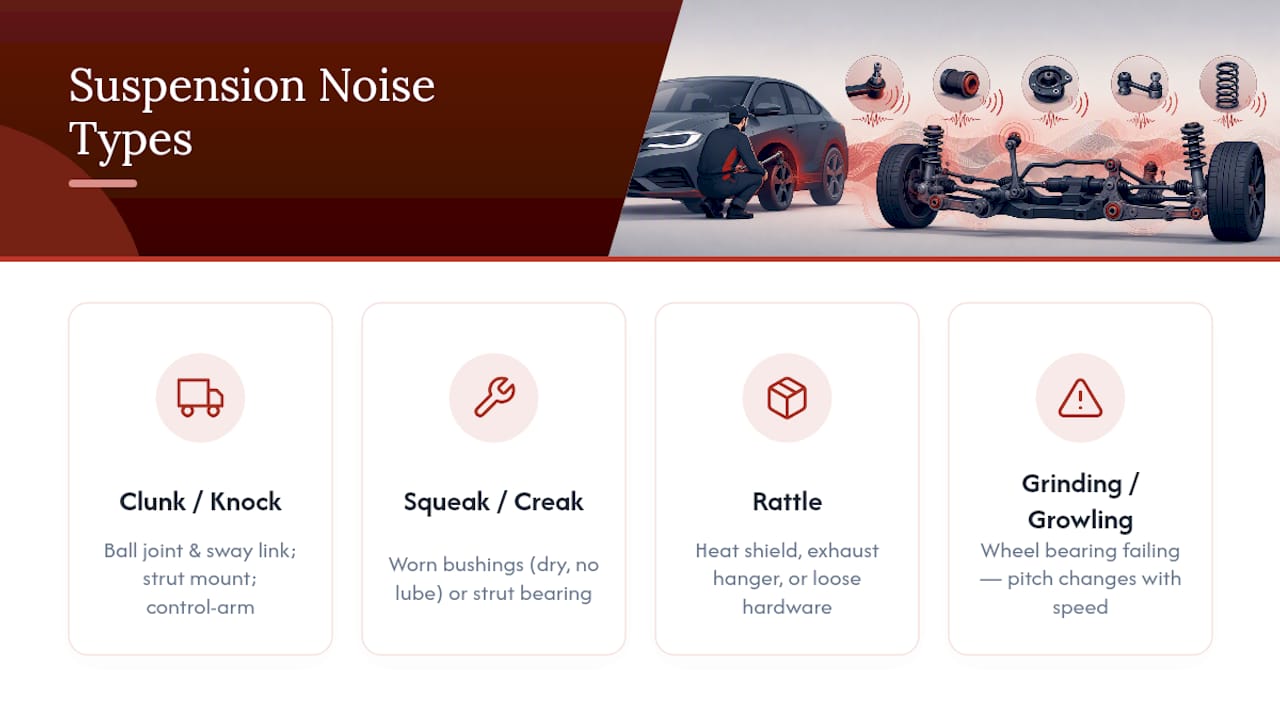
A clunk or knock is a solid, one-time impact sound, usually heard over potholes or speed bumps. It typically comes from a worn ball joint, a loose sway bar link, a failed strut mount, or play in a control arm bushing. A squeak or creak is a dry, repetitive sound tied to suspension movement. It almost always means a bushing has lost its lubrication or a strut bearing is worn. A rattle is a looser, metallic vibration that often comes from a heat shield, an exhaust hanger, or loose hardware rather than the suspension itself. Grinding or growling that changes pitch with vehicle speed is the classic signature of a wheel bearing on its way out.
The direction of the noise matters as much as the sound itself. Noise only when turning points to tie rods, the steering rack, or a strut bearing. Noise only over bumps points to bushings, links, or mounts. Noise that is constant and speed-related points to bearings or tires.
Before you assume it is the suspension, rule out the neighbors: brake squeaks have their own distinct pitch, and a loose exhaust hanger can rattle in a way that mimics a suspension clunk almost perfectly. A quick way to check: have someone rev the engine in neutral while you listen near the exhaust and undercarriage. If the noise tracks with RPM instead of bumps, it is not the suspension.
How Do You Isolate the Source of a Suspension Noise?
Shops rely on three tests, in this order, and you can run the first two yourself with basic tools and a helper.
- Road test first. Drive the same stretch of road at the same speed where you first heard the noise, and repeat it three or four times to confirm it is consistent. Note whether it happens over bumps, during braking, on turns, or only above a certain speed. Bring a passenger if you can. A second set of ears often catches direction and timing details the driver misses while focused on the road.
- Bounce test at each corner. Park on level ground, push down hard on each corner of the bumper, and let go. A healthy shock or strut lets the car settle after one, maybe two rebounds. If a corner bounces three or more times, that shock or strut is likely worn. Popular Mechanics recommends this exact test as one of the first free checks before spending money on parts, alongside checking your vehicle’s Technical Service Bulletins for known issues.
- Dry park test. With the car on level ground or a drive-on rack, have an assistant slowly turn the steering wheel back and forth while the car is stationary and you watch and listen at each wheel. This reproduces steering load without road speed, letting you actually see play in tie rods, ball joints, and rack bushings instead of guessing from the driver’s seat.
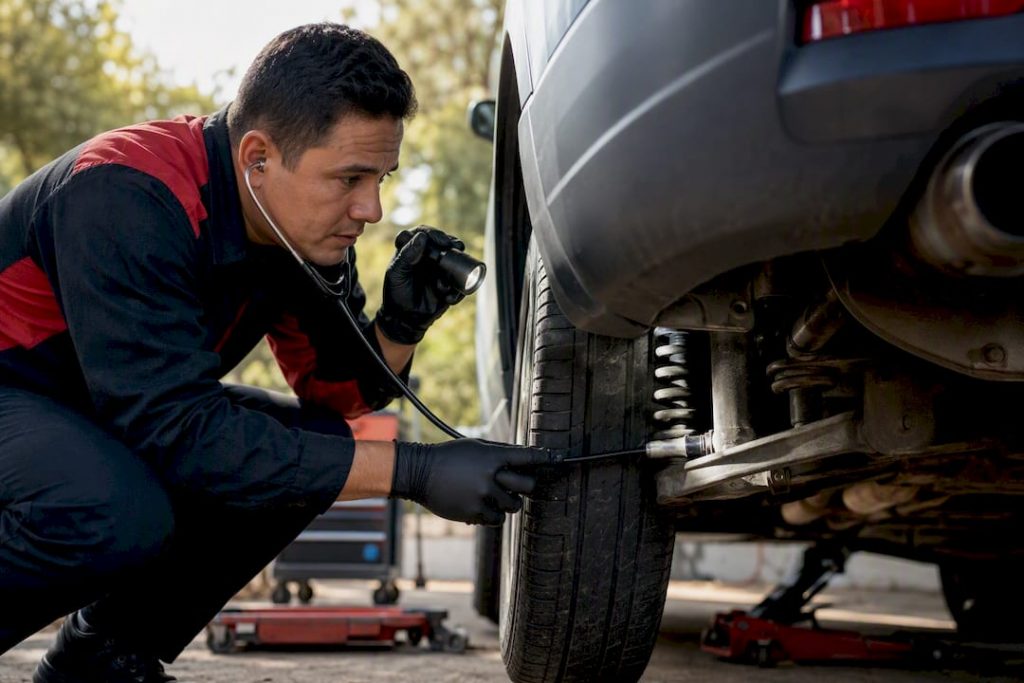
For pinpointing exactly where a noise is coming from, mechanics have used a cheap trick for decades: touch one end of a long screwdriver or a broomstick to the suspicious component and the other end near your ear. Sound travels through the shaft and tells you which part is the source, not just which side of the car.
Pro Tip: If you have an infrared thermometer, check bearing and strut temperatures right after a road test. A wheel bearing or strut working harder than it should runs noticeably hotter than its neighbor on the same axle, and that temperature gap can confirm a diagnosis a bounce test alone can’t.
Component Checklist: What Each Symptom Points To
Once you know roughly where the noise lives, work through these checks in order.
Ball joints and control arms. Grab the tire at the 12 and 6 o’clock positions and rock it, then try 3 and 9. Vertical play at 12/6 with no play at 3/9 usually means a bad ball joint. Look for a torn rubber boot or orange dust around the joint. Both are signs of wear that lubrication won’t fix; the part needs replacement, not maintenance.
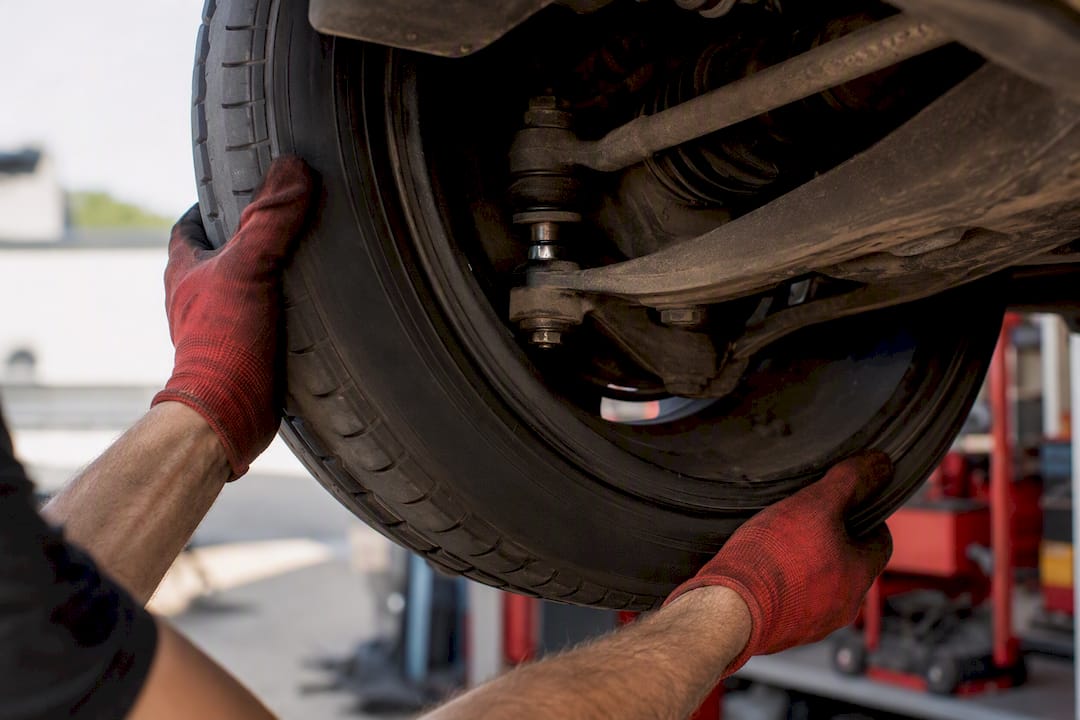
Tie rods and steering. Noise or a clunk only when turning almost always traces back to a tie rod end or steering rack. The dry park test above is the most reliable way to catch this kind of play.
Sway bar links and bushings. These cause an intermittent, sharp knock over uneven pavement, often only on one side. A pry bar applied with leverage reveals internal play that a static visual check will miss entirely.
Shocks and struts. Beyond the bounce test, check for oil residue on the shaft (a sign of a leaking seal) and inspect the mounting bushings at the top. A broken strut mount gland nut can produce a sharp clunk on full steering lock that feels exactly like a bad ball joint.
Wheel bearings. A growl or whine that grows with speed, paired with a temperature difference after a road test, points to a bearing under load stress. Wiggle the wheel at 12/6 while it’s off the ground; excess play confirms it.
Exhaust and mounts. A cold-touch test after the engine cools helps here. If tapping a hanger or bracket reproduces the exact rattle you heard driving, the suspension is innocent.
| Symptom | Likely Component | Quick Check |
|---|---|---|
| Clunk when turning | Ball joint, tie rod | Dry park test, 12/6 wheel rock |
| Squeak on bumps | Bushing, strut bearing | Bounce test, visual boot check |
| Intermittent knock over bumps | Sway bar link | Pry bar leverage check |
| Growl that grows with speed | Wheel bearing | Temperature check, wheel play |
| Rattle at idle or low speed | Exhaust hanger | Cold-touch reproduction test |
When Is a Suspension Noise a Safety Emergency?
Some findings mean stop driving now, not schedule an appointment for next week.
- Stop immediately if you notice steering wander, a sudden loss of steering feel, or you can see a component hanging loose underneath the car.
- Get it looked at within a day or two if you have a consistent clunk on bumps, a growing wheel bearing noise, or play you found during the dry park test.
- Monitor and schedule routine service if the noise is a minor squeak with no play detected and no change in handling.
A professional inspection goes further than driveway checks. Shops put the vehicle on a lift with the suspension loaded, not hanging free, which is when hidden play actually shows up. They also cross-check the vehicle against Technical Service Bulletins for known fixes before quoting any part replacement.
How Shops Diagnose Noises DIY Checks Miss
Intermittent or hard-to-pin-down noises are where a home garage runs out of tools. Shops solve this with a few specific advantages:
- ASE-certified technicians who have run this diagnostic sequence hundreds of times and know which noises are commonly mistaken for something else.
- Lift inspections with the suspension loaded, not just visually eyeballed while parked.
- Electronic listening tools such as the Steelman Smart Ear, which isolate a sound that would otherwise travel through the chassis and confuse a stethoscope trick.
- Infrared temperature checks and TSB lookups before any part gets replaced.
- All repairs backed by a 24 month / 24,000 mile warranty, so a fix stays fixed.
Before you book an appointment, do the shop’s job easier: record the noise on your phone, write down exactly when it happens, and note if it started after hitting a pothole or carrying a heavy load. That single piece of prep often cuts diagnostic time significantly.
What the DIY Checks Actually Get You
Here’s the honest read on all this: the bounce test and dry park test are genuinely reliable for the big, obvious failures. A shock that bounces three times is done. A tie rod with visible play in a dry park test needs replacing. Where the DIY approach runs out of road is with anything intermittent, anything that only shows up loaded, or anything where two components sound identical from the driver’s seat.
The conventional advice you’ll find in most forums treats diagnosis as a checklist you complete once. It isn’t. Reproducing a noise under the same load and steering input it originally occurred under is the difference between fixing the right part and replacing three parts before you get lucky. That’s the step people skip, and it’s the one that saves the most money.
If you take one thing from this: do the road test and bounce test first, every time, before you buy a single part. They cost nothing and rule out more than half the guesswork. Save the lift, the loaded checks, and the electronic listening tools for the noises that survive those first two tests. That’s not a compromise; it’s the actual order shops use internally, just without the lift.
Get a Shop-Grade Suspension Diagnosis in Lynnwood
A screwdriver stethoscope and a bounce test get you most of the way there, but loose ball joints, worn tie rods, or a failing wheel bearing need a loaded lift check to confirm before you spend money on parts. Tom’s B & M Auto runs that exact process: a road test to reproduce the noise, a lift inspection with the suspension loaded, and a written quote before any work starts.
Every appointment includes a documented diagnosis from ASE-certified technicians, and every repair carries a 24 month / 24,000 mile warranty, so a fixed noise stays fixed. If cost is a concern, financing options are available to spread out the repair. Same-day appointments are often available for diagnostic visits. Book your suspension diagnostic in Lynnwood or call the shop directly to get on the schedule this week.
Sources
- How to Isolate Suspension Noises — MOOG technical bulletin
- How To Fix Car Suspension Clunks and Rattles — Popular Mechanics
- Accurate diagnoses: how to check for worn or loose chassis parts — Mevotech
- Tool briefing: How to diagnose different suspension noise issues — VehicleServicePros