
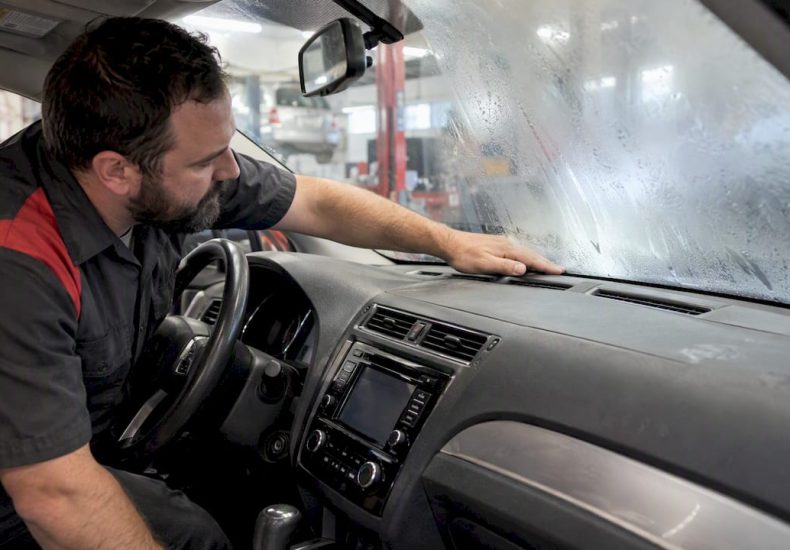
Drivers: 8 Point Shop Checklist if Your Car Heater Blows Cold Air
If your car’s heater is blowing cold air, the problem is usually either coolant isn’t flowing through the heater core or warm air isn’t reaching the vents through the ducts. A few quick checks, like confirming your controls and letting the engine warm up fully, can rule out the simple causes. If the problem persists, it typically points to a mechanical fault that needs a professional diagnostic.
TL;DR:
- Most heater failures are caused by coolant flow issues, such as a stuck open thermostat or low coolant levels, rather than internal leaks.
- Simple checks, including thermostat setting, cabin filter status, and hose temperature comparison, can often identify non-mechanical causes before professional diagnosis.
- Diagnostic procedures involve OBD-II scans, hose temperature comparisons, and pressure tests to locate restricted flow, leaks, or airflow blockages.
- Common repairs range from inexpensive cabin filter replacements to complex heater core disassembly, with costs and times varying accordingly.
- Safety-sensitive issues, like windshield fogging and frost, require prompt inspection since heater failure impacts defrosting and visibility.
Table of Contents
- Quick checks vehicle owners can run safely
- Technician diagnostic checklist: what the shop will test and why
- Common causes and how each fails
- Typical repair times and cost ranges
- When to call a pro and what to ask at the appointment
- Safety precautions when inspecting or repairing the heater system
- Impact of heater issues on vehicle defrosting functionality and safety implications
- Temporary workaround solutions while awaiting repair
- A mechanic’s take on heater complaints
- Book a heater and AC diagnostic appointment
- FAQ
- Sources
Quick checks vehicle owners can run safely
Before assuming the worst, rule out the easy stuff. Many “no heat” complaints turn out to be a setting or a clogged filter rather than a failed part.
- Confirm your temperature dial is set to full hot, the fan is on, and the vent mode is set to floor or dash rather than defrost-only or fresh air.
- Let the engine idle or drive for 5 to 10 minutes before judging heater output. Engines need that time to reach normal operating temperature, and a cold engine won’t produce warm air no matter what else is working.
- Check your cabin air filter. A clogged one restricts airflow and can make a working heater feel weak, and trusted guidance recommends starting with simple checks like this before moving to under-hood inspection.
- Check the coolant reservoir when the engine is cold, and look under the car for puddles or a sweet smell near the firewall.
- Once the engine is warm, carefully touch the two heater hoses running into the firewall. If they’re both warm, coolant is reaching the heater core.
For more background on how airflow and temperature settings interact, our automotive heating system guide walks through each component.
Pro Tip: Never open a hot radiator or coolant reservoir cap to check fluid level. Wait until the engine is completely cool.
Technician diagnostic checklist: what the shop will test and why
When owner checks don’t solve it, a shop moves through a structured sequence rather than guessing at parts.
- OBD-II scan: pulls codes related to coolant temperature sensors, blend-door actuators, and blower circuits that might not trigger a dashboard warning light.
- Heater hose temperature comparison: both hoses at the firewall should be similarly warm. A cold hose next to a hot one usually means restricted flow, while two warm hoses with cold vents point to an airflow problem instead of a coolant problem.
- Cooling system pressure and leak test: pressurizes the system to find hidden leaks that don’t show up as visible drips.
- Thermostat check: tested in place or on the bench to confirm it opens at the correct temperature.
- Water pump inspection: checked for bearing play, leaks, or a slipping drive belt that would reduce coolant circulation.
- Blower motor, resistor, fuse, and ground checks: isolates whether the fan itself, its speed control, or its power supply is the failure point.
- Blend-door and actuator actuation test: confirms the door that routes air past the heater core moves correctly when commanded.
- Heater core leak and access check: because heater core replacement often requires significant disassembly, sometimes including partial dash removal, a shop will confirm the core is actually the problem before quoting that labor.
Common causes and how each fails
Matching your symptoms to a likely cause helps you understand what a technician is looking for and roughly how serious the fix will be.
- Thermostat stuck open: the engine never reaches full operating temperature, so coolant stays too cool to heat the cabin. Engines should normally reach operating temperature, typically around 195 to 220 degrees Fahrenheit, within about 5 to 10 minutes of running; if the temperature gauge stays low longer than that, a stuck thermostat is a strong suspect. Our guide to the thermostat’s role in the engine explains this in more detail.
- Low coolant or trapped air pockets: produces intermittent heat that comes and goes, sometimes paired with an overheating warning or coolant residue under the car. Persistent low coolant without an obvious puddle can point to a slow leak or, less commonly, a head gasket issue. Our overview of what coolant does covers common leak points.
- Clogged or leaking heater core: often comes with a sweet smell inside the cabin and a damp or wet passenger-side footwell. Replacing it is one of the heavier heater repairs because of the disassembly involved.
- Blower motor, fuse, or resistor failure: hoses feel warm, but little or no air moves through the vents at any fan speed. These parts are generally easier and faster to replace than a heater core.
- Stuck blend door or failed actuator: hoses are warm, yet the air coming out stays cold because the door that should direct it past the core is jammed or not receiving a signal. Access varies by vehicle and is sometimes tucked deep behind the dash.
- Weak water pump or loose serpentine belt: reduces coolant circulation enough to starve the heater core even when the temperature gauge reads normal. Water pumps commonly last roughly 60,000 to 100,000 miles depending on the vehicle, so mileage is a useful clue.
A clogged cabin air filter is one of the most common reasons heat feels weak even when every mechanical part is working, and many vehicles have a recommended replacement interval on roughly a yearly or 20,000-mile schedule. Replacing it is often the cheapest fix you’ll ever make on this list.
Typical repair times and cost ranges
Costs vary by vehicle and location, so treat these as general bands rather than a quote.
- Simple fixes (cabin filter, thermostat, blown fuse): usually same-day with low labor time, often the lowest-cost repairs on this list.
- Moderate jobs (water pump, heater hoses, coolant flush): typically a half day to a full day, with parts and labor landing in a mid-range band.
- Major repairs (heater core replacement, blend-door assembly): can run many hours and sometimes stretch past one day when dash removal is required, placing them at the higher end of the cost range.
- Diagnostic fees generally apply upfront and are credited toward the repair cost once you approve the work, so ask whether that fee rolls into your final bill before authorizing the diagnostic.
When to call a pro and what to ask at the appointment
Some symptoms mean you should stop troubleshooting and get the car looked at right away.
- Book an appointment immediately if you notice: a sweet smell inside the cabin, a wet or damp passenger floor, visible coolant under the car, or the temperature gauge climbing toward overheating.
- Ask what tests were run: request the OBD-II scan results, the heater-hose temperature comparison, and whether a pressure or leak test was performed.
- Ask for a written quote before work begins, including whether parts are OEM or aftermarket.
- Ask about technician credentials and warranty coverage: ASE-certified technicians and a written warranty on parts and labor give you recourse if the repair doesn’t hold.
A 24-month/24,000-mile warranty on completed work, paired with upfront pricing before any repair starts, means you know the cost and the coverage before you commit, not after.
Pro Tip: Request digital inspection photos when available. Seeing the actual worn hose or corroded connector makes it much easier to trust the diagnosis.
Safety precautions when inspecting or repairing the heater system
Coolant runs hot and pressurized, and the heater core sits close to components that can burn you if you’re not careful.
Never open a radiator cap, coolant reservoir cap, or any cooling system fitting while the engine is warm or has recently been running. Pressure inside a hot system can send scalding coolant spraying out, and even a few minutes of cooling time is not enough. Wait until the engine is fully cool to the touch, which usually means waiting at least an hour after driving.
Handle coolant with care once drained. It’s toxic to pets and wildlife because of its sweet smell and taste, so collect it in a sealed container rather than letting it pool on the ground, and dispose of it at a facility that accepts automotive fluids rather than pouring it down a drain.
Keep hands and tools away from the serpentine belt and any moving engine components while the engine is running, since a water pump or belt inspection sometimes involves working near these parts with the engine idling. If you’re checking heater hose temperature yourself, touch them briefly with the back of your hand rather than gripping them, since they can be hot enough to cause a burn even through a glove in some cases.
If you smell coolant or notice a leak near the heater core, avoid running the heater fan on a high setting in an enclosed vehicle for extended periods until it’s inspected, since that can push fumes into the cabin.
Impact of heater issues on vehicle defrosting functionality and safety implications
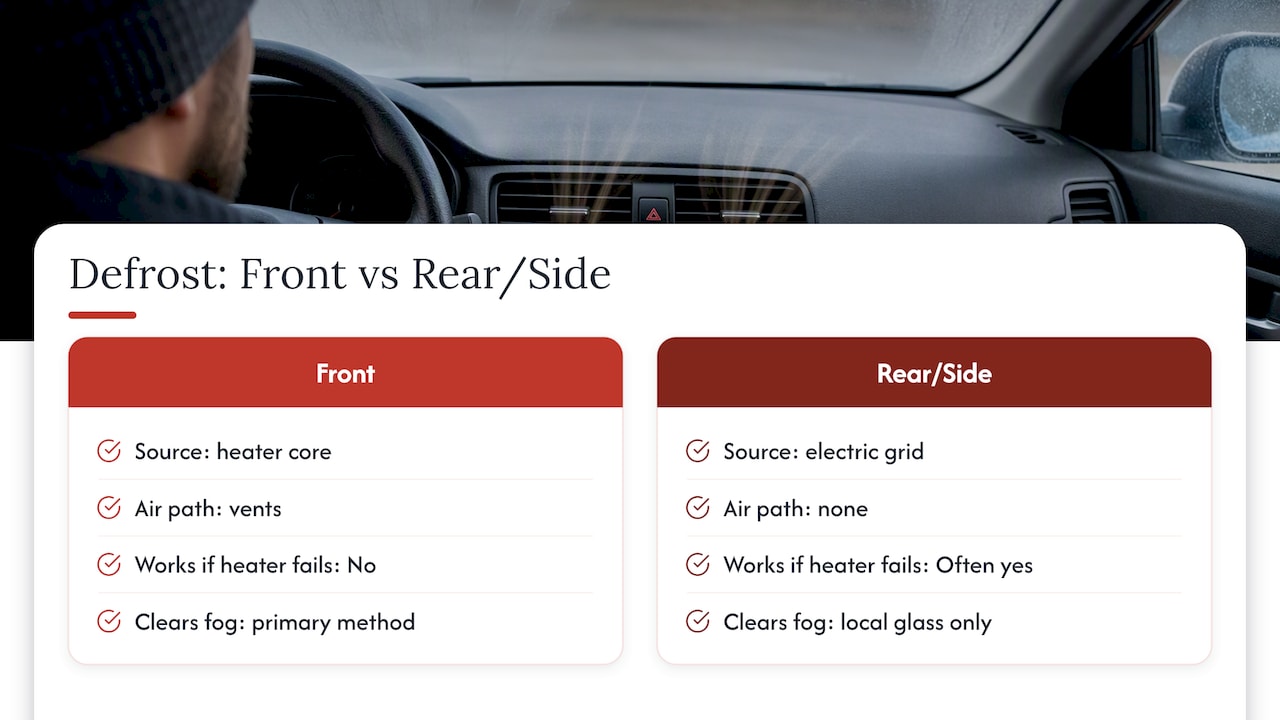
Your defroster and your heater share the same source of warm air, so a heater that isn’t producing heat usually means your windshield defrosting function is compromised too. That’s a bigger safety issue than cold feet.
A windshield that won’t clear fog or frost reduces visibility right when road conditions are often worst, during cold, wet, or snowy weather. If your heater has stopped working and you also notice your windshield fogging up and staying fogged despite running the defrost setting, treat that as a reason to get the car inspected sooner rather than later, not just an inconvenience to work around.
Rear and side window defrosting, where equipped, typically relies on electric grid heating rather than the same heater core system, so those may continue working even when your main heater fails. Don’t rely on that as a substitute for a clear windshield, though. If visibility through the windshield is impaired and you can’t resolve it with the physical window defrost or a cloth, it’s safer to delay the drive until the heater or defrost path is repaired.
Temporary workaround solutions while awaiting repair
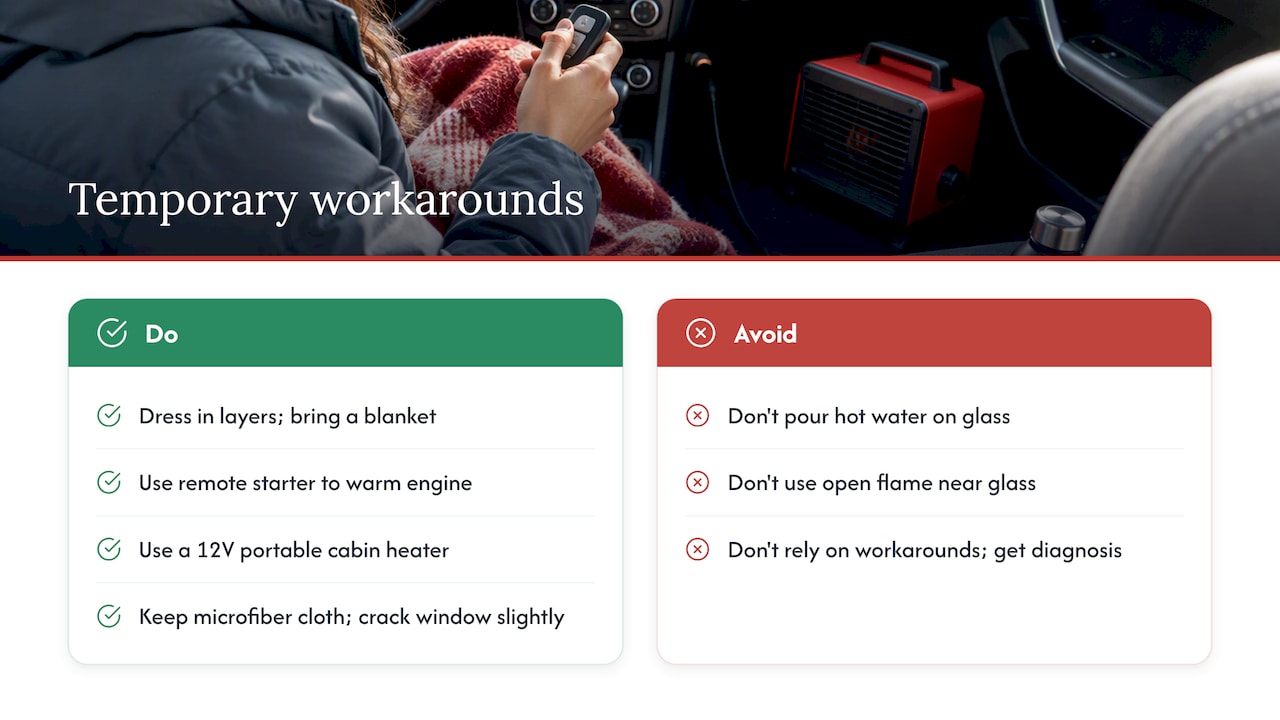
If you’re waiting on a repair appointment or parts, a few short-term steps can make driving more tolerable and your windshield safer in the meantime.
Dress for the cabin temperature rather than counting on the heater, with layered clothing and a blanket for passengers on longer trips. A remote starter, if your vehicle has one, lets the engine run and partially warm up before you get in, though it won’t fix an airflow or circulation problem once you’re driving. A portable 12-volt cabin heater can take the edge off cold air for short trips, but keep expectations modest since these draw limited power and won’t match a functioning heater core.
For windshield visibility, keep a microfiber cloth in the car to manually wipe condensation, and crack a window slightly to reduce fogging if the defrost setting isn’t clearing it. Avoid using very hot water or open flame near the glass to speed up defrosting, since rapid temperature changes can crack cold glass. These steps buy you time, but they’re not a substitute for diagnosing whether the underlying cause is a coolant flow issue or an airflow issue.
A mechanic’s take on heater complaints
Most heater complaints we see fall into one of two buckets: either coolant isn’t getting to the heater core, or coolant is getting there fine but something is blocking the air from carrying that heat into the cabin. Owners often assume the worst, a cracked heater core, when the actual fix turns out to be a blown fuse or a stuck blend door that takes an hour to sort out.
We back repairs across all makes with a 24-month/24,000-mile warranty. A common job we handle is a vehicle with warm heater hoses but cold vents, which usually traces back to a blend-door actuator rather than anything inside the cooling system itself.
— Shingi
Book a heater and AC diagnostic appointment
A cold heater in winter or a heater that won’t cooperate with your AC in summer both point to the same kind of diagnostic work, and we handle both under one roof with OBD-II scanning, hose temperature checks, and pressure testing on all makes, including hybrid and European vehicles.

Bringing a short description of your symptoms (when the cold air started, whether it’s worse at idle or while driving, any smells or leaks you’ve noticed) helps technicians narrow things down faster. You’ll get a written quote before any work begins.
| What you get | Detail |
|---|---|
| Diagnostic approach | OBD-II scan, heater hose temperature check, pressure/leak test |
| Vehicle coverage | All makes, including hybrid and European models |
| Warranty | 24 months / 24,000 miles on completed work |
| Pricing | Upfront, provided before repair starts |
- Book a diagnostic for a cold heater, weak airflow, or heater-and-AC issues through our AC repair page.
- Mention any recent coolant top-offs, overheating warnings, or smells so we can prioritize the right tests first.
- Ask about same-day scheduling when you call, since many diagnostic slots open up within the same week.
FAQ
Why does my heater blow cold air at idle but warm up while driving?
This usually points to a coolant circulation problem, often a weak water pump or low coolant, since idle speed doesn’t move enough coolant through the system to keep the heater core hot. A technician can confirm this with a heater hose temperature comparison at idle versus while driving.
What are the signs of a clogged or failing heater core?
Common signs include a sweet smell inside the cabin, a damp or wet passenger-side footwell, and fogging on the inside of the windshield that doesn’t clear. Heater core replacement often involves significant disassembly, so a leak test is usually done first to confirm the core is actually the cause.
Can a bad thermostat cause the heater to blow cold air?
Yes. A thermostat stuck open keeps the engine from reaching normal operating temperature, so the coolant never gets hot enough to warm the cabin even though it’s circulating. Engines should typically reach operating temperature within about 5 to 10 minutes of running, so a gauge that stays low longer than that is a useful clue.
How much does it cost to fix a car heater that isn’t blowing hot air?
Costs depend heavily on the cause: a cabin air filter or fuse is inexpensive and quick, while a heater core replacement involves more labor and runs higher due to dash access requirements. We provide upfront pricing before any repair begins, so you’ll know the cost before committing.
Is it safe to drive with no heat in the car?
It’s generally safe mechanically in the short term, but a heater failure often means your defrost function is also compromised, which can reduce windshield visibility in cold or wet weather. If fogging or frost on the windshield doesn’t clear with the defrost setting, it’s worth getting the heater system inspected before relying on that drive regularly.
Sources
Recommended
- How Your Automotive Heating System Works: What Car Owners Need to Know
- Car AC System Checklist: A Quick Diagnostic Guide
- Why Car AC Blows Warm Air: Causes and Fixes
- Car AC Heater: How They Work and When to Run Both
Leave a Reply