
Car AC Heater: How They Work and When to Run Both
Your car’s air conditioner and heater are not two separate systems bolted together by coincidence. They are integrated parts of a single climate-control unit: the A/C removes heat and humidity from cabin air, and the heater adds warmth back in. Run them together when you need to defog a windshield. That is not a quirk of your car; it is exactly how the system is designed to work.
Before you call a shop, run three quick checks:
- Blower test: Turn the fan to all speeds. If airflow is weak or absent at any setting, the blower motor or resistor may be failing.
- A/C compressor check: Switch the A/C on and listen for a click from the engine bay. That click is the compressor clutch engaging. No click usually means low refrigerant or an electrical fault.
- Heater output test: Set the temperature to max heat and let the engine warm up for five minutes. If air stays cold, suspect a low coolant level, a stuck thermostat, or a failing heater core.
Pro Tip: Keep your A/C functional year-round. Most vehicles automatically engage the compressor in defrost mode, and a compressor that sits idle all winter loses lubrication in its seals. A short A/C run once a week in cold months keeps those seals from drying out.
Key Takeaways
A car’s AC and heater are one integrated climate-control system: the A/C dehumidifies, the heater adds warmth, and running both together is the correct approach for defogging and year-round compressor health.
| Point | Details |
|---|---|
| Run A/C with heat for defogging | The evaporator strips moisture before the heater core reheats air, clearing glass faster and preventing fog from returning. |
| EV owners: preheat on the charger | HVAC can cut EV range by 10%–30%; preconditioning the cabin while plugged in preserves battery range for driving. |
| Portable 12V units have real limits | A cigarette-lighter heater tops out around 120–240 watts; factory HVAC runs at several kilowatts. Repair the factory system. |
| Delay turns small faults into big repairs | A slow defroster or slightly warm A/C is a warning. Catching a refrigerant leak early costs far less than a compressor replacement. |
| Tom’s B & M Auto warranty | All HVAC repairs carry a 24-month / 24,000-mile warranty; same-day appointments often available in Lynnwood, WA. |
Table of Contents
- How does a car AC heater system actually work?
- Key HVAC components and what they do
- How heating and cooling work differently in EVs and hybrids
- Are portable 12V heaters and aftermarket AC units worth buying?
- Common HVAC problems, how to diagnose them, and what repairs cost
- Should you run the A/C while using the heater?
- What to expect when Tom’s B & M Auto diagnoses your HVAC
- A local shop’s take on the mistakes that cost drivers the most
- Tom’s B & M Auto handles HVAC repairs with a warranty you can count on
- Sources
How does a car AC heater system actually work?
The cooling side runs on a vapor-compression cycle. Refrigerant (R-134a in most vehicles built before 2021, R-1234yf in newer ones) is pressurized by the compressor, flows to the condenser at the front of the car where it sheds heat to outside air, passes through a receiver/dryer that removes moisture, then expands through an orifice tube or expansion valve. That rapid expansion drops the refrigerant’s temperature sharply. It then flows through the evaporator, a small radiator-like core inside the dashboard. Cabin air blown across the evaporator loses both heat and moisture before it reaches you.
The heating side works differently. Engine coolant absorbs waste heat from the engine block, then a portion of that hot coolant circulates through the heater core, another small radiator tucked behind the dashboard. Air blown across the heater core picks up that heat and enters the cabin warm.
The evaporator and heater core sit in the same airbox. Blend doors, controlled by your temperature dial or climate-control module, determine how much air passes through each core before the two streams mix. Set 68°F and the system opens the blend door partway; set 85°F and it nearly bypasses the evaporator entirely.
What ties it together is airflow routing. Fresh or recirculated air enters the blower, passes through the evaporator first (always, when A/C is on), then through however much of the heater core the blend door allows, and finally out through whichever vents you have selected. Defrost mode forces air to the windshield and, on virtually every modern vehicle, automatically engages the A/C compressor to strip moisture before the heater core reheats it.
Pro Tip: If your defroster clears the windshield slowly, check whether the A/C compressor is engaging. A failed compressor means the system is reheating humid air instead of dry air, and the fog keeps coming back.
Key HVAC components and what they do
Understanding the parts makes it much easier to describe a symptom to a technician or decide whether a repair is DIY-friendly.
| Component | What it does | Common symptom when it fails | DIY or pro? |
|---|---|---|---|
| Compressor | Pressurizes refrigerant to drive the cooling cycle | No cold air; loud clicking or grinding from engine bay | Pro |
| Condenser | Releases heat from refrigerant to outside air | Warm air; visible damage or bent fins after road debris | Pro (replacement); DIY (fin straightening) |
| Receiver/dryer | Filters moisture and debris from refrigerant | Intermittent cooling; ice on evaporator | Pro |
| Expansion valve / orifice tube | Drops refrigerant pressure to trigger cooling | Inconsistent temperatures; frost on low-pressure line | Pro |
| Evaporator | Cools and dehumidifies cabin air | Musty smell; water on floor; poor cooling | Pro |
| Heater core | Transfers engine coolant heat to cabin air | No heat; sweet smell; foggy windshield; coolant loss | Pro |
| Blend doors | Mix cold and hot airstreams to hit target temp | Stuck at one temperature; clicking from dash | Pro (actuator); DIY (reset attempt) |
A few failure patterns worth knowing:
- Evaporator odor is almost always mold or mildew growing on the wet core surface. Running the fan on high with A/C off for the last minute of a drive helps dry it out.
- Heater core leaks often show up as a sweet, antifreeze smell inside the cabin or a film on the inside of the windshield. Coolant loss is slow but steady.
- Condenser damage from road debris is common in the Pacific Northwest. A bent fin reduces airflow and cooling capacity noticeably.
How heating and cooling work differently in EVs and hybrids
In a gas-powered car, the engine produces so much waste heat that warming the cabin is essentially free. Electric vehicles have no such luxury. EVs and hybrids do not use engine coolant for cabin heat; they rely on electric PTC (positive temperature coefficient) heaters or heat pump systems that draw directly from the high-voltage battery pack and require dedicated control modules to manage power safely.
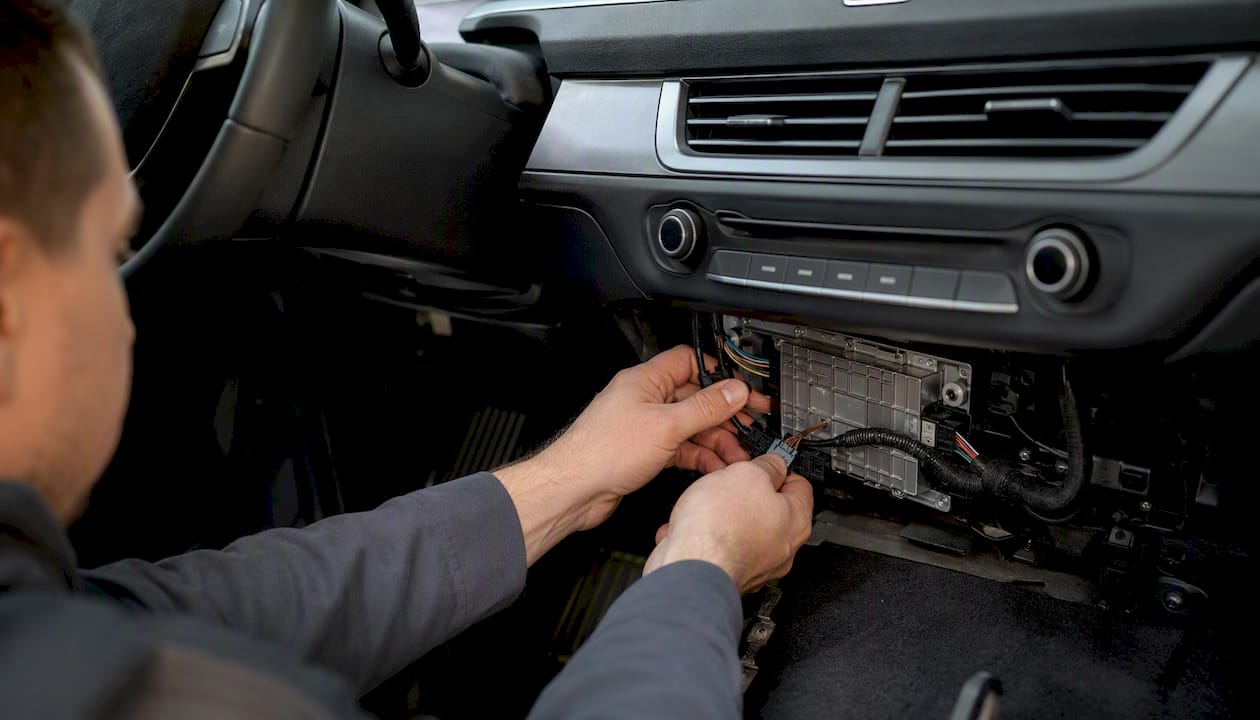
PTC heaters are resistive elements whose electrical resistance rises as they heat up, which automatically limits current draw and prevents overheating. They are reliable and simple, but they are also energy-hungry. A PTC heater pulling 3–5 kW on a cold morning is drawing power that would otherwise move the car.
Heat pumps are more efficient. They move heat rather than generate it, pulling warmth from outside air or waste heat from the motor and inverter. HVAC use in EVs can reduce driving range by roughly 10%–30% depending on ambient temperature and system design, with resistive PTC heating typically causing larger range reductions than heat pumps in cold conditions.
Advanced EV thermal systems go further. Patented designs route glycol loops and refrigerant circuits together, using valves and heat pumps to transfer heat between the battery pack, power electronics, and the cabin as conditions change. On a cold day, waste heat from the inverter can be redirected to warm the cabin instead of being dumped to the outside air.
Practical tips for EV and hybrid owners:
- Preheat while plugged in. Most EVs (Tesla, Rivian, Hyundai Ioniq 6, Kia EV6) allow cabin preconditioning via an app. Heating the cabin on grid power instead of battery power can meaningfully extend cold-weather range.
- Choose heat-pump-equipped vehicles if cold-weather range matters. Heat pumps typically deliver more cabin heat per kilowatt-hour than resistive elements.
- Use seat and steering wheel heaters first. They warm you directly and draw far less power than heating the entire cabin volume.
Are portable 12V heaters and aftermarket AC units worth buying?
The short answer: for most situations, no. Portable 12V heaters draw power through the cigarette lighter socket, which is typically fused at 10–20 amps. At 12 volts, that limits output to roughly 120–240 watts. A factory HVAC system operates at several kilowatts. The math does not favor the portable unit.
Portable A/C units marketed for vehicles face an even steeper problem. Cooling requires moving heat from inside the cabin to outside it. Without a sealed connection to the exterior, a portable unit simply recirculates heat inside the car. Engineers and reviewers consistently note that many portable units cannot match factory HVAC performance and often omit real cooling capacity figures from their marketing.
Safety concerns are real:
- Overloaded circuits from undersized wiring can cause fires.
- Units that require windows to be cracked for venting create security and weather exposure problems.
- Continuous high-current draw can drain a battery in a stationary vehicle faster than expected.
There are legitimate uses. A 12V ceramic heater can take the edge off a cold cabin during a brief idle while you wait for the engine to warm up, or provide supplemental warmth in a camper van with a robust electrical setup. Note that many states, including Washington, have idling restrictions that limit how long you can run a vehicle for cabin comfort, so check local rules before relying on this approach.
The cleaner path is almost always repairing the factory system. A professional recharge typically costs $150–$300. A heater core replacement runs $600–$1,200 depending on the vehicle. Those numbers beat the ongoing frustration and safety risk of an undersized workaround.
Common HVAC problems, how to diagnose them, and what repairs cost
Most HVAC complaints fall into a handful of patterns. Knowing which symptom points where saves time at the shop.
Symptom mapping:
- Warm air from A/C: Low refrigerant (leak), failed compressor, clogged condenser, or a bad expansion valve. Start by checking whether the compressor clutch engages.
- No heat: Low coolant, stuck-open thermostat, failed heater core, or a stuck blend door. Check the coolant level first; it is a two-minute check.
- Weak airflow at all speeds: Clogged cabin air filter (replace it yourself for $15–$30) or a failing blower motor.
- Weak airflow at low speeds only: Blower motor resistor, a common and inexpensive fix.
- Musty smell: Mold on the evaporator. An evaporator cleaner spray through the intake can help; persistent cases need professional treatment.
- Sweet smell or foggy windshield from inside: Heater core leak. Do not ignore this; coolant vapor is not something you want to breathe.
- Windshield fogs repeatedly despite defrost: Check whether the A/C compressor is engaging. A failed compressor leaves the defroster reheating humid air.
Quick checks you can do yourself:
- Replace the cabin air filter. A clogged filter cuts airflow dramatically and costs almost nothing to fix.
- Check coolant level in the overflow reservoir when the engine is cold.
- Turn on A/C and watch the compressor pulley for clutch engagement (the center of the pulley should spin with the belt).
- Inspect the condenser fins through the front grille for visible damage or debris buildup.
- Run defrost mode and confirm the A/C indicator light comes on.
What a shop does: A professional diagnosis starts with an OBD-II scan to catch any stored HVAC fault codes, followed by a pressure test on the refrigerant circuit. Leak detection uses electronic sniffers, UV dye, or both. If refrigerant is low, the system is evacuated, leak-repaired, and recharged to spec. Heater-core work requires partial dashboard removal on most vehicles, which is why labor costs dominate that repair.
| Repair | Typical cost range | Typical shop time |
|---|---|---|
| A/C recharge (no leak) | $150–$300 | 1–2 hours |
| Leak repair + recharge | $600 | 2–5 hours |
| Compressor replacement | $1,200 | 3–6 hours |
| Condenser replacement | $600 | 2–4 hours |
| Heater core replacement | $600–$1,200 | 4–10 hours |
| Blend door actuator | $150–$300 | 1–3 hours |
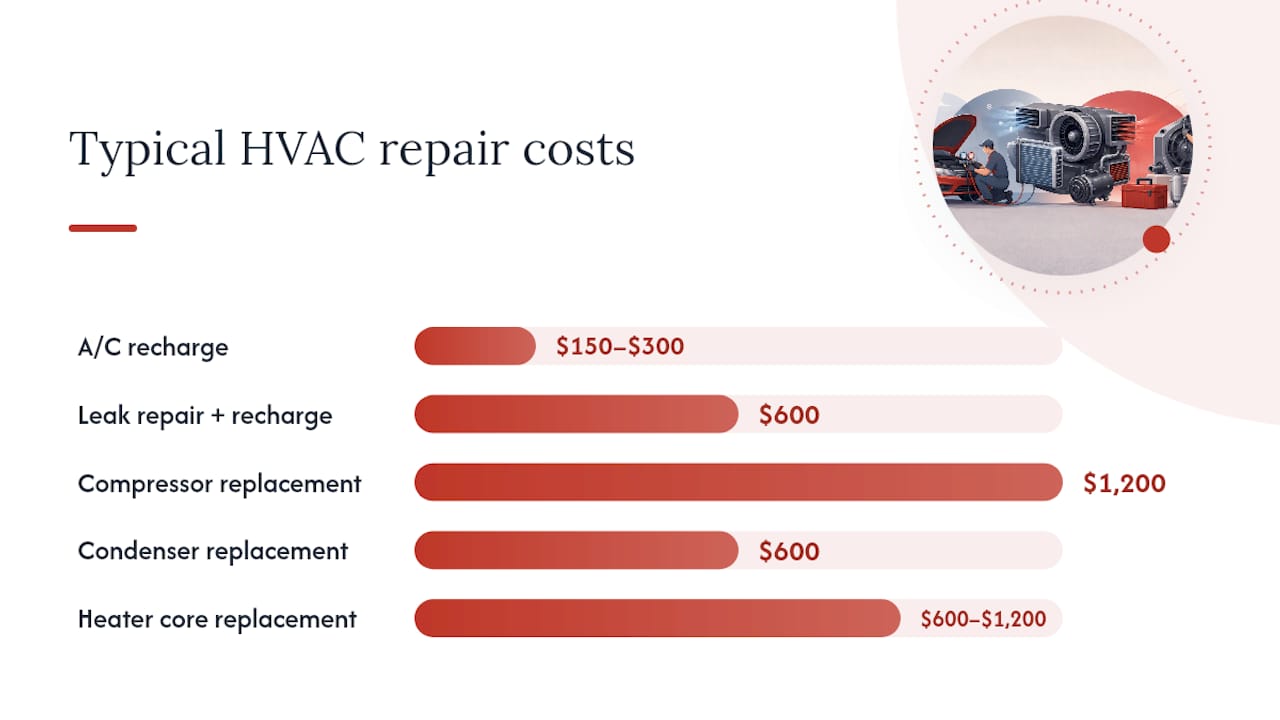
Prices vary by vehicle make, model year, and region. European and luxury vehicles typically sit at the higher end.
Pro Tip: If your car’s A/C is blowing warm air, don’t top off refrigerant without finding the leak first. Refrigerant doesn’t “run out” in a healthy system; low charge always means a leak somewhere.
Should you run the A/C while using the heater?
Yes, and for a specific reason: the evaporator removes moisture from cabin air before the heater core reheats it. Running A/C with the heater simultaneously is standard defrost behavior and also keeps compressor seals lubricated through the winter months. Drivers who disable the A/C to “save fuel” in winter often end up with a fogged windshield and a compressor that struggles to engage come spring.
Defogging step-by-step:
- Set the fan to medium-high or high.
- Select defrost mode (front or rear, depending on where fog is worst). The A/C compressor will engage automatically on most vehicles.
- Switch to fresh air (not recirculate). Recirculated air keeps the same moisture cycling through the cabin.
- Set temperature to warm. The heater core reheats the now-dry air from the evaporator, clearing the glass faster.
- Once the windshield is clear, you can reduce fan speed and switch back to your preferred vent setting.
When can you skip the A/C? On very short trips where windows are not fogging, or when outside temperatures drop below about 32°F and the compressor cuts off automatically (most systems have a low-temperature lockout to prevent refrigerant from freezing the evaporator). In those cases, the air is already dry enough that the A/C adds little benefit.
Pro Tip: If your car has an auto climate mode, use it. The system cycles the compressor and adjusts blend doors more efficiently than manual settings, and it will engage A/C only when humidity warrants it.
What to expect when Tom’s B & M Auto diagnoses your HVAC
Tom’s B & M Auto has been diagnosing and repairing HVAC systems in Lynnwood since 1985. ASE-certified technicians run every job, and the diagnostic process follows a consistent workflow so nothing gets missed.
What the process looks like:
- Customer intake: The technician asks when the problem started, whether it is constant or intermittent, and whether any previous repairs have been done. Bring notes if you have them.
- Visual inspection: Check refrigerant lines for oily residue (a sign of a leak), inspect condenser fins, and look for coolant stains near the heater core.
- OBD-II scan: Pulls any stored fault codes related to the climate-control module, blend door actuators, or compressor circuit.
- Pressure and leak test: Gauges confirm refrigerant charge; electronic sniffers and UV dye locate leaks precisely.
- Functional test: Blower speeds, actuator movement, and compressor engagement are all verified before an estimate is written.
- Estimate and scheduling: Upfront pricing before any work begins. Same-day appointments are often available for common HVAC jobs like recharges and blower motor replacements.
A proper HVAC diagnosis takes 45–90 minutes and tells you exactly what is wrong and what it will cost to fix. Skipping the diagnosis and guessing at parts is how a $300 repair turns into a $900 one.
All repairs at Tom’s B & M Auto carry a 24-month / 24,000-mile warranty. That covers parts and labor, so if a repaired component fails within that window, it is fixed at no additional charge.
For deeper background on what goes wrong inside the compressor and why, the AC compressor guide on the shop blog covers the mechanics in plain language.
A local shop’s take on the mistakes that cost drivers the most
The most expensive HVAC repairs I see at Tom’s B & M Auto are almost always the result of one thing: delay. A slow defroster in October becomes a failed heater core by January. A slightly warm A/C in May becomes a seized compressor by July. The system gives warnings; most drivers interpret them as minor inconveniences.
Three habits I’d push every driver to build:
- Annual A/C service check. Refrigerant charge and compressor function should be confirmed once a year, ideally in spring before the first hot stretch. A small leak caught early costs a fraction of what a compressor replacement does.
- Cabin air filter replacement every 15,000–25,000 miles. It takes ten minutes and directly affects airflow, A/C efficiency, and the air quality you breathe. Most drivers have never changed theirs.
- Coolant flush on schedule. Degraded coolant becomes acidic and corrodes the heater core from the inside. Check your owner’s manual; most manufacturers recommend a flush every 30,000–50,000 miles. The radiator and coolant system is the heater core’s lifeline.
Before winter in the Pacific Northwest, book a quick HVAC check. Confirm the defroster clears glass within 60 seconds, the heater reaches full temperature within five minutes of a cold start, and the A/C compressor engages. Those three checks take less time than scraping ice off a windshield that won’t defog.
Tom’s B & M Auto handles HVAC repairs with a warranty you can count on
Facing a repair estimate for a compressor, heater core, or refrigerant leak? Tom’s B & M Auto covers the full range of HVAC work: diagnostic, pressure testing, leak detection, recharge, compressor replacement, condenser service, and heater core replacement, all backed by a 24-month / 24,000-mile warranty on parts and labor.

The shop serves Lynnwood and surrounding areas including Kenmore, Shoreline, Mountlake Terrace, Edmonds, and Meadowdale. Same-day appointments are often available for common jobs. For larger repairs, financing options are available so cost doesn’t force you into a band-aid fix. Book your appointment or get a quote at Bandmautocare.
Sources
- How to design heating and cooling systems for HEV/EVs (Rev. A)
- How to Get the Most Out of Your Car’s Heater – Consumer Reports
- How Does Car AC Work? | UTI
- US12330472B2 – Thermal management system for electrified vehicles
- Is it OK to Run the A/C While the Heater is On? – FJC
Recommended
- What Is an AC Compressor? A Car Owner’s Guide – Tom’s B & M Auto Blog
- Why Car AC Blows Warm Air: Causes and Fixes – Tom’s B & M Auto Blog
- AC Repair in Kenmore, WA | Tom’s B&M Auto
- AC Repair in Edmonds, WA | Tom’s B&M Auto
Leave a Reply