

What Is an AC Compressor? A Car Owner’s Guide
The AC compressor is the mechanical heart of your vehicle’s air conditioning system, responsible for compressing refrigerant gas from a low-pressure, low-temperature state into a high-pressure, high-temperature state that makes cooling possible. Without it, refrigerant cannot circulate, heat cannot transfer, and your vents blow nothing but warm air. Every Toyota, Honda, Subaru, or domestic vehicle on the road depends on this single component to keep the cabin comfortable. Understanding how it works, what can go wrong, and how to maintain it saves you money and prevents bigger repairs down the road.
How does an AC compressor work?
The AC compressor function follows three distinct phases: suction, compression, and discharge. Each phase is a step in a continuous loop that moves heat out of your car’s cabin.
1. Suction. The compressor draws in low-pressure refrigerant gas from the evaporator. At this stage, the refrigerant has already absorbed heat from inside the cabin and is cool and gaseous.
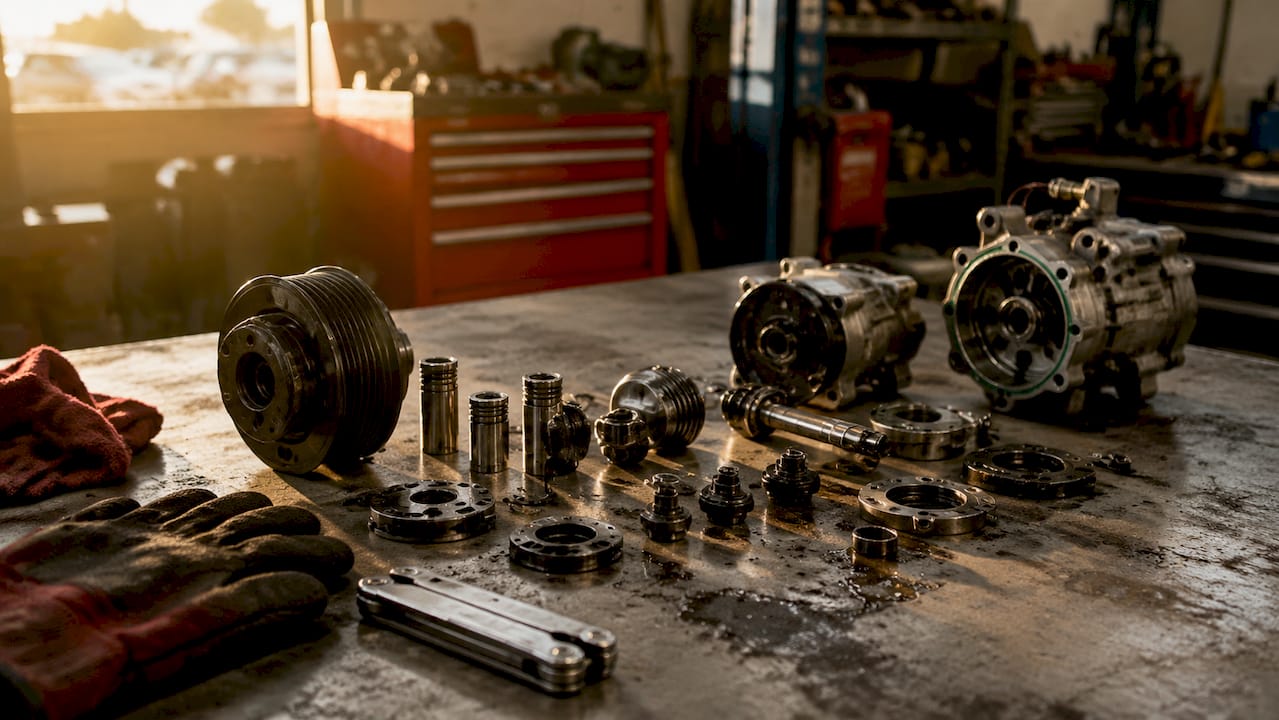
2. Compression. The compressor squeezes that gas mechanically, raising both its pressure and temperature. Compressed refrigerant temperatures often reach 80–100°C, while outside ambient air sits near 30°C. That temperature gap is what allows heat to flow outward.
3. Discharge. The now hot, high-pressure gas exits the compressor and travels to the condenser, which sits at the front of your vehicle. The condenser releases that heat to the outside air. The refrigerant then cools, becomes liquid, passes through the expansion valve, and enters the evaporator where it absorbs cabin heat again. The cycle repeats continuously while your AC runs.
| AC Cycle Stage | Refrigerant State | Key Component |
|---|---|---|
| Suction | Low pressure, low temperature gas | Evaporator |
| Compression | High pressure, high temperature gas | Compressor |
| Condensation | High pressure, cooling liquid | Condenser |
| Expansion | Low pressure, cold liquid | Expansion valve |
| Evaporation | Low pressure, heat-absorbing gas | Evaporator |
The compressor is the only major mechanical component in the refrigerant circuit. Every other part responds to what the compressor does.
Pro Tip: If your AC blows cold for a few minutes then warms up, the compressor may be short cycling. Note exactly when the warm air starts and tell your technician. That detail narrows the diagnosis significantly.
What are the types and key parts of an AC compressor?
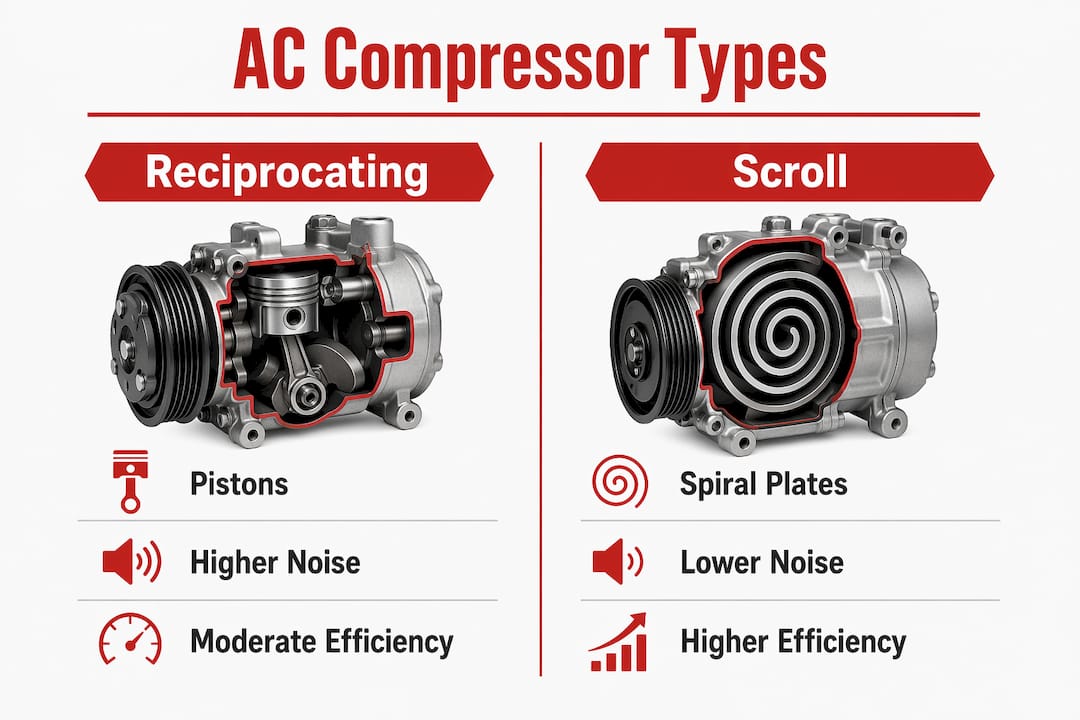
Two compressor designs dominate the automotive world: reciprocating (piston) and scroll compressors. Knowing which type your vehicle uses helps you understand what a repair involves.
Reciprocating (piston) compressors
Reciprocating compressors use pistons driven by a crankshaft to compress refrigerant. They are common in older vehicles and many domestic trucks. They handle variable load well but produce more vibration than scroll designs. Piston compressors are also more serviceable in some configurations, though most modern units are still replaced as complete assemblies.
Scroll compressors
Scroll compressors use two interlocking spiral plates. One plate stays fixed while the other orbits, trapping and compressing refrigerant between the spirals. They run quieter, produce less vibration, and are more efficient than piston designs. Many newer Toyota, Honda, and Subaru models use scroll compressors.
| Type | Noise Level | Efficiency | Common Use |
|---|---|---|---|
| Reciprocating (piston) | Higher | Moderate | Older vehicles, trucks |
| Scroll | Lower | Higher | Modern cars, hybrids |
Regardless of type, the compressor contains an electric motor or belt-driven pulley, the compression mechanism (pistons or scrolls), intake and discharge valves, a crankcase or housing, and an oil reservoir that lubricates internal parts. The entire assembly is hermetically sealed. That sealed design is why internal repair is rarely practical.
Key AC compressor parts at a glance:
- Clutch or pulley: Engages and disengages the compressor from the engine belt
- Pistons or scroll plates: The mechanical elements that compress refrigerant
- Valves: Control refrigerant flow direction during each cycle phase
- Oil reservoir: Keeps internal components lubricated to reduce wear
- Housing/crankcase: Protects and contains all internal components
Pro Tip: When a shop shows you a failed compressor, ask whether it is a piston or scroll design. Scroll units are generally more expensive to replace because of their tighter manufacturing tolerances. Knowing this upfront prevents sticker shock.
What are the signs of a bad AC compressor?
Catching compressor trouble early is the difference between a manageable repair and a full system replacement. Common signs of a failing compressor include warm air from vents, reduced cooling performance, loud grinding or rattling noises, and short cycling where the AC turns on and off rapidly.
Here is what each symptom tells you:
- Warm air from vents: The compressor is not building enough pressure to push refrigerant through the cycle. Cooling stops.
- Grinding or rattling noises: Internal bearings or pistons are worn. This sound means mechanical damage is already happening.
- Short cycling: The compressor switches on and off in quick bursts instead of running steadily. This stresses the motor and accelerates wear.
- Higher engine load: A struggling compressor draws more power from the engine. You may notice a slight drop in acceleration when the AC is on.
- Visible oil stains near the compressor: Refrigerant oil leaking from the housing signals a seal failure.
One critical point most car owners miss: warm air and poor cooling are often caused by a bad capacitor, a refrigerant leak, or dirty condenser coils rather than a failed compressor. Replacing the compressor without ruling out these cheaper causes wastes money. A proper diagnosis comes first.
Running an AC with a struggling compressor causes cascading failures that damage electrical components and the compressor itself. Loud noises and short cycling need immediate attention.
Pro Tip: Turn on your AC and listen with the hood open. A healthy compressor runs with a steady, low hum. Any grinding, clunking, or squealing is a signal to stop using the AC and get a diagnosis before the damage spreads.
How to maintain and troubleshoot your vehicle’s AC compressor
Compressor longevity comes down to consistent, simple habits. Most premature failures are preventable.
Keep the condenser clean
Dirt and debris blocking condenser coils force the compressor to work harder, reducing efficiency and shortening its lifespan. The condenser sits at the front of your vehicle, directly behind the grille, and collects road grime, bugs, and leaves. Rinse it gently with a garden hose during routine washing. Clear airflow means the compressor runs at lower load.
Run the AC regularly, even in winter
Many car owners shut off the AC entirely during cold months. That is a mistake. Running the AC for 10 minutes each week circulates refrigerant oil through the compressor seals, keeping them pliable. Seals that dry out crack and leak, leading to refrigerant loss and compressor strain.
Do not ignore early warning signs
Attempting electrical or refrigerant pressure tests without professional tools and training is dangerous. Refrigerant is under high pressure and requires EPA-certified handling. Your safe zone as a DIYer is observational: listen for unusual noises, check for warm air, and look for oil stains near the compressor. Everything beyond that belongs in a shop.
Understand when replacement beats repair
Compressors are hermetically sealed units and replaced as complete assemblies rather than repaired internally. When a compressor fails, replacing it is almost always more cost-effective than attempting internal repair. A reputable shop will also flush the system and replace the receiver-drier at the same time to remove metal debris from the failed unit. Skipping that step contaminates the new compressor and causes it to fail early.
If you are in the Lynnwood area and suspect compressor trouble, a professional AC compressor inspection is the right first step before committing to any parts.
Pro Tip: Ask your shop to check the AC clutch and belt tensioner whenever they service the compressor. These wear at similar rates and replacing them together avoids a second labor charge later.
Key Takeaways
The AC compressor is the single mechanical component that drives the entire refrigerant cycle, and its condition directly determines whether your vehicle’s air conditioning works at all.
| Point | Details |
|---|---|
| Core function | The compressor pressurizes refrigerant to create the temperature differential needed for cooling. |
| Two main types | Reciprocating (piston) compressors suit older vehicles; scroll compressors are quieter and more efficient in modern cars. |
| Early warning signs | Warm air, grinding noises, and short cycling signal compressor trouble before total failure occurs. |
| DIY limits | Observational checks are safe; refrigerant and electrical tests require professional tools and certification. |
| Replacement over repair | Hermetically sealed compressors are replaced as complete units, not repaired internally. |
The compressor doesn’t create cold. It moves heat.
After 40 years of working on vehicles at Tom’s B & M Auto, the single biggest misconception I hear from car owners is this: “My AC isn’t blowing cold, so the compressor must be dead.” That assumption costs people real money.
The compressor doesn’t create cold air. It moves heat from inside your cabin to outside the vehicle. When cooling fails, the compressor is one possible cause among several. A leaking refrigerant line, a failed capacitor, or a clogged condenser can all produce identical symptoms. I have seen customers pay for a new compressor when a $40 capacitor was the actual problem.
The other mistake I see constantly is ignoring early noise. A grinding compressor that runs for another two weeks does not just fail cleanly. It sends metal debris through the entire refrigerant circuit, contaminating the condenser, expansion valve, and evaporator. What started as a $600 compressor job becomes a $2,000 system flush and rebuild. Catching it at the first rattle matters.
My honest advice: run your AC weekly year-round, keep the front of your vehicle clean, and get a professional diagnosis before you authorize any parts. The diagnosis is cheap. The assumptions are expensive.
— Shingi
Get your AC compressor diagnosed by Lynnwood’s trusted shop

Tom’s B & M Auto has served Lynnwood, Edmonds, Kenmore, and Mountlake Terrace drivers since 1985. Our ASE-certified technicians handle AC compressor diagnosis, replacement, and full system service on all makes, including Toyota, Honda, Subaru, European, and hybrid vehicles. We use professional-grade diagnostics to confirm the actual cause of failure before recommending any repair. Every job comes with a 24-month / 24,000-mile warranty. If repair cost is a concern, financing options are available to keep your vehicle running without the financial strain. Same-day appointments are often available. Book your compressor replacement service today and get back to driving cool.
FAQ
What does an AC compressor do in a car?
The AC compressor pressurizes refrigerant gas, raising its temperature so heat can be expelled through the condenser. This pressure differential is what drives the entire cooling cycle.
How do I know if my car’s AC compressor is failing?
Warm air from vents, grinding or rattling noises when the AC is on, and rapid on-off cycling are the clearest signs. A professional diagnosis confirms whether the compressor or another component is the actual cause.
Can I drive with a bad AC compressor?
You can drive with the AC turned off, but continuing to run a failing compressor risks spreading metal debris through the refrigerant system. That turns a single-component repair into a full system replacement.
Why is replacing an AC compressor so expensive?
Compressors are hermetically sealed units replaced as complete assemblies. The labor also includes system flushing, refrigerant recovery, and replacing the receiver-drier to protect the new unit from contamination.
How long does an AC compressor last in a vehicle?
Compressor lifespan varies by vehicle, climate, and maintenance habits. Keeping the condenser clean, running the AC regularly year-round, and addressing early warning signs are the most effective ways to extend its service life.
Recommended
- AC Compressor Replacement in Kenmore, WA | Tom’s B&M Auto
- AC Compressor Replacement in Edmonds, WA | Tom’s B&M Auto
- AC Compressor Replacement in Mukilteo, WA | Tom’s B&M Auto
- AC Compressor Replacement in Lynnwood, WA | Tom’s B&M Auto
Leave a Reply