

The Role of Thermostat in Engine: Owner’s Guide
The thermostat is the valve that controls coolant flow between your engine and the radiator, getting the engine to its designed operating temperature and holding it there. That single function touches nearly everything you care about: fuel economy, emissions, cabin heat, and long-term engine health. Here’s what it actually does:
- Blocks coolant from the radiator during warm-up so the engine heats up fast instead of bleeding heat away constantly
- Opens progressively as temperature rises, routing hot coolant to the radiator for cooling
- Modulates continuously to hold the engine in its optimal temperature band, not just flip between hot and cold
Table of Contents
- What is the role of thermostat in engine cooling?
- Why your engine needs a thermostat to run well
- How to spot thermostat failure symptoms
- Can an engine run without a thermostat?
- What types of thermostats are in modern vehicles?
- When should you replace a thermostat?
- Key Takeaways
- The thermostat is more than a temperature switch
- Thermostat diagnosis and replacement at Tom’s B & M Auto
- Useful sources
What is the role of thermostat in engine cooling?
The thermostat sits at the outlet of the engine block, right where coolant exits before reaching the radiator. Inside is a wax pellet sealed in a brass housing. At low temperatures, the wax is solid and a spring holds the valve disc closed. Coolant circulates only through a short internal bypass loop, never reaching the radiator. The engine warms up fast because, as Caltech explains, it isn’t constantly losing heat to the radiator.
As coolant temperature climbs, the wax melts and expands, pushing a piston against the spring and cracking the valve open. This is not a binary switch. According to David Boettcher’s thermostat technical notes, the valve moves proportionally to temperature, making continuous micro-adjustments as heat load changes. At highway cruise, the valve might sit at 30% open. Under a heavy pull uphill, it opens further. The engine never “decides” between full radiator flow and no radiator flow — it blends them.
| Thermostat State | Coolant Routing | Typical Condition |
|---|---|---|
| Closed | Bypass loop only | Cold start, warm-up |
| Partially open | Split between bypass and radiator | Normal cruise |
| Fully open | Primarily through radiator | High load, hot ambient |
Fully open temperature is 12–15°C (22–27°F) higher than the initial opening temperature. A thermostat rated to open at 88°C won’t reach fully open until roughly 100–103°C. That range is the thermostat’s working zone, not a flaw.
There’s a secondary benefit worth knowing: the thermostat’s partial restriction raises pressure slightly in the cooling passages. Higher pressure raises the coolant’s boiling point, which helps prevent localized hot spots near combustion chambers from boiling even under heavy load.
Why your engine needs a thermostat to run well
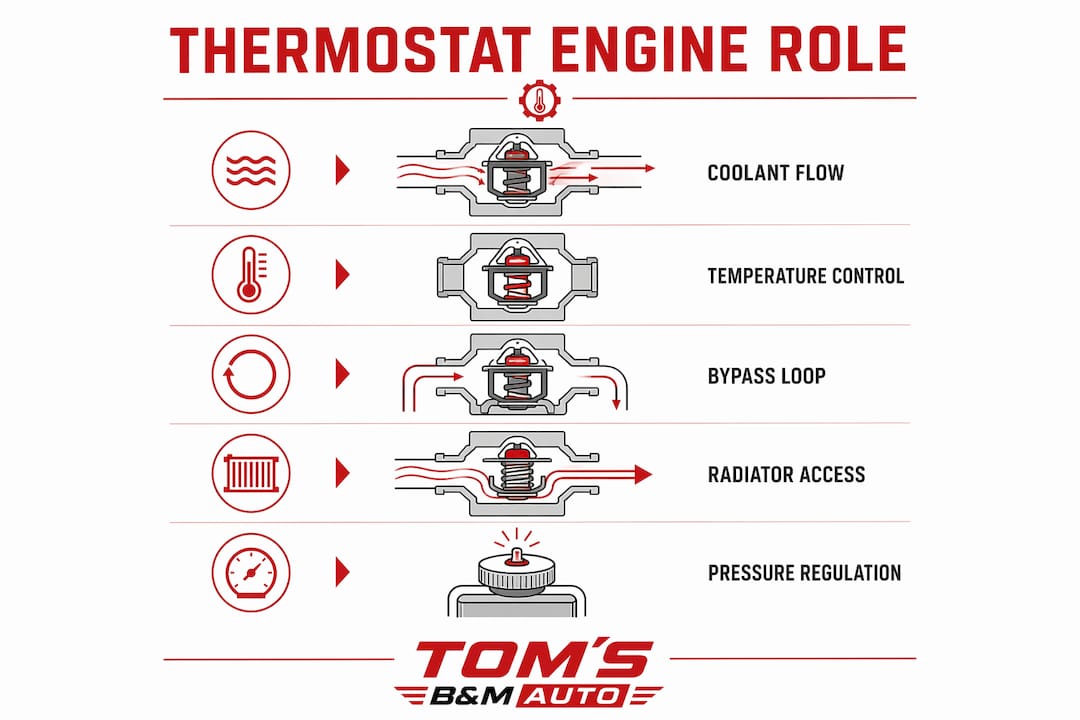
A cold engine is a wasteful engine. Oil is thick, metal clearances are tight, and combustion is incomplete. Keeping the engine isolated from the radiator during warm-up cuts the time spent in that inefficient state. Less time cold means less wear, less oil dilution from unburned fuel, and fewer cold-start emissions.
Once the engine hits its operating range, typically 195–220°F (90–104°C) for most modern vehicles, the benefits compound:
- Better combustion efficiency: Fuel atomizes and burns more completely at design temperature, which directly improves fuel economy
- Lower emissions: A fully warm engine produces fewer hydrocarbons and carbon monoxide because the catalytic converter also reaches operating temperature faster
- Stable cabin heat: The heater core draws from engine coolant; a thermostat that holds temperature steady means consistent heat output on cold mornings
- Longer engine life: Extreme temperature swings accelerate wear on gaskets, seals, and cylinder walls
If you’ve ever noticed your heater blowing lukewarm air on a cold day, a thermostat stuck open is one of the first things worth checking.
How to spot thermostat failure symptoms
Thermostat failures fall into two main categories, and they produce opposite symptoms.
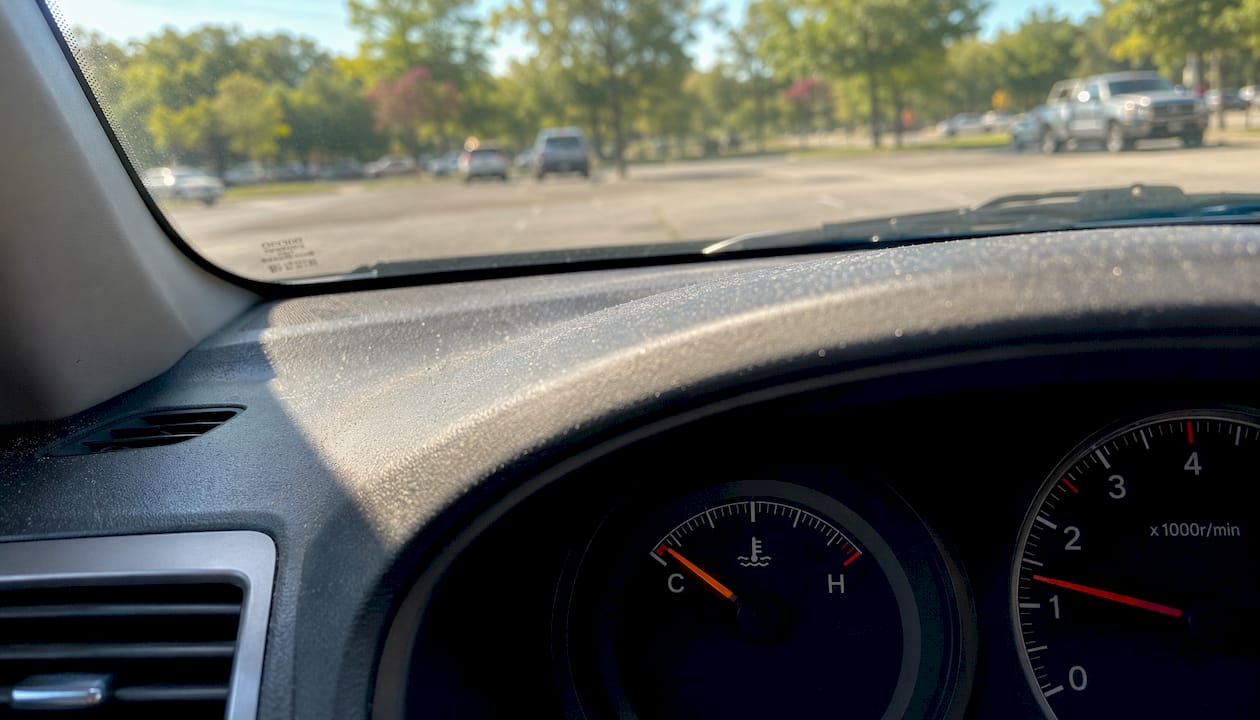
Stuck closed is the dangerous one. Coolant can’t reach the radiator, so heat builds fast. You’ll see the temperature gauge climb toward the red zone, the upper radiator hose will get extremely hot, and in severe cases you’ll notice steam from under the hood. Overheating can warp cylinder heads, blow head gaskets, or cause complete engine failure. If your gauge is climbing fast and you see steam, pull over and shut the engine off immediately. Don’t push it.
Stuck open is subtler but still costly. The engine never reaches normal operating temperature. The gauge sits below the normal mark, warm-up takes forever, the heater barely produces heat, and fuel economy drops noticeably. You might also see a check-engine light from fuel-trim codes because the ECU expects the engine to be warm.
Intermittent sticking produces erratic gauge behavior — the needle swings up and down without a clear pattern. This often means the wax pellet is partially degraded or debris is preventing the valve from seating cleanly.
Before assuming the thermostat is the culprit, check the basics. Low coolant level, a clogged radiator, or a failed water pump can mimic thermostat symptoms. Inspecting the cooling system as a whole — hoses, coolant level, radiator condition — is the right first step.
Pro Tip: Squeeze the upper radiator hose when the engine is at normal operating temperature. It should be hot and firm. If it’s still cool after 10 minutes of running, the thermostat is likely stuck open and coolant isn’t circulating through the radiator properly.
Can an engine run without a thermostat?
Yes, briefly. The engine will start and run. But pulling the thermostat is not a fix — it’s a trade-off that usually makes things worse.
Without a thermostat, coolant flows freely through the radiator at all times. The engine runs chronically cold, especially in winter or at highway speeds. Overcooling reduces efficiency, weakens heater output, increases emissions, and can confuse the ECU’s fuel maps — leading to richer fueling and worse economy. Some drivers remove the thermostat as a short-term workaround when they suspect it’s stuck closed and overheating, but that’s a temporary measure, not a solution.
Certain track or racing setups deliberately alter thermostat behavior to manage extreme heat loads, but those vehicles run purpose-built cooling systems tuned for that purpose. For a street car, running without a thermostat causes more problems than it solves.
What types of thermostats are in modern vehicles?
Mechanical wax-pellet thermostats are still the most common. They’re rated by opening temperature: 82°C (180°F), 88°C (190°F), and 92°C (197°F) are typical OEM ratings depending on the application. Simple, reliable, and cheap to replace.
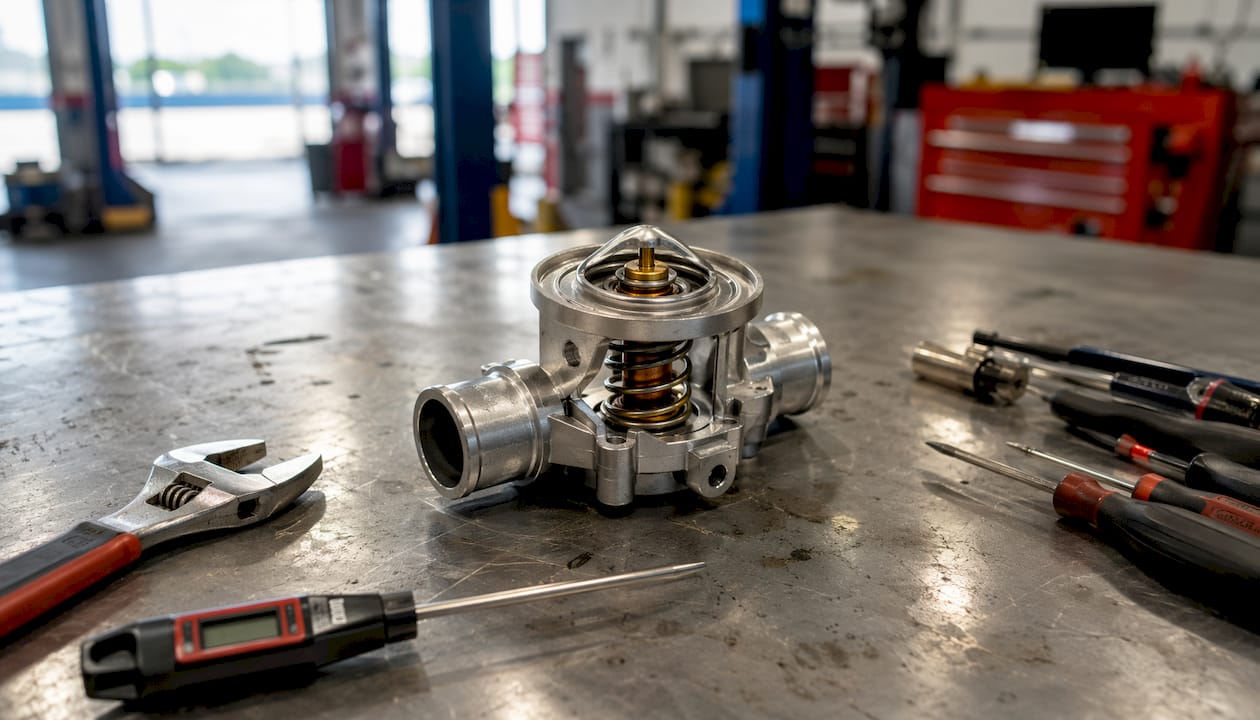
Fail-safe thermostats add a secondary spring that forces the valve open if the wax element fails. This prevents the catastrophic stuck-closed scenario by defaulting to full coolant flow. Many modern OEM thermostats use this design.
Electronically actuated thermostats replace the wax pellet with a motor-driven valve controlled by the ECU. The advantage is precision: the ECU can target a specific coolant temperature based on load, ambient conditions, and efficiency goals. Research suggests engines are over-cooled for the majority of their operating time.pdf) under classical mechanical control, which is exactly what electronic thermostats address. By running slightly hotter when conditions allow, they reduce oil viscosity, cut friction, and improve fuel economy. The industry trend toward controllable thermostats.pdf) is driven by tighter emissions regulations and fuel economy targets.
Quick comparison:
- Mechanical: Proven, low cost, no electrical failure modes, but fixed temperature response
- Electronic: Tighter control, efficiency gains, but more complex and costlier to replace
- Fail-safe: Best protection against stuck-closed failure; often the OEM choice on modern engines
For specialty builds, aftermarket options like adjustable thermostats let you dial in a specific opening temperature for performance applications. The fully-open delta of 12–15°C applies across all mechanical designs regardless of the base rating.
When should you replace a thermostat?
Thermostats generally last the life of the vehicle. Routine replacement on a schedule isn’t necessary — replace it when symptoms appear or when other cooling-system work makes it practical to swap it out at the same time. Common triggers:
- Persistent overheating with no other obvious cause
- Engine never reaching normal operating temperature
- Erratic temperature gauge readings
- Cooling-system repairs that require removing the upper hose or thermostat housing anyway
Replacement itself is straightforward: drain some coolant, remove the housing, swap the thermostat and gasket, refill, and bleed the system. On many four-cylinder engines it’s a 30–60 minute job. On some V6 and V8 applications with tight engine bays, access adds time.
Pro Tip: Always replace with an OEM-spec thermostat at the same temperature rating your vehicle came with. A thermostat with a different opening temperature can alter the ECU’s warm-up fuel maps and potentially trigger a check-engine light.
Parts typically run $10–$50 for the thermostat itself. Shop labor varies by vehicle and region — get a local estimate. If you’re also dealing with a radiator issue or hose replacement, bundling the work saves labor time. For high-mileage vehicles, replacing cooling components together during one visit is worth considering.
Key Takeaways
The thermostat is the single component that determines whether your engine runs at its designed temperature — everything from fuel economy to engine longevity depends on it working correctly.
| Point | Details |
|---|---|
| Thermostat controls coolant routing | It directs flow between the bypass loop and radiator to hold the engine at its optimal temperature band. |
| Fully open temp is 12–15°C above opening temp | A thermostat rated at 88°C won’t reach fully open until roughly 100–103°C — that range is normal operation. |
| Stuck closed overheats; stuck open undercools | Overheating risks engine damage; stuck open causes poor fuel economy, weak heat, and ECU fuel-trim issues. |
| Replace only when symptoms appear | Thermostats don’t need routine replacement; swap it when overheating, erratic readings, or related repairs arise. |
| Tom’s B & M Auto diagnoses thermostat faults | ASE-certified technicians in Lynnwood use OBD-II diagnostics to confirm thermostat failure before any repair. |
The thermostat is more than a temperature switch
Most people think of the thermostat as a simple on/off valve. It isn’t. It’s a proportional control device that’s constantly adjusting coolant flow in response to real-time heat load. That distinction matters for how you diagnose problems and what you replace it with.
The part I see underestimated most often: the impact of running the wrong thermostat rating. Swap in a cooler-opening unit thinking it’ll “run safer,” and you’ve actually told the ECU the engine is perpetually cold. Fuel trims shift richer, efficiency drops, and the catalytic converter takes longer to light off. The OEM temperature rating isn’t arbitrary — it’s calibrated to the entire engine management system.
Electronic thermostats take this further. They don’t just respond to temperature; they target a temperature based on operating conditions. That’s a meaningful shift in how thermal management works, and it’s why modern vehicles with electronic thermostats often show measurable efficiency gains over their predecessors. The wax pellet did its job for decades. The ECU-controlled valve does it better.
Thermostat diagnosis and replacement at Tom’s B & M Auto
When your temperature gauge is acting up or your heater isn’t keeping up on a cold Lynnwood morning, a thermostat diagnosis is a smart first call before spending money on larger repairs.
Tom’s B & M Auto has been serving Lynnwood, WA drivers since 1985 with ASE-certified technicians who use professional-grade OBD-II diagnostics to confirm whether the thermostat is actually the problem — or whether it’s something else in the cooling system. All thermostat and cooling-system work comes with a 24-month/24,000-mile warranty. If overheating is severe, stop driving and have the vehicle towed — don’t risk engine damage getting to the shop.
Book a free digital vehicle inspection to start, or go straight to engine repair service to schedule your appointment. Financing is also available for larger repairs if needed.
Useful sources
- David Boettcher — Thermostat Technical Notes: Detailed mechanical explanation of wax-pellet operation, proportional valve behavior, and the 12–15°C fully-open hysteresis figure.
- Caltech — Why Does an Engine Cooling System Have a Thermostat?: Concise engineering explanation of why isolating the engine from the radiator during warm-up reduces wear and emissions.
- Cars.com — Should I Change the Thermostat?: Practical maintenance guidance on when replacement is and isn’t warranted, including the OEM-rating caution.
- WSEAS — Advanced Control of the Cooling System in IC Vehicles (2021).pdf): Technical paper on electronically controlled thermostats, over-cooling under classical control, and efficiency gains from tighter thermal management.
- HowStuffWorks — What Does a Thermostat Do in a Car?: Accessible explainer covering thermostat function, failure modes, and why engine temperature affects performance and longevity.
Recommended
- What Is Radiator Function in Your Car’s Cooling System – Tom’s B & M Auto Blog
- Why Your Engine Overheats and How to Stop It – Tom’s B & M Auto Blog
- What Is Engine Coolant and Why Your Car Needs It – Tom’s B & M Auto Blog
- The Role of Transmission Fluid in Your Vehicle – Tom’s B & M Auto Blog
Leave a Reply