
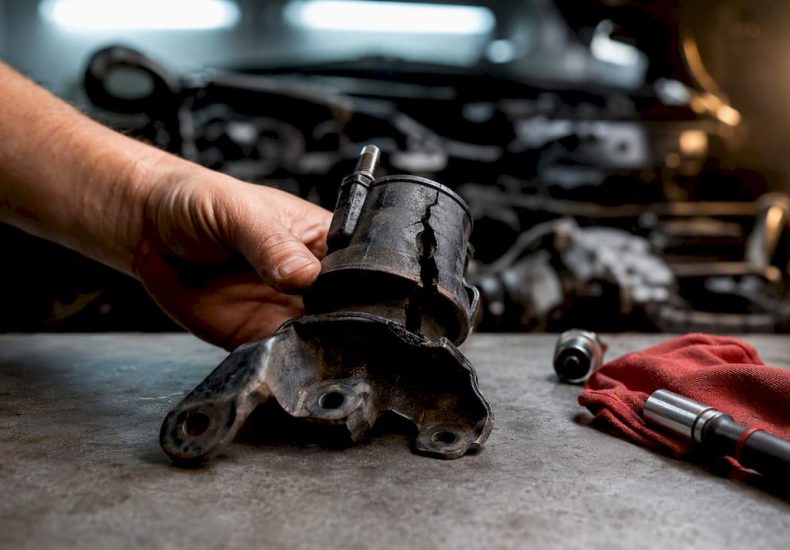
Car Owners: Diagnose Engine Mount Failure in 2 Minutes
A failed engine mount commonly causes cabin vibration, clunking noises, and visible engine movement, and it can worsen fast if ignored. Short, cautious trips are usually possible, but driving on bad mounts is not something to plan around. Do a quick visual check today, note whether the engine rocks under a brake torque test, and get it inspected before hoses, wiring, or the transmission take the hit.
TL;DR:
- Engine mounts typically last around five to seven years, but oil leaks, collision damage, and aggressive driving can shorten their lifespan significantly.
- Visible signs of failure include engine rocking during a brake torque test and excessive vibrations felt at idle, especially when the engine is tilted or misaligned.
- Ignoring a failed mount can lead to damage of hoses, wiring, exhaust components, and accelerate wear on other mounts, increasing repair costs over time.
- A proper diagnosis involves visual inspection for cracked or oily mounts and a brake torque test where movement over an inch signals potential failure.
- Most repairs range from a few hundred to over a thousand dollars, with professional diagnosis recommended to ensure correct parts and prevent further damage.
Table of Contents
- What Are the Signs of Engine Mount Failure?
- What Causes Engine Mounts to Fail?
- How Do You Diagnose a Bad Engine Mount?
- What Happens If You Ignore a Failed Engine Mount?
- Should You Repair Engine Mounts Yourself or Call a Pro?
- Why Do Shops Catch What Owners Miss?
- Get Your Mounts Checked at Tom’s B & M Auto
- Sources
- FAQ
What Are the Signs of Engine Mount Failure?
Engine mount failure rarely hides. The most reliable tell is vibration that shows up at idle or low speed and travels through the seats, the steering wheel, and even the pedals. A healthy mount absorbs that energy before it reaches you. Once the rubber cracks or a hydraulic mount loses fluid, that vibration transfers straight into the chassis, and a perfectly fine engine suddenly feels like it is falling apart.
The other giveaway is sound. Listen for clunking, thumping, or a metallic bang when you accelerate hard, let off the gas, or shift into Drive or Reverse. That noise usually means the engine has enough slack to knock against the frame, a bracket, or an accessory it was never meant to touch.
- Excessive shaking at idle, worse in Park or Neutral than at highway speed
- Clunks or thuds on acceleration, braking, or gear engagement
- Visible engine rocking when someone watches under the hood during a light throttle tap
- New rattles under load, especially from belts, brackets, or the exhaust brushing metal
Pro Tip: Before you blame the mounts, rule out tires and suspension. A bad CV joint or worn control arm bushing can mimic the same clunk. If the noise changes with steering input or road bumps rather than gear shifts, check the suspension first. The most common symptoms of a failing mount include clunky noises, abnormal vibration, and a visibly shifted engine, and driving on them for long stretches tends to make everything worse, not better.
What Causes Engine Mounts to Fail?
Rubber wears out. That is the simple version. Engine mounts typically hold up for roughly 5 to 7 years depending on the vehicle, the climate, and how the engine gets used, but heat cycling and constant flexing eventually turn firm rubber brittle or cause it to separate from its metal casing.
A few other things speed up the clock:
- Oil or coolant contamination softens rubber mounts or collapses the internal fluid chambers in hydraulic mounts, sometimes within a couple of years instead of five
- Collision damage can crack a mount instantly, even in a low-speed fender bender that never touches the engine bay
- Hard launches, towing beyond capacity, or aggressive shifting put repeated shock loads on mounts that were designed for steady torque, not sudden jolts
- A bad installation on a prior repair, using the wrong mount or over-torquing a bolt, shortens the life of the part before it ever gets a fair chance
Here is the part most owners miss: once one mount fails, the others start absorbing torque they were never designed to handle. That is why a single bad mount often turns into a two or three mount replacement within a year if it sits unaddressed.
How Do You Diagnose a Bad Engine Mount?
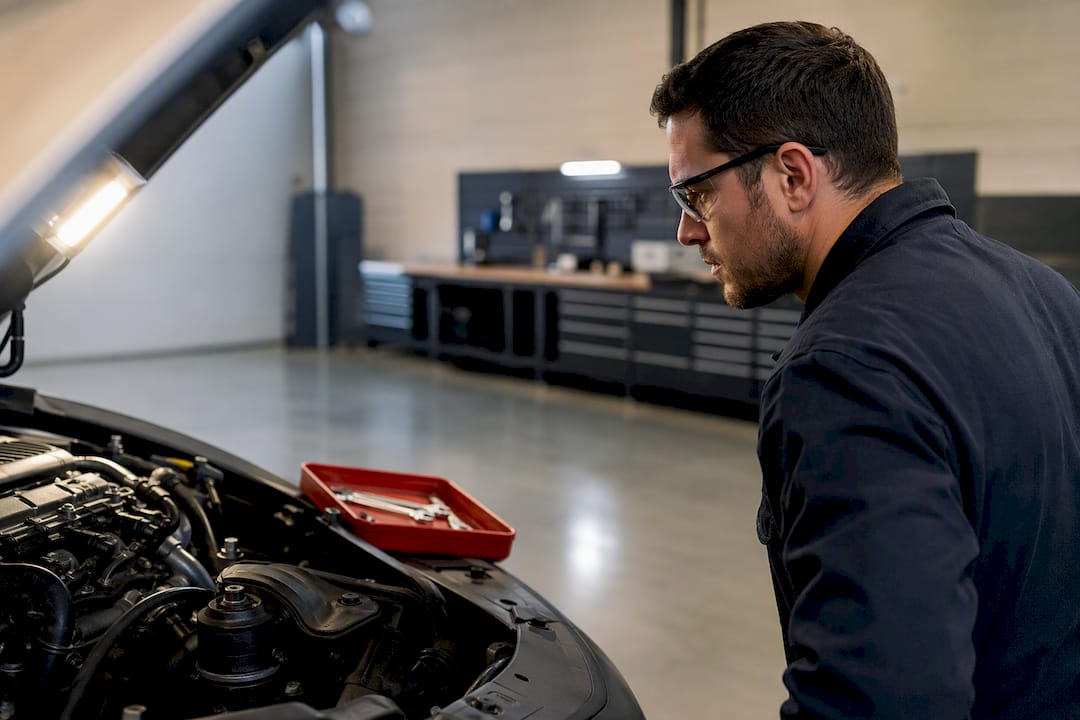
Start with your eyes before you start the engine. Pop the hood and look for cracked or “alligatored” rubber, rubber that has visibly separated from the metal plate, oily residue around hydraulic mounts (a sign the fluid chamber is leaking or has collapsed), loose or missing mounting bolts, and an engine that sits noticeably tilted compared to how it should sit level.
If the visual check looks borderline, move to a dynamic test. This is the brake torque test, and it takes about two minutes with a helper.
- Park on level ground, set the parking brake firmly, and keep the wheels chocked if you have them.
- Have a helper stand off to the side of the vehicle, never in front of it, with a clear view of the engine bay.
- With your foot firmly on the brake, shift into Drive and gently tap the throttle two or three times, watching the engine’s response.
- Repeat the same light throttle taps in Reverse.
- Have your helper note how far the engine shifts. Movement beyond about an inch usually points to a failed mount.
If the results are still unclear, an OBD-II scan can rule out misfires or sensor faults that sometimes mimic mount symptoms, and a closer look at the suspension bushings and control arms can rule out a lookalike clunk. If the engine lurches violently or you spot loose hardware during the test, stop immediately and have the car towed rather than driven in.
Pro Tip: Always watch from the side of the vehicle during a brake torque test, never from the front. If a mount fails completely mid test, the engine can shift enough to make standing in front of the bumper a genuinely bad place to be.
What Happens If You Ignore a Failed Engine Mount?
Engine movement does not stay contained to the engine. Every time the block rocks under load, everything connected to it flexes along with it: coolant hoses, wiring harnesses, exhaust flex pipes, and in some layouts, the transmission linkage itself.
Left long enough, that repeated flexing does real damage:
- Radiator or heater hoses can crack or tear from repeated stretching, leading to a coolant leak you did not see coming
- Exhaust flex sections and hangers can fatigue and crack, turning a mount problem into an exhaust repair
- Wiring harnesses can chafe against brackets or the frame, causing intermittent electrical faults that are miserable to trace later
- Driveshaft and CV joint angles can shift, accelerating boot wear and pulling a CV joint replacement into the picture
A failed mount that goes unaddressed tends to escalate into exactly these secondary repairs, which is why the fix is almost always cheaper the earlier it happens. If you notice violent engine movement, a burning smell, or a grinding sound under load, treat that as a tow situation, not a drive-it-home situation.
Should You Repair Engine Mounts Yourself or Call a Pro?
DIY is realistic for some owners, but the job has real failure points. You need a way to safely support the engine while the mount is off (an engine hoist or support bar, not a jack alone), the correct torque specs for your specific engine and mount type, and a replacement part matched to your VIN, since mount designs vary even within the same model year. Get any of those wrong and you can end up with a mount that fails faster than the one you replaced.
That is largely why most shops recommend professional service for this repair. ASE-certified technicians have the lift access, torque wrenches calibrated to spec, and diagnostic tools to confirm which mount (or mounts) actually failed before anything comes apart.
- A single mount replacement is sometimes enough if the others check out fine on inspection
- Shops often recommend inspecting or replacing adjacent mounts too, since a lone healthy mount left in a system with worn ones tends to wear out fast on its own
- Parts and labor together commonly range from a few hundred dollars for one mount to well over a thousand for multiple mounts on a transverse engine layout with tight access
- Vehicle type, mount design (rubber versus hydraulic), and local labor rates all move that number significantly
If your transmission mount is part of the equation, it is worth having that checked at the same visit. A transmission service inspection can catch related linkage stress before it becomes its own separate bill.
Why Do Shops Catch What Owners Miss?
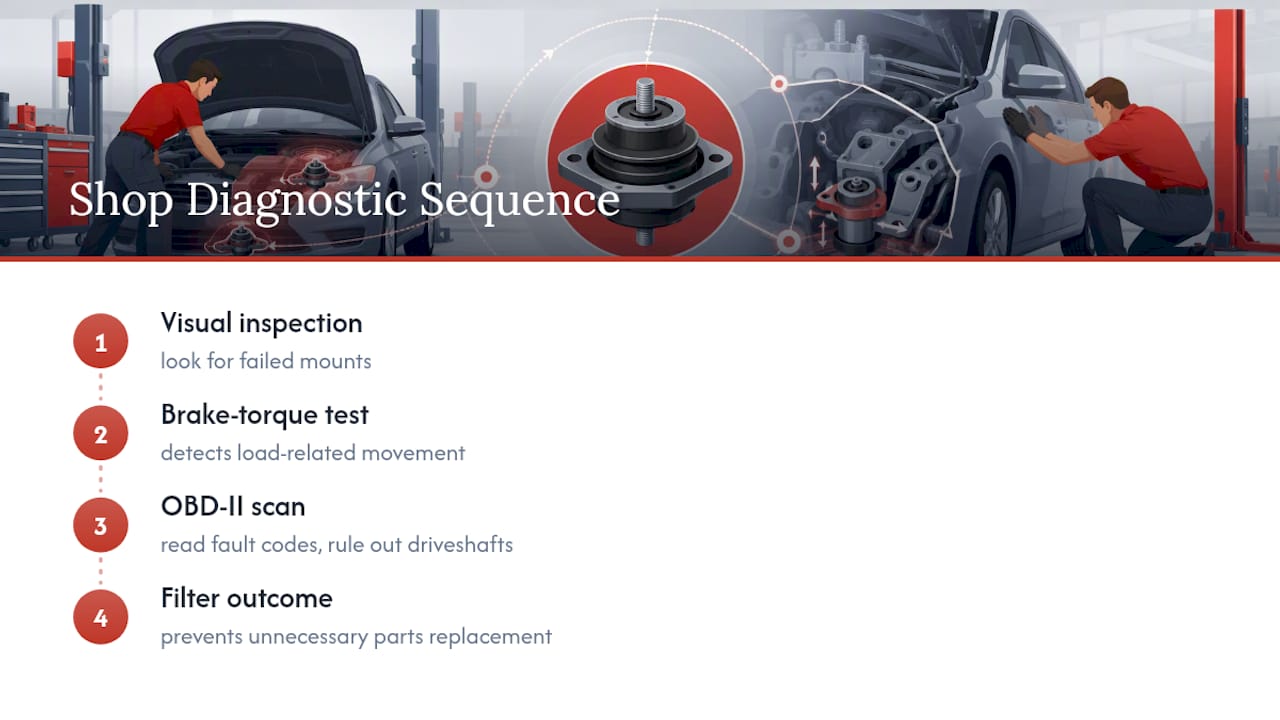
Owners frequently bring in cars they think have a transmission problem or a suspension issue, when the real cause is a mount that has quietly failed. Combining a visual inspection with a brake torque test and an OBD-II scan filters out the wrong diagnosis before any parts get replaced, which saves the owner from paying for work that would not have fixed anything.
At a shop built around ASE-certified diagnostics and a same-day inspection slot, that combination is standard procedure, not a special request. A 24-month or 24,000-mile warranty on the repair also means the fix is expected to hold, not just patch the symptom.
— Shingi
Get Your Mounts Checked at Tom’s B & M Auto
Get expert diagnosis with a technician confirming the issue using a lift and OBD-II scan tools, backed by decades of experience seeing how mounts fail on various engines.
If your car is vibrating at idle or clunking on shifts, DIY inspection is a fine first step. But once you are chasing a noise that will not pin down, or you are staring at oily residue on a hydraulic mount, professional diagnosis saves you from guessing. Professional shops often run ASE-certified diagnostics, use quality parts, and back repairs with warranties, with same-day appointments often available for these issues.
Start with a free digital vehicle inspection to get a straight answer on which mount, or mounts, actually need attention before anything else gets damaged.
Sources
- Carparts
- Engineerskill
- Signs you need to replace your motor mount – AutoZone
- What are engine mounts? – J.D. Power
FAQ
Can I still drive with bad engine mounts?
Short, cautious trips are often possible, but it is not something to rely on. A severely failed mount can let the engine shift enough to damage hoses, wiring, or the exhaust, and continued driving usually accelerates that damage.
How expensive is it to fix an engine mount?
Parts and labor together commonly range from a few hundred dollars for a single mount to over a thousand for multiple mounts, depending on the vehicle, mount type, and local labor rates. Repair shops typically provide an exact quote after diagnostic inspection since pricing varies by vehicle and mount count.
Is it worth fixing engine mounts?
Yes. A failed mount left unaddressed tends to damage hoses, exhaust components, and CV joints over time, which turns one straightforward repair into several more expensive ones.
How long do engine mounts usually last?
Most mounts hold up for roughly 5 to 7 years, though heat, oil contamination, and driving style can shorten that considerably.
Recommended
- Check Engine Sign in Car: What to Do Right Now
- Fix Engine Misfires Step by Step: A Car Owner’s Guide
- P0420 Code Fix: 5 Minute O2 Waveform Test That Can Save You Hundreds
- Engine Compression Test: What Car Owners Need to Know
Leave a Reply