
Mode 6 Data Explained: What Your Car’s Self-Tests Reveal
Mode 6 is the part of OBD-II that shows the raw results of your car’s own self-tests: the measured value, the pass/fail limits and the verdict for each monitored system. It can reveal a weakening component, such as a misfiring cylinder, before a trouble code is stored and the check engine light comes on. It is also the layer a professional-grade scan tool and a trained technician put to work, which is why a shop can often answer “what is wrong?” when a basic code reader only says “something is pending.” At Tom’s B & M Auto in Lynnwood, our ASE-certified technicians use professional-grade OBD-II diagnostics for exactly this kind of reading.
TL;DR
- Mode 6 (also written Mode $06) shows test results for the systems your engine computer monitors: catalyst, oxygen sensors, EVAP, EGR, misfire and more.
- Each line carries a test value, a minimum and/or maximum limit and a pass or fail result. Outside the limits, the computer starts the process that ends in a trouble code.
- Misfire counts per cylinder are the most practical use: they can point to the failing cylinder while no code exists.
- Mode 6 needs a professional-grade scan tool and the right translation for your make, model and year. Raw hex numbers mean little on their own.
- Bring a hard-to-pin-down drivability problem to a shop that reads Mode 6 as part of the diagnosis, and ask for the numbers behind the verdict.
Table of Contents
- What Mode 6 actually is
- How a Mode 6 line is built
- How pass and fail turns into a check engine light
- Misfire data: the most practical use
- Catalyst and oxygen sensor data
- Scan tool vs. code reader: who can see Mode 6
- Why your Mode 6 screen may say “not supported”
- What a good Mode 6 diagnosis looks like
- Promo: bring the numbers to a shop that reads them
- FAQ
- Sources
What Mode 6 actually is
Your engine computer constantly runs self-checks, called monitors. Some run continuously, like misfire detection. Others run only when conditions allow, like the catalyst, EVAP (fuel vapor) and heated oxygen sensor monitors. The SAE definition, quoted by MOTOR magazine, says Mode $06 gives access to the results of those tests, with each manufacturer assigning its own test identifiers and the latest values kept across ignition-off cycles until replaced.
Trade writer Larry Carley calls it the “missing mode” because most technicians skip it: the raw data is hexadecimal and meaningless without translation. He also describes it as the pending-code layer, the place where you see what may eventually set a code and turn on the check engine light.
That is the key idea for a vehicle owner. A trouble code is the verdict. Mode 6 is the evidence behind it, and sometimes the evidence arrives long before the verdict. If you want to see how Mode 6 data fits among the other OBD data and files stored in a vehicle’s electronics, this explainer on OBD file formats and ECU data is a good companion.
How a Mode 6 line is built
A typical Mode 6 screen shows a few columns. Vehicle Service Pros breaks them down this way:
| Field | What it tells you |
|---|---|
| Monitor ID (MID) | Which system is being tested |
| Test ID (TID) | Which specific test within that system |
| Test value | The actual measured result |
| Min limit | The lowest result that will not set a code |
| Max limit | The highest result that will not set a code |
| Units | The unit of measure, once translated |
A result below the minimum or above the maximum counts as a failure of that test. Carley’s Underhood Service article gives a worked example: TID $07 is the oxygen sensor monitor and CID $90 is the maximum heater current of the bank 1 oxygen sensor, in amps. It passes because the current sits within the manufacturer’s specification.
Older and newer naming
On older, pre-CAN vehicles the columns are TID and CID (component ID). On newer CAN-bus vehicles the terms shift: Carley explains that TIDs became MIDs and CIDs became TIDs, with the protocol spelled out in SAE HS3000. Don’t let the renaming throw you. The logic is the same: what was tested, what was measured, what the limits were.
Why the numbers look odd
Raw values often need scaling before they mean anything. MOTOR’s advanced Mode $06 article shows a catalyst test where the raw value of 255, multiplied by 0.0039, gives 0.994 against a maximum limit of 0.499 (128 × 0.0039). The computer judged that bank 1 catalyst as failed. The same article shows the repair check: after the catalyst was replaced and the monitor re-run, the value dropped from about 150 (over the 128 limit) to about 12.
Why the same ID means different things
Before CAN, the same test ID could mean different things by brand. MOTOR notes that Toyota’s TID $01 was the catalyst monitor while Ford’s TID $01 was the oxygen sensor monitor. The SAE HS3000 standard recommends MID $21 through $24 for catalyst data on CAN vehicles to bring uniformity. Even so, the data varies by make, model and year, which is why a technician works from the right definitions for your specific vehicle.
How pass and fail turns into a check engine light
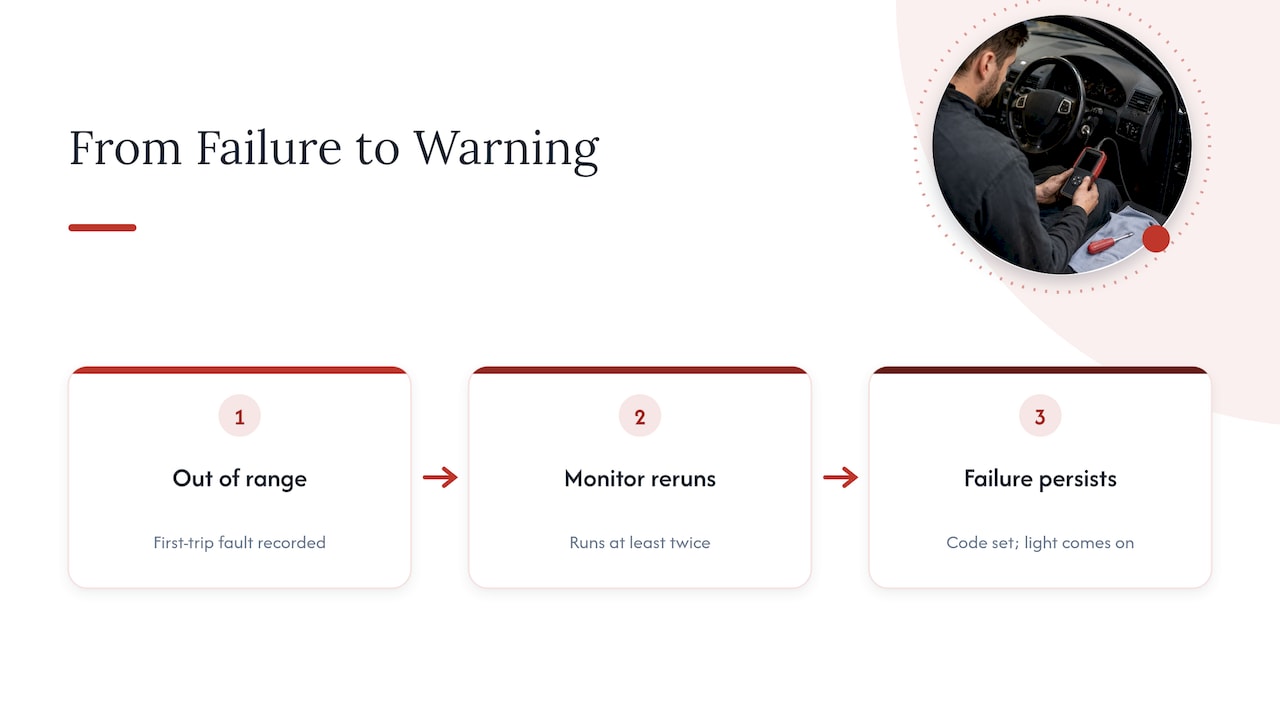
A single FAIL line does not light the dash right away. According to Carley’s Underhood Service piece, when a value is out of range the system flags it and keeps watching until the monitor has run at least twice. If the problem persists, a trouble code is set and the check engine light comes on. If every line reads PASS, the monitored components are within specification.
MOTOR’s catalyst example follows the same pattern: a first-trip fault is recorded when the limit is exceeded, and the light comes on after two failed trips. Monitors also only run under enabling conditions. For that P0420 catalyst test, MOTOR lists things like battery voltage above 11 V, coolant above 167°F, a steady 31 to 50 mph and no conflicting codes. That is one reason a problem can sit unseen for weeks: the test simply hasn’t had the right drive to run.
If you are unsure how pending and stored codes differ, our guide on pending vs stored codes walks through it.
Misfire data: the most practical use
Misfires are where Mode 6 pays off for drivers, because misfire problems are often intermittent, felt under load and gone by the time you reach a shop.
AA1Car explains that OBD-II adds one to a running count each time a cylinder misfires, and typically sets a code only when the rate passes roughly two percent. Below that, you may feel a stumble without any code. In Mode 6 you can see the counts per cylinder. Zero or near zero is healthy, and a few occasional misfires are usually acceptable, but several hundred to a thousand on one cylinder points to an ignition, fuel or compression problem in that cylinder.
A real example from a Ford F-150
MOTOR’s Ford misfire article shows an F-150 with TID $51 and CID $03 reading an actual value of 1177 against a maximum limit of 1638. Cylinder 3 was misfiring, but not enough to exceed the limit, so no code was stored. Once the value passes the limit, P0303 is stored and the light comes on. The same article lists Ford’s misfire test IDs: $51 on early models, $53 on later non-CAN systems, and $0B and $0C on CAN systems, while $50 covers misfires not tied to one cylinder, usually ending in P0300.
Two kinds of misfire monitor
Fender Bender explains that the misfire monitor is twofold. Type A looks at a 200-revolution window for misfires severe enough to damage the catalytic converter. Type B looks at a 1,000-revolution window for emissions-related misfires, generally 1 to 3 percent. The same article shows a sample line where a raw value of 420, multiplied by 0.0015, equals 0.6%, comfortably under the roughly 31.4% maximum at idle.

AVI OnDemand’s training piece makes the same point in a different way: it can take up to 35% misfires on a cylinder to set a code, yet a cylinder misfiring around 4% can already be enough to cause a driver complaint. That gap is where Mode 6 lives.
From data to a confirmed fix
Phil Fournier’s Practical Uses of Mode $06 shows the sequence. On a 1999 Mercury Marquis with a load-related misfire and no code, the counts identified the cylinder. The technician checked the plug boot and spark plug for arcing, swapped the coil with another cylinder’s coil, cleared codes (which also clears the misfire monitor data) and road-tested again to see whether the fault followed the coil. Data first, then a targeted test, then confirmation.
That is the approach we take to misfires too. Our guides on fixing engine misfires step by step, diagnosing P0300 and what an engine misfire repair costs cover what follows once the failing cylinder is known.
Catalyst and oxygen sensor data
The other common use is separating a failing catalytic converter from a failing oxygen sensor. A P0420 code on its own does not say which part is at fault. Mode 6 shows how close each test sat to its limit, and the oxygen sensor tests show whether the sensors respond the way they should. If you are weighing a P0420, see our P0420 waveform test guide, our notes on converter failure symptoms and our O2 sensor symptoms guide.
Mode 6 also helps after the repair. AA1Car points out that its greatest value may be repair verification: you can confirm a fix worked without waiting days of driving for the self-tests to complete on their own.
Scan tool vs. code reader: who can see Mode 6
This is where most owners get stuck. Carley’s tier breakdown, summarized by AA1Car, runs like this:
| Tool type | What it typically does |
|---|---|
| Basic code reader | Shows and clears trouble codes, sometimes monitor status. No live data or two-way communication. |
| Entry-level scan tool | Adds live data stream and readiness status. |
| Professional-grade scan tool | Everything above plus the full list of modes, usually including Mode 6. |
AA1Car adds that Mode 6 can only be reached with a professional-grade tool and software that converts hexadecimal into ordinary numbers. Vehicle Service Pros makes a related point: on many tools the test IDs are not translated into plain English and each test must be entered one at a time, which is so slow that many technicians skip Mode 6 altogether.
For you, the practical meaning is simple. A code tells you which monitor failed. The professional diagnostic tells you how far the system was from passing, which cylinder or sensor is involved and whether a repair worked. That difference is the reason a code alone should not be treated as a parts list. Our overview of the types of car diagnostic tests shows where each level fits.
Why your Mode 6 screen may say “not supported”
If a tool reports an error or “not supported,” there are a few ordinary reasons. Mode 6 support and definitions vary by make, model and year. Pre-CAN vehicles use manufacturer-specific IDs, so the tool needs the right translation. A tool that only displays raw hex will show numbers you cannot interpret. And the monitor you want may simply not have run yet, because its enabling conditions, like those catalyst conditions above, were never met on your recent drives.
None of that means your car has a problem. It means the data has to be pulled with the right equipment and read against the right definitions.
What a good Mode 6 diagnosis looks like
When you bring in a drivability complaint, expect this kind of process:
- Scan for stored and pending codes. This sets the starting point.
- Check monitor status. Which tests have run and which haven’t tells you how much to trust a clean result.
- Read Mode 6 for the suspect system. Compare each measured value to its limits, and note anything close to failing even if it passes.
- Test the physical component. A coil swap, a waveform or a compression check confirms what the numbers suggest.
- Repair, then re-run the monitor. Confirm the value is back well inside its limits.
The value is in step 5. Without it, you are guessing the repair worked.
Promo: bring the numbers to a shop that reads them
If your car stumbles, hesitates or has a check engine light, our Lynnwood shop can run professional-grade OBD-II diagnostics on all makes, including European and hybrid vehicles. Our technicians are ASE-certified, pricing is upfront, and same-day appointments are often available.
We offer a free check engine light review to start. If the diagnosis leads to a repair, the work is backed by our 24-month / 24,000-mile warranty. You can see the rest of our services, including engine repair, tune-ups and the 30k/60k/90k service, on our main site.
Perspective: why we read the numbers, not just the code
A trouble code is a conclusion the car reached after the evidence piled up. We would rather look at the evidence. When a customer comes in with a car that shudders under load and no light on the dash, the answer is often sitting in the self-test data, and the first job is reading it properly for that make, model and year.
That is why we put professional-grade OBD-II diagnostics at the front of the visit and why our technicians are ASE-certified. We work on Toyota, Honda, Subaru, domestic, European and hybrid vehicles, and each reports its data a little differently. A repair based on the numbers, with a re-check afterward, is a repair you can trust, and we stand behind it with a 24-month / 24,000-mile warranty on all work.
Shingi
FAQ
What is Mode 6 on an OBD2 scanner?
Mode 6 is the OBD-II service that displays the results of the vehicle’s onboard monitor tests, including measured values, limits and pass/fail status. It covers continuously monitored systems like misfire and non-continuous ones like the catalyst. The data varies by make, model and year and usually needs translation to be readable.
Can Mode 6 show a misfire before the check engine light comes on?
Yes. Mode 6 can list misfire counts per cylinder, so a cylinder that is misfiring below the code-setting threshold still shows up. In MOTOR’s F-150 example, cylinder 3 read 1177 against a limit of 1638, so there was no code yet but the problem was visible.
Can a basic code reader show Mode 6 data?
Typically not. Basic code readers display and clear codes, and sometimes monitor status. Mode 6 generally needs a professional-grade scan tool with software that converts the hex data into readable values. A shop with that equipment can pull it for you.
Does a passing Mode 6 result mean my car is fine?
It means the tests that have run were within their limits. If a monitor has not completed, there is no result to judge yet. Marginal values, close to a limit, can also be worth watching. A technician reads this against your symptoms.
Does clearing codes erase Mode 6 data?
It can. Fournier notes that clearing codes removes the Mode 6 misfire monitor data. That is why the readings should be captured before anyone clears codes, and why a shop checks first and clears after the repair.
Sources
- Advanced Mode $06 Diagnostics, MOTOR
- Special Report: Revisiting OBD II’s Missing Mode, Tomorrow’s Technician
- OBD-II Mode 6: Making it part of your diagnostic arsenal, Vehicle Service Pros
- OBD II Diagnostics: Checking into Mode $06, Underhood Service
- Checking into Mode $06, Underhood Service
- Diagnosing Ford Misfires, MOTOR
- Ford Mode $06 Misfire Tests, Fender Bender
- OBD II Mode $06 Diagnostics, AA1Car
- Practical Uses of Mode $06, Automotive Tech Info
- Mode $06 Part 1, AVI OnDemand
Recommended
- Types of Car Diagnostic Tests: 2026 Owner’s Guide
- Drivers: Pending vs Stored Codes, Mode 07/03/0A Steps, Shop Advice
- O2 Sensor Symptoms: Scan, Live Data, and Wiring Before Replacement
- What’s Causing Your Check Engine Light to Come On?
Leave a Reply