

Transmission Shifts Hard When Cold: Causes and Next Steps
A transmission that shifts hard when cold is usually reacting to thick fluid and low hydraulic pressure, and on some vehicles it is a designed warm-up strategy. It becomes a repair issue when the harsh shifts are severe, get worse over weeks, or keep happening after the car has warmed up. The way to tell the two apart is to reproduce the complaint, read the transmission data and check the maker’s bulletins for your exact vehicle. That is the diagnostic routine we run at Tom’s B & M Auto in Lynnwood, and it is why a short inspection beats guessing at fluid or parts.
TL;DR
- Cold fluid is thicker and builds pressure more slowly, so firm or delayed shifts for the first few minutes can be normal on some vehicles.
- Some makers program a deliberate warm-up shift schedule, but harsh shifts that persist after warm-up, or that arrive with slipping, flaring or warning lights, need inspection.
- Causes range from old or wrong fluid and low level to solenoid, valve body, filter and clutch problems, and some are model-specific and documented in service bulletins.
- A hard shift does not always store a trouble code, so the complaint has to be reproduced and the live transmission data read.
- If your car shifts hard when cold in the Lynnwood area, we can diagnose it with an ASE-certified technician and professional-grade OBD-II scan tools.
Table of Contents
- Why cold makes a transmission shift harder
- When hard shifting while cold is normal
- What can cause a transmission to shift hard when cold
- Model-specific problems and service bulletins
- How a shop diagnoses a cold hard shift
- Hard shift or slipping? How to tell
- What to do about it this week
- Transmission diagnosis and service in Lynnwood
- Our perspective
- FAQ
- Sources
Why cold makes a transmission shift harder
An automatic transmission shifts by using fluid pressure to apply clutches. The valve body routes that pressure, solenoids open and close the passages, and the control module decides when. The fluid also has frictional properties that shape how smoothly a clutch grabs. Transmission fluid supplies the hydraulic pressure that applies the clutches, and its friction characteristics affect shift quality.
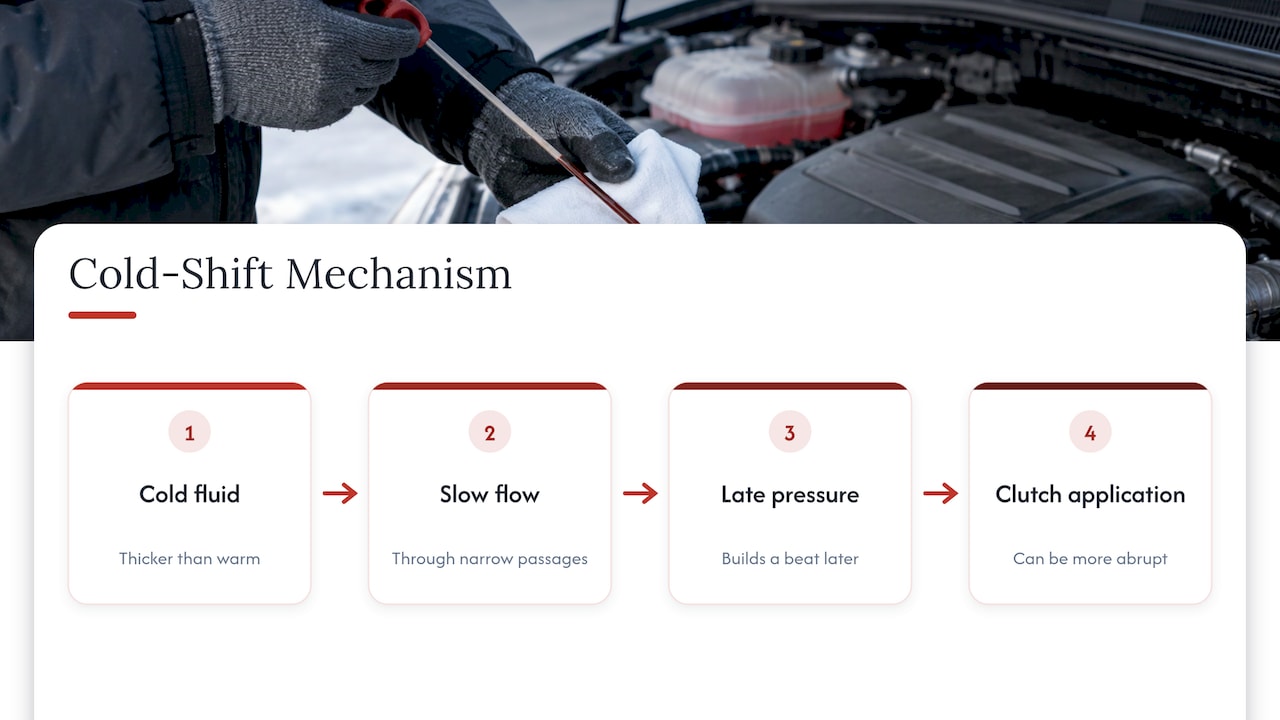
When the fluid is cold, it is thicker. It moves more slowly through narrow passages, pressure builds a beat later, and a clutch can apply more abruptly than it does at operating temperature. You feel that as a bump, a jolt or a delayed engagement into Drive or Reverse, then a smoother shift once the fluid warms.
Worn or aged fluid makes this more noticeable. Fluid that has lost its friction properties can cause hard, jerky or inconsistent shifts, and the effect is typically worst at the start of a drive. If your car has gone a long time between services, our guide to transmission fluid change intervals explains how to read the schedule for your type of transmission.
The pattern matters
The symptom is not one thing. Pay attention to these details, because they point toward different causes:
- Which shift? A harsh 2nd to 3rd shift only, a hard engagement into Drive, or every shift feeling firm each suggest something different.
- How long does it last? Two minutes of firmness is a different story from twenty.
- Does it get better when warm? Cold-only symptoms point toward fluid, pressure and control issues. Symptoms that persist when warm point toward wear or a fault.
- Any lights or codes? A check engine light adds data. No light does not mean nothing is wrong.
- Any slipping? Engine revs rising without the car accelerating is a separate and more serious symptom, covered below.
When hard shifting while cold is normal
Some transmissions are built to shift differently when cold. A General Motors service diagnostic document for a covered vehicle says that on cold days around 32°F (0°C) or colder a designed warm-up shift schedule may apply. The transmission delays or holds upshifts longer until the engine reaches normal operating temperature, and the document identifies this as normal for that vehicle. The reason is to bring the engine and catalytic converter up to temperature quickly.
A second example comes from a 2014 GM bulletin on the Chevrolet Spark with a CVT (continuously variable transmission, which uses a belt and pulleys instead of fixed gears). On that vehicle, the 2nd-gear-ratio upshift is held back while the fluid is below −4°F (−20°C), and GM describes this as designed behavior that helps emissions and cabin heater performance. The bulletin says not to repair the car if the upshift happens once the fluid is above that threshold.
The practical rule: a firm, higher-revving or delayed shift pattern on a very cold morning that smooths out within a few minutes may be by design. Pacific Northwest mornings around Lynnwood rarely get that cold, so a transmission that shifts hard at 40°F deserves more attention than the same behavior at 10°F in a colder climate.
Signs it is not normal
Get the car inspected promptly if you notice any of the following:
- Harsh shifts that continue after the engine and transmission are fully warm.
- Shifts that are getting worse month to month.
- Engine revs flaring between gears, or a gear that will not hold.
- A shudder, whine or clunk with the shift.
- A check engine light, transmission warning light or limp mode (the car refusing to leave one gear).
- Fluid on the ground, or a burnt smell.
If you see slipping or limp mode, avoid hard driving and have a shop look at it quickly. Continuing to drive a slipping transmission can turn a small repair into a large one.
What can cause a transmission to shift hard when cold
The same GM diagnostic document lists the usual suspects a technician works through for shift complaints: fluid level and condition, leaks or aeration, restricted filters or poor filter sealing, solenoid and line-pressure faults, inadequate adaptive activity, sticking or worn valves, pump faults and leaking seals. In plain terms:
| Cause | What it does | Typical clue |
|---|---|---|
| Low, old or wrong fluid | Poor friction properties and pressure; harsh or inconsistent shifts | Dark or burnt fluid, long gap since service |
| Leaks | Low level lets pressure drop or air enter the fluid | Spots under the car, level drops |
| Aeration (air in the fluid) | Foamy fluid cannot hold steady pressure | Erratic shifts, often with low level |
| Restricted or poorly sealed filter | Starves the pump or leaks pressure | Worse at start-up, debris in the pan |
| Solenoid faults | Control passages open late or stick | Specific gears affected, sometimes codes |
| Sticking or worn valves | Valve body routes pressure poorly | Cold-sensitive harshness that comes and goes |
| Pump or seal wear | Low line pressure | Delayed engagement, slipping |
| Adaptive learning out of range | Control module cannot correct shift feel | Firm shifts after a battery or software reset |
On that last point, a 2026 Ford bulletin cautions that adaptive shift relearning after a reset can produce firmer-than-normal shifts for several days. If your battery was disconnected or the transmission recently had a reset, give the car time before assuming a defect.
If you want to understand the part that does the opening and closing, our explanation of the role of the transmission solenoid walks through how the control side of the system works.
Model-specific problems and service bulletins
Sometimes the cold harshness is a known pattern on a specific vehicle, and the fix is not a fluid change. Two federal records show how specific these can be.
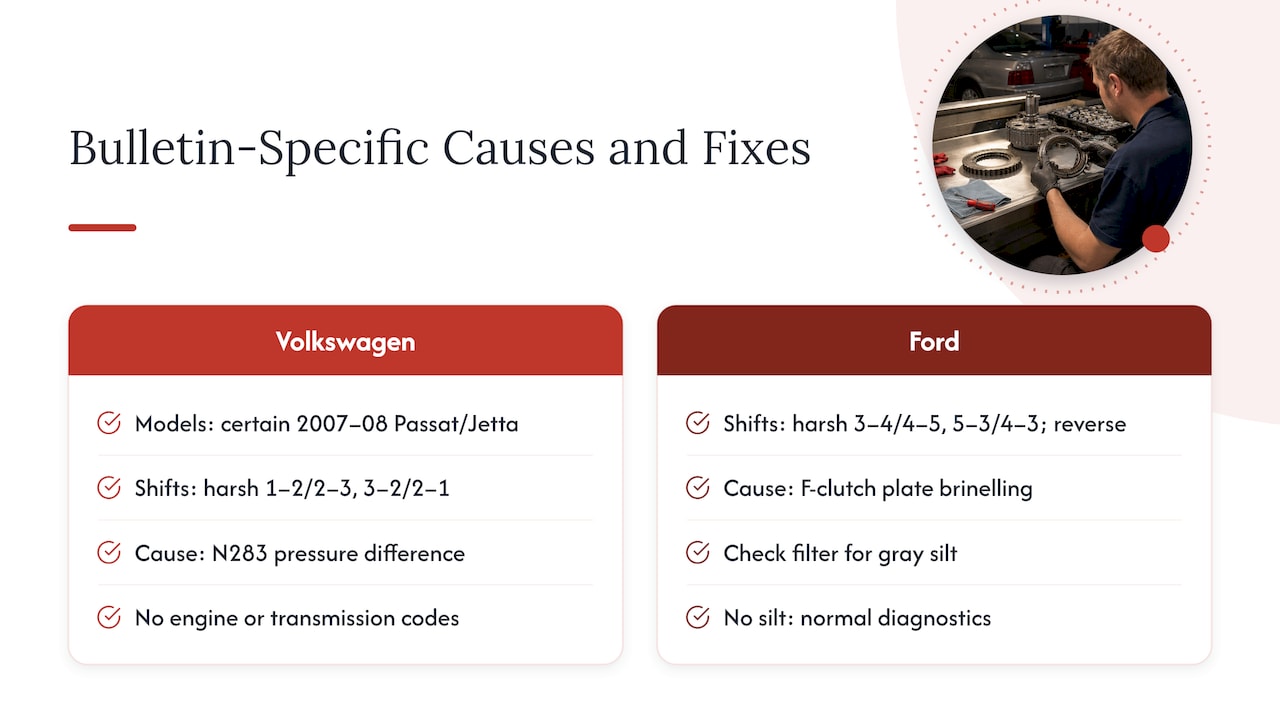
A 2013 Volkswagen bulletin covers certain 2007 to 2008 Passat and Jetta models with harsh 1-2 and 2-3 upshifts or 3-2 and 2-1 downshifts, most noticeable below 140°F (60°C). It states that no engine or transmission control module trouble codes are stored for this complaint. Volkswagen attributes it to an internal pressure difference at solenoid valve N283 and prescribes a software update and, depending on the software level, an updated valve body.
That detail matters: the car showed no codes, yet there was a documented, fixable cause. A shop that only reads codes would have found nothing.
A 2026 Ford bulletin covers harsh 3-4 and 4-5 upshifts, 5-3 and 4-3 downshifts or harsh reverse engagement that may be worse when cold and can be caused by friction plates in the F clutch brinelling into the clutch cylinder. (Brinelling means the plates have pressed dents into the metal they sit against.) The repair is conditional: the bulletin calls for inspecting the transmission filter for gray silt, and if it is absent, normal diagnostics apply. It also notes that vehicles built on or after August 16, 2022 have an upgraded clutch cylinder and do not need the bulletin’s replacement.
The lesson is that the same symptom can be a software calibration, a valve body, a clutch part or simply tired fluid. Replacing fluid on a transmission with a mechanical clutch problem will not fix it, and rebuilding a transmission that needed a software update wastes thousands of dollars. Matching the repair to the evidence is the whole job.
How a shop diagnoses a cold hard shift
This is the routine we follow, and what each step is looking for.
- Reproduce the complaint under your conditions. A useful first step is to recreate the symptom the way the customer describes it and record it with a scan tool. That is why we ask you to tell us when it happens: first start of the day, after sitting overnight, only in the rain. If you can leave the car overnight or drop it off cold, the technician can see it for themselves.
- Check codes and live data. Our professional-grade OBD-II diagnostics let us look at stored and pending codes and at transmission data such as fluid temperature, commanded versus actual gear and solenoid activity. Remember that the VW example stored no codes, so data matters as much as codes.
- Verify fluid level and condition. GM’s procedure directs technicians to verify ATF level and condition and inspect for leaks when diagnosing shift complaints. Color, smell, debris and foaming all tell a story. We use the fluid specification for your vehicle, because the wrong fluid can cause its own shift problems.
- Look up bulletins for your vehicle. Manufacturers publish technical service bulletins for known patterns. A bulletin can turn a mystery into a defined test.
- Inspect for the cause the data points to. That may mean a leak check, filter and pan inspection, a software update or a valve-body evaluation. Our digital inspections document what we find so you can see it.
- Quote the repair up front. You get upfront pricing before work starts, and the work carries our 24-month/24,000-mile warranty.
Hard shift or slipping? How to tell
Owners often use “hard shifting” for several different symptoms. The distinction affects urgency.
| Symptom | What you feel | What it usually suggests |
|---|---|---|
| Hard shift | A bump or jolt as the gear changes, then it smooths out | Cold fluid, pressure control, solenoid or calibration |
| Delayed engagement | A pause of a second or more after shifting into Drive or Reverse, then a clunk | Low pressure, fluid level, internal wear |
| Slipping | Revs rise but the car does not accelerate in step | Worn clutches or low pressure; more serious |
| Shudder | A vibration at steady speed, often under light throttle | Torque converter clutch or fluid condition |
Our guide on why a transmission slips covers the slipping signs in detail. If you notice a pause when shifting into gear, the 3-second tests for delayed engagement help you describe it accurately. A shudder is a different complaint with its own data signature, covered in our transmission shudder article.
Being precise helps. “It clunks into Drive for the first minute on cold mornings” is far more useful to a technician than “it shifts weird.”
What to do about it this week
If it eases in a few minutes and the car is otherwise healthy. Note the outside temperature, which gears are affected and how long it lasts. Check your service record. If the fluid has not been changed in a long time, or you do not know, that is the first thing to address, using the fluid your manufacturer specifies.
If it persists, worsens or comes with other symptoms. Book a diagnosis rather than waiting. Early inspection often finds a fluid, leak, filter or solenoid issue while it is still a modest repair.
Drive gently while you wait. Let the engine settle for a short time on a cold start, and avoid heavy throttle or towing until the transmission is warm. If the transmission slips or goes into limp mode, have it looked at before driving further.
If the car is older and the transmission has already failed. Some owners at that point compare the repair quote with selling a car with transmission failure. A proper diagnosis first tells you whether the problem is a repair-sized one, so the comparison rests on facts.
Transmission diagnosis and service in Lynnwood
We have been family-owned and operated in Lynnwood since 1985, and our technicians are ASE-certified. We service Toyota, Honda, Subaru, domestic, European and hybrid vehicles, and same-day appointments are often available. If your transmission shifts hard when cold, our transmission service in Lynnwood starts with a diagnosis of the actual symptom, and every repair is covered by our 24-month/24,000-mile warranty. Prices for transmission work are quoted up front once we know what your car needs. You can also see the rest of our services at bandmautocare.com.
Military members, seniors and first responders can ask about our exclusive discounts when booking.
Our perspective
Most hard-shift complaints we hear arrive with a theory attached: “I think it needs a flush” or “I think it needs a rebuild.” The records show why we do not start from a theory. The same cold-morning bump can be designed warm-up behavior, a tired fluid, a software calibration, or a worn clutch part, and each one has a different repair.
What works is the order of operations: reproduce the symptom, read the live data, check the fluid, look up the bulletins for that exact vehicle, then recommend the repair the evidence supports. That is how a customer avoids paying for a fluid service that could not help, or a rebuild that was never needed.
It is also why we put the findings in front of you in a digital inspection, give you upfront pricing and stand behind the work with a 24-month/24,000-mile warranty. A cold hard shift is one of the easiest transmission symptoms to catch early, and the shops that diagnose it properly are the ones that save owners the big bills.
Shingi
FAQ
Is it normal for a transmission to shift hard when it is cold?
Sometimes. Cold fluid is thicker, and some manufacturers program a warm-up shift schedule that delays or holds shifts until the transmission warms. If the harshness fades within a few minutes and the car otherwise drives well, it may be by design. If it persists after warm-up or is getting worse, have it inspected.
Why does my transmission shift hard when cold but fine when warm?
The most common reasons are thick or aged fluid, slow pressure build-up and control components such as solenoids or valves that are sensitive to temperature. On certain models it is a documented condition with a specific fix, such as a software update or valve body. A diagnosis that reads live data and checks bulletins for your vehicle separates these.
Will changing the transmission fluid fix hard shifting when cold?
It can when the cause is old, degraded or wrong fluid. It will not help when the cause is a control, valve or clutch problem. That is why we check fluid condition and the vehicle’s data first, then recommend service or repair based on what we find.
Why does my transmission shift hard after it warms up?
Harsh shifts when warm point away from simple cold-fluid thickness. Possibilities include worn internal parts, a solenoid or pressure fault, or adaptive shift relearning after a battery disconnect or reset, which can feel firm for several days. If it lasts longer than that, book a diagnosis.
Can a hard shift be confused with slipping?
Yes. A hard shift is a jolt at the gear change. Slipping is engine revs rising without matching acceleration. Slipping is more serious and should be checked promptly, and you should avoid hard driving until it has been.
Sources
- Volkswagen service bulletin on cold harsh shifts, NHTSA (2013)
- GM preliminary information bulletin on CVT upshift at low temperature, NHTSA (2014)
- Ford technical service bulletin on harsh shifts, NHTSA (2026)
- GM service diagnostic document 1593288
- Transmission fluid and shift quality overview
- Automatic transmission service and diagnosis lesson
- Selling a car with transmission failure
Recommended
- Why Transmission Slips: Causes, Symptoms, and Fixes
- Drivers: Use 3 Second Tests to Avoid Rebuilds for Delayed Engagement
- The Role of Transmission Solenoid in Automatic Gear Shifting
- 30,000–100,000 Miles: Transmission Fluid Change Interval for Drivers
Leave a Reply