
Honda VTC Actuator Rattle: Causes, Symptoms and Repair
A loud rattle that lasts one to three seconds when you start a cold Honda, then disappears, is the classic sign of a worn VTC actuator. VTC stands for Variable Timing Control, Honda’s system for adjusting camshaft timing. The fix is a specific repair on a specific list of engines, and the diagnosis depends on a cold-soak listening test, not a guess. At Tom’s B & M Auto in Lynnwood, WA, our ASE-certified technicians work on Hondas of all years, and we confirm the noise with a proper cold-start check and a written, upfront price before any engine work begins.
TL;DR
- A short rattle at cold start, usually about two seconds, points to the VTC actuator on many 2.4L four-cylinder Hondas, including the Accord, CR-V and Crosstour.
- Honda’s own diagnostic check is to let the engine sit at least six hours, start it, and listen right away. A different noise means normal troubleshooting, not an assumed actuator.
- The repair is replacing the actuator. For the 2013-15 applications in Honda’s bulletin it carries a 2.0-hour flat-rate operation because the cam chain is not fully removed.
- Honda’s bulletin treats this as a job for skilled technicians with proper tools, not a driveway project.
- Every repair at our shop carries a 24-month / 24,000-mile warranty.
Table of Contents
- What the VTC actuator does and why it rattles
- Symptoms of a failing VTC actuator
- Which Hondas are affected
- How a mechanic confirms it is the actuator
- Is it safe to keep driving?
- How the repair is done
- Oil, maintenance and the noise
- Book the cold-start check in Lynnwood
- FAQ
- Sources
What the VTC actuator does and why it rattles
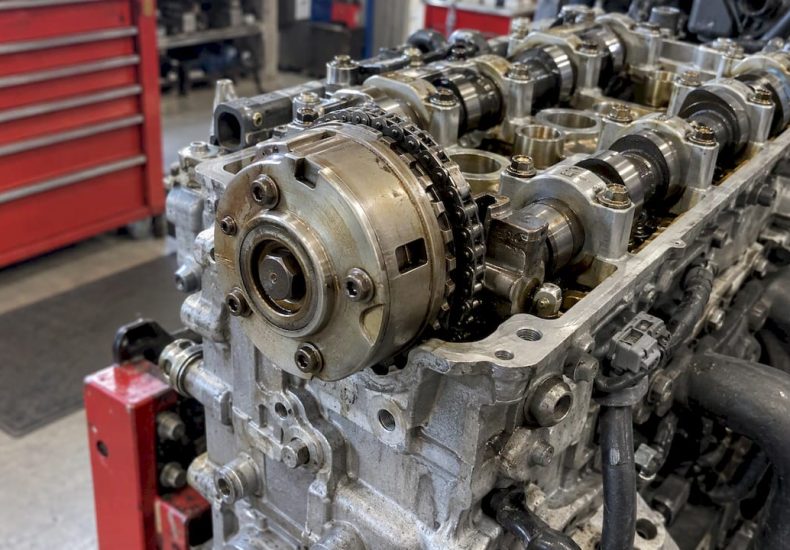
The VTC actuator sits on the end of the intake camshaft. Engine oil pressure moves an internal vane inside a housing, which advances or retards cam timing as you drive. That is how the engine balances power, fuel economy and emissions.
When the engine is off, oil drains out of the actuator. A small internal lock pin is supposed to hold the vane in place until oil pressure builds on the next start. Honda’s own Tech Line article explains the mechanism: a weak lock pin lets the vane move inside the housing at startup, and that movement is the one-to-three-second rattle. Once oil reaches the actuator, the vane is controlled and the noise stops.
That explains the pattern owners describe:
- The noise is worst after the car has sat overnight or longer.
- It is worse in cold weather, when oil is thicker and takes longer to refill the actuator.
- A warm restart after a short stop is usually quiet.
- Once the rattle clears, the engine runs normally.
The reason many owners notice it only in winter is in Honda’s bulletins. A December 2015 Honda article, summarized by an OEM bulletin index, describes a 1-2 second rattle after an overnight cold soak below 32°F. Puget Sound mornings in November through February meet that condition often.
Symptoms of a failing VTC actuator
The symptom list is short and specific, which is what makes the diagnosis tractable.
- A loud rattle or grinding at cold start. Honda’s 2017 service bulletin describes it as a loud rattle lasting about two seconds, sometimes only intermittent when temperatures fall below 40°F.
- It happens after the engine has been off for hours. The same bulletin calls for a rest period of at least six hours so oil drains from the VTC system.
- It is brief. A rattle that continues after warm-up, changes with RPM, or shows up with the engine already hot is a different problem.
- A check engine light may or may not appear. Owners sometimes see a timing-related code, but the noise alone is what the bulletins key on. If the light is on, a scan with a professional-grade OBD-II tool tells us what the engine computer has stored.
If you also have a no-start or slow-crank issue in cold weather, that is usually a battery or starter question, not VTC. Our guide on why a car won’t start in cold weather separates the two.
Which Hondas are affected
The problem is best known on the 2.4L four-cylinder (K24) engine. Honda’s bulletins cover specific applications, and they are VIN-specific, so the model and year alone do not settle it. The documented ones include:
| Vehicle | Source and what it says |
|---|---|
| 2008-09 Accord four-cylinder | Honda’s October 2011 bulletin ties a roughly two-second cold-start rattle to a defective VTC actuator |
| 2008-12 Accord four-cylinder, 2007-12 CR-V | Honda’s 2012 bulletin lists VTC actuator parts for these, with different part numbers by year |
| 2013-14 CR-V, 2013-15 Crosstour | Honda’s 2017 bulletin covers the cold-start rattle and the repair procedure |
A technician guide from Underhood Service likewise names 2008-12 Accord, 2012-13 CR-V and 2012-13 Crosstour as affected applications.
You may have read about the VTC actuator class action. The official case website lists 2012 Accord four-cylinder, 2012-14 CR-V 2.4L and 2012-15 Crosstour vehicles as class vehicles. That is a legal definition tied to California and Illinois purchases and repairs, not a complete technical list of every Honda that can rattle, so use it for background only. If your Honda is outside the table, the same cold-start symptom is still worth a proper inspection.
How a mechanic confirms it is the actuator
This is where a good diagnosis saves money. Several things can rattle on startup: a loose heat shield, a failing timing chain tensioner, a worn accessory pulley or an exhaust problem. Our post on why exhaust systems rattle covers one of those look-alikes.
The procedure follows Honda’s bulletin:
- Cold soak the engine. Leave it off for at least six hours so oil drains from the VTC system. Hot-engine testing proves nothing.
- Start it and listen immediately. The bulletin looks for a loud rattle lasting about two seconds. Import Car’s repair article, written by an ASE technician, describes the same clue.
- Compare the sound to the spec. If the noise differs from the specified two-second startup rattle, Honda’s bulletin says to continue normal troubleshooting. If there is no abnormal noise, gather more information first.
- Check codes and history. A scan of stored codes, plus the oil change history and oil level, rules out lubrication problems that can mimic or worsen the noise.
- Inspect the actuator when the engine is open. Honda’s service manual for the 2012 CR-V says to verify the actuator is locked by turning it counterclockwise, and to replace it if it stays unlocked. The same inspection includes an air test of the advance passage, and the actuator is replaced if it does not move smoothly.
The cold-soak requirement is the practical hurdle for owners. A shop visit at 8 a.m. with a car that sat overnight is the best test. If you can, drive in with the engine off for the night and do not warm it up first. Tell us when you book so we can plan the check around a true cold start. Same-day appointments are often available.
Is it safe to keep driving?
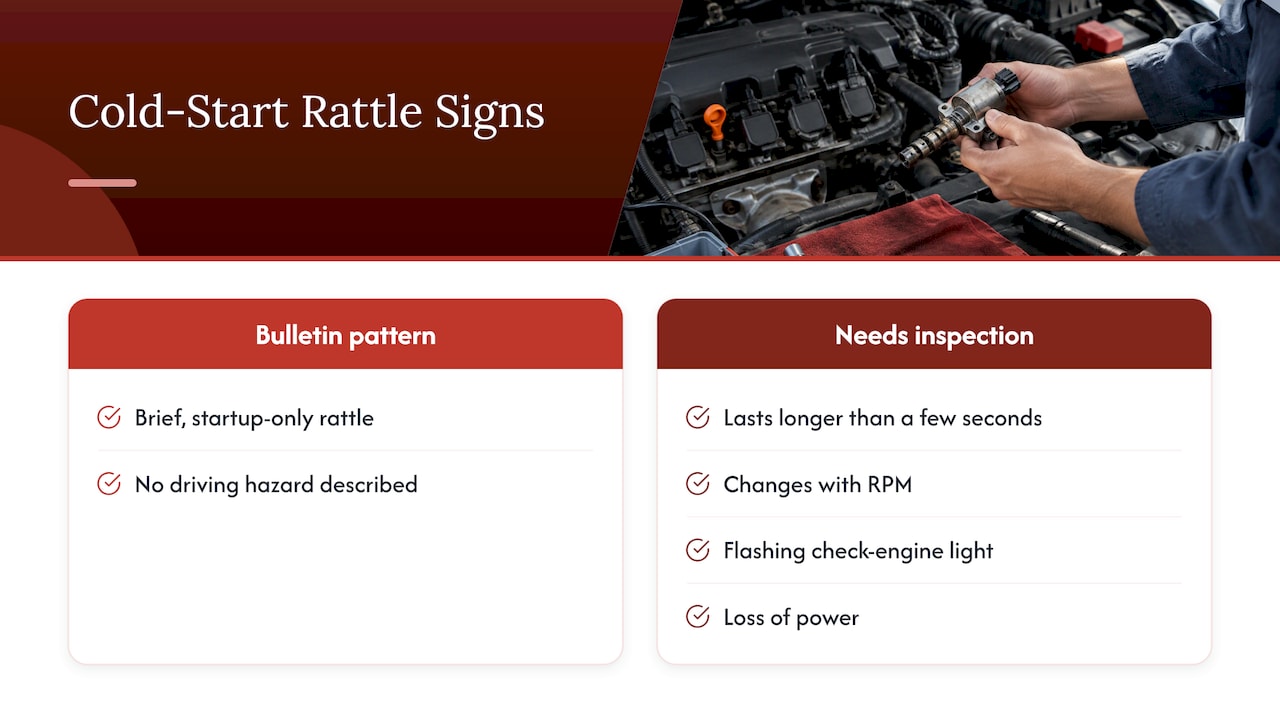
The cold-start rattle in Honda’s bulletins is a brief, startup-only noise. The bulletins describe it as a noise condition and give a repair procedure for it. They do not describe a driving hazard. Still, a noise that lasts longer than a few seconds, that changes with RPM or that comes with a flashing check engine light, a loss of power or an oil pressure warning is not the pattern in the bulletins. Have the car inspected before driving it far.
Planning the repair rather than waiting for the noise to grow is the simple approach. Timing components work together, and a noise you can hear every cold morning is the engine telling you where to look. Our common Honda repair needs guide shows where this fits among the other items Honda owners tend to meet as mileage builds.
How the repair is done
The repair is replacing the VTC actuator. What matters for scheduling and cost is how much of the engine has to come apart.
- Labor. For the 2013-14 CR-V and 2013-15 Crosstour applications, Honda’s bulletin prescribes replacing the actuator without completely removing the cam chain and related parts, and lists a 2.0-hour flat-rate operation. Honda notes the procedure is shorter than the normal repair for that reason. Other years and engines can differ, and we quote from the actual vehicle.
- Parts. Part numbers vary by year and model. Honda’s 2012 bulletin lists 14310-RZA-003 for 2007-09 CR-V, 14310-R40-A01 for 2010-11 CR-V, and 14310-R44-A01 for 2012 CR-V and 2008-12 Accord four-cylinder. A later Honda bulletin records a replacement actuator, 14310-R5A-305, for a repair on which the failed part was the R44-A01. Getting the right one for your VIN is part of the job.
- Sealant. That same bulletin lists Honda Bond HT, part 08718-0004, as a required material, a reminder that this is more than a bolt-on swap.
- Skill level. Honda’s 2011 bulletin says its customer information is for skilled technicians with proper tools, equipment and training, and should not be attempted by do-it-yourselfers. The actuator sits on the cam, and a mistake in timing can damage the engine.
We use OEM-quality parts, and our digital inspections show what the technician found so you can see it before approving the work. You get an upfront price first, and the finished repair is backed by our 24-month / 24,000-mile warranty on all work.
What to do when you book
Give the shop the information that shortens the diagnosis:
- Year, model, engine and, ideally, VIN.
- When the noise happens: first start of the day, only below a certain temperature, or every start.
- How long it lasts, in seconds.
- Whether the check engine light has been on.
- The date of your last oil change and the oil grade used.
If the check engine light is on, that is a separate lead worth running at the same visit. Our Lynnwood shop handles check engine light diagnosis alongside engine repair.
Oil, maintenance and the noise
The actuator runs on oil pressure, so oil condition matters. Fresh oil of the grade specified for your engine keeps the passages clean and the pressure steady, which is the condition Honda’s actuator is designed around. A scheduled oil change is the simplest maintenance item that supports this system, and our oil change starts from $100. If you are near a 30k, 60k or 90k interval, the 30k 60k 90k service is a good time to have the noise checked in the same visit.
For owners curious about timing systems in general, our technician’s guide to engine timing procedures goes deeper into how cam timing is set and verified.
Perspective
We see Honda owners wait on this noise because it goes away in two seconds. That is understandable, but we think the better approach is to treat the sound as information. A rattle that matches Honda’s description, after a true cold soak, tells us where to look. A rattle that does not match tells us to keep looking, and that is why we run the cold-start check before anyone quotes an engine job.
Our approach is built around three things: an ASE-certified technician who knows Honda engines, a digital inspection so you see what we see, and an upfront price before work starts. Because the actuator job sits on the camshaft and timing, we do it with OEM-quality parts and stand behind it with a 24-month / 24,000-mile warranty. That is how a family shop that has served Lynnwood since 1985 earns repeat Honda owners.
Shingi
Book the cold-start check in Lynnwood
If your Honda rattles for a second or two on cold mornings, bring it to Tom’s B & M Auto. We serve Toyota, Honda, Subaru, domestic, European and hybrid owners from Lynnwood, and our engine repair team diagnoses the noise, explains what it found and quotes the repair upfront. We also offer discounts for military, seniors and first responders.

If you are in Edmonds, Shoreline, Kenmore or Mountlake Terrace, we are a short drive away, with engine repair pages for each: Edmonds, Shoreline, Kenmore and Mountlake Terrace.
FAQ
Why does my Honda CR-V rattle when I start it?
On the 2.4L engines in Honda’s bulletins, a one-to-three-second rattle at cold start is usually the VTC actuator. Its lock pin does not hold the internal vane while oil has drained overnight, so the vane moves until oil pressure builds. If the sound lasts longer or happens when the engine is warm, it needs a different diagnosis.
Is VTC rattle bad?
Honda’s bulletins describe it as a brief startup noise and prescribe a repair for it. If the rattle lingers, changes with RPM, or comes with a warning light or power loss, have the engine inspected promptly rather than waiting for the next cold morning.
How long does a VTC actuator replacement take?
For the 2013-14 CR-V and 2013-15 Crosstour applications, Honda’s bulletin lists a 2.0-hour flat-rate operation because the cam chain is not fully removed. Other applications can take longer, so we quote from your specific vehicle. Ask us for the price upfront when you book.
Can I diagnose it myself?
You can note the symptoms: how long the rattle lasts, how cold it was and how long the car sat. Confirming the actuator and replacing it is work Honda directs to skilled technicians with proper tools and training. Bring the notes to us and we will take it from there.
Sources
- Honda Tech Line article on VTC actuator startup rattle (2018)
- Honda service bulletin, engine rattles at cold start-up (2011)
- Honda 2012 service bulletin, VTC actuator parts information
- Honda 2017 service bulletin, cold-start rattle and repair
- Honda service bulletin, replacement actuator part numbers
- Honda bulletin index, December 2015 cold-soak rattle
- VTC actuator class action official website
- Underhood Service, Honda Accord and CR-V rattle at start
- Import Car, Honda variable valve timing noise at start-up
- Honda 2012 CR-V service manual, VTC actuator testing and inspection
Recommended
- Why Exhaust Rattles: Causes, Fixes, and Costs
- Common Honda Repair Needs: Your 2026 Owner’s Guide
- Car Problem Sounds: What Each Noise Means and What to Do
- Timing Chain Rattle: Is It Safe to Drive Right Now?
Leave a Reply