
Burnt Transmission Fluid Smell: What It Means and What to Do
A burnt smell from the transmission means the fluid has overheated and started to break down. Something inside the transmission, or around it, is making more heat than the fluid can carry away. The smell is the early warning. Catching it at this stage often decides whether you pay for a fluid service or for a rebuild.
If you smell it while driving, ease off, pull over somewhere safe and shut the car down. If it has been there a few days, get the car inspected soon. We service transmissions for all makes, including hybrid and European models, at our Lynnwood, WA shop, and our transmission service starts with finding out why the fluid got hot.
TL;DR
- Burnt transmission fluid smells sharp and acrid, a bit like burnt toast or hot tar. Healthy fluid is red or pink and smells faintly sweet.
- The usual causes are low fluid, old fluid that has lost its protection, heavy loads such as towing, and slipping clutches that generate friction heat.
- A red transmission temperature warning means stop. Idle in Park or Neutral until it clears, because boiled-over fluid can reach hot exhaust parts and catch fire.
- Dark fluid with a burnt smell and metal particles points to internal wear. The sooner it is inspected, the more options you have.
- Do not keep driving to see whether it goes away. Heat damage compounds with every mile.
Table of Contents
- What burnt transmission fluid smells like
- What the smell actually means
- What causes transmission fluid to burn
- Overheated transmission symptoms to watch for
- What a high transmission temperature warning means
- What to do when you smell it
- What dark fluid and metal particles tell a technician
- Buying a used car that smells burnt
- Can you drive with burnt transmission fluid?
- How we diagnose it at our shop
- Why a shop visit beats waiting
- Book a transmission check in Lynnwood
- FAQ
- Sources
What burnt transmission fluid smells like
People describe it in different ways: burnt toast, scorched oil, hot tar, or burning rubber. What they share is sharpness. Healthy automatic transmission fluid (ATF) has a mild, slightly sweet petroleum smell that you barely notice. Burnt fluid smells acrid and stays in your nose.
Color tells the same story. New ATF is usually bright red or pink. As it ages and cooks, it turns brown, then dark brown or black, and it loses its see-through quality. A medical-style rule of thumb applies: smell and color together are more reliable than either one alone.
Two things get confused with it:
- Burning oil from the engine. Oil dripping on a hot exhaust smells different, more like a hot skillet, and the fluid on the ground is brown or black. Black fluid on the ground is typically engine oil, while reddish spots point to transmission fluid, as Car and Driver explains. Our guide to engine smells helps you sort the others.
- Burning clutch or brakes. A stuck brake or a slipping manual clutch also smells burnt. If the smell comes mostly after braking on a hill, the brakes are the likelier source.
What the smell actually means
ATF does three jobs at once. It is a hydraulic fluid that moves the clutches and bands inside the transmission. It is a coolant that carries heat out to the cooler. And it is a lubricant and friction medium that lets clutch packs engage smoothly. Heat attacks all three.
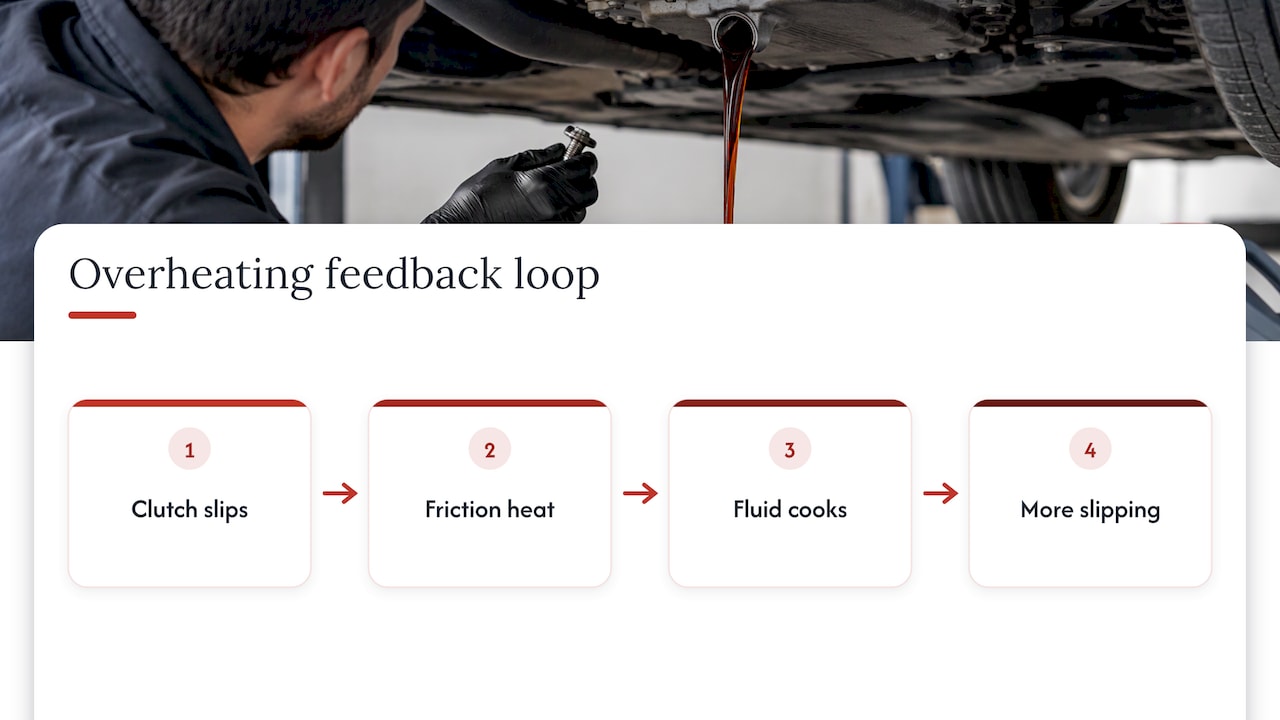
When fluid runs too hot, it oxidizes. It thickens, darkens and stops protecting the parts it touches. That is the smell you notice. In many cases the heat is also the result of something mechanical: a clutch pack that slips generates friction heat, which cooks the fluid, which makes the clutch slip more. It becomes a loop.
There is a second problem. Fluid that has overheated carries worn friction material and varnish through the passages of the valve body, the part that directs fluid pressure to the right clutch at the right moment. Debris there can make valves stick, so a problem that began in one clutch pack can spread. That is why we treat the smell as urgent rather than as a nuisance.
What causes transmission fluid to burn
Most cases come down to a short list.
Low fluid
Low fluid is the most common starting point. A burning smell from the transmission usually means the fluid is overheating, breaking down, or leaking onto hot engine components, and the level is the first thing to check, according to AutoZone’s guide. With less fluid in circulation, the same amount of heat is carried by less liquid, so it climbs quickly. Low fluid usually means a leak: a pan gasket, a cooler line, an axle seal.
Old, overdue fluid
Fluid wears out. Car and Driver notes that dark fluid with a burnt smell usually follows missing the recommended service interval, though a premature mechanical issue is possible. Your owner’s manual gives the interval for your car, and our post on the transmission fluid change interval explains how mileage and driving conditions change it.
Heavy loads and severe use
Towing a trailer, hauling heavy loads, driving up long grades in summer heat and stop-and-go traffic all raise transmission temperature. Manufacturers say so directly: Ram’s owner information says high transmission fluid temperature may occur during strenuous use such as trailer towing. Around Lynnwood, think of the climb on I-5 and the Cascade passes with a loaded vehicle.
Slipping clutches or a failing torque converter
Worn clutch packs, bands or a torque converter clutch that cannot hold lock-up create friction heat. This is the cause where the smell comes with symptoms: slipping, delayed engagement, harsh shifts, or a shudder at steady light throttle. Our posts on why a transmission slips and on transmission shudder and fluid fixes cover those symptoms in more detail.
Cooling problems
The transmission cooler is often built into the radiator or sits beside it. A clogged cooler, a restricted line, or an engine cooling problem sends hot fluid back into the transmission. If the engine also runs hot at idle, read our overheating at idle fan test.
A faulty sensor
A transmission fluid temperature circuit fault, code P0711, can come from low or contaminated fluid, a bad temperature sensor or a defective control module, and KBB lists symptoms such as a warning light, smells, gear slippage and limp mode. Because a code can point at a sensor rather than a real overheat, it takes a proper scan and a fluid check to know which one you have.
Overheated transmission symptoms to watch for
The smell is rarely alone for long. Here is the typical order of progression, from earliest to most serious:
- A burnt smell, often noticed at the dipstick or after a long drive.
- Fluid that looks dark brown or black instead of red.
- Slipping under load: engine revs rise but the car does not accelerate to match.
- Delayed or harsh shifts, or a shudder at light throttle.
- A transmission temperature warning light, or a check engine light with a transmission code.
- Limp mode, where the car sticks in one gear to protect itself.
- Red or brown puddles under the car, which mean fluid is escaping.
A check engine light on its own is not a diagnosis. Our guides to the check engine light and what to do when it comes on explain how codes are read.
What a high transmission temperature warning means
Some cars have a dedicated gauge or warning light. The wording differs, but the message is the same: fluid is too hot right now.
Manufacturer instructions are consistent. Ram’s owner information says to stop and idle in Park or Neutral until the light goes out. It warns that continuing to drive with the light on could make fluid boil over onto hot engine or exhaust parts and cause a fire, and eventually cause severe transmission damage or failure (Ram owner information). A federal safety recall notice for another Chrysler model describes the same hazard: a fire risk that may result in personal injury.
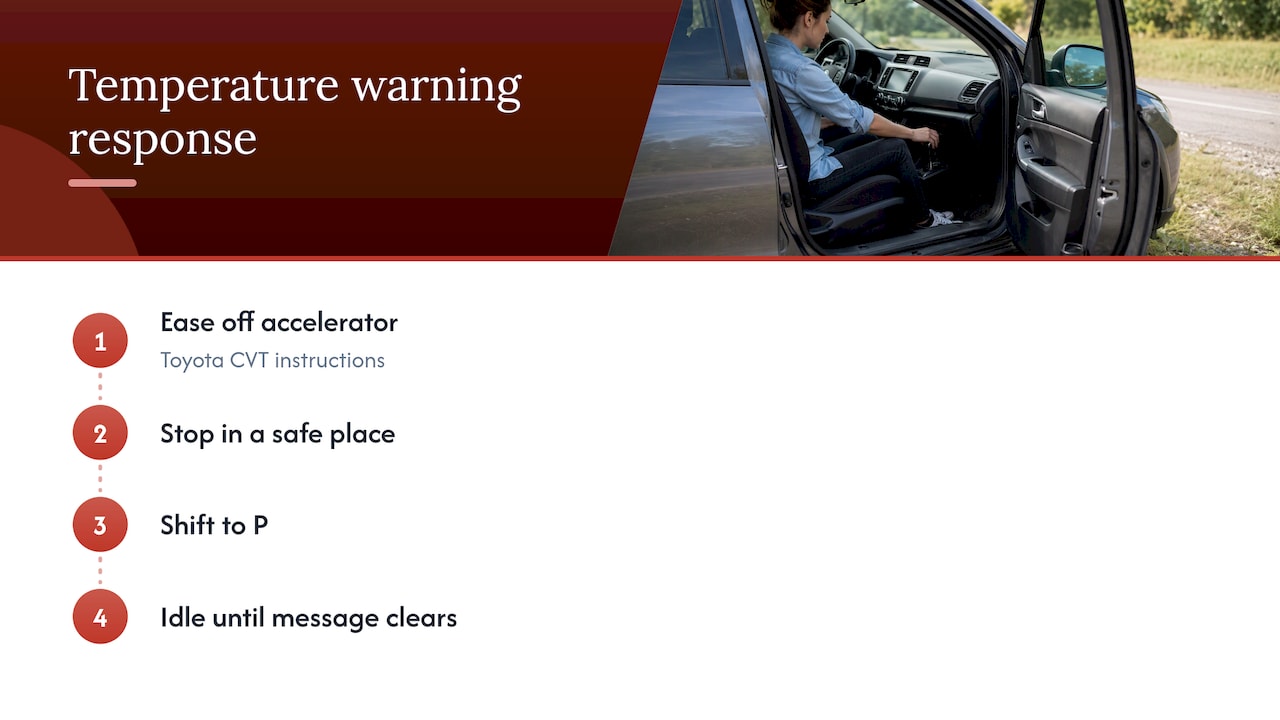
Toyota’s CVT instructions for the Corolla Cross, for example, tell the driver to ease off the accelerator, stop in a safe place, shift to P and let the engine idle until the message clears (Toyota Corolla Cross CVT procedure). Your own owner’s manual has the exact procedure for your car, so keep it in the glovebox.
A warning light that returns after it clears is not fixed. The fluid has been through a heat event, and something is making that heat.
What to do when you smell it
If you smell it while driving
- Ease off the throttle and avoid hard acceleration.
- Pull over in a safe, level spot away from traffic and dry grass.
- If a warning light is on, follow your manual: typically Park or Neutral with the engine idling until it goes out. If there is smoke, shut the engine off and move away from the vehicle.
- Look under the car for red or brown fluid.
- If the smell stays, or the car slips or shifts hard afterward, do not continue. Arrange a tow.
Transmission fluid is flammable, and a GMC service document warns that fluid reaching exhaust parts or the catalytic converter can cause smoke or fire and serious injury. Smoke from under the hood is a reason to stay clear of the car and call emergency services.
If the smell is faint and the car drives normally
Don’t wait for it to get worse. Fluid that smells burnt but shifts normally is the best-case situation: early, and often fixable with service and a repair of whatever is causing the heat. Book an inspection within days, and keep loads and highway hills to a minimum until then.
After a fluid change
A light burnt smell after a recent service can be leftover fluid on the pan or exhaust, and it usually fades over a day or two of driving. If it gets stronger, or a puddle appears, the level may be wrong or a leak may have started. Bring the car back right away.
What dark fluid and metal particles tell a technician
What the fluid carries matters as much as how it smells. Factory service documents give technicians a clear rule. A GMC procedure says fluid that is very dark or black with a burnt odor calls for inspecting for excessive metal particles or debris. Large pieces or metal particles mean flushing the oil cooler and cooler lines and overhauling the transmission, while a small amount of friction material in the pan is normal (GMC service document). A Cadillac manual says that if no internal damage is found, the fix is to change the fluid, repair the oil cooler and flush the cooler lines.
That difference is the reason a diagnosis matters before spending money. Two cars can smell the same and need very different work:
| What the technician finds | What it usually points to | Typical direction |
|---|---|---|
| Dark fluid, burnt smell, no metal, normal shifting | Overdue fluid or a brief heat event | Fluid service, then fix the cause of heat |
| Burnt smell, low level, red drips | A leak let the fluid run low | Repair the leak, restore level, replace fluid |
| Burnt smell plus slipping or shudder | Worn clutches or a torque converter issue | Deeper diagnosis and repair |
| Burnt smell plus metal in the pan or fluid | Internal damage | Cooler flush and overhaul or replacement |
The worst case is not common, but it is the one that gets expensive. Acting early keeps you in the top rows.
Buying a used car that smells burnt
If the smell shows up on a test drive or at the dipstick of a car you are thinking of buying, treat it as a major finding. Walk away or get a thorough inspection before you pay. A mobile pre-purchase car inspection can document the fluid condition, debris and signs of internal damage at the seller’s location. We also do buyer inspections at our shop for used cars before you commit.
Can you drive with burnt transmission fluid?
Short answer: only as far as safety and the car allow, and ideally not at all. Every mile on overheated fluid adds wear to clutch packs, seals and the torque converter, and adds debris to the valve body. If the car still shifts normally, a short, gentle drive straight to a shop is reasonable. If it slips, shudders, smokes, throws a warning light or smells strongly, tow it. A tow costs a fraction of a transmission.
Two things do not help. Pouring in additives will not undo heat damage, and topping off with the wrong fluid type creates a new problem. Use the exact specification in your owner’s manual, because many modern transmissions, especially CVTs and dual-clutch units, are fussy about it. Many modern cars also have no user-serviceable dipstick, so checking the level properly takes a shop visit and the right equipment.
How we diagnose it at our shop
The goal of the visit is to find out why the fluid got hot, not only to replace it. At our Lynnwood shop, ASE-certified technicians work on all makes, including European and hybrid vehicles. We use professional-grade OBD-II diagnostics to read stored codes, and digital inspections so you can see what we see. You get upfront pricing before the work starts, and our repairs carry a 24-month / 24,000-mile warranty.
What that looks like in practice: we check the fluid’s level, color and smell, look for leaks, scan for transmission and temperature codes and test how the car shifts. Then we tell you what we found and what each path costs. Same-day appointments are often available, which matters when the smell showed up this morning.
Why a shop visit beats waiting
The fluid is the cheapest component in the transmission, and the first to show that something is wrong. A fluid service on a transmission that is only slightly overheated is a routine job. After clutches have slipped and debris has spread, the same fluid change can no longer cure the problem. Research on this topic agrees with what we see in the bay: smell and color with normal shifting is the window to act, and once slipping or shudder joins it, fluid alone usually isn’t enough.
Our view
A burnt smell is the transmission asking for help while it still can. Most of the expensive transmission jobs we hear about started as a smell someone decided to live with for a few weeks.
We would rather see the car at the smell stage. At that point the question is simple: is the fluid overdue, is there a leak, is a cooler restricted, or is something slipping? Each has a different fix, and a proper diagnosis with codes, fluid inspection and a road test separates them, so you pay for the repair the car needs and nothing else.
That is why we pair OBD-II diagnostics with a digital inspection, quote the work upfront and stand behind it with a 24-month / 24,000-mile warranty. The earlier the visit, the more of the transmission we can save.
Shingi
Book a transmission check in Lynnwood
If your car smells burnt, shifts oddly or has thrown a temperature warning, we can look at it. Our transmission service covers fluid service, leak repair and diagnosis, and we also handle engine repair if the heat traces back to the cooling side. Military members, seniors and first responders get exclusive discounts. If you are passing through Shoreline, Kenmore, Mountlake Terrace or Mukilteo, we serve those areas as well, such as through our Mukilteo transmission service page.
Ask for a transmission inspection when you call. If you can, note when the smell appears (cold start, after highway driving, under load), whether any lights came on, and the date of the last fluid service. It speeds up the diagnosis.
FAQ
What does it mean when transmission fluid smells burnt?
It means the fluid has overheated and begun to break down, often because of low fluid, overdue service, heavy loads or slipping clutches. The smell is sharper than healthy fluid’s mild sweetness. It is a reason to have the car inspected soon.
Is burnt transmission fluid always a sign of failure?
No. If the smell and dark color come with normal shifting, the problem is often caught early and can be handled with service and a fix for whatever caused the heat. Once slipping, shuddering or metal particles appear, the repair gets larger, which is why waiting costs more.
What should I do if my transmission temperature warning light comes on?
Pull over safely and follow your owner’s manual. Typically that means Park or Neutral with the engine idling until the light goes out. Manufacturers warn that driving on can boil fluid over onto hot parts and cause a fire, so do not continue with the light on.
Can low transmission fluid cause a burnt smell?
Yes, it is one of the most common causes. Less fluid carries the same heat, so it gets hotter and breaks down faster. Finding and repairing the leak matters as much as refilling it.
Does a burnt smell after a fluid change go away?
A faint smell from spilled fluid can fade within a day or two of driving. If it stays, strengthens or comes with drips or shifting problems, have the level and the work checked right away.
Sources
- Car and Driver: How and Why You Should Check Your Transmission Fluid
- AutoZone: Signs of a Bad Transmission
- Ram owner information: Transmission Temperature Warning Light
- NHTSA safety recall notice on transmission fluid temperature warning
- KBB: P0711 transmission fluid temperature sensor circuit
- Toyota Corolla Cross CVT driving procedure
- GMC service document on transmission fluid condition
- iNeedaPPi: What Issues Can a Mobile Car Inspector Uncover?
Recommended
- Engine Smells: What Every Driver Needs to Know
- Why Transmission Slips: Causes, Symptoms, and Fixes
- Gas Smell in Your Car: When to Stop and What Mechanics Test
- The Role of Transmission Fluid in Your Vehicle
Leave a Reply