
Oil in Coolant: Causes, Risks and What to Do Next
Oil in your coolant means engine oil is getting into the cooling system through a failed seal, a leaking oil cooler or a crack in the engine. Stop driving the car, because oil and coolant are incompatible fluids and running the engine this way can cause overheating and serious wear. The safest next step is a proper diagnosis before anything else gets replaced. If you are near Lynnwood, WA, we can run that diagnosis for you.
TL;DR
- Oil in coolant usually points to a failed head gasket, a leaking oil cooler, or a cracked head or block. It does not automatically mean the head gasket.
- Don’t keep driving. Contamination can speed up wear, overheating and engine failure.
- Milky or chocolate-milk residue is a warning sign, but residue under the oil cap alone can be ordinary condensation.
- Shops separate the causes with a cooling system pressure test, a combustion gas (block) test and a compression test.
- After the source is fixed, the whole cooling system has to be cleaned, and hoses checked, or the contamination comes back.
Table of Contents
- What oil in coolant looks like
- Why oil gets into the coolant
- Can you drive with oil in the coolant?
- Is it milk in the oil too? How to read the dipstick and cap
- Head gasket or oil cooler: how a mechanic tells
- What the repair involves
- BMW coolant loss and leaks: not always oil
- Why overheating makes everything worse
- Perspective
- Get it checked in Lynnwood
- What to do while you wait for your appointment
- FAQ
- Sources
What oil in coolant looks like
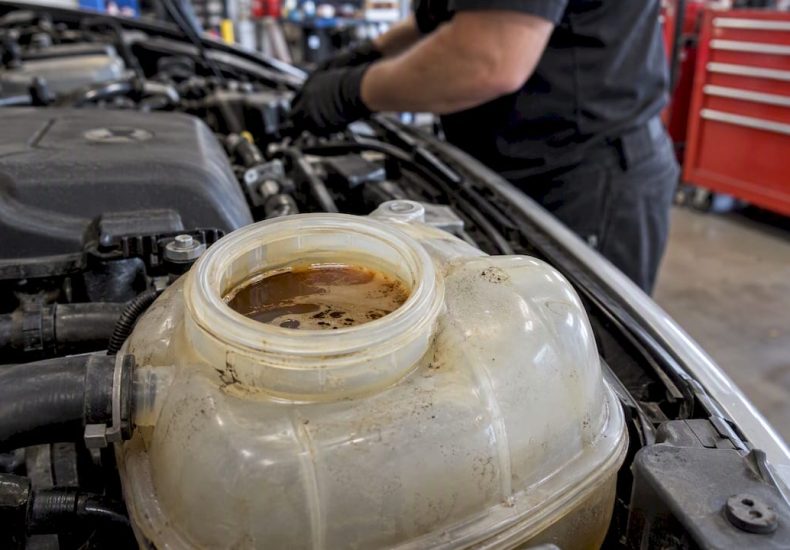
Most people find out in one of three ways. You open the coolant reservoir and see a brown or tan film floating on top. The coolant has turned dark or looks like a thin milkshake. Or the low-coolant warning comes on and you find the level has dropped with no puddle under the car.
The terms readers use for this are “milky coolant” and “chocolate milk coolant.” They describe the same thing: oil and coolant emulsified into a tan, creamy sludge. Industry trade coverage notes that coolant-contaminated oil may look milky or brownish and thick, and that oil entering the cooling system makes the coolant darker.
Other signs that often travel with it:
- Coolant level that keeps dropping with no visible leak
- Temperature gauge climbing, or overheating in traffic
- Milky or foamy oil on the dipstick
- White exhaust smoke with a sweet smell (coolant burning in the cylinders)
- Rough running or a misfire, if the leak is into a cylinder
- Oil floating in the radiator when the cap is off on a cold engine
These are the “oil in radiator symptoms” people search for. Not every car shows all of them, and a car can show only one.
Why oil gets into the coolant
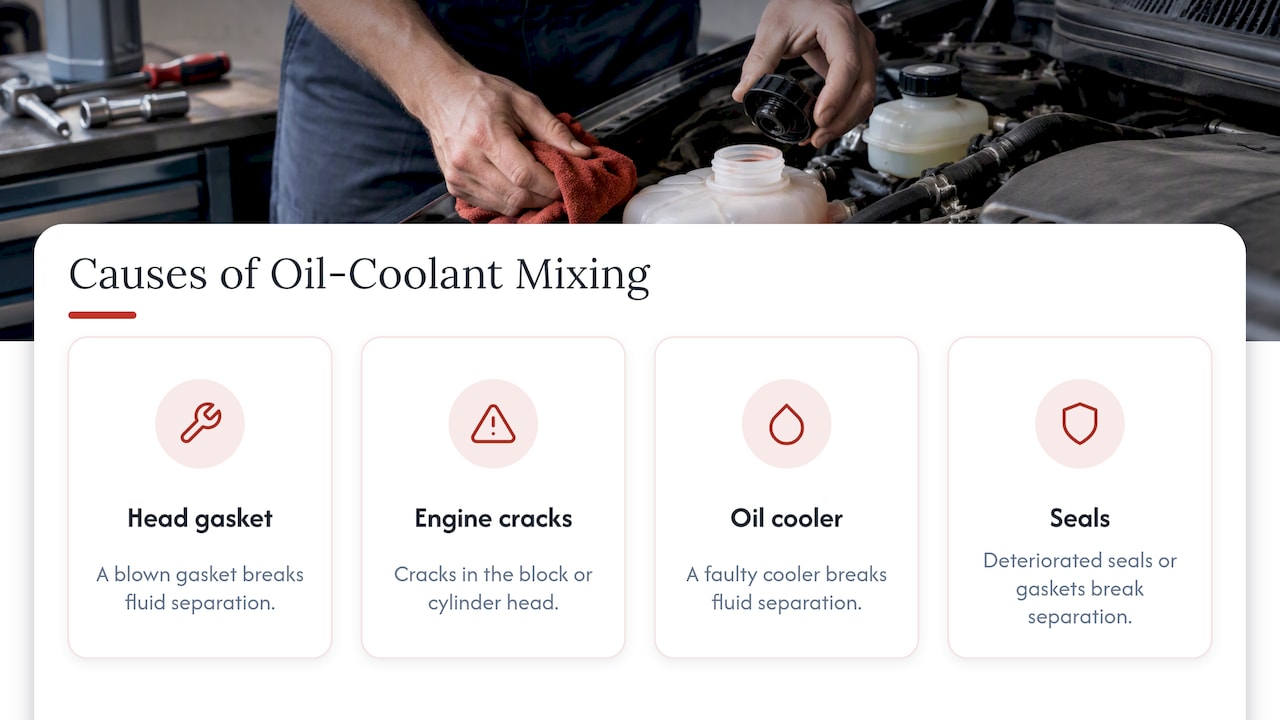
Oil and coolant run through separate passages in the engine. Anything that breaks the wall between them lets one fluid into the other. The common culprits are a blown head gasket, cracks in the engine block or cylinder head, a faulty oil cooler, and deteriorated seals and gaskets.
Head gasket failure
The head gasket seals the joint between the cylinder head and the block. Hagerty’s Hack Mechanic column says oil in the coolant is commonly caused by a failed head gasket between oil and coolant passages. It is the most likely cause, which is why it gets blamed first.
Cracked cylinder head or block
The same article points out that a crack in the cylinder head is another possible cause. Cracks or pinholes in the oil galleys of a casting can also let oil into the coolant. This matters because a new head gasket will not fix a cracked head. The part gets replaced or repaired, and the cost changes completely.
A leaking oil cooler
Many engines have an oil cooler, a small heat exchanger that uses engine coolant to pull heat out of the oil. When its internal walls fail, the two fluids meet. Oil pressure is usually higher than coolant pressure, so the oil tends to push into the coolant, not the other way around. An oil cooler failure is a much smaller repair than a head gasket job, and it is easy to overlook.
A transmission cooler inside the radiator
Many radiators have a transmission fluid cooler built in. If it leaks, red or brown fluid can end up in the coolant and look like oil. One long-time repair writer cautions that oil floating in the coolant does not automatically mean a bad head gasket, and that the transmission fluid and transmission condition should be checked too. Checking the transmission dipstick, where there is one, is a quick first look.
Can you drive with oil in the coolant?
No. Coolant dilutes engine oil and compromises its lubricating and protective properties, and the two should never mix. Driving with the fluids mixed can cause engine overheating, poor lubrication and potential engine failure.
Practical guidance:
- If the temperature gauge is rising or the warning light is on, pull over safely and shut the engine off.
- Never open a hot radiator or reservoir cap. Pressurized coolant can scald.
- Don’t top off and keep going. Adding coolant hides the symptom while the damage continues.
- Have the car towed or driven only a very short distance, with the gauge in the normal range, to a shop.
A car that still runs normally is not a safe car. The Mercedes owner on a popular forum thread says the SUV is “still drivable.” That is true until the bearings starve, and by then a repair that was affordable has become an engine replacement. The cheapest moment to diagnose this is right now.
Is it milk in the oil too? How to read the dipstick and cap
Look in two places: the oil and the coolant. Contamination in both tells you more than either alone.
- Dipstick: Milky, tan or chocolate-milkshake oil is a warning sign of coolant contamination.
- Underside of the oil filler cap: A creamy film here is a warning too, but residue under the cap alone can also be ordinary condensation, especially on short winter trips. That is why it should not condemn the head gasket by itself.
The difference is in how the fluid behaves. Condensation in oil can be normal. But coolant-induced thickening and acid formation in oil, which cause corrosion, will not boil away like water from condensation. If the dipstick is milky and the coolant level keeps falling, treat it as real contamination.
Around Lynnwood, many cars do short, stop-and-go commutes on I-5 and 196th Street in cool, damp weather. That is exactly the pattern that leaves harmless condensation under the cap. It is also why we test before we call anything a head gasket.
Head gasket or oil cooler: how a mechanic tells
Visual clues can mislead, so a shop uses tests. Three do most of the work.
Cooling system pressure test
The shop pressurizes the cooling system and watches for a drop. It finds external leaks and can show whether pressure is escaping into the engine. It is also one of the standard diagnostic methods for coolant in oil.
Combustion gas (block) test
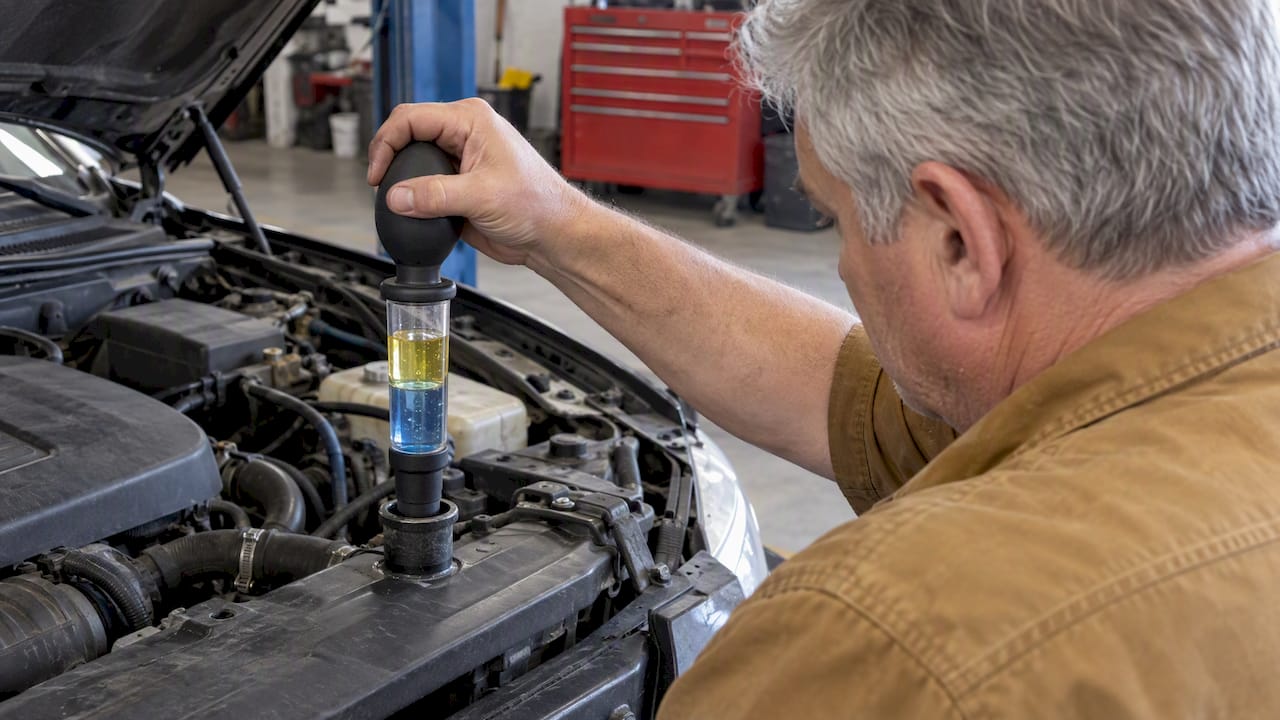
MotorTrend describes a combustion-leak test in which a tester draws vapor from the radiator through a chemical reagent that changes from blue to yellow when combustion gas is present. Exhaust gas in the coolant points to a head gasket or a crack into a cylinder. A negative test with oil still in the coolant points the finger toward the oil cooler.
Compression test
A compression test checks how well each cylinder holds pressure, and low readings point to head gasket failure. We explain how it works in what car owners need to know about an engine compression test.
How the results line up
A technical guide on heavy-duty oil coolers separates the two failures by checking engine operation, cooling-system pressure, compression and combustion gas in the coolant. As a rule, an oil-cooler failure generally leaves combustion and compression normal, while a head gasket failure can cause rough running, low compression and excessive cooling-system pressure. That guide covers a truck engine, so treat it as the general logic, not a rule for every car.
| Finding | Points toward |
|---|---|
| Combustion gas in coolant, low compression, rough running | Head gasket or cracked head |
| Oil in coolant, normal compression, no combustion gas | Oil cooler or its seals |
| Red or brown fluid in coolant, transmission fluid low or off | Transmission cooler in the radiator |
| Cracks seen on inspection of head, block or cooler | Cracked casting, which needs repair or replacement |
This table is a starting point. Real cars overlap, which is why a mechanic confirms with more than one test.
What the repair involves
The fix follows the source. We will not quote a repair before the diagnosis, because the range between an oil cooler seal and a cracked head is huge.
- Find and fix the source. A cooler gasket or seal, a head gasket, a cracked head or a radiator cooler each has its own repair.
- Drain the cooling system. Every drop of contaminated coolant has to come out.
- Clean it. A factory service bulletin for a cooling system contaminated with oil calls for identifying and correcting the source, draining all coolant, using an industrial cleaner or degreaser or a low-sudsing detergent, and repeating the procedure as necessary.
- Check the hoses. The same bulletin says to inspect rubber hoses for swelling after cleaning and replace them as needed. Oil softens rubber, and swollen hoses fail later.
- Change the oil and filter. If coolant got into the oil, the old oil and filter are done.
- Refill and verify. Fill with the correct coolant, bleed the air and retest.
Skipping step 3 is the most common reason the same problem seems to return. Leftover oil film in the radiator and passages keeps fouling fresh coolant. A reader on one forum replaced intake gaskets on a Chevy S10 after finding oil in the radiator, and the symptom came back, which is the sort of story you hear when the source or the cleanup was incomplete.
If you do any of the draining yourself, you need a wide, low container for the dirty coolant. A large pan such as this 4.2 gallon drain pan is useful when you are cleaning the cooling system after the source has been repaired. Used coolant is toxic to pets and wildlife, so take it to a hazardous waste collection point and never pour it down a drain.
BMW coolant loss and leaks: not always oil
BMW owners search “BMW coolant leak” and “BMW coolant loss” a lot, and the answer is often not oil at all. Two federal service bulletins show how model-specific it is:
- For affected B58C vehicles with coolant leaks or loss and pressure in the low-temperature cooling system, BMW’s guidance is to drain and refill the system twice with approved HT-12 coolant.
- On S63 engines, coolant loss can come from a chemical and thermal reaction involving the plastic expansion tank, and the repair is to replace the tank.
The point: a dropping coolant level on a BMW can be an expansion tank, a hose or a pressure issue, long before anyone should suspect the engine internals. It still deserves a pressure test. If the level drops and you see no puddle, our guide to coolant loss with no visible leak explains what a pressure test finds. We service European and hybrid vehicles as well as Toyota, Honda, Subaru and domestic makes.
Why overheating makes everything worse
Oil in the coolant can both cause overheating and be caused by it. An engine that has run hot is more likely to warp a head or fail a gasket. If your temperature gauge has been climbing, our article on why an engine overheats and how to stop it covers the usual causes. Catching a cooling problem early is the best protection for the head gasket.
Perspective
We see the same pattern most weeks: a car owner finds a tan film in the reservoir, assumes the worst, and either keeps driving or pays for a head gasket job nobody confirmed.
Both are expensive mistakes. Our approach is to test first. A pressure test, a combustion gas test and a compression check tell us whether we are looking at a gasket, a cooler or a crack, and then we explain the findings and the price before any work starts.
We have been family-owned in Lynnwood since 1985, our technicians are ASE-certified, and we do digital inspections so you can see what we see. Every repair carries our 24-month / 24,000-mile warranty. The cleanup after the repair gets the same care as the repair itself, because that is what keeps the problem from coming back.
Shingi
Get it checked in Lynnwood
If you have oil in the coolant, milky residue or a coolant level that keeps dropping, bring the car in rather than driving it. We diagnose first, tell you what is failing and give you upfront pricing before we repair anything. Same-day appointments are often available.
The repair that usually follows is engine repair in Lynnwood, and once the source is fixed, a cooling system flush in Lynnwood helps clear the system. We also serve Edmonds, Shoreline, Kenmore, Mountlake Terrace and Mukilteo. Not sure what you are looking at? Start from our main page and book a diagnostic visit. We also offer discounts for military, seniors and first responders.
What to do while you wait for your appointment
- Don’t run the engine to “see what happens.”
- Take photos of the reservoir, dipstick and cap so the technician can see what you saw.
- Note when the problem began, how often you add coolant and whether the heater blows cold.
- Write down whether the car has been overheating or smoking from the tailpipe.
- Check the transmission fluid if your car has a dipstick for it, and tell us what you find.
Oil analysis is another option on some vehicles. Labs can detect glycol, sodium or potassium in engine oil, which gives early warning of coolant contamination before visible sludge appears. It is not a replacement for pressure and combustion gas tests, but it helps with borderline cases.
FAQ
Can you drive with oil in the coolant?
No. Mixed fluids can lead to overheating, poor lubrication and engine failure, so the engine should be shut off and the car inspected. Short, careful trips to a shop with the gauge in the normal range are the most you should risk.
Does coolant in oil mean a head gasket has failed?
Not necessarily. A head gasket is the most likely cause, but a crack in the cylinder head between the oil and coolant passages can do the same thing. Testing is the only way to know which one it is.
How do you tell an oil cooler leak from a head gasket leak?
A mechanic pressure tests the cooling system, runs a combustion gas test and checks compression. Normal compression with no exhaust gas in the coolant points toward the oil cooler. Combustion gas and low compression point toward the head gasket.
Is milky residue under the oil cap always a problem?
No. It can be condensation from short trips in cool weather. If the dipstick is also milky, or the coolant level is dropping, it needs a proper test.
Can I just flush the coolant and carry on?
A flush alone does not stop oil from getting in. The source has to be found and repaired first, then the system cleaned and the hoses checked.
Sources
- Fluid Loss and (Engine Professional, 2018)
- How to Fix Coolant Mixing with Oil
- Identifying cracked heads and blown head gaskets (Hagerty)
- How to test for a head gasket leak
- Blown Head Gasket Diagnostic (MotorTrend)
- Volvo D13 Oil Cooler Failure diagnosis
- Cooling system contaminated with oil (NHTSA TSB, 2016)
- BMW B58C coolant leak bulletin (NHTSA, 2022)
- BMW S63 expansion tank bulletin (NHTSA, 2022)
- How to Test for a Blown Head Gasket Without Disassembly
Recommended
- Why Your Car Leaks Oil: Causes, Risks, and Fixes
- Coolant Loss With No Leak? Pressure Tests and Safe Home Checks
- Why Your Engine Overheats and How to Stop It
- What Is Engine Coolant and Why Your Car Needs It
Leave a Reply