
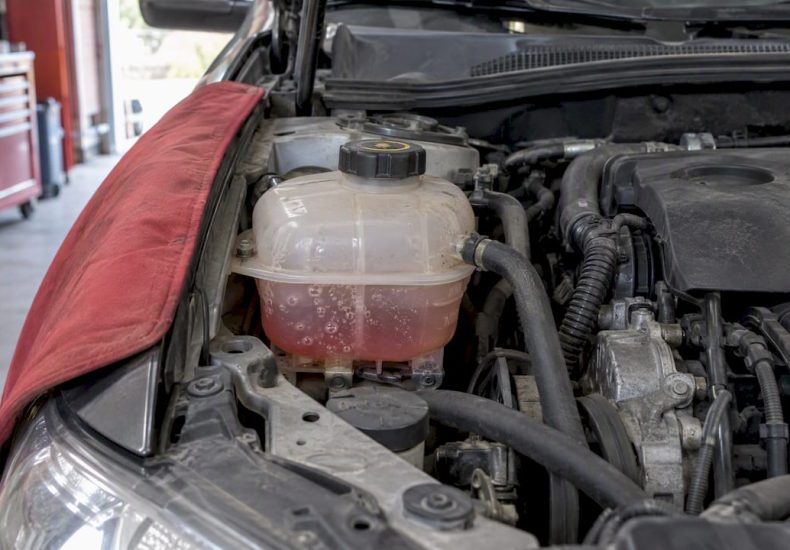
Coolant Reservoir Bubbling: Causes, Risks and What to Do
Bubbles in the coolant reservoir are not always a problem. A few bubbles after a coolant service or while the engine warms up are usually trapped air working its way out. Constant bubbling from a cold start, bubbling with a rising temperature gauge, or foamy, milky coolant points to something that needs a shop visit soon, and sometimes right away.
This guide helps you sort out which situation you are in, what each cause looks like from the driver’s seat, and what to do next. We run a full-service repair shop in Lynnwood, WA, so we see all of these cases, from a simple air pocket to a failed head gasket.
TL;DR
- A little bubbling that fades as the engine reaches temperature, especially after a coolant top-off or service, is usually trapped air.
- Bubbling that starts within minutes of a cold start, never stops, or comes with overheating can mean combustion gas is entering the coolant, a sign of head gasket trouble.
- If the temperature gauge climbs or you see steam, pull over and shut the engine off. Never open the cap on a hot system.
- Sweet-smelling puddles, low coolant with no visible leak, or a heater that blows cold are all worth a pressure test.
- Early diagnosis is cheaper than waiting. Overheating is what turns a minor repair into an engine replacement.
Table of Contents
- Why a coolant reservoir bubbles
- Cause 1: Air trapped after service or a top-off
- Cause 2: Hot coolant and pressure changes
- Cause 3: Combustion gas from a head gasket leak
- Can you drive with bubbling coolant?
- Foamy or milky coolant in the reservoir
- How a shop diagnoses the cause
- What the fix looks like
- Perspective from our shop
- Get your cooling system checked in Lynnwood
- FAQ
- Sources
Why a coolant reservoir bubbles
Bubbles come from one of three things: air, vapor or combustion gas. According to a 2026 explainer on reservoir bubbling, bubbling usually means air or gas is moving through the cooling system, or the coolant has reached a temperature where vapor begins to form. The same source lists trapped air, coolant vapor from restricted flow or pressure drops, and combustion gases entering through a compromised internal seal as the main causes.
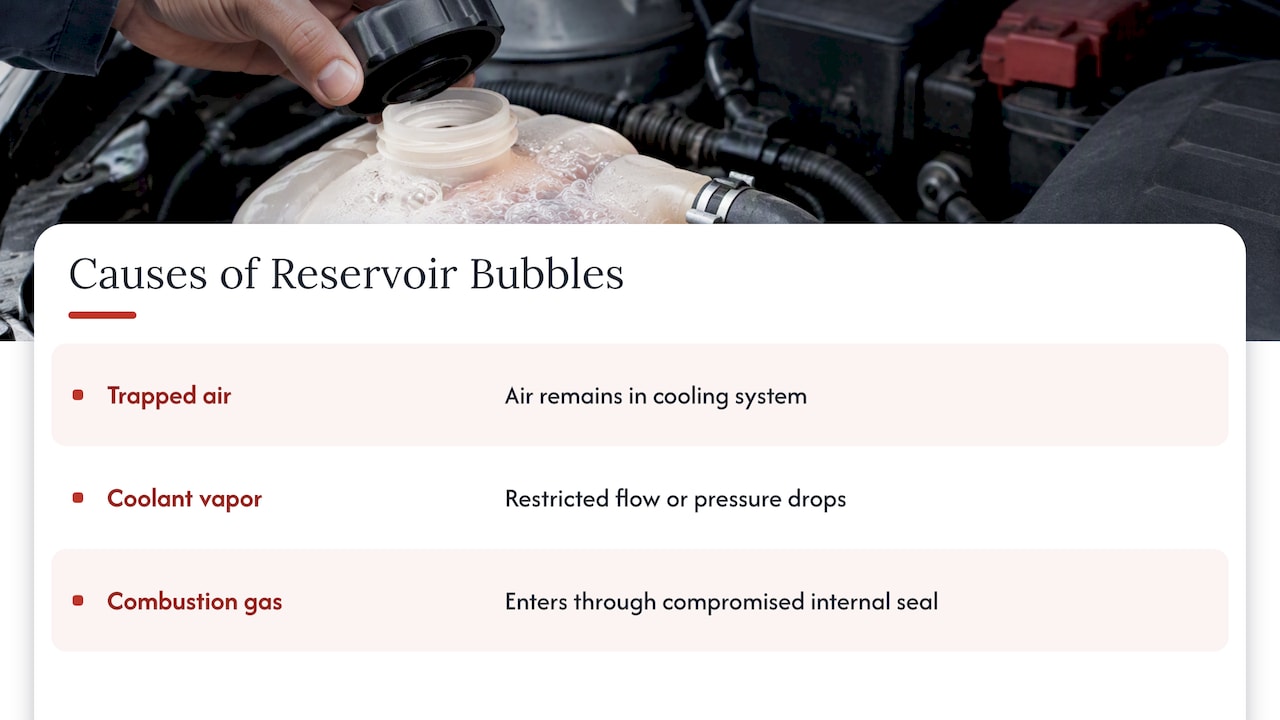
The reservoir is a good place to see this because it is the one visible window into a sealed system. On most modern cars the tank is only partly filled with liquid on purpose. The air space cushions the expansion of heated coolant and helps keep pressure from climbing too high. So a small amount of movement or fizzing in that tank can be normal, while a steady stream of bubbles is not.
If you want a refresher on what the fluid itself does, we cover it in what engine coolant is and why your car needs it.
Cause 1: Air trapped after service or a top-off
This is the most common and least worrying cause. Any time coolant has been drained, a hose has been replaced, or the level has run low, air can end up in the system. It collects in high spots, such as the engine, the heater core and the upper radiator hose, then works its way to the reservoir once the thermostat opens and coolant starts circulating.
Air can also get in through a leak. According to a cooling system overview in MOTOR Magazine, air or gases can enter through an air leak at the water pump inlet, at a hose connection, or through a combustion chamber leak. That matters because a repaired system that keeps producing air is telling you there is a leak somewhere.
Symptoms of air in the cooling system
The usual signs are:
- Gurgling or sloshing sounds behind the dash or from the radiator area
- A temperature gauge that wanders up and down
- Cabin heat that turns cold and hot without warning
- Occasional overheating, especially in traffic
The heater is a useful clue. When air collects around the heater core, warm air stops flowing even though the engine is hot. If that sounds like your car, the thermostat guide explains why a stuck or slow thermostat can make these swings worse.
How long should bubbling last?
Trapped-air bubbling typically shows up once the engine warms enough for the thermostat to open, then tapers off as the air is pushed out. In practice, that means you might see activity during the first drive or two after a service. If bubbles are still appearing day after day, the air is not the whole story.
Cause 2: Hot coolant and pressure changes
Coolant is designed to run well above the boiling point of water because the system is pressurized. When pressure drops, for example from a weak radiator cap or a small leak, coolant can start to form vapor at a lower temperature. Vapor pockets also form when flow is restricted by a clogged radiator, a failing water pump or a stuck thermostat.
This bubbling often appears after a hard drive, a long climb or a stop in traffic, when the engine is at its hottest. It can look like boiling in the reservoir. The temperature gauge usually tells the story: if it is climbing toward hot while the reservoir churns, the system is overheating.
Common contributors include:
- A worn radiator cap that no longer holds pressure
- A partly blocked radiator or a radiator that is leaking slowly (see radiator leak symptoms)
- A cooling fan that is not turning on, which we walk through in our 60-second fan test
- A water pump with a worn impeller or bearing
- Low coolant from a leak you cannot see
That last one is more common than people think. If your level keeps dropping but the driveway stays dry, read coolant loss with no leak.
Cause 3: Combustion gas from a head gasket leak
The head gasket seals the combustion chambers from the coolant passages. When it fails, high-pressure exhaust gas can push into the cooling system and show up as bubbles. O’Reilly is a parts retailer, so we are not linking it; instead, here is what a major financial services guide to head gaskets says: bubbling in the radiator or coolant reservoir can be a sign of head gasket failure, and overheating can itself cause a gasket to fail through material breakdown.
So the answer to “does bubbling coolant mean a blown head gasket?” is: it can, but it does not have to. Plenty of bubbling is just air. What separates the two is the pattern.
Air or combustion gas? Clues that help
| What you notice | More likely trapped air | More likely combustion gas |
|---|---|---|
| When bubbles start | After the engine warms and the thermostat opens | Within the first minutes of a cold start, before the gauge moves |
| How long they last | Taper off over one or a few drives | Continuous, often stronger when revving |
| Recent service | Yes, coolant was drained or topped off | Not necessarily |
| Temperature gauge | Steady or slightly erratic | Climbing, or overheating repeatedly |
| Coolant condition | Normal color | Oily film, milky look or sludge |
| Other signs | Gurgling, heater swings | White exhaust smoke, rough running, coolant loss, misfire |
The early-bubbling clue works because cylinder pressure exists the moment the engine runs, while air bubbles need coolant to circulate first. Treat it as a pointer, not proof.
An older government cooling-system publication makes a related point. With no exhaust gas involved, a continuous flow of bubbles at a steady operating temperature indicates air being drawn into the low-pressure side of the water pump. So even constant bubbling is not automatically a head gasket: a loose hose clamp or a failing pump seal on the intake side can do it too. That is exactly why confirming the cause matters before anyone quotes a major repair.
For the full list of warning signs, see our article on head gasket symptoms.
Can you drive with bubbling coolant?
It depends on what else is happening.
Light bubbling, normal gauge, normal heat. Short, careful trips to a shop are generally reasonable. Check the level only when the engine is cold and keep an eye on the gauge.
Bubbling with a rising gauge, steam, a hot smell or a warning light. Do not keep driving. Farmers Insurance advises that driving an overheating vehicle can cause severe engine damage, and that you should pull over, turn the engine off and call for professional roadside help instead of opening the hot system.
Here is the sequence we recommend if the gauge spikes:
- Turn off the air conditioning and turn the heater to full hot with the fan on high. This pulls some heat out of the engine while you look for a place to stop.
- Pull over somewhere safe and shut the engine off.
- Leave the hood closed for a few minutes if you see steam, then open it carefully.
- Do not open the radiator cap or reservoir cap while the engine is hot. The system is under pressure and the coolant can spray out.
- Call for a tow if the gauge is in the red or the coolant is low.
A hot cap also causes a repair problem. One GM service bulletin for Duramax diesels warns that removing the cap while the system is hot or pressurized can let air back in, which means the fill procedure may need to be repeated. That bulletin is for specific trucks, but the idea applies broadly: opening a hot system makes things worse.
Foamy or milky coolant in the reservoir
Foam is a different signal from clear bubbles. Here is how we read it:
- Light foam that settles: often caused by mixing incompatible coolant types, an overfilled tank or air from a recent service.
- Brown, rusty or sludgy coolant: the coolant is past its service life, or corrosion is present.
- Milky, tan or oily coolant: oil and coolant are mixing. That points to a head gasket, a cracked head or a failed oil cooler, and the car should not be driven.
- Coolant that smells like exhaust: another sign of combustion gas.
One quick check you can make with the engine off and cold is to look at the oil dipstick and oil filler cap. A milky, mayonnaise-like film is a red flag. It is also worth bringing to your technician.
How a shop diagnoses the cause
You can guess from symptoms, but guessing is how people pay for the wrong repair. A proper diagnosis follows an order that rules out the cheap causes first:
- Visual inspection. Coolant level and condition, hoses, clamps, the radiator cap, signs of seepage at the water pump and radiator.
- Cooling system pressure test. The system is pressurized cold and watched for a drop. This finds external leaks and a cap that does not hold pressure.
- Cap test. Checks whether the cap opens at the correct pressure.
- Combustion gas test. A chemical test over the reservoir or radiator opening detects exhaust gas in the coolant. Haynes notes that pressure testing or chemical analysis can confirm exhaust gases.
- Temperature and fan checks. Confirms the thermostat opens and the fans cycle on, using a scan tool for live data.
- Air purge. If the system is simply airy, it is bled using the correct procedure for that engine, then re-checked after a test drive.
At our shop, the work is done by ASE-certified technicians, and we use professional-grade OBD-II diagnostics along with digital inspections so you can see what we found. Pricing is upfront before repairs begin.
What the fix looks like
The repair follows the cause:
| Cause | Typical fix |
|---|---|
| Air after service | Bleed the system; recheck after a drive |
| Low coolant from a hose or clamp leak | Replace the hose or clamp, refill, bleed |
| Weak radiator cap | Replace the cap |
| Failed thermostat | Replace the thermostat and refill |
| Clogged or leaking radiator | Repair or replace; see how the radiator works |
| Failing water pump | Replace the pump, usually with the coolant and sometimes the belt |
| Head gasket or internal failure | Engine repair, which depends on how far the damage has gone |
| Old or mixed coolant | Cooling system flush and refill with the right coolant |
If your car has overheated, the earlier the work happens the better. A significant combustion-seal failure can cause overheating and engine damage, especially on modern aluminum engines. For more on prevention, see why engines overheat and how to stop it.
Perspective from our shop
Most people who come to us about bubbling are worried about the worst case, a blown head gasket. In our experience that is the minority. More often the cause is an air pocket from a previous top-off, a tired radiator cap, or a hose that is weeping just enough to let air in.
What we do is work from the cheapest, most likely cause toward the most serious. We pressure test, check the cap, confirm the fans and thermostat, and only then test for combustion gas. That order means you do not pay for an engine repair you do not need, and if it is a head gasket, you find out before the engine is cooked.
We have served Lynnwood drivers since 1985, and we work on Toyota, Honda, Subaru, domestic, European and hybrid vehicles. Hybrids matter here because many have a separate cooling loop for the inverter and power electronics, so a bubbling or low reservoir deserves proper attention on those models too. Our repairs carry a 24-month / 24,000-mile warranty, so the fix is backed after you leave.
If you are unsure, bring the car in before the next long drive. A quick check is a lot cheaper than a tow and a new engine.
Shingi
Get your cooling system checked in Lynnwood
If your reservoir is bubbling and you are not sure why, we can find out. Our team handles cooling system diagnosis, leak and pressure testing, thermostat and water pump work, radiator repair, coolant flushes and engine repair for all makes. Same-day appointments are often available.

If a check engine light has come on along with the bubbling, or the car is already running hot, book through our main page and tell us what you are seeing. Military members, seniors and first responders qualify for discounts.
FAQ
Is it normal for the coolant reservoir to bubble?
A small amount of bubbling or fizzing can be normal while the engine warms up, particularly after a coolant service when trapped air is leaving the system. It should fade after a drive or two. Constant bubbling, bubbling from a cold start, or bubbling with a climbing temperature gauge is not normal and needs to be checked.
Does bubbling coolant mean a blown head gasket?
Not necessarily. Bubbling can be a sign of head gasket failure, but trapped air, a weak cap or an air leak on the intake side of the water pump can look the same. A combustion gas test and a pressure test tell the two apart.
How long does it take for coolant to stop bubbling?
After a coolant service, trapped air usually clears within a drive or two as the thermostat opens and circulation moves the air to the reservoir. If bubbles continue for days, the system is either still airy because of a leak, or something else is forcing gas into it. Have it checked rather than topping it off repeatedly.
How do I fix foamy coolant in the reservoir?
The fix depends on why it is foamy. Mixed or old coolant calls for a flush and refill with the correct type, and an air pocket calls for bleeding the system. Milky or oily foam points to oil and coolant mixing, which needs professional diagnosis before the car is driven further.
Can I keep driving if my coolant is bubbling?
Only if the temperature gauge is steady and the heater works normally, and then only to get to a shop. If the gauge rises, you see steam, or a warning light appears, stop driving, shut off the engine and call for help.
Sources
- Why Your Coolant Reservoir Is Bubbling: Key Causes Explained
- What Is the Expansion Tank and What Does It Do
- Automotive Cooling System Basics, MOTOR Magazine
- What Is a Head Gasket and How Can You Tell If It’s Blown
- Cooling System, U.S. government publication
- What To Do When Your Engine Overheats, Farmers Insurance
- GM Service Bulletin, NHTSA
- Driving with a Blown Head Gasket, Fel-Pro
Recommended
- Coolant Loss With No Leak? Pressure Tests and Safe Home Checks
- Radiator Leak Symptoms: How to Spot One Early
- What Is Engine Coolant and Why Your Car Needs It
- Why Your Engine Overheats and How to Stop It
Leave a Reply