
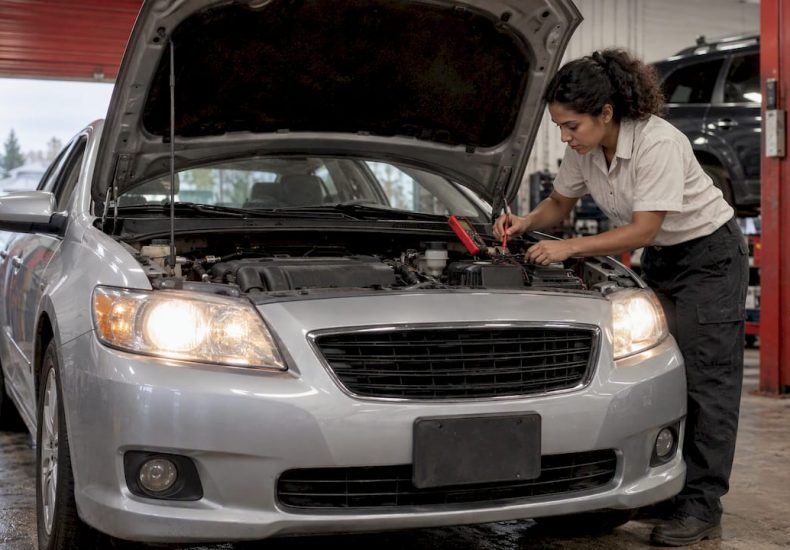
Headlights Dim at Idle? Causes and What to Check
If your headlights dim when the car sits at a light and brighten when you press the gas, the charging system is the first place to look. The alternator makes less power at low engine speed, so a weak alternator, a slipping belt, a poor connection or a tired battery shows up as dimming at idle. A slight, brief dip when a big electrical load switches on can be normal. Dimming that is obvious, repeated or getting worse needs a proper test, and the sooner it happens the cheaper it usually is.
This guide explains why it happens, how to tell a normal dip from a real fault, what a technician measures, and when to stop driving and call a shop.
TL;DR
- At idle the alternator spins slowly and makes less power, so any weakness in the charging system shows first as dim headlights that brighten with revs.
- A small, short dip when the blower, fan or defroster kicks on can be normal. Strong, constant or pulsing dimming is not.
- The usual suspects: a slipping belt, loose or corroded battery and ground connections, a worn alternator, or a weak battery.
- A healthy charging system reads about 13.5 volts at idle and over 14 volts with revs, but one reading alone does not make a diagnosis.
- If the battery light comes on, the engine stumbles or the dimming is severe, get the car checked before driving far.
Table of Contents
- Why headlights dim at idle and brighten with revs
- Is some dimming normal?
- The main causes, from most to least likely
- Quick checks you can describe to your technician
- What a proper charging system test looks like
- Is it safe to keep driving?
- What the repair usually involves
- Our perspective
- Get your charging system checked in Lynnwood
- Keeping the charging system healthy
- FAQ
- Sources
Why headlights dim at idle and brighten with revs
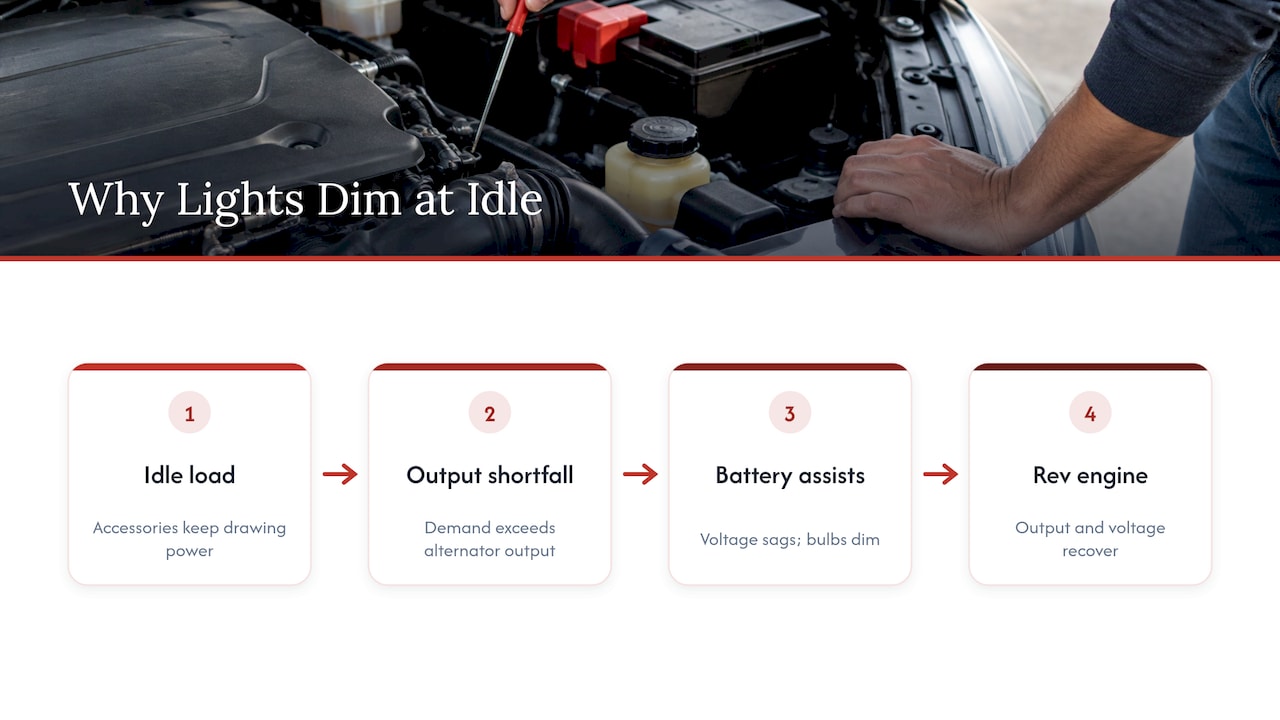
Your alternator is driven by a belt from the engine. Slow engine, slow alternator, less output. At cruising speed it has plenty of margin. At a stoplight it is working near the bottom of its range while the headlights, blower, cooling fan, rear defroster, heated seats and electric steering all keep drawing power. When demand is higher than output, the battery makes up the difference and system voltage sags. Bulbs get dimmer when voltage falls, and you see it.
Rev the engine and the alternator speeds up. Output rises, voltage recovers and the lights brighten. That pattern, dim at idle and brighter with revs, is the classic sign that the charging system is struggling at low speed.
Haynes Manuals describes this exact symptom as an undercharging condition. Its list of possible causes includes a slipping auxiliary belt, poor connections between the alternator, battery and regulator, internal alternator faults and bad diodes.
Is some dimming normal?
Yes, a little. Honda explains that some dimming is a normal operating characteristic of modern computer-controlled electrical systems, which manage alternator output to balance fuel economy and electrical stability.
A brief, small change in brightness is typically fine when:
- the air conditioning compressor or cooling fan cycles on,
- you switch on the rear defroster or heated seats,
- the blower goes to high,
- you turn the steering wheel at a standstill in a car with electric steering.
In those cases the lights recover within a moment. The pattern to worry about is different:
- dimming that is deep enough to notice from the driver’s seat every time you stop,
- lights that pulse or flicker in time with the engine,
- dimming that lasts as long as you are idling,
- dimming together with a dash light, a slow crank, a whining noise or a rough idle,
- anything that has gotten worse over a few weeks.
If you are not sure which side your car is on, treat it as worth checking. A charging test is quick and gives you a clear answer.
The main causes, from most to least likely
A weak or aging alternator
Alternators wear out. Brushes, bearings, the voltage regulator and the diodes inside all age with heat and mileage. A tired alternator may still produce enough at highway speed and fall short at idle, which is why the problem shows up at stoplights first. Alternators supply the ignition, fuel pump, injectors, lights and accessories while also recharging the battery, and heavy loads at idle can overheat and damage the diodes. That is one reason not to let this one ride for months.
So, can a bad alternator cause headlights to dim at idle? Yes. It is the most common explanation, and it fits the pattern Haynes lists for lights that dim at idle and brighten with revs. It is not the only one, which is why a test matters before any parts are replaced.
A slipping or worn serpentine belt
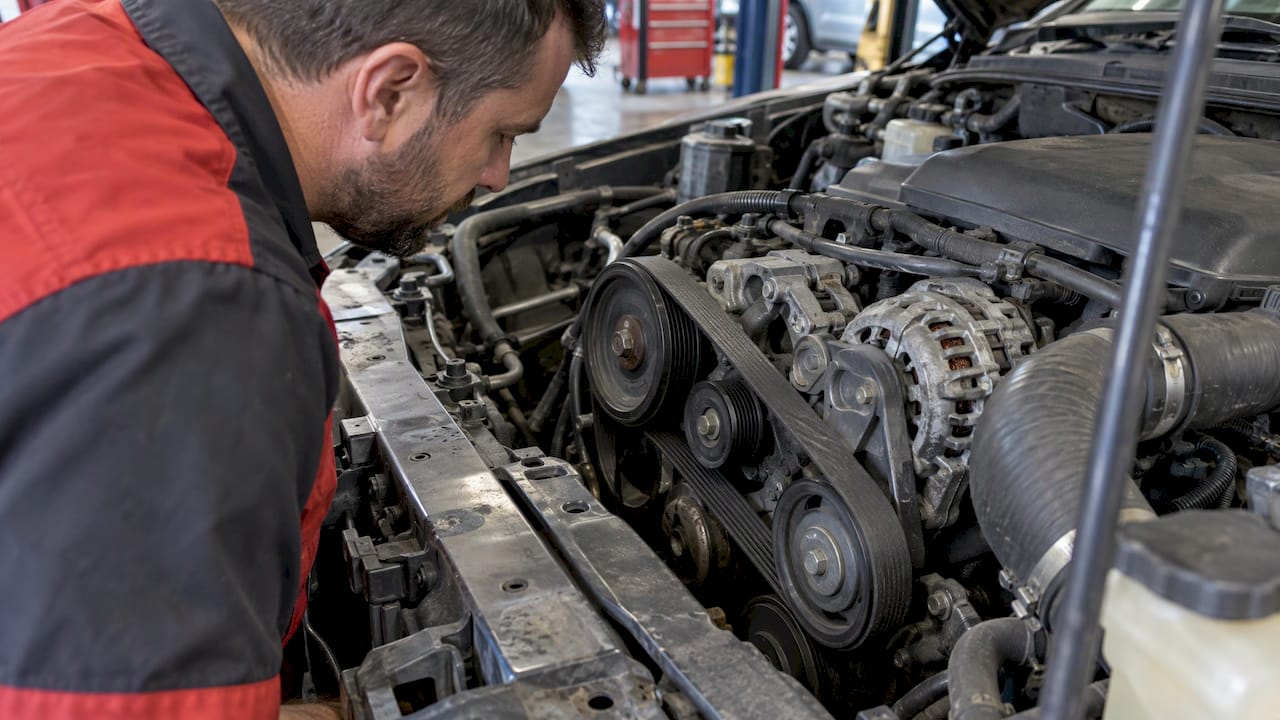
If the belt that turns the alternator is glazed, cracked, loose or contaminated with oil, it can slip, especially under load. The alternator then turns slower than the engine suggests. You may hear a squeal on start-up or when the A/C comes on. A belt is a modest repair compared with an alternator, which is why we look at it first.
Loose or corroded connections and grounds
Electricity needs a complete path. The cable from the alternator to the battery, the battery terminals and the ground straps (engine to chassis, battery to body) all have to carry current with almost no resistance. When they corrode or loosen, resistance rises and voltage is lost along the way. One source notes that corroded or loose ground connections commonly cause dimming, especially in vehicles over ten years old. Here in the Pacific Northwest, damp air is hard on terminals and under-hood connections, so this is a regular finding.
A weak or failing battery
The battery stabilizes voltage and covers the gap when demand spikes. When it is old or has lost capacity, the alternator has to work harder and voltage swings are larger. A weak battery can also make a healthy alternator look bad, and a bad alternator will ruin a good battery over time. They need to be tested as a pair.
Extra electrical load
Aftermarket amplifiers, light bars, winches, dash cams wired in poorly or LED conversions that draw more than expected can exceed what the factory charging system was designed for. If the dimming started after an accessory install, mention it to your technician right away.
The bulbs or one side only
If only one headlight is dim, look at that side: the bulb, the socket, the connector or the local ground. Guidance on the topic notes that one dim light points to a local fault, while both lights changing together point to the battery, alternator, cables or grounds. Dim lights that stay dim at any engine speed are more likely a bulb, lens or aiming issue than a charging problem.
Quick checks you can describe to your technician
You do not need tools to give a shop useful information. A few observations save diagnostic time:
- Do both headlights dim together? Both points to the system. One points to that side.
- Does it brighten when you rev? If yes, that fits an undercharge at idle.
- What was running? Note whether A/C, defroster, heated seats or the fan were on when it dimmed.
- Do other things change? Dash lights, radio, interior lights or the idle itself may waver along with the headlights.
- Any sounds or smells? A squeal, a growl from the alternator or a hot, burning smell matter.
- Did anything change recently? New battery, accessory installs, a jump start or a recent repair.
- Is a warning light on? A battery or charging light on the dash is a strong clue.
That last list is also a handy way to separate this from related symptoms. If the engine is stumbling at the same time, our guides on why a car stalls at idle and on engine surging at idle cover what is going on from the engine side. If the car is slow to crank, see our no-crank, no-start guide.
What a proper charging system test looks like
The goal is to measure, not guess. Alternators are among the most commonly replaced parts that did not actually need replacing, because the real problem was a belt, a terminal or a ground.
Step 1: Battery and visual inspection
We check the battery’s state of charge and health, inspect terminals and cables for corrosion and looseness, and look at the belt for wear, glazing and tension.
Step 2: Charging voltage at idle and with revs
With the engine running, a multimeter on the battery shows what the alternator is delivering. Haynes gives the typical benchmark: about 13.5 volts at idle and over 14 volts when revved, and it should not go over 15 volts. If you want to see how a meter is used on a battery, this walkthrough on how to test battery voltage with a multimeter shows the basics of reading the numbers.
A single number is not the whole story, though. Many modern vehicles deliberately vary alternator output according to battery state, temperature and load, so a reading that looks odd may be the system doing its job. Testing should follow the vehicle manufacturer’s procedure rather than a rule of thumb. That is where scan-tool data and experience with the specific make make a difference.
Step 3: Voltage drop testing
Voltage drop finds resistance in the wiring while current is actually flowing. Fluke’s application note explains that voltage drop must be measured with the circuit loaded. Its published limits are 0.10 volt across grounds, 0.20 volt across wires or cables and 0.30 volt across switches. Readings above those mean there is a restriction to find and fix, such as a corroded ground strap, a loose lug or a damaged cable.
Step 4: Ripple and diode check
A failing diode inside the alternator can leak AC into the DC system. A multimeter set to AC volts, or a scope, can reveal it. Fluke notes that if the alternator’s output stud is awkward to reach, you can probe at the battery posts instead.
Step 5: Load test with accessories on
Finally, we turn on the headlights, blower, defroster and other loads and watch whether voltage holds at idle. This reproduces what you see at the stoplight, on the bench, in numbers.
Is it safe to keep driving?
Short term, many cars will keep running with a weak charging system, but you are using up the battery as you go. If the charging system fails, the battery may supply power for only a handful of miles, depending on the vehicle and what is switched on. Low voltage can cause electronics, ignition or fuel systems to misbehave, and the engine can stall.
Stop and get help soon if:
- the battery or charging warning light is on,
- the engine stumbles, stalls or idles roughly along with the dimming,
- power steering feels heavy or gauges act up,
- the lights are very dim at night or in rain,
- you notice a burning smell or hear a loud whine or grinding from the alternator.
A stall at night on a busy road like Highway 99 or I-5 is exactly what you want to avoid. Cut accessories you do not need, keep the trip short and head straight to a shop. If the car will not start after the lights dimmed for days, see the no-crank guide for what the clicks mean.
What the repair usually involves
The fix depends on what the testing shows:
| Finding | Typical repair |
|---|---|
| Glazed, cracked or loose belt | Belt (and sometimes tensioner) replacement |
| Corroded terminals or cables | Clean, tighten or replace terminals and cables |
| High voltage drop at a ground | Repair or replace the ground strap and clean contact surfaces |
| Weak or old battery | Battery replacement |
| Low output or failed diodes | Alternator replacement |
| Accessory overload | Rewire or right-size the accessory, or upgrade charging capacity |
| Single dim light | Bulb, socket or connector repair |
The point of the order is simple: the cheapest, most likely cause is eliminated first, and an alternator is replaced when the numbers say it should be.
Our perspective
Dim headlights at idle are one of the most common electrical complaints we hear, and they are also one of the most commonly misdiagnosed. A driver reads online that it is the alternator, buys one, and the lights still dim because the real cause was a corroded ground or a belt that slips when the A/C kicks on.
Our approach is to test the whole charging circuit before we recommend a part: battery, belt, connections, voltage drop and alternator output under load. Our ASE-certified technicians use professional-grade OBD-II diagnostics, and we work on all makes, including European and hybrid vehicles, where charging strategy can be more complex and the manufacturer’s procedure matters.
You get upfront pricing before work starts, and our repairs carry a 24-month / 24,000-mile warranty. We have been family-owned and serving Lynnwood drivers since 1985, and that experience means we usually know where to look first on the Toyotas, Hondas, Subarus and domestic vehicles that come through our bays.
Shingi
Get your charging system checked in Lynnwood
If your headlights dim at idle, we can test the battery, belt, grounds and alternator and tell you exactly what needs attention, with the price upfront. Same-day appointments are often available, and we also look after fleets that cannot afford a vehicle stalling on the road. Military members, seniors and first responders can ask about our discounts.

Book your visit through our auto repair page, or ask about our check engine light diagnostics if a warning light has come on along with the dimming. Published prices for related services start at $150 for AC repair, which is worth knowing if your A/C load is when the dimming is worst.
Keeping the charging system healthy
A few habits cut down on charging problems:
- Replace the battery on a sensible schedule. Weak batteries stress alternators. Have it tested at routine service, such as the 30k, 60k and 90k service.
- Look at the belt at every oil change. Cracks and glazing are visible before the belt fails.
- Keep terminals clean and tight. A little corrosion costs more voltage than most people expect.
- Do not stack accessories beyond what the charging system supports without talking to a technician.
- Do not ignore early symptoms. Dim lights, a slow crank or a flickering dash are cheaper to address early.
- Mind the A/C and defroster. If both are weak and the lights dim, the electrical and climate systems may be related. See our guides to why car AC blows warm air and the defroster not working.
FAQ
Why do my headlights dim at idle but get bright when I rev?
The alternator makes less power at low engine speed. At idle, the electrical demand from lights and accessories can outrun output, so voltage drops and the bulbs dim. Revving speeds the alternator up and the lights recover. Large or constant dimming points to a belt, connection, battery or alternator issue.
Will a bad alternator cause dim headlights?
Yes, it is one of the most common causes, and the dimming often shows up at idle first. It is not the only cause, though. A slipping belt, corroded ground or weak battery can look identical, so the charging system should be tested before replacing the alternator.
Is it normal for headlights to dim a little at a stoplight?
A small, brief dip when a fan, defroster or A/C compressor switches on can be normal, and Honda notes that some dimming is a normal characteristic of modern electrical systems. If the dimming is deep, pulsing or lasts the whole time you are stopped, have it checked.
How long can I drive with dimming headlights?
There is no safe number. If the charging system fails completely, the battery may only power the car for a few miles, and the engine can stall. If you see a battery warning light or the engine runs rough, get to a shop soon rather than waiting.
Could it just be a bad bulb?
If only one headlight is dim, a bulb, socket, connector or local ground is a likely cause. If both dim together and brighten with revs, the problem is more likely in the charging system.
Sources
- Why Do My Headlights Dim While Driving? Causes, Diagnosis
- Haynes: Troubleshooting Common Charging System Issues and Causes
- Honda Brand Knowledge: headlights and dashboard lights dimming
- Alternator Failures: Low Voltage To Battery
- Headlights Dim at Idle: Causes
- Headlights Dim at Idle but Brighten With RPM? Check Voltage
- Fluke: Diagnosing voltage drop
- Fluke: How to Test Alternator Ripple Voltage with a Multimeter
- How to Test Battery Voltage With a Multimeter
Recommended
- Car Stalls at Idle: Causes, Diagnosis, and Fixes
- Engine Surging at Idle in Lynnwood? Diagnose Before Buying Parts
- Rough Idle After Refueling: Causes, Checks and Fixes
- Check Engine Light Meaning: What Drivers Need to Know
Leave a Reply