

Honda B1 Service Meaning: What the Code Includes
Honda B1 service means your car is due for an engine oil and oil filter change (the B), plus a tire rotation (the 1). The B code also calls for a set of inspections: brakes, steering, suspension, fluid levels, exhaust and fuel lines. It is a routine service, not a warning that something has failed. Below, we explain each part of the code, how it differs from A1 and B12, how long you can safely wait, and what to do when it appears on your dash.
TL;DR
- B1 = B + 1. B is an engine oil and filter change with a multi-point inspection. 1 is a tire rotation.
- It comes from the Maintenance Minder. The system estimates remaining oil life from how you actually drive, then shows a code when service is due.
- A1 is the lighter visit; B12 adds filters. B12 adds a new air cleaner element and dust and pollen filter, plus a drive belt inspection.
- Reset it after service. If a shop other than a dealer does the work, you reset the display yourself. A skipped reset makes the next interval wrong.
- Check your own manual. Not every Honda uses the same sub item codes.
Table of Contents
- What the Honda Maintenance Minder is
- How to read the letter and the number
- What B1 service includes
- B1 compared with A1, B12 and other codes
- How long can you drive once B1 appears?
- Is B1 service really necessary?
- What to do when B1 appears
- Perspective: how we treat a B1 visit
- Getting B1 service done in Lynnwood
- FAQ
- Sources
What the Honda Maintenance Minder is
The Maintenance Minder is the system behind the codes. Instead of telling you to change oil every fixed number of miles, it calculates remaining engine oil life as a percentage based on how the vehicle has been operated. Short cold trips, stop-and-go traffic and hard acceleration use up oil life faster than steady highway miles, so two Hondas can hit B1 at very different odometer readings.
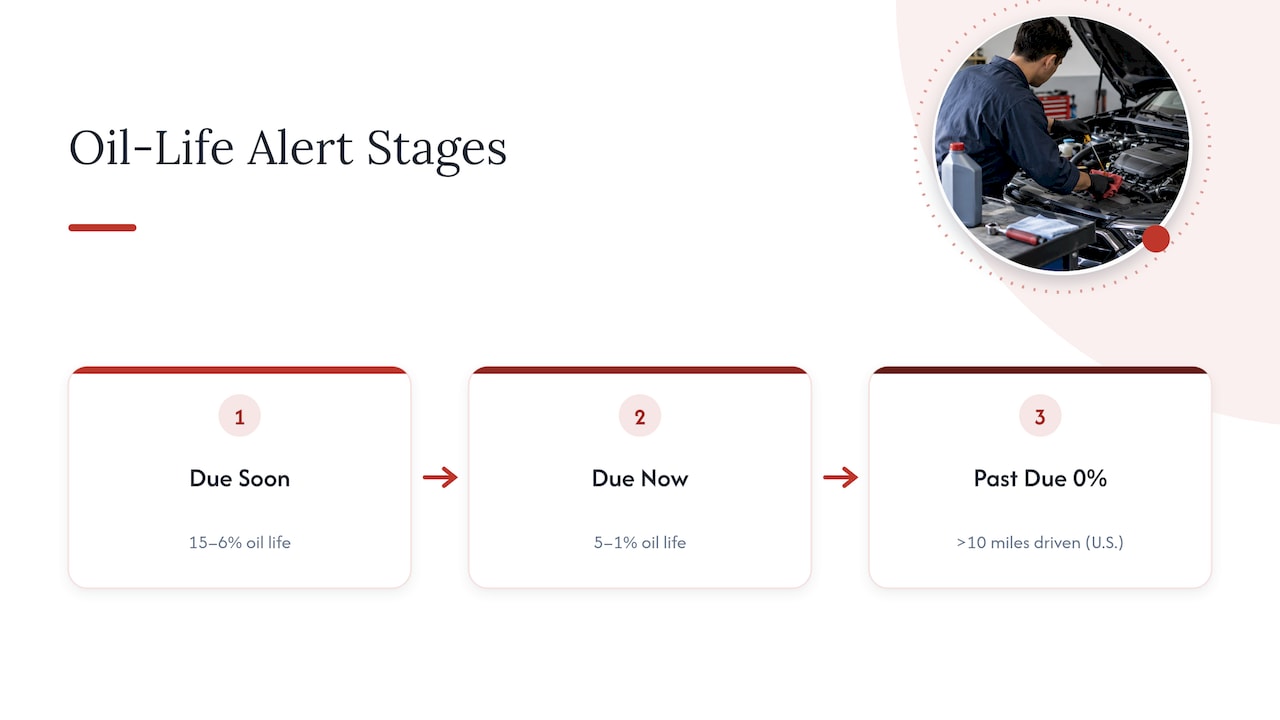
When the percentage drops, the display moves through stages. According to the same owner’s manual, “Maintenance Due Soon” appears at 15 to 6% oil life, “Due Now” at 5 to 1%, and “Past Due” once oil life has run out and the car has been driven more than 10 miles in the U.S. The service code shows alongside the message, so you see something like B1 next to the oil life reading.
One limit is worth knowing. American Honda notes that the system does not account for operating in extreme conditions, so owners with unusual use should check the owner’s manual for specific milestones. Honda Canada adds that the system does not monitor oil level, wear parts like brake pads or tires, or extreme use such as heavy towing. It tells you when service is due. It does not replace looking at your car.
How to read the letter and the number
Every code has two layers.
- The letter (A or B) is the main service item. It is about the engine oil, and the letter decides how much inspection comes with it.
- The number (1 to 9) is a sub item: an extra job such as a tire rotation or a filter replacement, depending on the model.
Honda’s own explanation is that letters denote main service items and numbers indicate specific sub-service items like tire rotation or fluid changes. So B1 is simply “main item B, sub item 1”. Once you know that, any code on the dash becomes readable, even ones you have never seen.
What B1 service includes
Here is the full B1 job, broken into its two halves.
The B: oil, filter and inspection
Code B means the engine oil and oil filter should be replaced. The same page lists the inspections that go with it:
- Front and rear brakes
- Tie rod ends, steering gearbox and boots
- Suspension components
- Driveshaft boots
- Brake hoses and lines, including ABS and VSA
- All fluid levels and condition
- Exhaust system
- Fuel lines and connections
This list is why B1 costs more than a basic oil change. A technician is paid to look at parts that wear quietly: a torn CV boot, a seeping brake line or a weak fluid. Catching one of those early is usually cheaper than fixing it after it fails. If you want a printable idea of what a good inspection touches, our car safety inspection checklist walks through it, and our brake system components checklist explains what the brake inspection is looking for.
The 1: tire rotation
Sub item 1 specifies rotating the tires. Moving tires between axles evens out tread wear, because front tires on a front-wheel-drive car wear differently from the rears. It is also a natural moment to check tire condition and pressure while the wheels are off, and to look at the brakes with the wheels removed.

B1 compared with A1, B12 and other codes
The codes you are likely to see on a Honda follow the same logic. Always confirm against your own manual, since the sub item list varies.
| Code | Main item | Sub item | What the visit usually involves |
|---|---|---|---|
| A1 | A: engine oil change | 1: tire rotation | Oil change and tire rotation, the lightest visit |
| B1 | B: oil and filter plus inspection | 1: tire rotation | Oil and filter, full multi-point inspection, rotation |
| B12 | B: oil and filter plus inspection | 1 and 2 | Everything in B1, plus air cleaner element, dust and pollen filter, drive belt inspection |
The A1 versus B1 difference comes down to depth. Honda’s knowledge base describes A1 as an oil change with a tire rotation, while B1 adds the oil filter replacement and a comprehensive mechanical inspection of major systems. In practice, a shop will often replace the filter on any oil service, but the inspection scope is what separates the two codes.
For B12, the 2 means replacing the air cleaner element and the dust and pollen filter, and inspecting the drive belt. The engine air filter protects the engine from dirt, and the cabin dust and pollen filter protects the air you breathe, so this is a two-filter visit on top of B1.
Does it vary by model?
Yes. Honda is clear that not every vehicle has the same sub item codes, and owners should consult the Owner’s Manual or Owner’s Guide for specifics. A Civic, a CR-V, a Pilot and a hybrid Accord can each assign different jobs to the same number. The B1 described here matches Honda’s published description, but your exact car may differ at the edges, and your manual is the final word.
How long can you drive once B1 appears?
This is the question behind many searches: B1 shows up, oil life reads 10%, and the schedule is tight. The system gives you a runway. The “Due Soon” stage starts at 15% and runs down to 6%, and “Due Now” runs from 5% to 1%. That is a warning period, not a deadline you can ignore.
A practical way to handle it:
- At 15 to 6%: book the appointment. You have time to choose a day that suits you.
- At 5 to 1%: get in this week. Oil is near the end of its useful life.
- At 0% and “Past Due”: stop putting it off. Worn oil protects the engine less, and you are now running on borrowed time.
We will not give you a mileage number for the runway, because the percentage depends on your driving and a mileage guess would be wrong for some owners. What we can say is that the percentage, not the odometer, is the honest measure. If you tow, drive in dusty or very hot conditions, or make mostly short trips, treat the system as a minimum and service earlier. For more on how interval choices play out, see our guide to the oil change interval U.S. drivers should follow.
Is B1 service really necessary?
Owners often ask whether the inspection half is a way to sell extras. It is a fair question, and our answer is that the oil and the rotation are not optional, and the inspection is where the value hides. Honda’s own inspection list covers brakes, steering and suspension, the parts most tied to safety. A good shop shows you what it finds, explains which items are urgent and which can wait, and does not push repairs your car does not need.
Two habits protect you:
- Ask to see it. Worn pads, a cracked boot or a leaking line can be shown on your own car, ideally with photos.
- Ask what is urgent. Separate “fix now for safety” from “watch and revisit at the next service”.
If the brake inspection flags wear, the usual next step is a brake repair quote. Pads, rotors and hardware are priced per axle, so you will want to know whether the front, rear or both axles need work.
What to do when B1 appears
- Note the code and oil life percentage. Take a quick photo of the dash.
- Check your owner’s manual for what your model assigns to sub item 1.
- Book a shop that handles all makes and ask for the full B service inspection, not only an oil change.
- Ask for a written list of anything found, with urgency.
- Reset the Maintenance Minder if the work was not done by a dealer.
That last step matters more than most people think. Honda’s manual states that if someone other than a dealer performs the service, you reset the display yourself. And Honda warns that failing to reset it leads to incorrect intervals, which can lead to serious mechanical problems. If the light comes back right after a service, a missed reset is the first thing to check. We cover the button sequence in our guide to resetting a Honda Maintenance Minder, and a broader walkthrough in how to reset a service maintenance light.
Perspective: how we treat a B1 visit
We have worked on Hondas in Lynnwood since 1985, alongside Toyotas, Subarus, domestic cars and European and hybrid models. In that time, we have seen the same pattern on B1 visits again and again: the oil change is what the owner came for, and the inspection is what saves them money.
Here is how we approach it:
- We treat B1 as a health check. The oil and rotation take the least time. The brake, steering, suspension and fluid review is the real work, and ASE-certified technicians do it.
- We show our findings. Our digital inspections let you see what the technician saw, so the conversation about urgent versus later is based on evidence.
- We price up front. You hear the cost before the work starts, and nothing is added without your approval.
- We stand behind it. Our work carries a 24-month / 24,000-mile warranty.
- We do not oversell. If a part has life left, we say so and note it for the next visit.
The mistake we see most is not skipping B1 but skipping the reset afterward, or relying on the dash alone and never glancing at tires, brake pads or oil level between services. The Minder is a good tool. Pair it with a quick monthly look and you will catch almost everything early.
— Shingi
Getting B1 service done in Lynnwood
If your Honda is showing B1 and you are near Lynnwood, our oil change service starts from $100, and we pair it with the inspection work B1 calls for. Same-day appointments are often available. If the inspection points to worn pads or rotors, our brake repair starts from $280 per axle. If you are approaching a larger mileage milestone, our 30k, 60k and 90k service covers those intervals. Military members, seniors and first responders qualify for discounts, so mention it when you book.
If you drive a Honda with many miles on it, our high mileage maintenance tips and common Honda repair needs explain what tends to come up after the B-service inspection. Hybrid owners can read about common hybrid service needs.
FAQ
What is Honda B1 service?
It is a service code from the Maintenance Minder. B means replace the engine oil and filter and carry out a multi-point inspection. The 1 means rotate the tires.
What does Honda A1 service mean?
A1 is the lighter code: an oil change and a tire rotation. B1 adds the filter replacement and the comprehensive inspection of brakes, steering, suspension and fluids, according to Honda’s knowledge base.
What does B12 mean on a Honda?
B12 is B1 plus the 2 sub item. That means a new air cleaner element and dust and pollen filter, and a drive belt inspection. As with all sub items, confirm against your model’s owner’s manual.
Can I ignore B1 for a while?
You can drive through the Due Soon stage, but not indefinitely. Honda’s system shows “Due Soon” at 15 to 6% oil life and “Due Now” at 5 to 1%, so book an appointment when it first appears. Past Due means oil life has run out.
Do I need to go to a Honda dealer for B1?
No. Any qualified shop can do the work. The only difference is that if someone other than a dealer does it, you reset the Maintenance Minder display yourself, and Honda’s manual explains how.
Sources
- Honda Brand Knowledge: What do the Maintenance Minder codes mean on my Honda
- Honda HR-V 2025 Owner’s Manual: To Use Maintenance Minder
- Honda CR-V 2024 Owner’s Manual: Maintenance Minder
- Honda Canada: Maintenance schedules
Recommended
- Drivers: Pending vs Stored Codes, Mode 07/03/0A Steps, Shop Advice
- Service Engine Soon: What It Means and What to Do
- Check Engine Light Meaning: What Drivers Need to Know
- How to Reset a Honda Maintenance Minder in Under a Minute
Leave a Reply