
Oil Every 5,000–10,000 Miles: European Car Maintenance Schedule for US
Follow your car’s condition-based service display when it has one. If it doesn’t, run a conservative baseline: oil and filter every 5,000 to 10,000 miles, a full inspection at 30,000-mile intervals, and brake fluid every two years regardless of mileage. Manufacturer owner’s manuals back this up with normal and severe schedules, and an ASE-certified technician at a shop like Tom’s B & M Auto can confirm which one applies to your driving.
TL;DR:
- European automakers’ condition-based systems track wear sensors and driving habits, triggering maintenance alerts between 10,000 and 15,000 miles depending on driving style.
- Typical mileage milestones include oil and filter changes at 5,000 to 10,000 miles, brake fluid flush every two years, and timing belt replacement around 90,000 miles for many engines.
- Using the correct manufacturer-approved oil specification is crucial for engine health and emissions system longevity, not just viscosity ratings.
- Severe driving conditions involving short trips, towing, or cold climates require shorter maintenance intervals, often halving the recommended oil change timeline.
- Independent shops can perform most routine services without voiding warranty, but it’s essential to track and document your actual service history and use specific VIN-based schedules.
Table of Contents
- What BMW, Mercedes, Audi, and VW Actually Recommend
- A Mileage-Based Timeline You Can Actually Plan Around
- Why These Specific Services Matter So Much
- How Condition-Based Service Systems Actually Work
- When to Shorten Your Intervals for Severe Driving
- Keeping a Service History That Protects Your Warranty
- What an ASE-Certified Shop Sees Most Often
- Getting Your European Car Serviced the Right Way in Lynnwood
- Sources
- FAQ
What BMW, Mercedes, Audi, and VW Actually Recommend
European automakers don’t hand you a printed chart taped inside the glove box anymore. They build the schedule into the car itself, and each brand does it a little differently.
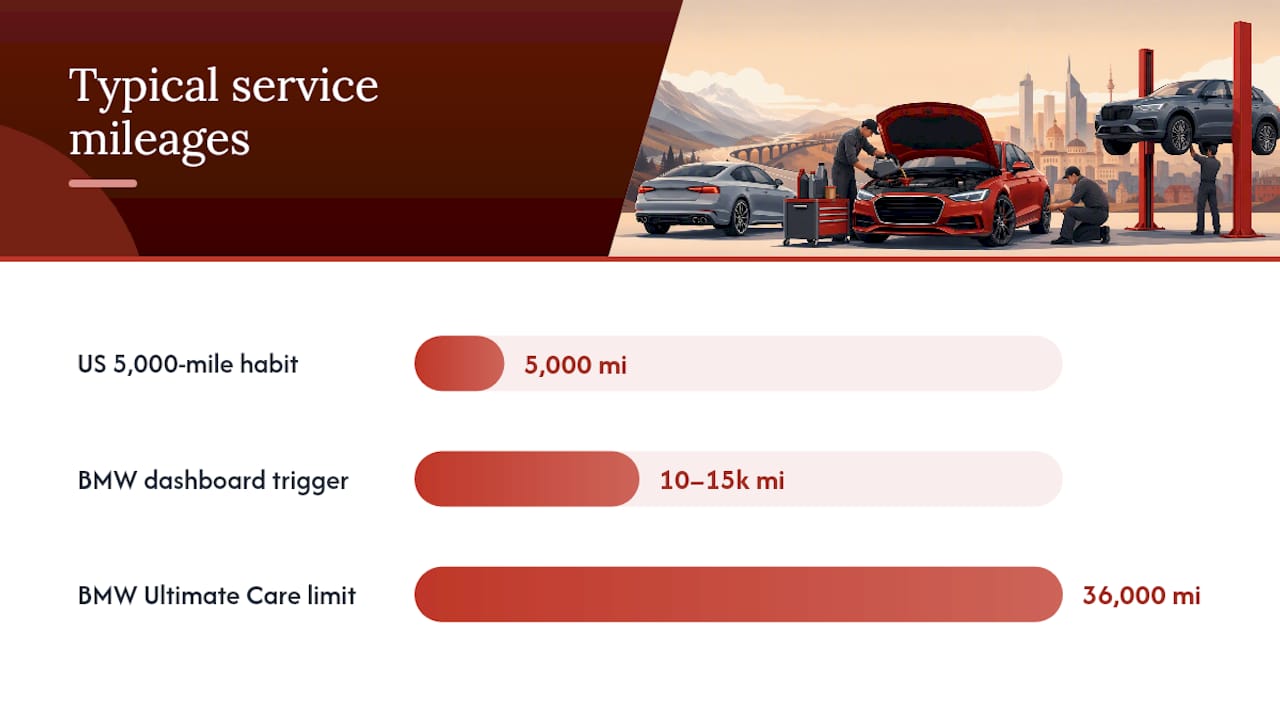
BMW uses Condition-Based Service, a system that tracks oil quality, mileage, brake pad wear, and even how hard you drive to calculate when service is due. The dashboard displays a countdown rather than a fixed number, and BMW documents this system alongside its BMW Ultimate Care coverage, which covers scheduled maintenance for the first 36 months or 36,000 miles on eligible models. Owners frequently see the display trigger anywhere from 10,000 to 15,000 miles depending on driving style, which surprises people used to a flat 5,000-mile oil change habit.
Mercedes runs a comparable system called ASSYST, which splits service into two tiers. Service A is the lighter check, usually oil, filter, and a visual inspection. Service B happens roughly every other Service A and adds brake fluid, cabin filters, and a deeper multi-point inspection. The interval rhythm lands close to BMW’s, but the A/B labeling makes it easier for owners to know what they’re paying for before they book.
Audi and Volkswagen lean on flexible service scheduling tied to your VIN. Audi Care, for example, prepays a bundle of scheduled services at signup, and both brands let you look up your specific model’s interval through a VIN-based tool rather than a universal chart. This matters because the same engine can carry different intervals depending on model year and market spec.
A few notes worth keeping in your back pocket:
- Mini and Volvo mostly mirror their parent companies’ condition-based logic (Mini borrows heavily from BMW’s system).
- Jaguar tends to publish more traditional fixed-interval schedules rather than full condition-based monitoring.
- Prepaid maintenance programs (BMW Ultimate Care, Audi Care) often require dealer-network service to stay valid, so check the fine print before you assume an independent shop visit won’t affect coverage.
A Mileage-Based Timeline You Can Actually Plan Around
If your car lacks a condition-based display, or you just want a paper trail you can follow without checking a dashboard every week, a mileage timeline works fine. Here’s what tends to happen at each stage across most European makes:
- 5,000 miles — Oil and filter change if you’re not on a long-life synthetic interval; tire rotation and a visual brake inspection.
- 10,000 miles — Cabin air filter check, fluid level review, and a multi-point inspection covering suspension bushings and CV boots.
- 30,000 miles — Engine air filter replacement, brake fluid flush (if not already done at the two-year mark), spark plug inspection on gas engines, and a coolant check.
- 60,000 miles — Transmission fluid service on most automatics and DSG-equipped VWs and Audis, brake pad and rotor evaluation, and a closer look at timing belt condition if your engine uses one.
- 90,000 miles — Timing belt replacement window opens for many belt-driven engines, along with water pump inspection, engine mount checks, and a full suspension review.
Some of these are nearly universal. Oil changes, brake fluid, and tire rotation apply regardless of brand. Others vary a lot by platform. A turbocharged four-cylinder Audi and a naturally aspirated Mercedes six won’t hit transmission service or spark plug intervals at the same mileage, so treat this timeline as a planning tool, not gospel.
One more thing: if a meaningful share of your driving involves short trips, towing, or extreme temperatures, owner’s manuals explicitly call this severe usage and recommend a tighter schedule. That gets its own section below because it changes almost everything on this list.
Why These Specific Services Matter So Much
Not every line item on a maintenance sheet carries equal weight. Some are cosmetic. A few, if skipped, turn into four-figure repair bills.
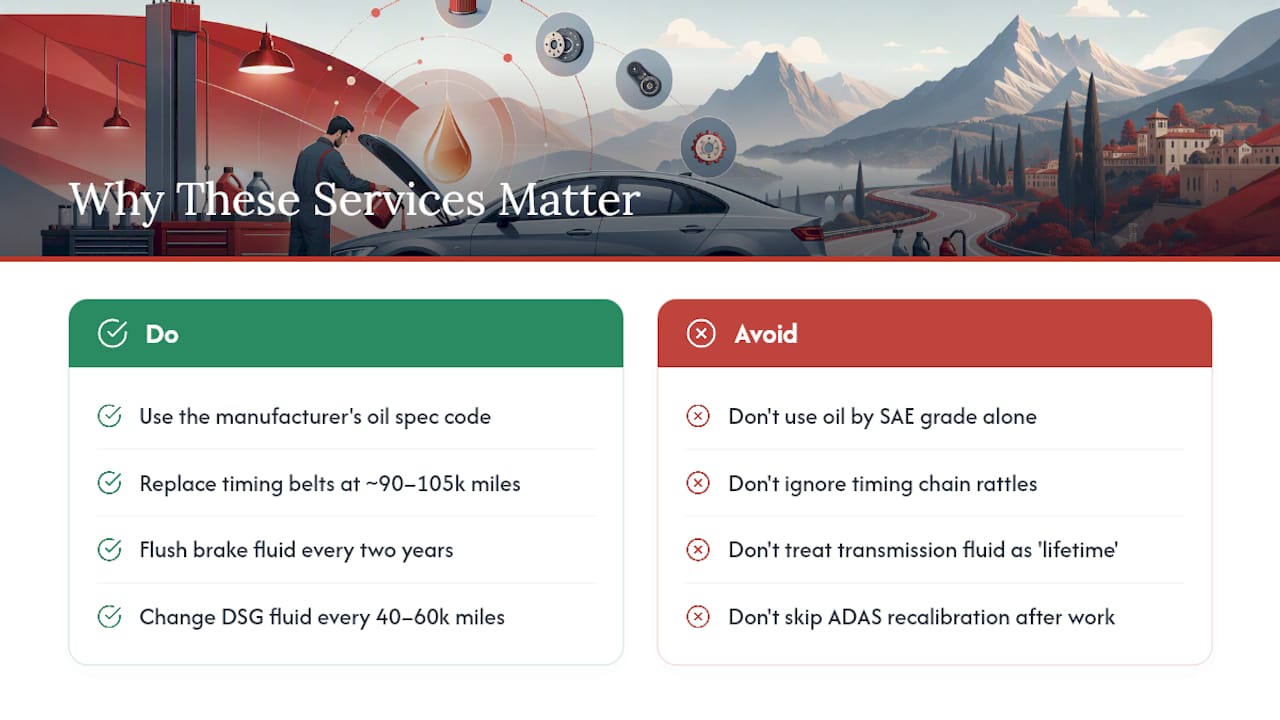
Oil specification matters more than viscosity. European manufacturers require oils that meet a specific approval code, not just a generic SAE grade. A manufacturer spec code tells you the oil was tested against that engine’s tolerances, additive package, and emissions hardware. Pouring in a bottle that matches the viscosity but skips the spec approval can foul particulate filters or damage variable valve timing components over time.
Timing belts and timing chains fail differently. A timing belt has a hard replacement window, often somewhere in the 90,000 to 105,000-mile range depending on the engine, and it gives almost no warning before it snaps. A timing chain is designed to last the life of the engine, but a stretched or worn chain announces itself with a rattling noise on cold start. Ignore that noise and you risk the chain jumping timing entirely.
Brake fluid absorbs moisture from the air, which lowers its boiling point and can lead to a soft pedal or corroded brake lines over time. That’s why a biennial flush is standard advice across nearly every European brand, regardless of mileage.
Transmission fluid is rarely truly “lifetime.” Dual-clutch DSG transmissions in particular need fluid and filter changes on a defined interval, often every 40,000 to 60,000 miles, despite marketing language that once suggested otherwise.
ADAS calibration is now part of routine service. Any time a windshield, bumper sensor, or alignment gets touched, cameras and radar units tied to lane-keep and adaptive cruise systems often need recalibration to function correctly.
Pro Tip: Keep a copy of your engine’s exact oil spec code (not just “5W-30”) saved in your phone. Quick-lube chains sometimes stock the wrong oil for European engines, and having the code on hand avoids a costly mismatch.
How Condition-Based Service Systems Actually Work
CBS, ASSYST, and similar systems use sensors to estimate wear rather than counting miles alone. Oil-quality sensors, brake pad wear sensors, and even data on how aggressively you accelerate all feed into an algorithm that predicts when a service is genuinely due.
That’s a smarter approach than a flat mileage number, but it has blind spots. Sensors don’t catch a slowly weeping coolant hose, a cracked plastic reservoir, or a battery that’s degrading quietly under the hood. Those need a human set of eyes.
Practical steps worth building into your routine:
- Look up your VIN-specific schedule through your manufacturer’s owner portal before assuming the dashboard countdown covers everything.
- Ask your shop to read the actual service counter data during diagnostics, not just reset it, since workshop tools that log diagnostic history can flag patterns before a warning light ever appears.
- Confirm any software update your shop performs doesn’t silently reset a counter that should have triggered a service.
When to Shorten Your Intervals for Severe Driving
Manufacturers define “severe usage” pretty specifically, and most European car owners in the U.S. qualify without realizing it.
If a large share of your trips run under five miles, if you tow, drive on gravel or dusty roads, or spend winters in freezing temperatures, you’re likely in severe territory. Owner’s manuals set separate thresholds for this, often cutting the oil-change interval roughly in half compared to normal use.
Cold climates add their own checklist. Battery capacity drops sharply in freezing temperatures, and the Department of Energy notes measurable fuel economy losses in cold weather, alongside slower engine warm-up that stresses components more.
Build these checks into a severe-usage routine:
- Test battery voltage and load capacity before the first hard freeze, not after a no-start morning.
- Verify coolant concentration matches your climate; a weak mix freezes or overheats more easily.
- Inspect the undercarriage for corrosion if you drive on salted roads.
- Cut your oil-change interval roughly in half if most trips are under five miles.
Keeping a Service History That Protects Your Warranty
A documented service history is worth more at resale than most owners expect, and it can be the difference between a covered warranty claim and a denied one.
Keep every invoice, whether digital or paper, along with printouts of your service counter reading at each visit. Some prepaid programs, like certain Audi Care packages, require dealer-network service to remain valid, while routine maintenance outside those programs can usually go to a qualified independent shop without voiding coverage.
Before any appointment, bring:
- Your owner’s manual or a photo of the maintenance schedule page.
- A printout or photo of the current CBS/ASSYST counter reading.
- Prior service invoices, especially for timing belt or transmission work.
- Both sets of keys if your car uses a comfort-access or keyless system.
What an ASE-Certified Shop Sees Most Often
The failures that show up most in European vehicles rarely start as dramatic breakdowns. They’re a cracked coolant reservoir nobody noticed, brake fluid nobody flushed in six years, or a sensor chain that finally trips a fault code after quietly degrading for months.
Sequencing diagnostics before jumping to repairs catches these early, and it’s usually cheaper than waiting for a warning light. Preventative inspections cost far less than the overheating repair or brake failure they prevent. If you want a technician to walk your specific VIN’s schedule against what your car’s counters actually show, that conversation is worth having before small issues turn expensive.
— Shingi
Getting Your European Car Serviced the Right Way in Lynnwood
Tom’s B & M Auto has serviced Lynnwood-area drivers since 1985, and for European models, that means matching the exact interval your BMW, Mercedes, Audi, or Volkswagen calls for, not a generic shop schedule.
The shop’s technicians use professional-grade OBD-II diagnostics to read your vehicle’s actual service counter data, not just clear the warning light, and every job carries a warranty. That covers the milestone work this article walks through: oil and filter service, brake fluid flushes, and full 30k/60k/90k service packages that bundle the inspections your BMW or VW is due for at each stage. Same-day appointments are often available, and pricing is upfront before any work starts, including BMW-specific repair experience and dedicated Volkswagen service for owners who’d rather skip the dealer wait.
Bring your owner’s manual, a photo of your current service counter reading, and any prior invoices when you book, and the shop can tell you exactly where you stand against your model’s real schedule.
Sources
- BMW MY26 Maintenance (2026) — BMW USA
- Normal maintenance schedule (Europe) | 2025 Genesis GV70
- Fueleconomy
FAQ
What Is the $3,000 Rule for Cars?
It’s a rule of thumb some owners use to decide whether a repair is worth it: if a single repair estimate approaches a high cost on an older car, many drivers weigh that cost against the car’s current value before authorizing the work.
What Is the 30-60-90 Rule for Cars?
It refers to the common milestone services scheduled at 30,000, 60,000, and 90,000 miles, covering items like air filters, brake fluid, transmission fluid, and, on many engines, timing belt replacement near the 90,000-mile mark.
What Is a Typical Car Maintenance Schedule?
A typical schedule follows either the manufacturer’s condition-based display, where equipped, or a mileage baseline of oil changes every 5,000 to 10,000 miles with fuller inspections at 30,000-mile intervals, tightened further under severe driving conditions.
How Often Should Brake Fluid Be Replaced on a European Car?
Most manufacturers and independent shops recommend flushing brake fluid roughly every two years regardless of mileage, since it absorbs moisture over time and loses braking effectiveness.
Can an Independent Shop Perform Scheduled Maintenance Without Voiding My Warranty?
Yes, in most cases a qualified independent shop like Tom’s B & M Auto can perform routine scheduled maintenance without affecting your factory warranty, though certain prepaid dealer programs may require dealer-network service to keep that specific prepaid coverage valid.
Recommended
- 5,000–10,000 Miles? Oil Change Interval U.S. Drivers Should Follow
- How to Service a European Vehicle Brake System
- Why Your Car Burns Oil: Causes, Checks, and Fixes
- European Car Repair Challenges: What Owners Must Know
Leave a Reply