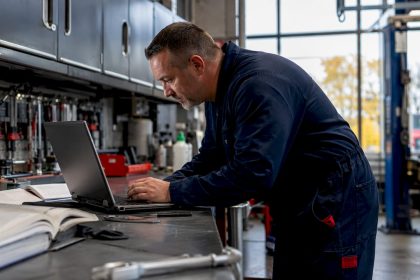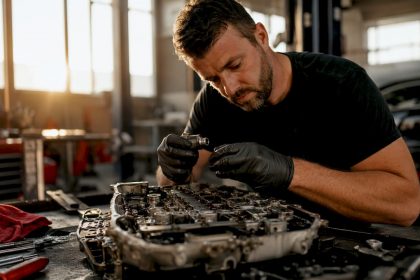
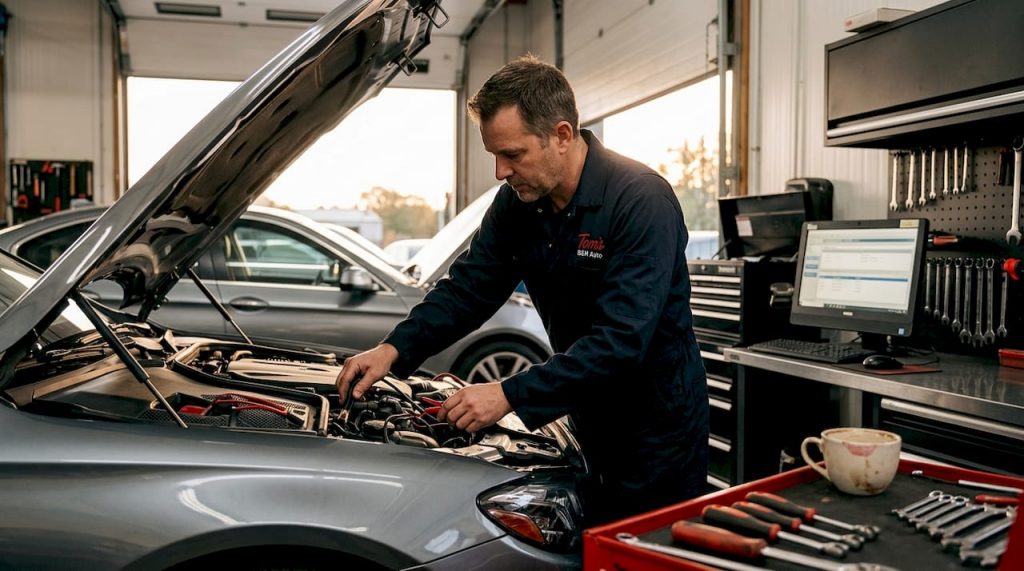
European car repair challenges are defined by a single root cause: manufacturers locking critical software functions behind proprietary systems that independent shops cannot access. Brands like Porsche, Peugeot, and Alfa Romeo now build vehicles where electronics govern everything from oil service resets to suspension calibration. EU Regulation 461/2010 requires automakers to share repair data with independent shops, yet OEMs routinely restrict software in ways that regulation has not fully addressed. The result is a repair market where owning a European vehicle means navigating dealer dependencies, rising costs, and increasingly complex mechanical systems.
1. European car repair challenges start with software barriers
The most disruptive force in European auto service today is not a broken part. It is a locked software ecosystem. Digital control mechanisms have shifted market power decisively toward OEMs, leaving independent shops able to perform mechanical work but unable to complete the job without dealer-level access.
A Porsche lawsuit filed in 2025 made this concrete. Porsche’s software locks prevent independent shops from resetting the oil service indicator, forcing owners back to authorized dealers for a task that takes minutes. This is not an isolated case. Across Stellantis brands, BMW, and Volkswagen Group vehicles, service resets and module programming require cryptographic authentication that only OEM-authorized tools carry.
“For repairs requiring service reset or programming, shops need exact OEM-level software with secure cryptographic access. Without it, the repair is technically incomplete even if the part is physically fixed.”
The practical consequence is real. Your independent shop may replace a turbocharger correctly, but if the ECU cannot be reprogrammed to recognize the new part, warning lights stay on and the vehicle may enter a reduced-power mode. Shops working on BMW diagnostics and other European platforms need OEM-grade tools, not just generic OBD-II scanners, to close out the repair properly.
Common software-related barriers at independent shops:
- Oil service and inspection resets locked to dealer software
- New component activation requiring OEM security tokens
- Firmware updates unavailable outside authorized networks
- Cybersecurity protocols blocking third-party scan tools from full module access
2. Common mechanical problems in European vehicles
Software restrictions compound an already demanding mechanical picture. European vehicles are engineered to tight tolerances, and that precision creates specific failure patterns that owners should recognize before they become expensive.
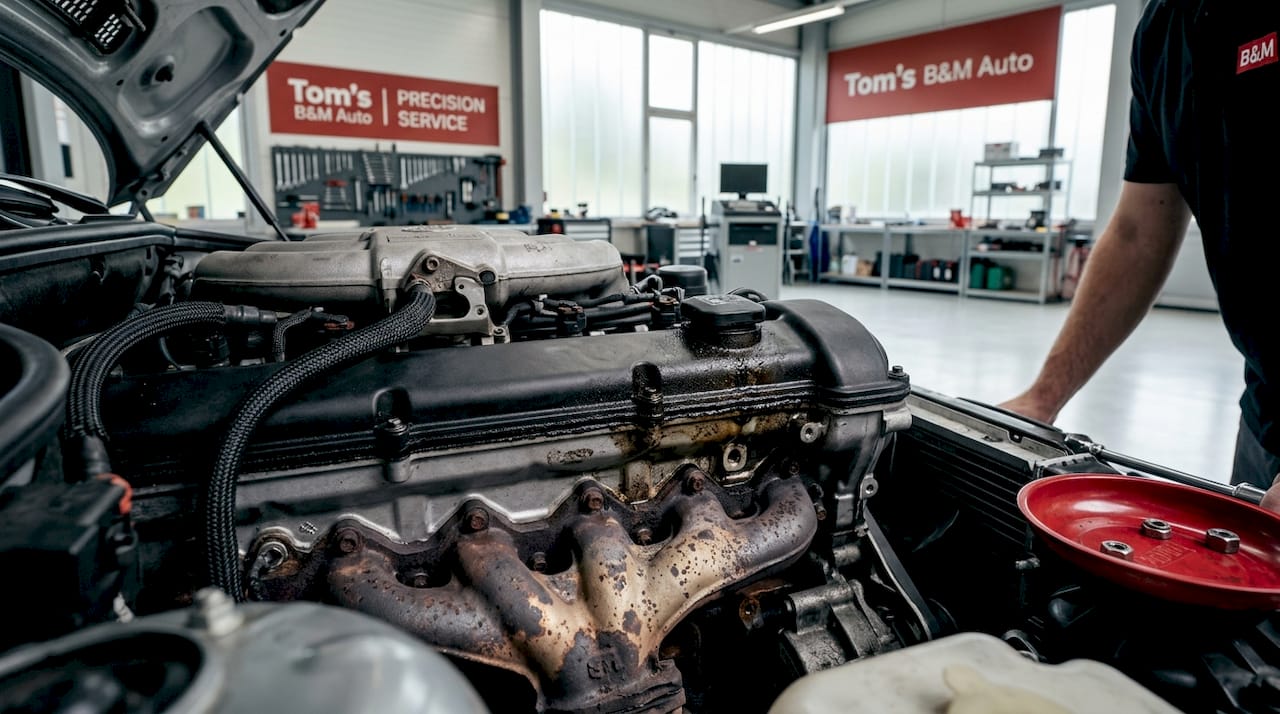
| System | Common failure | Typical cost range |
|---|---|---|
| Valve cover gaskets | Oil leaks onto exhaust manifold | $300 to $600 |
| Control arms and bushings | Suspension knock, uneven tire wear | $400 to $900 |
| Cooling system | Radiator or water pump failure | $500 to $1,200 |
| Turbocharger | Oil starvation, boost loss | $1,500 to $4,000 |
| Emissions systems (DPF, EGR) | Fault codes, limp mode | $800 to $3,500 |
Modern emissions and electronic system failures in European cars can reach repair costs up to €10,000, a figure that reflects both parts pricing and the diagnostic labor required to isolate faults across interconnected systems. That cost ceiling is not reserved for exotic vehicles. A diesel particulate filter replacement on a Volkswagen Passat or a BMW 3 Series can easily exceed $2,500 once labor and programming are included.
The cooling system is a particularly common failure point across German and French brands. BMW’s N54 and N55 engines are known for water pump and thermostat failures before 80,000 miles. Peugeot and Citroën turbodiesels develop EGR valve deposits that trigger limp mode at highway speeds. Addressing exhaust and emissions repairs early prevents the cascade where one failed component forces the next one to overwork.
High-frequency mechanical issues to monitor:
- Valve cover and camshaft seal leaks on BMW inline-six engines
- Front control arm bushing wear on Audi, Volkswagen, and Volvo platforms
- Coolant expansion tank cracks on BMW E90 and F30 series
- Dual-mass flywheel wear on European diesel transmissions
3. How technician shortages make repairs slower and costlier
The labor side of European auto service issues is deteriorating faster than most owners realize. Diagnostic service delays rose 40% across European repair markets, and average repair cycles lengthened by 11 days, driven directly by a shortage of certified technicians. EVs now represent over 60% of the EU new vehicle fleet, and the technician pipeline has not kept pace.
Apprenticeship numbers in automotive trades have declined across Germany, France, and the UK over the past decade. The declining apprenticeship numbers combined with mandatory EV certification requirements mean that shops competing for qualified technicians are paying significantly more, and passing those costs to customers. A shop that once charged $120 per hour for European vehicle labor now charges $160 or more in many metro markets.
For owners, this translates directly to longer waits for appointments, extended diagnostic windows, and the risk that a shop without the right specialist will misdiagnose a complex fault. Choosing a shop with ASE-certified technicians who hold specific European vehicle training is not a luxury. It is the difference between a correct first repair and a second visit.
Pro Tip: When booking a European vehicle repair, ask the shop directly whether their technicians hold OEM-specific training for your brand. A shop certified for BMW or Audi work will have access to model-specific service data that a general shop will not.
4. Practical strategies for managing repair costs and delays
Owning a European vehicle in 2026 requires a proactive maintenance posture. Reactive repairs on these platforms cost two to three times more than scheduled maintenance because diagnostic labor alone can consume an hour before a wrench touches the car.
The first strategy is interval discipline. European manufacturers publish specific service intervals for brake fluid, spark plugs, and transmission fluid that many owners skip because the car feels fine. Skipping a BMW transmission fluid service at 60,000 miles, for example, dramatically increases the risk of a $4,000 mechatronic unit failure at 90,000 miles.
The second strategy is shop selection. Authorized dealerships have full software access but charge premium labor rates and often have limited appointment availability. Independent shops with OEM-level diagnostic tools offer a middle path. Shops with proper OEM tools can complete service resets and programming that generic shops cannot, without the dealership markup. Verify tool capability before authorizing any work that involves module programming or service indicator resets.
Pro Tip: Request a pre-purchase inspection from a European-specialist shop before buying any used European vehicle. A one-hour inspection that surfaces a failing water pump or cracked expansion tank saves thousands in post-purchase surprises.
The third strategy is parts sourcing awareness. OEM parts from authorized dealers carry a premium, but aftermarket alternatives from suppliers like Bosch, Febi Bilstein, and Lemförder meet OEM specifications at 30 to 50 percent lower cost. Ask your shop which parts tier they use and whether it affects your warranty coverage.
5. How the recall process actually works for European car owners
Recalls are one area where European car ownership works in your favor, provided you understand the logistics. The recall process itself is straightforward: the manufacturer notifies registered owners by mail or email, directs them to an authorized dealer, and the repair is performed at no cost.
The Stellantis recall affecting 77,500 vehicles across Peugeot, Citroën, and Alfa Romeo models in Spain illustrates how recalls can be simple. The fix involved replacing a protective cover to eliminate a fire risk, took approximately 30 minutes, and cost owners nothing. That is the best-case scenario. The challenge is logistics, not the repair itself.
What to expect during a recall:
- Notification arrives by mail or through the manufacturer’s owner portal
- Parts may not be immediately available at your nearest dealer
- Scheduling can take two to six weeks during high-volume recall periods
- Confirm the specific repair scope before your appointment so you are not surprised by additional findings
- Ask whether a loaner vehicle is available if the repair requires an overnight stay
Recall fixes vary widely in complexity. Some are 30-minute component swaps. Others require parts that are back-ordered for months. Treat every recall as a logistics project: confirm parts availability when you call to schedule, and ask the service advisor for an honest time estimate.
6. ECU tuning and aftermarket modifications add another layer
Owners who modify their European vehicles face a compounded version of the standard repair challenges. ECU tuning on platforms like the BMW N20, Volkswagen EA888, or Audi 2.0 TFSI introduces calibration variables that complicate fault diagnosis. Common ECU tuning mistakes at the workshop level include improper base map selection and ignoring hardware limitations, which can trigger fault codes that look like mechanical failures but are actually calibration errors.
Any shop diagnosing a modified European vehicle needs to know the tune is present before interpreting fault codes. A misfire code on a tuned engine may point to a fueling table issue rather than a physical injector fault. Disclose modifications to your technician upfront. Withholding that information leads to misdiagnosis and unnecessary parts replacement.
Key takeaways
European car repairs are most effectively managed by choosing shops with OEM-level software access, following manufacturer service intervals, and treating recalls as logistical tasks that require proactive scheduling.
| Point | Details |
|---|---|
| Software access determines repair quality | Shops without OEM-level tools cannot complete service resets or module programming, leaving repairs technically incomplete. |
| Mechanical failures follow predictable patterns | Cooling systems, valve cover gaskets, and emissions components are the highest-frequency failure points across European brands. |
| Technician shortages increase wait times and costs | A 40% rise in diagnostic delays means booking appointments early and choosing certified specialists matters more than ever. |
| Recalls are free but require logistics management | Confirm parts availability and appointment timing before assuming a recall will be resolved quickly. |
| Proactive maintenance prevents compounding costs | Skipping manufacturer-specified fluid and filter intervals on European vehicles accelerates expensive downstream failures. |
The real cost of complexity: a perspective from the shop floor
The conversation about European car repair challenges usually focuses on what goes wrong. What gets less attention is why owners keep choosing these vehicles despite the complexity, and what that says about how to manage them intelligently.
From my experience watching how these repairs unfold, the owners who fare best are not the ones who avoid problems. They are the ones who build a relationship with a shop that has the right tools and the right training before something breaks. A BMW owner who shows up at a general shop with a cryptographic software lock issue is going to pay for two diagnostic sessions: one at the general shop and one at a specialist. That is a preventable cost.
The aftermarket is also shifting in ways that favor informed owners. More independent shops are investing in OEM-level diagnostic platforms like ISTA for BMW or ODIS for Volkswagen Group vehicles. This narrows the gap between dealer and independent service, but only at shops that have made that investment. The question to ask any shop before authorizing European vehicle work is simple: what scan tool are you using, and does it have full programming capability for my specific model year?
The long-term value of a European vehicle depends almost entirely on maintenance discipline and shop selection. The engineering is genuinely excellent. The complexity is real. Both things are true, and the owners who accept both tend to have far better outcomes than those who expect European reliability to be as hands-off as a Toyota Camry.
— Shingi
Get your European vehicle diagnosed right the first time
Tom’s B & M Auto has served Lynnwood and the surrounding area since 1985, and European vehicles are a regular part of the shop’s daily work. ASE-certified technicians use professional-grade OBD-II diagnostics to identify faults accurately, and the shop carries the software access needed to complete service resets and programming that generic shops cannot finish. Whether you drive a BMW, Volvo, or Audi, upfront pricing and a 24-month / 24,000-mile warranty back every repair. If you need engine repair in Kenmore or a full diagnostic on a European vehicle anywhere in the area, same-day appointments are often available. Call or book online to get started.
FAQ
Why can’t independent shops reset my European car’s service light?
Many European manufacturers use proprietary software with cryptographic security that blocks third-party scan tools from completing service resets. Without OEM-level access, a shop can perform the physical repair but cannot clear the indicator.
What are the most common mechanical problems in European cars?
Valve cover gasket leaks, control arm bushing wear, cooling system failures, and emissions component faults like clogged DPF filters are the most frequent issues across German, French, and Swedish brands.
How long does a recall repair take for a European vehicle?
Recall repair times vary widely. Simple fixes like the Stellantis protective cover replacement take about 30 minutes, while complex recalls involving back-ordered parts can extend to several weeks.
Does the technician shortage affect repair costs for European car owners?
Diagnostic delays have risen 40% in European markets due to certified technician shortages, which translates directly to longer wait times and higher labor rates at shops competing for qualified staff.
Should I use an authorized dealer or an independent shop for European car repairs?
Independent shops with OEM-level diagnostic tools offer comparable repair quality at lower labor rates. Verify that the shop has brand-specific software access before authorizing any work involving programming or service resets.