

The transmission solenoid is the electro-hydraulic valve that controls transmission fluid flow inside your automatic transmission, and without it, your car simply cannot shift gears correctly. Every time your vehicle accelerates or decelerates, the transmission control module (TCM) or engine control unit (ECU) sends an electrical signal to the appropriate solenoid, which opens or closes to direct hydraulic pressure to the right clutch packs and bands. The result is a smooth, timed gear change you barely notice when everything works as it should.
Here is a quick overview of what transmission solenoids actually do:
- Shift solenoids open fluid passages to engage specific gears when the TCM commands a gear change.
- Pressure control solenoids (also called EPC or line pressure solenoids) regulate overall hydraulic pressure distributed throughout the valve body.
- Torque converter clutch (TCC) solenoids lock and unlock the torque converter to improve efficiency and fuel economy at cruising speeds.
- Control solenoids apply precise pressure to valve body valves, which then modulate clutch engagement for smooth transitions.
A single faulty solenoid can throw off the entire gear selection sequence, affecting drivability, fuel economy, and long-term transmission health.
Table of Contents
- How transmission solenoids actually work inside your vehicle
- Warning signs that your transmission solenoid may be failing
- How mechanics diagnose a solenoid fault without guessing
- What to expect when a solenoid needs to be repaired or replaced
- Why transmission solenoids matter more than most drivers realize
- Key Takeaways
- Get your transmission diagnosed right the first time at Tom’s B & M Auto
How transmission solenoids actually work inside your vehicle
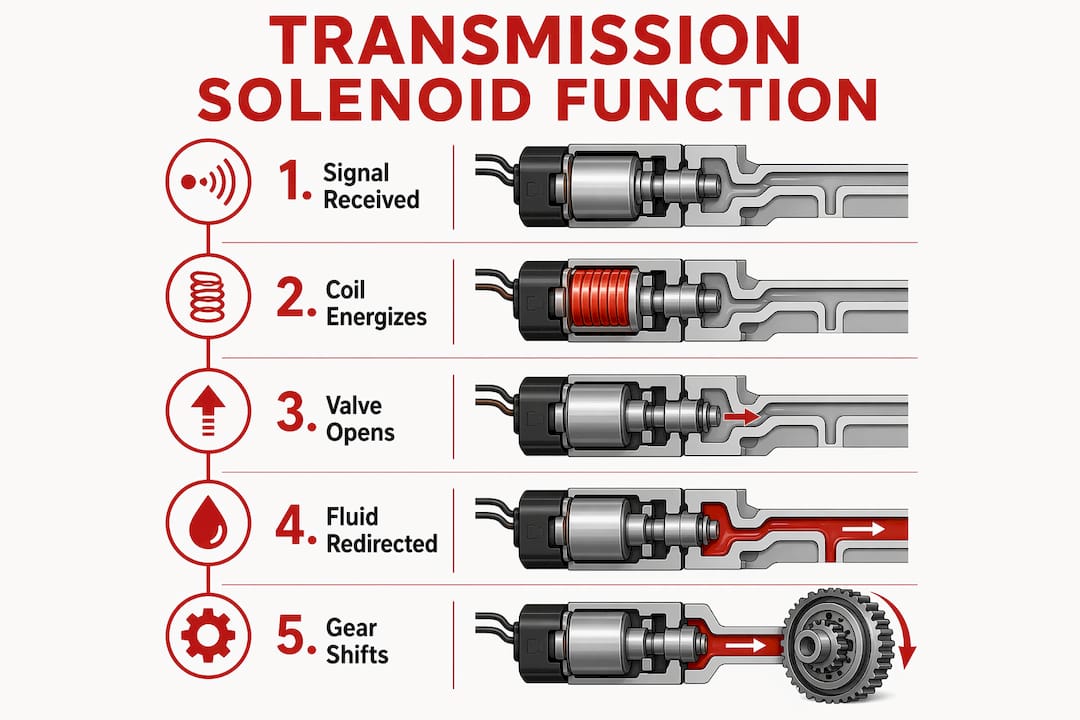
The transmission solenoid mechanism starts with a simple but clever design: a cylindrical coil of wire wrapped around a spring-loaded plunger inside a steel body. When the TCM sends an electrical pulse to that coil, it becomes an electromagnet and forces the plunger to move, opening a fluid passage in the valve body. Hydraulic pressure then flows to the targeted clutch pack or band, engaging the gear. When the signal stops, the return spring pushes the plunger back, closing the passage.

What makes modern solenoids more sophisticated than their predecessors is their ability to vary pressure continuously rather than just switching on and off. Variable-force solenoids (VTS), like those developed by Bosch, modulate pilot pressure across a range rather than toggling between two states, giving the transmission far finer control over shift feel and timing. This is why a well-maintained modern automatic shifts so much more smoothly than a transmission from the 1980s.
Solenoids are mounted directly to the valve body, which sits inside the transmission pan. Each solenoid connects to the TCM through a wiring harness. The TCM reads real-time inputs from sensors monitoring throttle position, vehicle speed, engine load, and gear selector position, then fires the correct solenoid at precisely the right moment. The number of solenoids varies by vehicle; older or simpler automatics use fewer shift solenoids, while modern advanced transmissions feature multiple solenoids each performing specific functions.
- The coil generates an electromagnetic field when energized.
- The plunger moves to open or restrict the fluid channel.
- Hydraulic pressure shifts to the target clutch or band.
- The gear engages; the TCM monitors the result and adjusts.
Pro Tip: Solenoids continuously adapt to driving conditions by reading real-time engine and load data. If you notice your transmission shifting differently under heavy acceleration versus light cruising, that is the solenoid system doing exactly what it was designed to do.

Warning signs that your transmission solenoid may be failing
Solenoid problems rarely announce themselves all at once. They tend to start subtly, with a slight hesitation when shifting from first to second, or a brief shudder when the torque converter locks up on the highway. Left alone, those small symptoms grow into something you cannot ignore.
The most common signs of solenoid-related shifting problems include:
- Delayed or harsh shifts: The transmission hesitates before engaging a gear, or slams into it instead of gliding in.
- Gear slipping: The transmission briefly drops out of gear mid-acceleration, causing a loss of power.
- Limp mode: The TCM detects a fault and locks the transmission in a single gear (usually second or third) to protect internal components. You can still drive, but barely.
- Check Engine light: A solenoid fault almost always triggers a diagnostic trouble code (DTC), typically in the P0750–P0770 range for shift solenoids.
- Erratic or unpredictable shifting: The transmission shifts at the wrong RPM, hunts between gears, or refuses to downshift when you slow down.
Fuel economy also takes a hit when solenoids malfunction. A stuck or sluggish pressure control solenoid can keep line pressure too high or too low, forcing the engine to work harder than necessary. A faulty TCC solenoid prevents the torque converter from locking up at highway speeds, which burns more fuel on every mile.
Driving with a failing solenoid risks transmission damage, overheating, and significantly more expensive repairs down the road. If you notice any of these symptoms, getting a diagnostic scan done promptly is the right call.
Ignoring early warning signs is where most of the real cost comes from. A solenoid replacement is a fraction of the price of a full transmission rebuild.
How mechanics diagnose a solenoid fault without guessing
The biggest mistake a shop can make with transmission problems is replacing parts before confirming the actual cause. Incorrect sensor data or wiring faults can send the TCM wrong signals, producing symptoms that look identical to a failed solenoid even when the solenoid itself is perfectly fine. Misdiagnosis is common precisely because solenoids sit at the intersection of the electrical system and the hydraulic system.
A proper diagnosis follows a specific sequence:
- OBD-II scan for DTCs: The first step is always pulling the fault codes. Codes like P0750 (Shift Solenoid A Malfunction) or P0745 (Pressure Control Solenoid A) point the technician toward the right circuit, but they do not confirm the solenoid is the failed component.
- Electrical continuity and resistance testing: Using a multimeter, the technician checks the solenoid’s resistance against the manufacturer’s specification. A reading outside that range indicates a failed coil winding.
- Wiring harness inspection: Damaged wiring or a failing TCM are common root causes of shifting problems that get blamed on solenoids. Checking for chafed wires, corroded connectors, and voltage drop is non-negotiable before ordering parts.
- Solenoid activation test: With a scan tool capable of bidirectional control, the technician can command individual solenoids to activate and listen or feel for the characteristic click that confirms mechanical function.
- Transmission fluid inspection: Burnt, dark, or metallic-smelling fluid points to contamination that may have damaged the solenoid internally.
Pro Tip: Professional diagnostics prioritize the electrical system before touching the solenoid itself. A shop that jumps straight to replacement without testing the wiring and TCM signals is likely to hand you back a car with the same problem.
What to expect when a solenoid needs to be repaired or replaced
Once a solenoid is confirmed as the root cause, the repair process is more involved than swapping a sensor on the engine. Here is what the job typically looks like:
- Drain the transmission fluid. The pan must come off, so the fluid comes out first.
- Remove the transmission pan. This exposes the valve body and the solenoid pack or individual solenoids mounted to it.
- Access and remove the faulty solenoid. Most solenoids are held in place by a single bolt or a clamping plate and disconnect from the wiring harness via a plug.
- Inspect the valve body. While the pan is off, a good technician checks for debris, scoring, or wear in the valve body channels.
- Install the new solenoid. OEM-spec or quality aftermarket solenoids are both options; understanding when to repair vs. replace with aftermarket parts can save money without sacrificing reliability.
- Replace the transmission filter and gasket. Since the pan is already off, skipping this step would be a missed opportunity.
- Flush and refill with fresh fluid. Transmission fluid contamination causes solenoids to stick or fail prematurely, so putting clean fluid back in protects the new part from day one.
- Clear DTCs and road test. The technician clears the fault codes, confirms the repair with a test drive, and verifies no new codes return.
The complexity of solenoid replacement varies significantly by vehicle. On many Toyota and Honda models, the valve body is accessible with the pan removed and the job takes a few hours. On some European vehicles or trucks with transaxle configurations, the transmission may need to come out of the vehicle entirely, which multiplies labor time and cost considerably.
Pro Tip: When replacing a solenoid, always address the wiring harness and connector at the same time. A corroded or brittle connector on a new solenoid will cause the same fault code within months.
Why transmission solenoids matter more than most drivers realize
Solenoids are not just a convenience feature. They are the mechanism by which your transmission stays in sync with your engine under every driving condition, from a cold start on a winter morning to a full-throttle merge onto the freeway. When they work correctly, you never think about them. When they do not, the effects ripple through the entire drivetrain.
Here is what healthy solenoid function actually protects:
- Optimal hydraulic pressure: Consistent pressure keeps clutch packs engaging fully and releasing cleanly, which prevents slipping and the heat that comes with it.
- Fuel efficiency: A properly functioning TCC solenoid locks the torque converter at highway speeds, reducing engine RPM and fuel consumption. A stuck-open or stuck-closed TCC solenoid eliminates that efficiency gain on every highway mile.
- Emissions: A transmission that hunts for gears or stays in the wrong ratio forces the engine to run outside its optimal efficiency window, increasing exhaust emissions.
- Transmission longevity: Smooth, correctly timed shifts reduce wear on clutch packs, bands, and the valve body itself.
The most common root causes of solenoid failure are not mechanical wear but rather fluid contamination and electrical degradation. Microscopic debris or burnt fluid can block the tiny orifices inside a solenoid, causing it to stick partially open or closed. Routine transmission fluid maintenance is the single most effective way to extend solenoid life, and it costs a fraction of what a solenoid replacement does.
Electrical issues are the other major culprit. Corroded connectors, chafed wiring, and aging TCMs all degrade the signal quality that solenoids depend on. A solenoid receiving a weak or intermittent signal behaves erratically, producing the same symptoms as a mechanically failed unit. That is why a transmission concern that looks like a solenoid or gear slipping issue always warrants a full system inspection rather than a parts-swap approach.
Key Takeaways
Transmission solenoids are the electro-hydraulic valves that control fluid flow for every gear shift in an automatic transmission, and their failure affects drivability, fuel economy, and long-term transmission health.
| Point | Details |
|---|---|
| Solenoids control every gear shift | They open and close fluid passages in the valve body in response to TCM/ECU signals. |
| Failure symptoms appear early | Delayed shifts, gear slipping, limp mode, and a Check Engine light are the key warning signs. |
| Diagnosis must precede replacement | Wiring faults and TCM issues mimic solenoid failure; testing before replacing avoids unnecessary cost. |
| Fluid maintenance protects solenoids | Contaminated or burnt fluid is a leading cause of solenoid sticking and premature failure. |
| Repair complexity varies by vehicle | Some models require full transmission removal; consult a professional before estimating repair scope. |
Get your transmission diagnosed right the first time at Tom’s B & M Auto
If your vehicle is showing any of the symptoms covered above, the worst move is waiting. Tom’s B & M Auto has been diagnosing and repairing transmissions for drivers in Lynnwood, WA since 1985, with ASE-certified technicians and professional-grade OBD-II diagnostic equipment that reads the full picture before any parts are ordered.
Whether your Check Engine light just came on or your transmission has been acting up for weeks, Tom’s B & M Auto offers upfront pricing, same-day appointments when available, and a 24-month/24,000-mile warranty on all work. Financing is available for repairs that go beyond a simple solenoid swap.
Call or schedule online today. A transmission problem caught early is always cheaper than one that waited.