
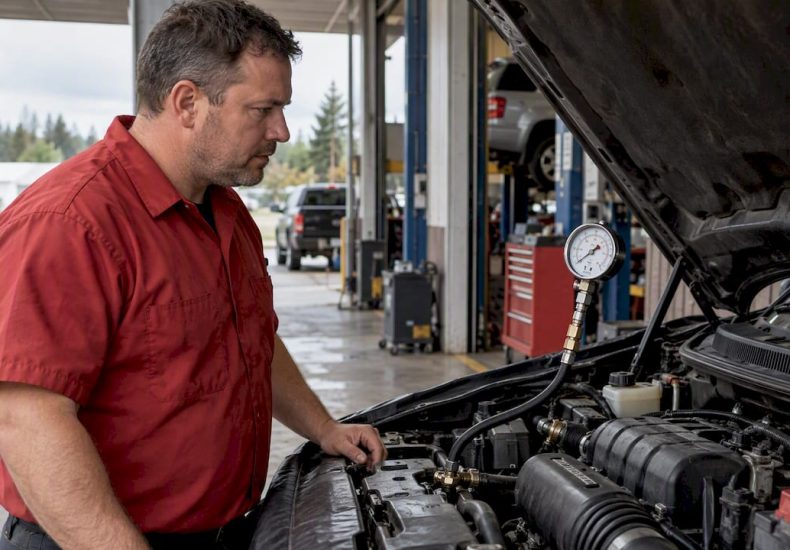
Drivers: Start With Live Fuel Pressure If Power Drops Accelerating
A sudden loss of power accelerating almost always traces back to one of four systems: air, fuel, ignition or the exhaust and drivetrain. If the power loss is severe or paired with smoke, stop driving and get the car checked. Otherwise, the right first move is an OBD-II scan with live data, or a shop reading fuel pressure while the engine is under load.
TL;DR:
- Fuel pumps can pass static pressure tests but still fail under load, so testing fuel pressure during acceleration is essential.
- Exhaust restrictions from clogged catalytic converters or diesel particulate filters often cause power drops specifically during high demand or uphill driving.
- Mechanical engine wear, such as low compression or timing issues, requires internal tests like compression or leak-down checks for proper diagnosis.
- Sensors like the throttle position, MAP, or oxygen sensors can trigger limp mode, which reduces power deliberately to protect the engine.
- Accurate diagnosis relies on live data and specific test readings rather than guesswork, making proper testing critical to avoid unnecessary repairs.
Table of Contents
- Common Causes of Loss of Power During Acceleration
- Step-by-Step Diagnostic Roadmap for Power Loss
- What Each Diagnostic Test Actually Reveals
- What to Do Safely When Power Suddenly Drops
- Repair Costs and Timelines by Cause
- What Trustworthy Diagnostics Look Like
- Why Guessing at Parts Costs More Than Testing Does
- Sources
- FAQ
Common Causes of Loss of Power During Acceleration
Airflow problems are often the simplest to fix and the easiest to overlook. A clogged air filter starves the engine of oxygen, a failing mass airflow (MAF) sensor sends the computer bad readings, and a cracked intake hose lets unmetered air sneak in. Any of these can make a car hesitate when accelerating because the engine cannot build the air-fuel mixture it needs.
Fuel-delivery trouble is next in line. A blocked fuel filter chokes supply, a weakening fuel pump cannot keep up with demand once you press the gas, and a stuck fuel pressure regulator throws off the whole system. According to the ASE L1 study guide, low fuel delivery and stuck-closed pressure regulators are common findings when a vehicle lacks power under heavy load.
Ignition issues show up as misfires, and misfires do double damage: they cause the hesitation you feel, and over time they can send unburned fuel into the exhaust where it overheats the catalytic converter. Worn spark plugs and failing ignition coils are the usual suspects. You can read more about spark plug wear signs if you suspect the plugs are the problem.
Exhaust restriction is a quieter cause but a serious one. A clogged catalytic converter or diesel particulate filter creates backpressure that fights the engine on every acceleration attempt. The EPA’s technical background on catalytic converters explains that chronic misfires or an overly rich mixture can overheat the converter until the internal substrate melts, turning a fixable ignition problem into an expensive exhaust repair. Diesel truck owners dealing with a clogged diesel particulate filter see a similar pattern: power drops hardest under load, exactly when the filter needs to flow the most exhaust.
Mechanical wear inside the engine, such as low compression or a stretched timing chain, produces the same symptom but needs a different fix entirely. So does a slipping transmission or a failing torque converter, both of which can feel exactly like an engine losing power even though the engine itself is fine.
Finally, a faulty throttle position sensor, MAP sensor or oxygen sensor can trigger the computer’s limp mode, deliberately cutting power to protect the engine. That one often resolves with a sensor replacement rather than anything mechanical.
- Air: dirty filter, bad MAF sensor, intake leak
- Fuel: clogged filter, weak pump, stuck regulator
- Ignition: worn plugs, failing coils, misfires
- Exhaust: clogged catalytic converter or DPF
- Mechanical: low compression, timing wear
- Drivetrain: slipping gears, torque-converter fault
- Sensors: throttle position, MAP, oxygen sensor issues
Pro Tip: Note exactly when the power loss happens, uphill, cold start, high RPM, because that detail narrows the list faster than any single test.
Step-by-Step Diagnostic Roadmap for Power Loss
Chasing symptoms with parts is the most expensive way to fix a car. AA1Car’s diagnostic guidance stresses systematic testing over guesswork, and that advice holds whether you are doing this yourself or handing the job to a shop.
- Decide if it is safe to keep driving: smoke, burning smells or repeated stalling mean you pull over now.
- Check the obvious: fuel level, warning lights, unusual noises or smoke visible from the tailpipe.
- Pull OBD-II codes and look at live data, not just the check engine light.
- Review long-term and short-term fuel trim (LTFT/STFT) at steady RPM, since a lean trim points toward air or fuel starvation and a rich trim points toward a sensor or injector problem.
- Count any stored misfire events and note which cylinders are affected.
- Write down the exact conditions: uphill versus flat ground, cold engine versus warm, light throttle versus full acceleration.
- Ask for a fuel pressure test performed while the engine is under load, not just sitting at idle.
- If fuel and ignition check out, move to exhaust backpressure or DPF inspection, a compression test, or a transmission scan.
Fuel pressure deserves special attention here. A pump can show acceptable pressure at idle and still fail the moment you demand acceleration, which is why static-only testing misses so many intermittent failures. Mechanics often watch for a pressure drop of more than 5 psi once the engine is loaded, a practical threshold drawn from field experience rather than a fixed industry standard, according to AA1Car’s testing guidance. That single test, done under real acceleration demand, often answers the fuel-pump question faster than replacing the part on a guess.
Pro Tip: Before you authorize any repair, ask what reading or test proved the part was bad. A part swap without evidence is a guess you are paying for.
If you want a closer look at how LTFT numbers translate into a diagnosis, see our guide on why your car hesitates during acceleration.
What Each Diagnostic Test Actually Reveals
OBD-II live data is the starting point for almost every case. LTFT and STFT readings show whether the computer is adding or subtracting fuel to compensate for a problem, and misfire counters point straight at specific cylinders. A lean trim with no misfires usually means air or fuel starvation; a rich trim with scattered misfires points toward ignition.
Fuel pressure testing under load can catch failures that a static check misses, because some fuel pumps only drop pressure when the engine demands more fuel during acceleration.
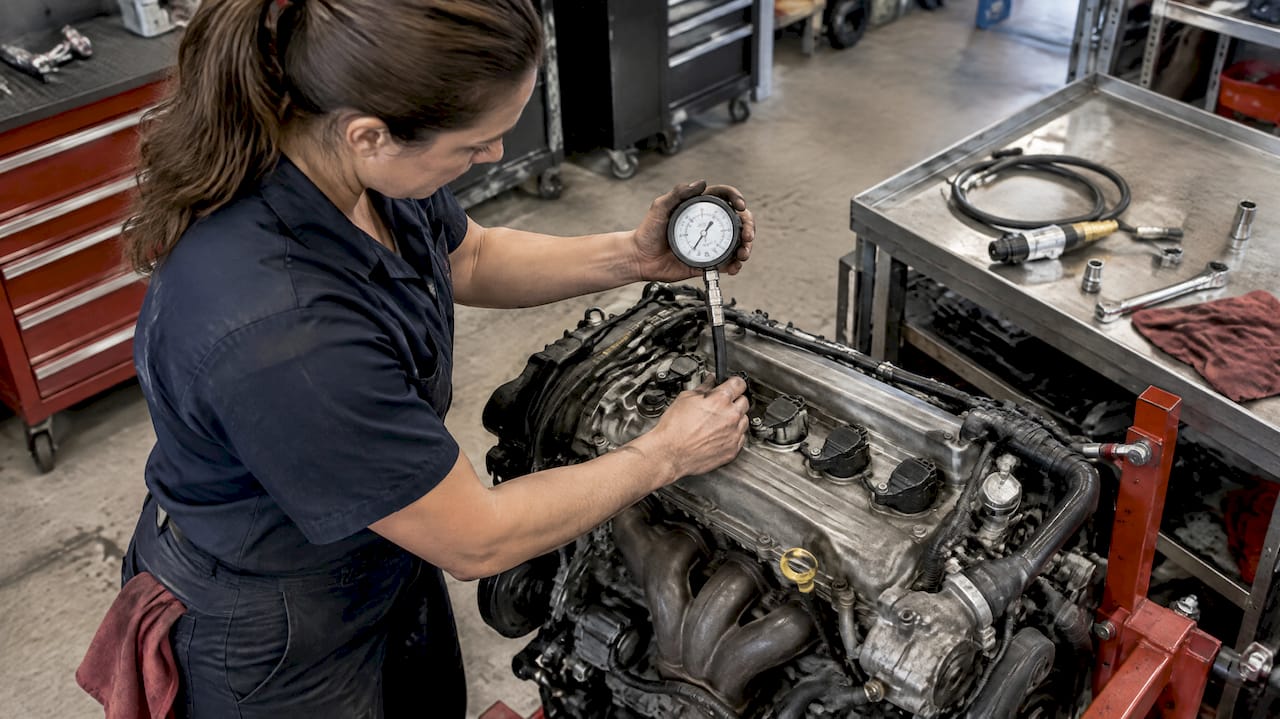
Compression and leak-down tests expose mechanical wear: worn rings, a burnt valve or a timing problem that static checks will never find. Our breakdown of engine compression testing covers what the numbers mean in plain terms.
Exhaust backpressure and catalytic converter checks matter because restriction fights the engine hardest at acceleration, exactly when flow demand peaks, and that restriction is frequently the end result of misfires the driver ignored. Our guide to the P0420 code and O2 sensor waveform test walks through a quick way to check this yourself.
Transmission diagnostics round out the list. A scan tool plus a test drive can reveal slipping gears or a torque-converter fault that feels exactly like engine power loss but needs an entirely different repair.
- Live data: separates air, fuel and ignition faults fast
- Fuel pressure under load: catches pumps that pass at idle but fail under demand
- Compression: confirms or rules out internal engine wear
- Backpressure/converter: confirms exhaust restriction as the bottleneck
- Transmission scan: rules out drivetrain slip mimicking engine loss
What to Do Safely When Power Suddenly Drops
Losing power mid-acceleration is unsettling, but a calm, deliberate reaction keeps you and the car safe. Signal early, ease off the throttle, and move toward the shoulder or an exit lane well before you need to stop completely.
- Use your turn signal and hazard lights as soon as you notice the loss of power.
- Shut the engine off if you see smoke, smell burning, or feel the car surging and cutting out repeatedly.
- Decide between limping to a nearby shop or calling a tow based on how severe and consistent the symptom is.
- Avoid highway speeds entirely if the hesitation keeps happening, since a stall there is far more dangerous than on a side street.
A single hesitation that clears up on its own is worth monitoring. Repeated, worsening symptoms are worth a tow rather than a gamble on making it home.
Repair Costs and Timelines by Cause
Costs vary widely depending on which system failed, and getting the diagnosis right before buying parts is what keeps the bill reasonable.
- Low-cost fixes: an air filter or spark plug set is usually an hour or less of labor plus inexpensive parts, and a single sensor replacement often falls in a similar range.
- Medium-cost repairs: a fuel pump or fuel filter replacement typically takes a half day, and catalytic converter diagnosis, and replacement if needed, adds real cost since the converter is often damaged by an unresolved ignition or fuel problem upstream.
- High-cost repairs: internal engine work or major transmission repairs can take several days and represent the most expensive end of the range, which is exactly why ruling out cheaper causes first matters.
Ask for the specific test result, a code, a pressure reading, a compression number, that supports each recommended repair, and get the warranty terms in writing before work begins. For routine maintenance that can prevent some of these failures before they start, see the 30k/60k/90k service schedule.
What Trustworthy Diagnostics Look Like
A shop that diagnoses power loss properly should scan the system, pull live data, and test fuel pressure under load before recommending parts, adding a compression or transmission check only if those first tests point that way. Local shops that use ASE-certified technicians and professional-grade OBD-II diagnostics provide reliable service, often backed by warranties on completed work.
- Ask to see the live data or test reading, not just a part name.
- Ask what specific test proved the part failed.
- Treat a vague estimate with no supporting data as a red flag.
Why Guessing at Parts Costs More Than Testing Does
The instinct to replace the most-blamed part first, usually the fuel pump or the catalytic converter, is understandable and almost always wasteful. The evidence here points the other way: live fuel pressure under load and a careful read of LTFT catch the real fault far more reliably than swapping parts on suspicion, and they usually cost less than the part you were about to replace.
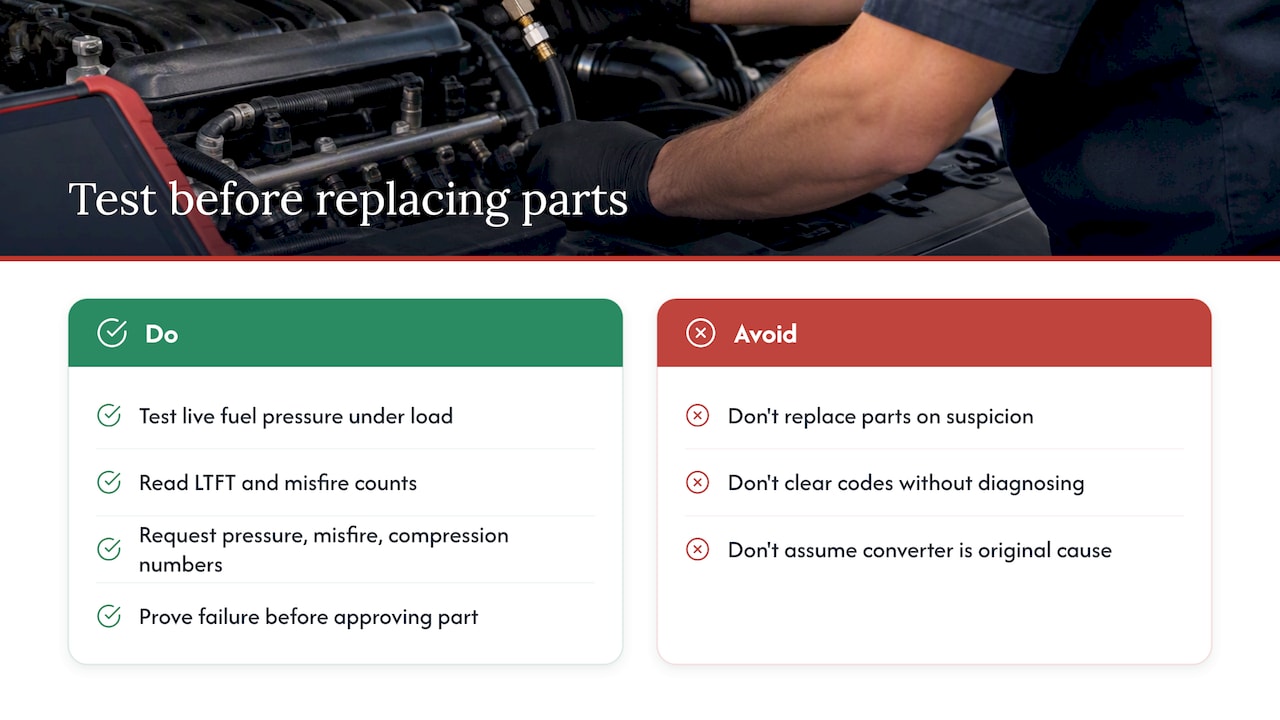
The conventional advice to “just try a new pump” or “just clear the code and drive it” skips the one step that actually saves money: proving the failure before paying for it. A clogged catalytic converter is a good example. It is often not the original problem, it is the bill that arrives after a misfire went unaddressed for too long.
If you take one thing from this, make it this: ask for the number before you approve the part. A pressure reading, a misfire count, a compression figure. If nobody can show you one, you are paying for a guess.
— Shingi
Sources
This guide draws on the ASE L1 study guide for loaded-mode acceleration testing, AA1Car’s diagnostic library on hesitation and fuel pressure, and EPA material on catalytic converter function. For deeper reading, see our guides on diagnostic test types and fixing engine misfires.
- ASE L1 study guide (Acceleration simulation and power loss causes)
- Motor Vehicle Emissions Control. Book Seven, Catalytic Converter Systems (EPA)
FAQ
Why does my truck feel like it’s losing power when I accelerate?
Trucks commonly lose power under load because of restricted exhaust flow, a clogged diesel particulate filter, or fuel delivery that cannot keep up with acceleration demand. A scan for stored codes along with a fuel pressure test under load usually narrows this down quickly.
Why is my car suddenly struggling to accelerate?
A sudden struggle to accelerate usually points to an air, fuel, or ignition fault, such as a clogged filter, a weak fuel pump, or worn spark plugs causing misfires. An OBD-II scan with live data is the fastest way to tell which system is responsible.
Why did I just lose all power while driving?
A complete loss of power can mean a major fuel delivery failure, a severe misfire, or the transmission or computer forcing a protective limp mode. Pull over safely as soon as possible and have the vehicle scanned before driving further.
Why is my car accelerating then stopping?
A car that accelerates and then cuts out often has an intermittent fuel pressure drop, a failing sensor confusing the engine computer, or a transmission issue mimicking an engine problem. Checking live fuel pressure under load and reviewing stored codes usually identifies the cause.
Recommended
- Ten Minute Pressure Test: Fuel Pump Failure Symptoms to Check First
- Why Your Car Hesitates During Acceleration: 2026 Guide
- Fix Engine Misfires Step by Step: A Car Owner’s Guide
- Car Stalls at Idle: Causes, Diagnosis, and Fixes
Leave a Reply