
Ten Minute Pressure Test: Fuel Pump Failure Symptoms to Check First
If your engine sputters under load, struggles to start, or you hear a whine from the fuel tank, you’re likely looking at fuel pump failure symptoms rather than a random glitch. The single fastest gut check: turn the key to ON without cranking and listen for a two-second hum near the tank. No hum, no start under load, or repeated stalling means it’s time to check the fuse and relay, then get a real fuel pressure test before anyone touches the pump itself.
TL;DR:
- Listening for a prime hum during key-on can quickly identify a dead pump or circuit, but a proper pressure test is necessary for confirmation.
- Symptoms like sputtering under load, long cranking times, or hot-soak stalls indicate a weakening or overheating fuel pump, often worsened when fuel demand increases.
- Electrical supply checks and fuel pressure tests under load help distinguish between pump failure and common issues like blown fuses, bad relays, or clogged filters.
- Running low on fuel or bypassing simple electrical checks risks accelerating pump damage, which is why topping off and swapping relays are quick precautions.
- Immediate shop diagnosis is recommended when experiencing recurring stalls, no-start conditions, or abnormal pressure readings, to avoid unnecessary parts replacement.
Table of Contents
- Common Fuel Pump Failure Symptoms And What They Mean
- How To Diagnose A Fuel Pump Before You Replace It
- Common Mimics That Aren’t Actually The Fuel Pump
- What To Do Right Now (And When To Stop Driving)
- When It’s Time To Bring The Car In
- Why We Test Before We Touch The Pump
- Get A Real Diagnosis Before You Pay For A New Pump
- Sources
- FAQ
Common Fuel Pump Failure Symptoms And What They Mean
Fuel pump problems rarely announce themselves with one clean signal. They show up as a pattern, and matching your symptoms to the right cause saves you from paying for parts you don’t need.
-
Sputtering at sustained speed or under load. The engine runs fine at idle but stumbles on the highway or climbing a grade. This happens because a weakening pump can’t hold pressure once fuel demand spikes, which is exactly why symptoms often worsen under load like acceleration, towing, or hills.
-
Loss of power when accelerating or towing. You press the gas and the response lags behind the pedal. This is the same low-delivery problem as sputtering, just more pronounced when the engine asks for more fuel than a failing pump can push.
-
Long crank times or trouble starting. The starter turns and turns before the engine catches, or it just won’t fire. A pump that can’t hold residual line pressure overnight lets fuel bleed back into the tank, so measuring how fast pressure decays with the engine off is one way to separate a fuel problem from a starter or electrical fault.
-
Intermittent stalling, especially hot-soak stalls. The car dies in traffic, restarts after sitting a few minutes, then does it again later. That “works again after cooling” pattern usually points to an overheating pump motor or one drawing too much current, particularly when the tank runs low.
-
Whining or humming from the tank. A steady, elevated whine at key-on or while driving, especially if it gets louder, often signals a pump motor wearing out internally.
-
Complete no-start with no prime hum. Key to ON, no sound from the tank, no start. That’s either a dead pump or a dead circuit feeding it, and you won’t know which without testing.
-
Poor fuel economy, surging, or random rev spikes. An inconsistent pump can cause the engine computer to compensate erratically, burning more fuel while running worse.
-
Check engine light with lean or low-pressure codes. Codes tied to fuel trim or pressure deserve attention. Note that modern direct-injection engines run a separate high-pressure fuel pump, and HPFP failures generate different codes, including P0087 and similar codes, with distinctive hot-restart symptoms worth flagging to a technician.
If any of this sounds familiar, don’t assume the worst yet. Sputtering and hesitation under load also show up with engine misfires, and stalling has its own separate diagnostic tree worth reading before you commit to a pump replacement.
How To Diagnose A Fuel Pump Before You Replace It
Confirming pump failure takes a handful of checks, most of which take less time than driving to the parts store.
- Listen for the prime. Turn the key to ON without starting the engine and listen for a brief hum near the tank. No hum at all is a strong sign of either a dead pump or a dead circuit.
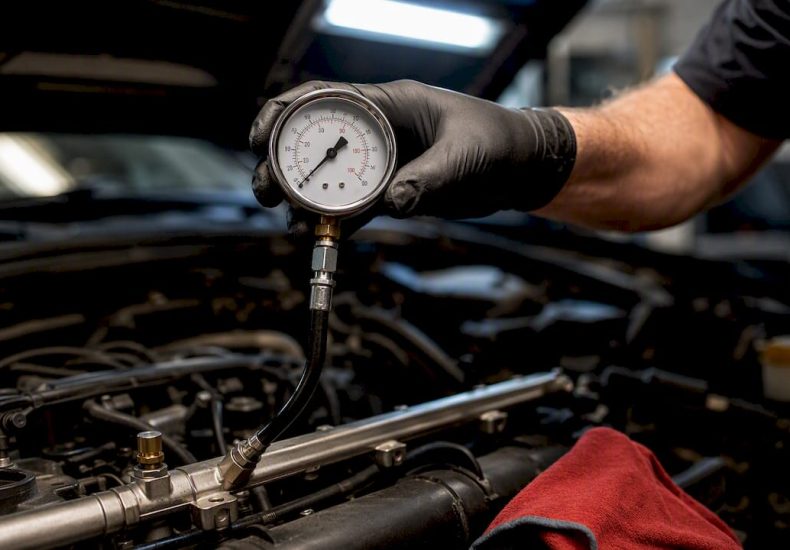
- Run a fuel pressure test. Connect a gauge to the Schrader valve or fuel rail and compare the reading to your vehicle’s specified range. Pressure that reads low at idle or collapses once you rev the engine points straight at the pump or a restricted line.
- Scan for codes. An OBD-II scan can turn up lean-condition or fuel-trim codes, and on direct-injection engines, a code like P0087 signals the high-pressure side specifically.
- Check the electrical supply. Pull the fuel pump fuse and inspect it, swap or bench-test the relay, and measure voltage at the pump connector. Testing the electrical supply first catches a surprising number of cases mistaken for pump failure.
- Check flow and volume under load, not just static pressure. A pump that holds pressure at idle but drops under simulated load is often the intermittent, hard-to-catch kind of failure.
Pro Tip: Test before you buy. Return rates on replacement fuel pumps run high because the real cause often turns out to be a filter, relay, or wiring fault rather than the pump itself. A ten-minute pressure test can save you the cost of an unnecessary part.
Common Mimics That Aren’t Actually The Fuel Pump
Plenty of fuel pump problems turn out to be something else entirely, and telling them apart usually just takes a process of elimination.
- A clogged fuel filter or pickup screen produces the same starving, sputtering symptoms and is far cheaper to rule out first.
- A blown fuse, bad relay, or corroded wiring can mimic a dead pump completely, including a missing prime hum.
- A failing crank position sensor or MAF/MAF sensor causes misfires and hard starts that have nothing to do with fuel delivery.
- Leaking injectors, vacuum leaks, or a bad fuel pressure regulator can all produce the surging and power loss people blame on the pump.
Check electrical supply first, then the filter, then pressure under load. That order rules out the cheapest fixes before you consider the most expensive one.
What To Do Right Now (And When To Stop Driving)
A few cheap, low-risk steps can buy you time or confirm the problem without a shop visit.
- Top off the tank if it’s low. Running low starves the in-tank pump of the fuel that cools and lubricates it, and driving on low fuel accelerates pump failure that’s already starting.
- Swap the fuse or relay if you have a spare. It’s the cheapest possible test and rules out a huge category of false pump diagnoses.
- Skip the highway, towing, and hill driving if you’re seeing stalls or power loss. Load is exactly when a weak pump gives out completely.
- If it stalls in traffic, get to the shoulder, hit the hazards, and call for a tow rather than trying to restart repeatedly.
Running a failing pump dry or pushing through repeated stalls risks stranding you somewhere worse than your driveway.
When It’s Time To Bring The Car In
Some situations call for a shop visit immediately rather than more home diagnosis: a complete no-start, stalling that keeps recurring, a pressure test that comes back out of spec, or any stall that happens somewhere unsafe.
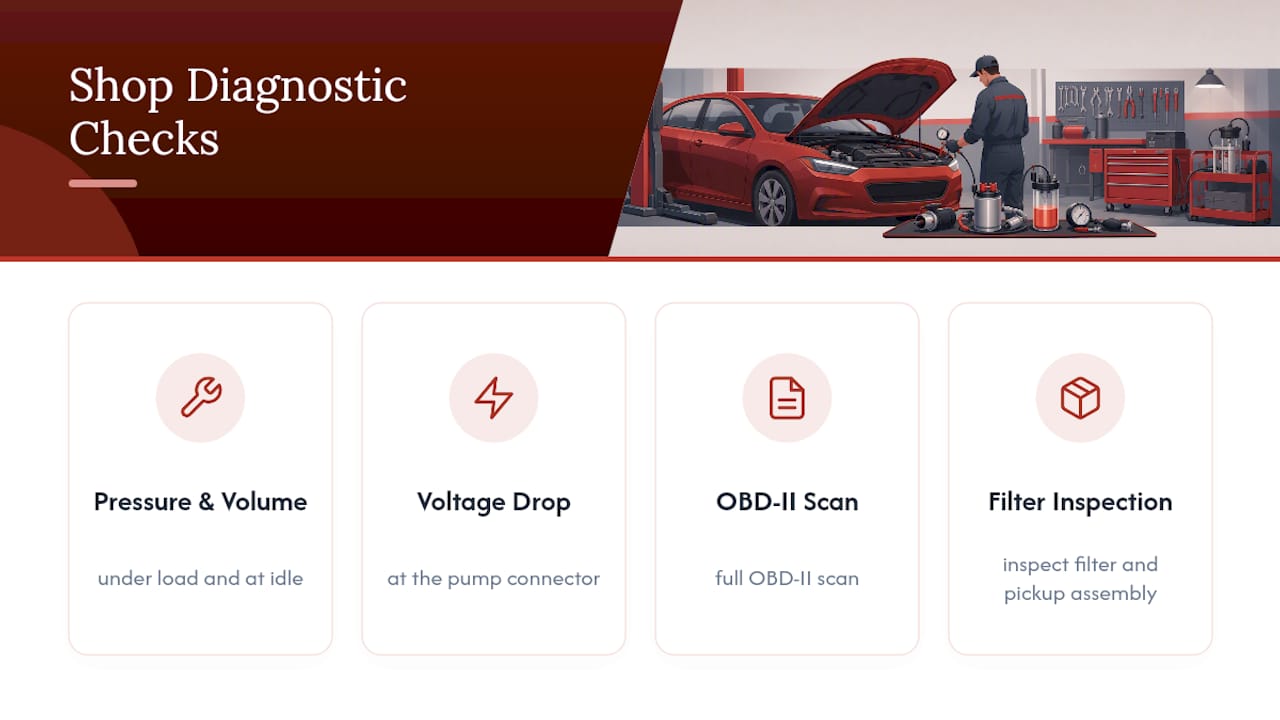
A proper shop diagnosis covers pressure and volume testing under load and at idle, an electrical check with voltage-drop testing at the pump connector, a full OBD-II scan, and inspection of the filter and pickup assembly. Ask for the documented pressure readings before agreeing to a replacement. In-tank pump access varies a lot by vehicle, so labor time and parts quality both swing repair costs, and a shop that stands behind the work with a real warranty is worth more than one offering the lowest quote.
Why We Test Before We Touch The Pump
Misdiagnosed fuel pumps get replaced more often than they should, usually because nobody ran the pressure test first. Our ASE-certified technicians pressure-test every time, backed by 40 years serving Lynnwood drivers and a 24-month/24,000-mile warranty on the repair. For more on related symptoms, see our guides on engine hesitation during acceleration and idle stalling.
— Shingi
Get A Real Diagnosis Before You Pay For A New Pump
Tom’s B & M Auto is the alternative to guessing your way through a parts-store return line: we pressure-test first, so you only pay for the fix your car actually needs. That’s the whole point of skipping the trial-and-error approach outlined above.
Same-day appointments are often available, and repairs come with a warranty. If you’re not sure whether it’s the pump, the relay, or something else entirely, start with our free digital vehicle inspection or book a check engine light diagnosis if a code already popped up. Facing a bigger repair bill than expected? We offer financing options to help spread out the cost. Call or book online today to get your fuel system properly tested, not just replaced.
Sources
- How to Identify the Signs of a Bad Fuel Pump – AutoZone
- Symptoms of a bad fuel pump — O’Reilly How-To Hub
- How To Diagnose A Bad Fuel Pump | FCP Euro
FAQ
How does a car act when the fuel pump is going out?
Expect sputtering under load, hesitation when accelerating, intermittent stalling (especially after the engine gets hot), a whine from the tank, or a long crank before starting.
How do you temporarily fix a fuel pump?
You can’t truly fix a failing pump temporarily, but keeping the tank above a quarter full, checking the fuse and relay, and avoiding highway or towing loads can buy time until you get a fuel pressure test.
Does the fuel pump give warning before going out?
Often, yes. Whining noises, hesitation under load, and hot-soak stalling frequently show up days or weeks before a complete failure, though some pumps do fail without much warning.
Can a fuel pump run but still be bad?
Yes. A pump can produce the prime hum and even start the engine while failing to hold pressure under load, which is why a fuel pressure test under load matters more than just listening for the hum.
Recommended
- Fix Engine Misfires Step by Step: A Car Owner’s Guide
- Engine Smells: What Every Driver Needs to Know
- Check Engine Sign in Car: What to Do Right Now
- Engine Compression Test: What Car Owners Need to Know
Leave a Reply