
What Your Car’s Exhaust Smoke Color Is Telling You
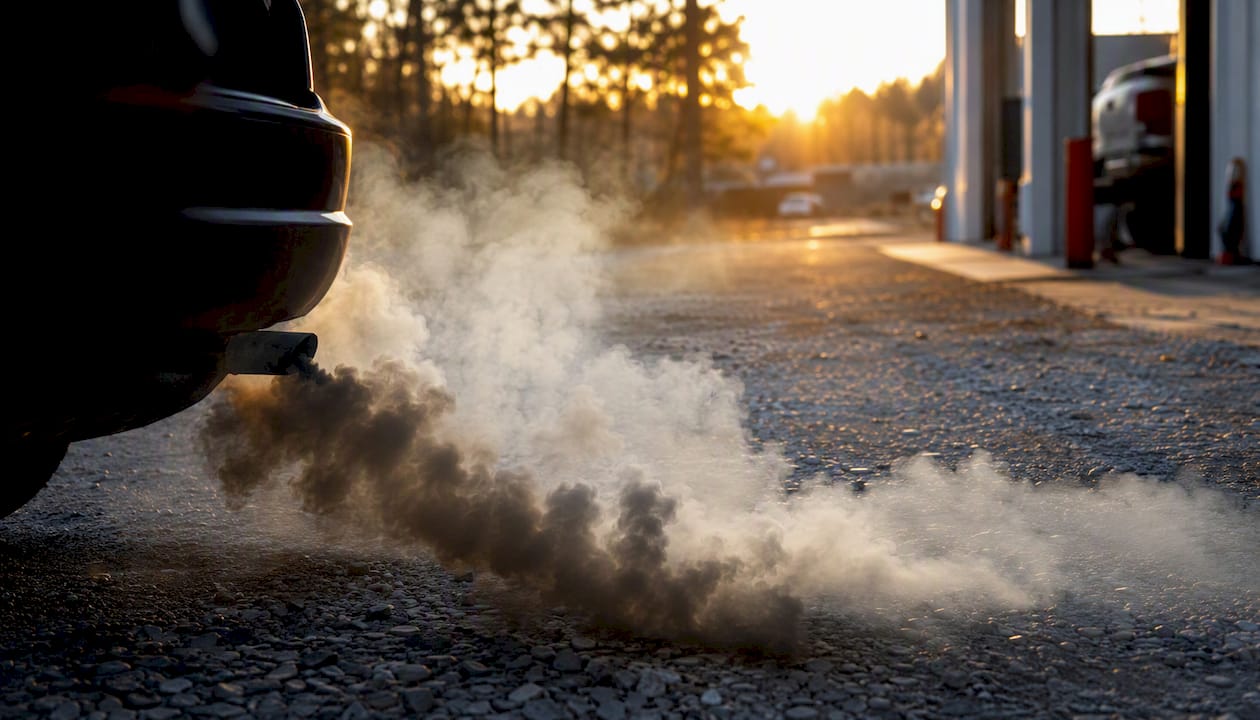
Thick white smoke billowing from a warm engine usually means coolant is entering the combustion chamber. Blue or gray smoke points to burning oil, and black smoke signals too much fuel. The color narrows the cause fast, and knowing which one you’re looking at tells you whether to keep driving, monitor closely, or pull over immediately.
Safety first: If you see heavy continuous smoke combined with an overheating gauge, a sweet smell, or rapid coolant loss with no visible external leak, stop driving and have the car towed. These are the signs that continuing to drive will turn a repair into an engine replacement.
Pro Tip: Before calling a shop, take a short video of the smoke on your phone. Note when it appears (cold start, acceleration, cruise) and what it smells like. That 30-second clip can cut diagnostic time significantly.
Key Takeaways
Exhaust smoke color is the fastest first filter for diagnosing engine problems: white points to coolant, blue or gray to oil, and black to excess fuel, with each color leading to a distinct set of tests and repairs.
| Point | Details |
|---|---|
| White smoke after warm-up | Likely coolant in the combustion chamber; check dipstick for milky oil and coolant level before driving further. |
| Blue or gray smoke | Engine is burning oil; track consumption daily and replace the PCV valve as a first low-cost step. |
| Black smoke | Rich air/fuel mixture; start with the air filter and an OBD-II scan for fuel-trim codes. |
| Stop driving immediately | Overheating, milky oil, rapid coolant loss, or heavy continuous smoke all require towing, not monitoring. |
| Tom’s B & M Auto | ASE-certified diagnostics (OBD-II, compression, coolant pressure) with a 24-month/24,000-mile warranty on all repairs. |
Table of Contents
- What does smoke from your exhaust actually mean?
- White smoke: is it harmless condensation or a coolant problem?
- Blue or gray smoke: what oil burning looks like and why it happens
- Black smoke: too much fuel and what’s causing it
- What a mechanic will do: the diagnostic process step by step
- Quick checks and inexpensive DIY fixes before you visit a shop
- When to get professional help immediately, and what repairs cost
- Why fast diagnosis is the difference between a repair and a rebuild
- Tom’s B & M Auto: exhaust smoke diagnostics and engine repair in Lynnwood
- Sources
What does smoke from your exhaust actually mean?
Exhaust smoke colors map directly to which fluid or system is misbehaving: dense white usually signals coolant leaking into the combustion chamber, blue or gray indicates oil burning, and black typically means an overly rich air/fuel mixture. Each color points the mechanic toward a different set of tests, which is why color-first diagnosis reduces unnecessary guesswork before a single wrench turns.
A quick OBD-II scan often accompanies the visual check, since misfires, lean/rich codes, and coolant-temperature faults frequently show up alongside visible smoke. ASE-certified diagnostic procedures treat the color observation as the first filter, then use scan data and fluid checks to confirm the system at fault.
White smoke: is it harmless condensation or a coolant problem?
This is the one color that genuinely has two completely different meanings depending on when and how it appears.
The harmless version
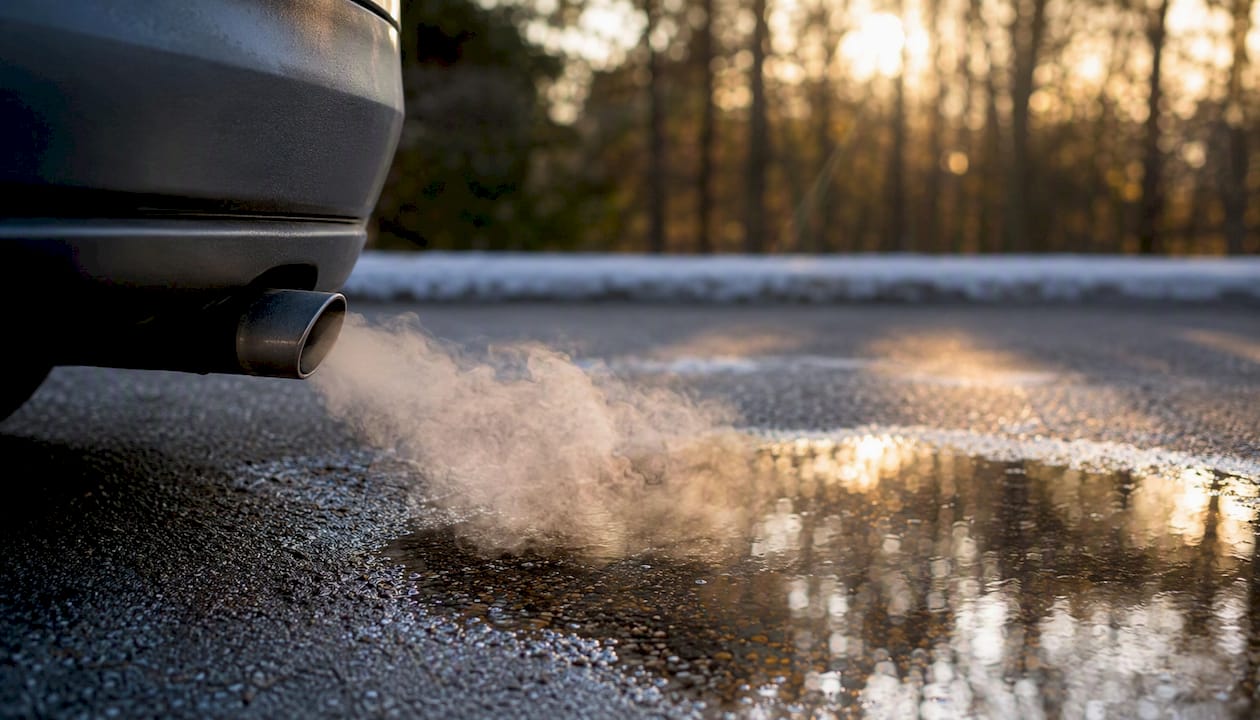
Thin, wispy white vapor on a cold morning clears within two to three minutes as the engine warms up. That’s condensation burning off inside the exhaust system, and it’s completely normal. Cold-start vapor disappears quickly; if yours is gone before you reach the end of the block, you can stop worrying about it.
The version that needs attention
Thick, persistent white smoke that continues after the engine reaches operating temperature is a different story. A sweet smell alongside it is the clearest signal that coolant is burning in the cylinders. Common culprits:
- Blown head gasket — the most frequent cause; allows coolant to pass from the cooling jacket into the combustion chamber
- Cracked cylinder head or engine block — less common but more serious; often produces the same sweet-smelling white smoke
- Intake manifold gasket failure — on certain V6 engines (notably older GM and Chrysler designs), coolant passages run through the intake manifold and a failed gasket lets coolant drip into the intake ports
DIY checks to run right now
To confirm coolant is entering the combustion chamber, check these three things before calling a shop:
- Coolant reservoir level — check it cold, before starting. If it’s dropping steadily with no visible puddle under the car, coolant is going somewhere internal.
- Dipstick and oil cap — pull the dipstick and look at the oil cap underside. Milky, caramel-colored residue means coolant and oil are mixing, which is a head-gasket red flag.
- Smell test — lean toward the tailpipe when the engine is warm. A sweet, slightly syrupy odor is ethylene glycol burning.
Urgency: Milky oil or a steadily dropping coolant level with no external leak means stop driving now. Coolant in the oil destroys bearing surfaces quickly. If the smoke is white but the oil looks clean and the coolant level is stable, you can monitor it for a day or two while scheduling a shop visit, but don’t let it go longer than that.
Pro Tip: A combustion leak test kit (sometimes called a block test or exhaust gas test) costs around $25 at most auto parts stores. You draw air from the coolant reservoir through a test fluid; if the fluid changes color, combustion gases are present in the coolant. It’s not definitive on its own, but it’s a fast, inexpensive way to confirm your suspicion before paying for a full shop diagnosis.
Blue or gray smoke: what oil burning looks like and why it happens
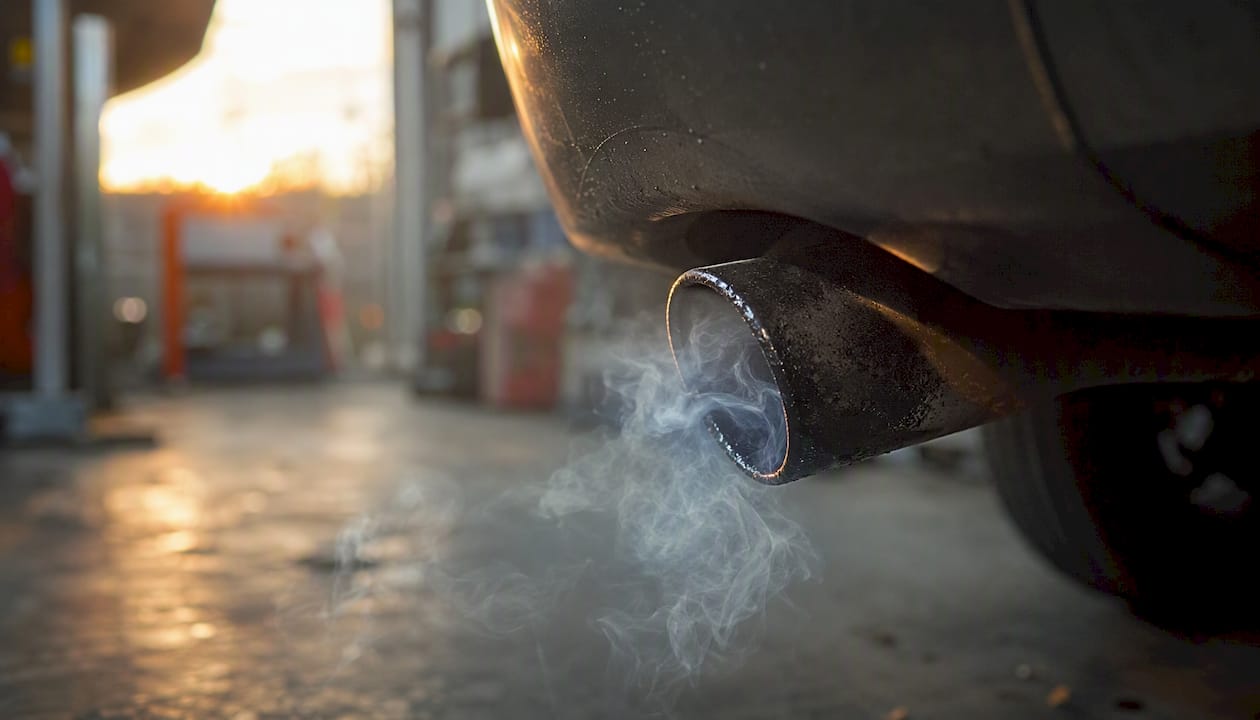
Blue or gray smoke from the tailpipe means engine oil is reaching the combustion chamber and burning alongside the fuel. The timing of the smoke is the first diagnostic clue: a puff at startup that clears quickly points toward valve stem seals, while smoke that appears during hard acceleration or sustained cruising is more consistent with worn piston rings or a failing turbocharger seal.
Common causes
- Worn piston rings — rings that no longer seal properly allow oil from the crankcase to enter the cylinder on the compression stroke
- Valve stem seals — hardened or cracked seals let oil seep past the valve guides and into the intake or exhaust ports; most noticeable after the engine sits overnight
- Turbocharger seal failure — a worn center bearing seal pushes oil into the intake or exhaust side of the turbo; you may also see oily residue around the turbo outlet pipe
- Clogged PCV valve — a blocked positive crankcase ventilation valve raises crankcase pressure and forces oil past seals it would otherwise not reach
- Overfilled oil or wrong viscosity — too much oil creates excess pressure; a viscosity that’s too thin flows past worn seals more easily
Blue or gray smoke that appears only at startup and clears within a minute or two on an older, higher-mileage engine often means valve stem seals are the primary culprit. Persistent blue smoke throughout a drive, especially under load, is a stronger indicator of piston-ring wear or a turbocharger seal issue — both of which require more involved repairs.
What to track before your shop visit
Check the oil level every day and note how fast it drops. Losing more than a quart every 1,000 miles is a sign the engine needs attention soon. Look for an oily film around the tailpipe opening or at the turbo outlet. If the oil on the dipstick looks dark and smells burnt but is otherwise normal (not milky), the problem is oil burning rather than coolant contamination.
Short-term driving: A PCV valve replacement is a straightforward DIY fix and costs under $20 on most vehicles. If the PCV is the cause, blue smoke often clears after replacement. Valve stem seals are a shop job but not an emergency if oil consumption is moderate. Piston-ring wear is a longer-term repair; avoid extended highway drives that put sustained load on the engine while you’re monitoring the situation. For more on why engines burn oil and how to track consumption, that’s worth a read before your appointment.
Black smoke: too much fuel and what’s causing it
Black, sooty smoke from the tailpipe almost always means the engine is running rich, meaning it’s burning more fuel than the air supply can combust cleanly. Common causes include clogged air filters, faulty fuel injectors, a failing fuel pressure regulator, or bad MAF and O2 sensors. On older carbureted vehicles, a stuck float or worn needle valve produces the same result.
What’s typically at fault
- Clogged air filter — the most common and cheapest fix; a severely restricted filter starves the engine of air, tipping the mixture rich
- Faulty fuel injectors — injectors that stick open or leak deliver excess fuel; you’ll often notice a strong fuel smell from the exhaust
- Bad MAF sensor — a dirty or failing mass airflow sensor sends incorrect readings to the ECU, which then commands too much fuel
- Failing O2 sensor — a dead upstream oxygen sensor removes the feedback loop the ECU uses to trim the fuel mixture
- Fuel pressure regulator failure — a regulator stuck in the high-pressure position floods the injectors
Quick checks you can do yourself
- Pull the air filter and hold it up to light. If you can’t see light through it, replace it. A new filter costs $15–$30 and takes five minutes.
- Scan for OBD-II codes. Rich-condition codes (P0172, P0175) and MAF codes (P0100–P0104) point directly at the fuel system. A basic code reader costs under $30, or many auto parts stores will scan for free.
- Check for fouled spark plugs. Black, sooty plugs confirm the engine has been running rich for a while.
- Note fuel economy. A sudden drop in miles per gallon alongside black smoke is a reliable sign of a fuel delivery problem.
Drive safety: Black smoke alone rarely makes a car immediately dangerous to drive, but prolonged rich running fouls spark plugs, clogs the catalytic converter, and eventually damages the O2 sensors. A clogged catalytic converter can run into $800–$2,500 to replace, so addressing a rich condition early is worth it. If the smoke is heavy and constant and the engine is misfiring, pull over and have it checked before driving further. For misfire-related black smoke, the engine misfire guide covers the overlap between rich running and ignition faults.
What a mechanic will do: the diagnostic process step by step
A good shop doesn’t guess. Here’s the standard sequence an ASE-certified technician follows when a vehicle comes in with exhaust smoke:
- Driver interview — when does the smoke appear, what color, how long has it been happening, any recent repairs or fluid top-offs? This narrows the test list before the hood opens.
- OBD-II code scan — pulls stored and pending fault codes; rich/lean codes, misfire codes, and coolant-temp faults all point toward specific systems.
- Visual inspection — checks for external coolant leaks, oil leaks, oily residue at the turbo or exhaust, and fluid levels.
- Coolant pressure test — pressurizes the cooling system to check for internal leaks; a system that won’t hold pressure points to a head gasket, cracked head, or failed intake gasket.
- Compression test — measures cylinder pressure across all cylinders; low compression in one or more cylinders indicates ring wear, valve problems, or head-gasket failure.
- Leakdown test — follows a low-compression finding; pressurizes each cylinder individually and listens for where air escapes (crankcase = rings, intake = intake valve, exhaust = exhaust valve).
- Oil analysis and turbo inspection — checks for coolant contamination in the oil and inspects turbo shaft play and seal condition where applicable.
| Diagnostic test | What it reveals | Time to run | When it’s used |
|---|---|---|---|
| OBD-II scan | Fault codes, fuel trim data, sensor failures | 15–30 min | First step on any smoke complaint |
| Coolant pressure test | Internal or external cooling system leaks | 30 min | White smoke, suspected head gasket |
| Compression test | Cylinder seal integrity, ring and valve condition | 45 min | Blue smoke, white smoke, power loss |
| Leakdown test | Pinpoints where compression is lost (rings, valves) | 60 min | After low compression is confirmed |
| Turbo inspection | Shaft play, seal condition, oil in intake/exhaust | 30 min | Blue smoke on turbocharged engines |
Timeline: An OBD-II scan and visual inspection typically happen the same day. Coolant pressure testing usually takes the same day as well. A full compression and leakdown sequence, especially on a multi-cylinder engine, often runs into the next day. For suspected head-gasket failures, combining a coolant pressure test with a compression/leakdown test gives the clearest picture before any disassembly begins.
Quick checks and inexpensive DIY fixes before you visit a shop
Running through these before your appointment saves time and gives the technician useful information:
- Check coolant level cold — open the reservoir cap (never the radiator cap on a warm engine) and note the level. Dropping fluid with no external puddle is a red flag.
- Pull the dipstick — look at the color and consistency. Milky or foamy oil means coolant contamination. Dark but normal-looking oil with a dropping level points to oil burning.
- Inspect the air filter — locate the airbox (usually a black plastic box near the engine intake), unclip it, and pull the filter. Replace it if it’s visibly clogged. This takes five minutes and costs under $30.
- Check and replace the PCV valve — on most engines it’s a small valve plugged into the valve cover with a hose attached. Shake it; a working PCV rattles. A stuck-open or stuck-closed PCV is a $10–$20 fix that sometimes eliminates blue smoke entirely.
- Look for obvious leaks — check under the car after it’s been parked overnight. Coolant leaves a colored puddle (green, orange, or pink depending on type); oil leaves a dark stain.
What to avoid: Don’t drive long distances with confirmed oil burning or a dropping coolant level. Don’t open the radiator cap when the engine is hot; the pressurized coolant can cause serious burns. Don’t add stop-leak products to a cooling system with suspected head-gasket failure without talking to a mechanic first; they can clog passages and make the eventual repair more expensive.
Pro Tip: Take a short video of the smoke from behind the car and note the exact conditions: cold start, after 10 minutes of driving, under hard acceleration. Share it with the shop when you book. A technician who can see the smoke pattern before the car arrives will have a shorter diagnostic path and a faster turnaround for you.
When to get professional help immediately, and what repairs cost
Some symptoms mean you stop driving now, not after work, not after the weekend.
Pull over and tow if you have any of these:
- Temperature gauge climbing toward the red while smoke is present
- Rapid coolant loss with no visible external leak (coolant is going internal)
- Milky or foamy oil on the dipstick
- Heavy, continuous white or blue smoke that doesn’t clear
- Noticeable loss of power alongside smoke
- Dashboard warning lights (check engine, coolant temp, oil pressure) active at the same time
For getting an accurate estimate, bring your OBD-II codes if you’ve scanned them, your video of the smoke, and notes on fluid levels. Ask the shop to perform a compression or coolant pressure test before quoting major work; a quote based on visual inspection alone for a suspected head-gasket job is not a reliable number.
Ballpark U.S. repair ranges (these vary significantly by vehicle make, model, and region — treat them as starting points, not firm quotes):
- Air filter replacement: $15–$50 (DIY) or $50–$100 at a shop
- PCV valve replacement: $20–$75 at a shop
- Valve stem seal replacement: $200–$600 depending on engine design
- Fuel injector cleaning or replacement: $150–$600 for a set
- MAF or O2 sensor replacement: $150–$400 per sensor
- Head gasket repair: $1,200–$2,800 on most four-cylinder engines; $2,500–$4,500 on V6/V8 engines
- Piston ring replacement (engine rebuild): $2,500–$5,000+
Always get a written estimate with the specific tests that led to the diagnosis. For major repairs over $1,000, ask about financing options and any current shop specials before committing.
Why fast diagnosis is the difference between a repair and a rebuild
The most expensive engine failures I see at a shop aren’t the ones that came in early. They’re the ones where someone drove on milky oil for two weeks because they weren’t sure if the smoke was serious, or kept topping off coolant without asking why it kept disappearing.
A head gasket caught early, before coolant has mixed with the oil and before the aluminum head has warped from overheating, is a $1,500 repair on many four-cylinder engines. The same failure caught after extended driving with contaminated oil can mean a cracked head, scored cylinder walls, and a bill that approaches the car’s value. The diagnostic tests exist precisely to catch the failure mode before it cascades.
ASE-certified technicians follow a structured diagnostic sequence because skipping steps leads to misdiagnosis. A compression test that shows low pressure in one cylinder tells you something specific. A leakdown test that follows it tells you whether the problem is rings, valves, or the head gasket. Without both, you’re guessing at a $2,000+ repair. That’s the argument for getting a proper diagnosis even when the repair estimate feels like a lot: the alternative is paying for the wrong fix and then paying again for the right one.
Tom’s B & M Auto: exhaust smoke diagnostics and engine repair in Lynnwood
Visible exhaust smoke is one of those problems where the gap between “I’ll watch it for a while” and “now it needs an engine rebuild” can be measured in days. Tom’s B & M Auto has been diagnosing exactly these situations for Lynnwood-area drivers since 1985, with ASE-certified technicians and professional-grade OBD-II equipment on hand for same-day code scans and visual inspections.
For smoke-related concerns, the shop handles the full diagnostic sequence: OBD-II scan, coolant pressure testing, compression and leakdown tests, turbo inspection, and head-gasket repair through full engine work. All repairs carry a 24-month/24,000-mile warranty. If you’re facing a larger repair, financing is available to spread the cost. For a no-cost starting point, book a free digital vehicle inspection and bring your phone video, your fluid-level notes, and any OBD-II codes you’ve already pulled. The shop serves Toyota, Honda, Subaru, domestic, European, and hybrid vehicles. Book your engine repair appointment and get a test-backed estimate before any major work begins.
Sources
- What Black, Blue, or White Smoke from a Car’s Exhaust Means – AutoZone
- Exhaust Smoke Colors Explained: White, Blue & Black — Car Care Total
- Blue smoke from your tailpipe: causes and solutions | Repsol
- White Smoke From Exhaust: What Does it Mean & How to … – Edmunds
Recommended
- Check Engine Sign in Car: What to Do Right Now – Tom’s B & M Auto Blog
- Car Problem Sounds: What Each Noise Means and What to Do – Tom’s B & M Auto Blog
- Why Your Car Burns Oil: Causes, Checks, and Fixes – Tom’s B & M Auto Blog
- Check Engine Light Meaning: What Drivers Need to Know – Tom’s B & M Auto Blog
Leave a Reply