

Why Car AC Blows Warm Air: Causes and Fixes
A car’s air conditioning system blows warm air when refrigerant leaks, compressor failure, or airflow restrictions prevent the system from cooling properly. These are the three most common reasons for warm air, and each one requires a different fix. Misdiagnosing the cause leads to wasted money and repeat repairs. Understanding why car AC blows warm gives you a clear starting point before spending anything. Major repairs run $500–$1,200, while simple fixes like a cabin air filter replacement cost as little as $15–$30.
Why car AC blows warm: refrigerant leaks explained
Low refrigerant caused by leaks is the leading cause of warm air from car AC systems. Refrigerant is the fluid that absorbs heat from your cabin and releases it outside. Without enough of it, the system simply cannot cool the air. Car AC systems are sealed by design, which means refrigerant does not evaporate over time. If the level is low, there is a leak somewhere.
Common leak points include:
- Compressor shaft seals: These wear down over time, especially in older vehicles.
- Condenser: Road debris can puncture the condenser fins, causing slow refrigerant loss.
- Rubber hoses and O-rings: These degrade with heat and age, creating small but steady leaks.
- Evaporator core: Located inside the dashboard, evaporator leaks are hard to spot and expensive to fix.
One diagnostic sign many car owners miss is oily residue around compressor seals. Refrigerant carries lubricating oil through the system. When refrigerant leaks, the oil escapes with it, leaving a greasy film near the leak point. Spotting this residue is a strong indicator of where the leak originates.
Adding refrigerant without fixing the leak can worsen the problem. Overcharging the system causes pressure imbalances that reduce efficiency and can damage the compressor. The refrigerant will simply leak out again, and you will have spent money on a temporary fix.
Pro Tip: DIY recharge cans sold at auto parts stores do not fix leaks. They add refrigerant temporarily, but if the underlying leak is not repaired, the compressor runs low on lubricant and can seize. Always have a leak diagnosed before recharging.
One more detail worth knowing: modern vehicles use either R-134a or the newer R-1234yf refrigerant. These two types require different equipment and are not interchangeable. Using the wrong refrigerant can permanently damage the AC system. A professional shop will identify which type your vehicle uses before touching the system.
How compressor failure causes warm air
The AC compressor is the heart of the system. It pressurizes the refrigerant and pushes it through the cooling cycle. When the compressor fails, refrigerant stops circulating, and the system blows warm air regardless of how much refrigerant is present.
A failing compressor clutch is a common cause of intermittent cooling that gets misdiagnosed as a refrigerant shortage. The clutch engages and disengages the compressor as needed. When it fails partially, the compressor runs inconsistently, producing cooling that comes and goes. Car owners often top off refrigerant in response, which does nothing to fix the clutch.
Signs of compressor trouble include:
- Clicking or grinding noises when the AC is turned on
- No clutch engagement — the center of the compressor pulley does not spin when AC is active
- Vibrations felt through the steering wheel or dashboard
- Pressure readings outside normal range when tested with manifold gauges
You can learn more about compressor symptoms and causes to understand what a technician will look for during diagnosis. Compressor repair or replacement costs between $500 and $1,200, making it one of the more expensive AC repairs. That cost makes accurate diagnosis critical before any parts are ordered.
Professional diagnostics matter here. Pressure testing with manifold gauges tells a technician whether the compressor is building adequate high-side and low-side pressure. Without those readings, guessing at compressor failure wastes money on parts that may not be the problem.
Airflow problems: filter, condenser, and fan issues
Weak airflow is often mistaken for a cooling failure. The air coming out of your vents may actually be cold, but if it barely moves, the cabin never cools down. This is one of the most common diagnostic errors car owners and even some shops make.

A clogged cabin air filter is the easiest and cheapest fix in all of AC troubleshooting. The cabin air filter sits behind the glove box in most vehicles and filters dust, pollen, and debris from the air entering the cabin. When it clogs, airflow drops sharply. Replacement costs $15–$30 and takes about 15 minutes.
Pro Tip: Before assuming your AC has a refrigerant or compressor problem, check the cabin air filter first. Hold it up to light. If you cannot see through it, replace it. You may solve the problem for $20.
The condenser also plays a direct role in airflow and cooling. It sits at the front of the vehicle, just behind the grille, and releases heat from the refrigerant into the outside air. Blocked or damaged condenser fins reduce heat exchange, which means the refrigerant stays too warm and cannot cool the cabin effectively. This problem shows up most at idle and in slow traffic, where airflow through the grille is minimal.
| Airflow component | Common problem | Typical fix cost |
|---|---|---|
| Cabin air filter | Clogged with dust and debris | $15–$30 |
| Condenser | Bent fins or debris blockage | $50–$300+ |
| Cooling fan | Motor failure or relay fault | $100–$400 |
The cooling fan pulls air through the condenser when the vehicle is stationary. If the fan motor fails or its relay burns out, the condenser overheats at idle and cooling drops off. You will notice the AC works fine at highway speeds but blows warm in traffic. That pattern points directly to the cooling fan.
Less common causes: electrical faults, blend door, and evaporator
Not every car AC problem comes down to refrigerant or airflow. A range of electrical and mechanical faults can produce warm air, and these are the issues most likely to be misdiagnosed.
Blown fuses, bad relays, or failed pressure switches can prevent the compressor from engaging at all. Fuse and relay replacements cost as little as $1–$30, making them worth checking early in any diagnosis. A pressure switch protects the compressor by shutting it off when refrigerant pressure falls outside safe limits. If the switch fails, it may cut compressor power even when pressure is normal.
Other less obvious causes include:
- Blend door actuator failure: The blend door controls the mix of hot and cold air entering the cabin. When the actuator motor fails, the door can stick in the wrong position, sending warm air regardless of your temperature setting. Blend door failure often produces clicking noises and inconsistent cabin temperatures.
- Expansion valve or orifice tube failure: These components regulate refrigerant flow into the evaporator. A stuck or clogged valve disrupts the pressure drop needed for cooling, causing the system to blow warm or inconsistently cool air.
- Evaporator core problems: Ice buildup on the evaporator blocks airflow and stops cooling. Clogging from debris has the same effect. The evaporator is hard to access, sitting deep inside the dashboard, which makes repairs expensive.
- Sensor and wiring faults: Modern vehicles, especially European models, rely heavily on temperature sensors and pressure transducers. Faulty sensors or wiring can cause uneven cooling or complete AC failure even when refrigerant levels are correct. Owners of European vehicles face greater diagnostic complexity because of these intricate electronics.
These causes share one trait: they are difficult to diagnose without professional tools. An OBD-II scanner, manifold pressure gauges, and an electrical multimeter are all needed to rule them out accurately. Guessing at these components leads to expensive parts replacements that do not fix the problem.
Key Takeaways
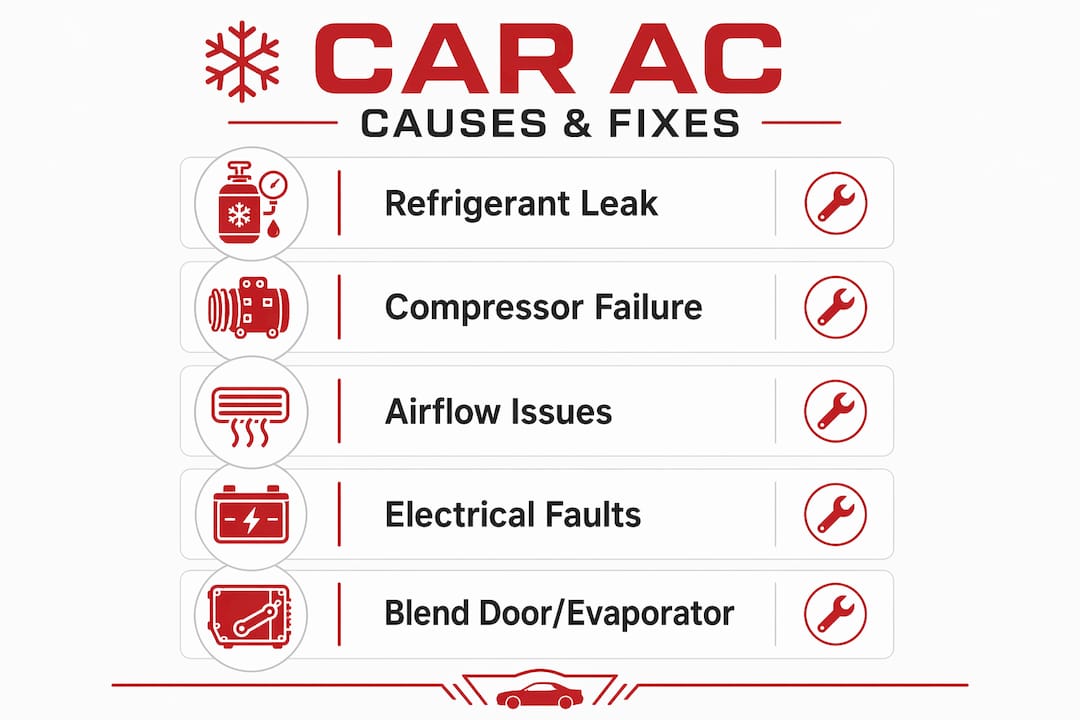
A car AC that blows warm air almost always traces back to one of five causes: refrigerant leaks, compressor failure, airflow restrictions, electrical faults, or a failed blend door actuator.
| Point | Details |
|---|---|
| Refrigerant leaks are the top cause | Low refrigerant from a leak is the leading reason for warm AC air; fix the leak before recharging. |
| DIY recharge kits carry real risk | Adding refrigerant without repairing the leak depletes compressor lubricant and risks full compressor failure. |
| Check airflow before assuming refrigerant loss | A clogged cabin air filter or failed cooling fan can mimic refrigerant problems and costs far less to fix. |
| Compressor clutch failure causes intermittent cooling | Partial clutch failure produces on-and-off cooling that is routinely misdiagnosed as low refrigerant. |
| Electrical and sensor faults need professional tools | Blown fuses, bad relays, and failed sensors require gauges and a multimeter to diagnose accurately. |
What I have learned diagnosing AC problems over the years
The most expensive AC repair I see is the one that started with a $30 recharge can. A car owner notices warm air, buys a DIY refrigerant kit, adds the gas, and gets cold air for two weeks. Then it is warm again. They add more. By the time the car comes into the shop, the compressor is damaged from running without adequate lubrication, and what could have been a $150 leak repair has turned into a $900 compressor replacement.
The second most common mistake is skipping the airflow check entirely. Car owners assume warm air means refrigerant problems. Technicians who are in a hurry make the same assumption. A cabin air filter so clogged it looks like a felt mat can drop airflow enough to make a perfectly functional AC system feel useless. That filter costs $20 and takes 15 minutes to swap. Always check it first.
My honest view on modern vehicles: if you drive a European car, a late-model hybrid, or anything with dual-zone climate control, do not attempt AC diagnosis yourself beyond the filter check. The sensor-dependent AC systems in these vehicles require scan tools that read live pressure and temperature data to pinpoint faults. A general visual inspection will not find a failing pressure transducer or a wiring short in the climate control module.
The cost-versus-repair question comes up often. If a compressor replacement on a 12-year-old vehicle costs $900 and the car is worth $4,000, that math is uncomfortable. But driving without AC in a Pacific Northwest summer is its own problem, and a seized compressor can sometimes take other components with it. Get the diagnosis first, then make the financial call with accurate information rather than assumptions.
Preventive maintenance is the real answer. Running the AC for at least 10 minutes every few weeks, even in winter, keeps seals lubricated and prevents the refrigerant from sitting stagnant. It is the cheapest AC repair there is.
— Shingi
AC diagnosis and repair at Tom’s B & M Auto
Tom’s B & M Auto has been diagnosing and repairing car AC systems in the Lynnwood area since 1985. ASE-certified technicians use professional-grade manifold gauges and OBD-II diagnostics to pinpoint the exact cause of warm air before any parts are ordered.

Whether the fix is a $20 cabin filter or a full compressor replacement, you get upfront pricing and a 24-month / 24,000-mile warranty on all work. Financing is available for larger repairs, so cost does not have to delay getting your AC working again. Same-day appointments are often available. Book your AC inspection in Edmonds or call to schedule at your nearest location.
FAQ
Why is my car AC blowing warm air suddenly?
Sudden warm air most often points to a refrigerant leak, a blown fuse, or a failed compressor clutch. A technician can confirm the cause with a pressure test and electrical check in under an hour.
Can I fix warm AC air myself?
You can replace a clogged cabin air filter yourself for $15–$30. Beyond that, refrigerant handling requires EPA-certified equipment, and electrical or compressor faults need professional diagnostics to avoid costly mistakes.
How much does it cost to fix a car AC blowing warm air?
Repair costs range from $15–$30 for a cabin air filter to $500–$1,200 for compressor replacement or major leak repairs. The actual cost depends on which component has failed.
Why does my AC only blow warm air at idle?
Warm air at idle but cold air at highway speeds points to a failed cooling fan or a blocked condenser. The cooling fan pulls air through the condenser when the car is stopped; without it, the refrigerant cannot release heat properly.
Is it safe to drive with a car AC that blows warm air?
Driving is safe, but ignoring the problem is not. A refrigerant leak that goes unrepaired causes compressor lubricant loss, which can lead to full compressor failure and a much larger repair bill.
Recommended
- What Is an AC Compressor? A Car Owner’s Guide – Tom’s B & M Auto Blog
- AC Repair in Kenmore, WA | Tom’s B&M Auto
- Why Transmission Slips: Causes, Symptoms, and Fixes – Tom’s B & M Auto Blog
- AC Repair in Mukilteo, WA | Tom’s B&M Auto
Leave a Reply