

How to Write Accurate Repair Order Notes That Work
Accurate repair order notes are the formal written record of every customer complaint, technician diagnosis, and repair action taken on a vehicle. Without them, shops lose money, technicians waste time, and customers lose trust. The industry standard term for this document is the repair order, or RO, and poor documentation causes more misdiagnoses and lost customer confidence than physical repair errors ever do. To write accurate repair order notes, you need a structured approach that captures the right information at the right time. Tom’s B & M Auto has applied these practices since 1985, and the results show up in fewer callbacks and stronger customer retention.
What should every repair order note include?
A complete repair order captures six categories of information. Miss any one of them and the RO becomes a liability instead of an asset.
- Customer identification. Full name, phone number, and email. This is the contact trail for approvals and follow-up.
- Vehicle details. Year, make, model, VIN, and current mileage. The VIN is non-negotiable. It ties the record to a specific vehicle and protects the shop legally.
- Customer complaint in context. Not just “check engine light on.” When did it start? Does it happen at highway speed or in stop-and-go traffic? Has drivability changed? Specific customer context reduces diagnostic time by giving technicians a clear starting point instead of guesswork.
- Technician findings. Measurements, test results, and observed conditions. “Brake pad thickness measured at 2mm, below the 3mm service limit” is useful. “Brakes worn” is not.
- Itemized labor and parts. Every labor line with hours and every part with a part number. Itemized documentation creates alignment on scope and pricing and forms a defensible audit-ready record.
- Recommendations and approvals. What the shop recommends, what the customer approved, and when. Timestamps and signatures belong here.
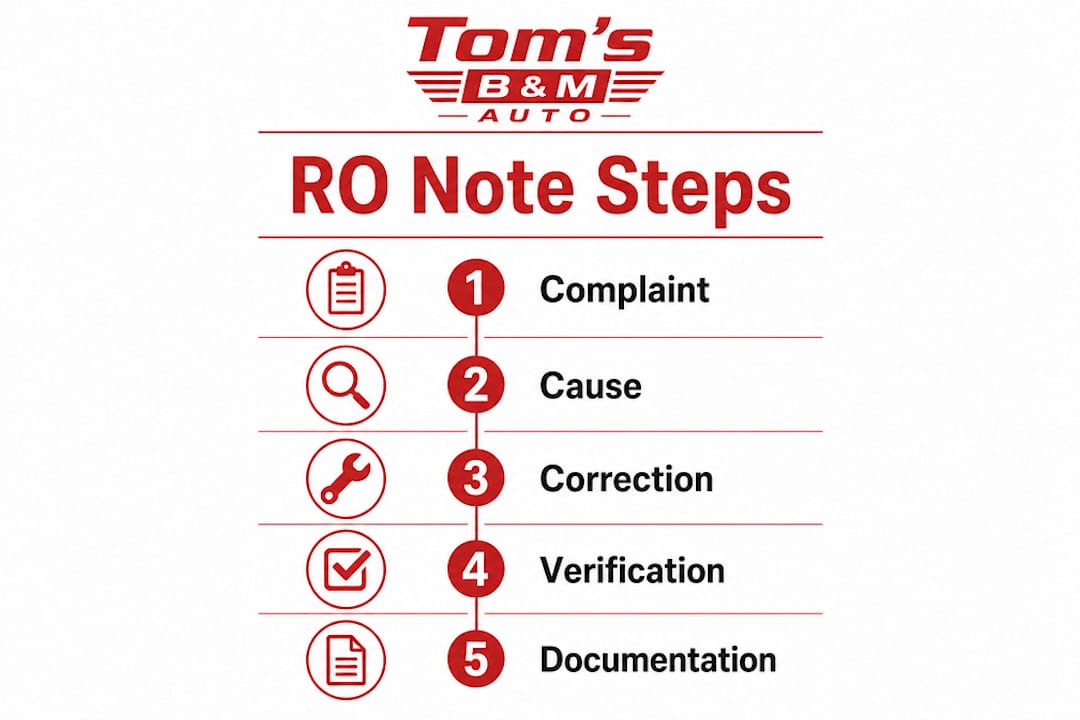
The three-part diagnostic sequence known as Complaint, Cause, and Correction ties all of these fields together. Every RO should answer: what did the customer report, what did the technician find, and what was done about it.
Which tools and techniques help write and maintain accurate repair notes?
The right tools remove the friction that causes documentation to slip. Here is a practical framework for any shop.
-
Use digital shop management software. Paper ROs get lost, smudged, and misfiled. Digital platforms keep every note timestamped, searchable, and tied to a customer’s vehicle history. Service advisors who maintain accurate vehicle history prevent lost tickets and improve customer retention directly.
-
Build standardized templates. A blank form invites inconsistency. A template with labeled fields for VIN, mileage, complaint, cause, and correction forces completeness. Every technician fills in the same structure every time.
-
Require live note entry. Technicians must input notes during work, not from memory at the end of the day. Memory-based notes introduce inaccuracies and slow down estimate creation. Live entry also lets service advisors update customers in real time.
-
Train service advisors to write technical action statements. Vague symptom descriptions like “noise from front end” create extra diagnostic steps. Writing outcome-focused statements like “inspect and replace drive-end bearing” eliminates questions and clarifies the technician’s task before the vehicle reaches the bay.
-
Conduct weekly RO audits. Assign a fixed time each week to review a sample of completed repair orders. Regular audits catch missing mileage, incomplete notes, and approval gaps before they become patterns.
Pro Tip: Enforce the Complaint, Cause, Correction sequence as a shop-wide standard. Post it at every service writer station. When every RO follows the same structure, final invoices are cleaner and disputes drop.
How to write repair order notes step by step
A well-written RO follows a clear sequence. Each step builds on the last.
-
Open with the customer’s complaint in their own words. Write exactly what they said, then add context. “Customer states vehicle pulls left at highway speeds, started two weeks ago, worsens in wet conditions.” That sentence gives the technician three diagnostic clues before they touch the car.
-
Record the technician’s diagnosis with cause identified. State what was found and how it was confirmed. “Inspected front suspension. Left front tie rod end has 4mm of play, exceeding the 2mm service limit. Confirmed with road test.” Specific measurements make the cause undeniable.
-
Specify the correction using clear, technical action language. Writing to the desired outcome with statements like “replace left front tie rod end and perform four-wheel alignment” removes all ambiguity. The technician knows exactly what to do. The customer knows exactly what they are paying for.
-
Itemize labor and parts. List each labor line separately with estimated hours. List each part with its part number and cost. This protects the shop if a customer disputes the bill and supports accurate repair shop estimates from the start.
-
Document customer approval. Record the date, time, and method of approval. “Customer approved via phone at 10:32 AM on March 4, 2026. Approved scope: replace left front tie rod end and alignment. Approved total: $380.” No approval, no work.
-
Update status and timestamps as work progresses. Mark when work started, when parts were ordered, and when the repair was completed. A live record prevents bottlenecks and gives service advisors accurate answers when customers call.
Here is the difference between a weak note and a strong one:
| Element | Weak note | Strong note |
|---|---|---|
| Complaint | “Noise from front” | “Customer reports clunking from front left over bumps, started 3 weeks ago” |
| Cause | “Worn part” | “Left front sway bar end link has 6mm of play, confirmed with lift inspection” |
| Correction | “Fixed noise” | “Replaced left front sway bar end link, torqued to spec, road tested, noise resolved” |
| Approval | “Customer said OK” | “Customer approved by phone at 2:15 PM, March 4, 2026, for $210 total” |

The strong note protects the shop, informs the technician, and satisfies the customer. The weak note does none of those things.
What common mistakes hurt repair order accuracy?
Documentation errors cause most of the friction in a shop’s workflow. Recognizing them is the first step to fixing them.
- Vague complaints. “Check engine light on” with no context forces the technician to start from zero. Always capture when, how often, and under what conditions.
- Technician-only shorthand. Notes written in abbreviations or internal jargon that only the technician understands create delays at the front counter. Technician notes must use language that service advisors and customers can read without a translation.
- Memory-based documentation. Reconstructing a full day’s work from memory at 5:00 PM produces inaccurate notes. Details get dropped, measurements get rounded, and approval times get fabricated.
- Missing mileage. Mileage at write-up and at delivery is a legal and warranty requirement. Missing mileage and scattered documentation contribute directly to RO breakdowns and workflow inefficiency.
- Unlogged approvals. An undocumented approval is no approval at all. If a customer disputes a charge and the shop has no record of consent, the shop loses.
- Notes stored outside the RO system. Sticky notes, text messages, and verbal agreements that never make it into the management software are invisible to anyone who was not in the room.
Reviewing hidden repair cost patterns in your RO history often reveals where documentation gaps are inflating costs or creating disputes.
Pro Tip: Set a recurring calendar block every Friday to pull five random completed ROs and score them against your Complaint, Cause, Correction standard. One hour a week catches recurring gaps before they become shop-wide habits.
Key Takeaways
Accurate repair order documentation is the single most effective tool for reducing diagnostic errors, preventing customer disputes, and building long-term shop credibility.
| Point | Details |
|---|---|
| Use the three-part sequence | Every RO must follow Complaint, Cause, and Correction to stay consistent and dispute-proof. |
| Capture complaint context | Record when, how often, and under what conditions the issue occurs, not just the symptom. |
| Enter notes live | Technicians must document during the repair, not from memory at day’s end, to keep records accurate. |
| Write for the front counter | Use plain language that service advisors and customers can read without technical translation. |
| Audit weekly | Review a sample of completed ROs every week to catch missing mileage, approvals, and incomplete notes. |
Why documentation is the repair you keep skipping
I have spent years watching shops invest in lifts, scan tools, and training programs while their RO quality stays stuck at the level of a napkin sketch. The technicians are skilled. The service advisors are experienced. But the documentation is vague, inconsistent, and written as an afterthought.
The uncomfortable truth is that most customer disputes do not start with a bad repair. They start with a note that said “fixed noise” instead of explaining what was found, what was replaced, and why. When a customer comes back two weeks later saying the noise returned, a strong RO tells the whole story. A weak one leaves the shop defenseless.
The shops I have seen turn this around fastest are the ones where the service manager treats the RO as a product, not a form. They review notes the same way a quality control manager reviews a finished part. They catch the shorthand, the missing mileage, and the vague complaints before the vehicle leaves the lot. That discipline compounds over time. Fewer callbacks, faster approvals, and customers who refer their friends because they actually understood what was done to their car.
Training staff to write clearly is a one-time investment with a permanent return. Pair that with a digital management system and a weekly audit habit, and your shop’s documentation will be stronger than most shops running twice your volume.
— Shingi
Tom’s B & M Auto: where documentation meets quality repair
Tom’s B & M Auto has served Lynnwood, WA since 1985 with the kind of thorough, transparent repair process that starts with a well-written RO and ends with a satisfied customer. Every job at Tom’s B & M Auto is backed by a 24-month / 24,000-mile warranty, which only holds up when the documentation is airtight.
Whether you need engine repair in Kenmore or domestic auto repair in Edmonds, Tom’s B & M Auto’s ASE-certified technicians document every finding, every approval, and every correction before the vehicle leaves the bay. If cost is a concern, financing options are available to help you invest in quality repairs without delay. Call Tom’s B & M Auto or book online to experience what a properly documented repair looks like from start to finish.
FAQ
What is a repair order note in an auto shop?
A repair order note is the written record of a customer’s complaint, the technician’s diagnosis, and the repair work performed on a vehicle. It serves as the legal and operational document for every service transaction.
What does the Complaint, Cause, Correction sequence mean?
Complaint, Cause, and Correction is a three-part diagnostic format that structures every repair order around what the customer reported, what the technician found, and what was done to fix it. Standardizing this sequence across a shop produces cleaner invoices and fewer disputes.
Why should technicians enter notes live instead of at day’s end?
Live note entry prevents the inaccuracies that come from reconstructing a full day’s work from memory. It also lets service advisors update customers in real time and speeds up estimate creation.
How often should a shop audit its repair orders?
Assigning a fixed weekly time to review a sample of completed repair orders is the most effective way to catch missing mileage, incomplete notes, and unlogged approvals before they become recurring problems.
What is the most common repair order documentation mistake?
Vague complaint descriptions with no context are the most common error. Writing “check engine light on” without noting when it occurs, how long it has been happening, or whether drivability has changed forces technicians to start diagnosis from scratch.
Recommended
- How to Get an Accurate Repair Shop Estimate in Lynnwood – Tom’s B & M Auto Blog
- Mechanic Flat Rate Efficiency Tips to Maximize Pay – Tom’s B & M Auto Blog
- Financing Available | Tom’s B&M Auto | Lynnwood, WA
- How to Avoid Unnecessary Upsells at Your Auto Shop – Tom’s B & M Auto Blog
Leave a Reply