

What Is Electronic Brake Distribution? A Car Owner’s Guide
Electronic brake distribution (EBD) is defined as a system that electronically varies the braking force applied to each wheel based on speed, load, and road conditions to maximize stopping stability. The industry standard term is electronic brakeforce distribution, though EBD is the widely used shorthand. Most drivers never notice it working, yet it operates every time you press the brake pedal. Modern vehicles from Toyota, Honda, Mercedes-Benz, and Subaru all rely on EBD as a core part of their brake safety systems. Understanding what is electronic brake distribution, and why it matters, gives you a clearer picture of how your car keeps you safe.
What is electronic brake distribution and how does it work?
EBD electronically varies braking force per wheel using real-time data from wheel-speed sensors, load inputs, and the vehicle’s control unit. It does not apply the same pressure to all four wheels. Instead, it calculates the grip available at each wheel and adjusts brake pressure accordingly, millisecond by millisecond.
The physics behind this matter. When you brake hard, weight shifts forward. The front axle carries the bulk of the vehicle’s mass during a stop, while the rear axle becomes lighter. During hard braking, the front axle typically carries 70%–80% of the vehicle’s mass. EBD reduces rear brake pressure in response, preventing the rear wheels from locking up before the fronts do.
EBD handles several real-world scenarios that a fixed mechanical proportioning valve cannot:
- Cornering while braking: The outside wheels carry more load, so EBD increases pressure there and reduces it on the inside wheels.
- Slippery or uneven surfaces: One wheel may have less grip than the others. EBD reduces pressure on that wheel to prevent a skid.
- Loaded vehicles: A full trunk or rear passengers add weight to the rear axle. EBD recognizes this and adjusts rear brake pressure upward to match the increased load.
- Emergency stops: EBD sets optimal brake input before ABS even activates, reducing the workload on the ABS system.
EBD integrates with ABS and electronic stability control (ESC) to form a coordinated braking safety network. It uses the same wheel-speed sensors as ABS but operates at a different stage. EBD shapes brake pressure distribution first. ABS then steps in if any wheel approaches its slip threshold. Think of EBD as the first line of brake management, and ABS as the safety net behind it.
Pro Tip: If your vehicle carries heavy loads regularly, such as camping gear or rear passengers, EBD is working harder than usual. Keep your brake system in top condition so it can respond accurately to those load changes.

What are the safety benefits of electronic brake distribution?
EBD prevents rear wheel lock-up, which is one of the most dangerous outcomes of hard braking. A locked rear wheel causes the back of the vehicle to swing out, triggering a spin. EBD adjusts brake pressure in real time to keep all four wheels rotating and the vehicle tracking straight.
The safety gains extend across multiple driving conditions:
- Wet roads: Reduced grip means wheels lock up more easily. EBD continuously recalculates pressure limits for each wheel, keeping braking within the available traction.
- Uneven surfaces: Gravel, painted lines, or road debris can cause one wheel to lose grip suddenly. EBD compensates by redistributing pressure to the wheels with better contact.
- Emergency braking: EBD prepares the brake system before ABS activates, shortening the overall stopping distance.
- Cornering: Braking mid-corner is inherently unstable. EBD manages the pressure difference between the inner and outer wheels to reduce the risk of oversteer or understeer.
- Changing loads: Passengers, cargo, and towing weight all shift the vehicle’s balance. EBD adapts to these changes without driver input.
“EBD keeps brake force at the maximum each wheel can grip dynamically to avoid premature lock and maintain vehicle stability during braking.” — HandWiki, Electronic Brakeforce Distribution
EBD also supports electronic stability control. When ESC detects oversteer or understeer, it applies individual wheel brakes to correct the vehicle’s path. EBD ensures those individual brake applications are calibrated correctly for the current load and speed. Mercedes-Benz, for example, integrates EBD with active brake assist logic in vehicles like the EQV, where the system monitors critical braking situations and adjusts force distribution automatically.
How does EBD compare to ABS and trailer brake controllers?
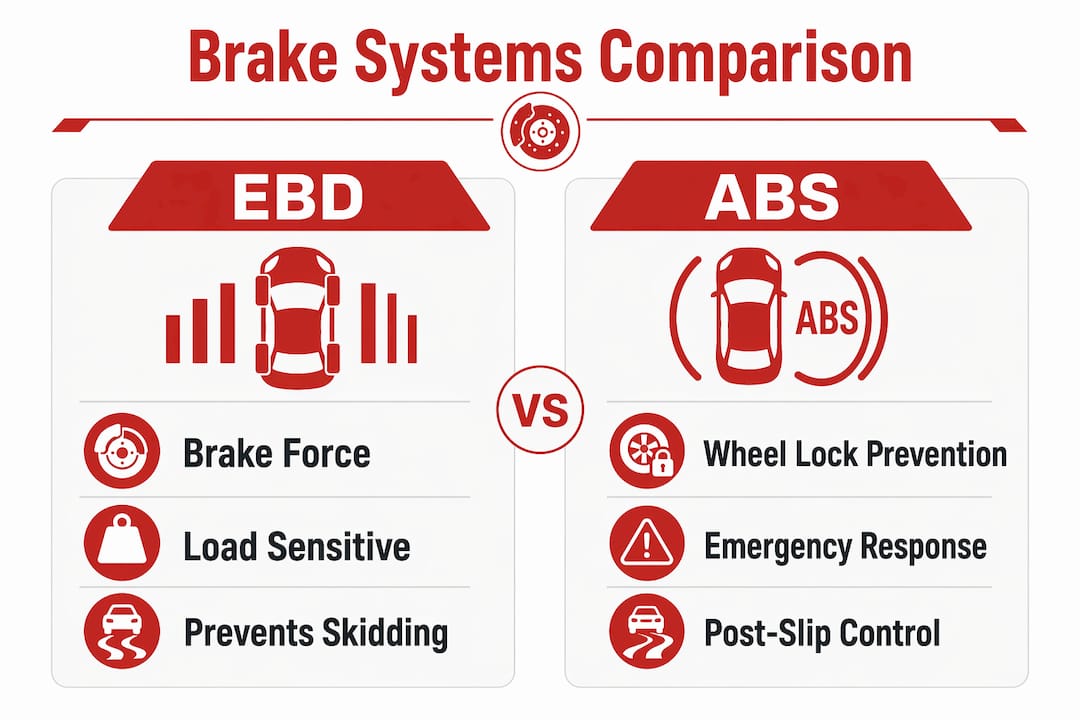
EBD and ABS are not the same system, though they share hardware and work together. Confusing them is common. The table below clarifies the key differences.
| Feature | EBD | ABS | Trailer brake controller |
|---|---|---|---|
| Primary function | Distributes brake force across wheels | Prevents wheel lock-up | Controls trailer brakes |
| When it activates | Every braking event | When wheel slip is detected | When towing vehicle brakes |
| Hardware used | Wheel-speed sensors, control unit | Wheel-speed sensors, hydraulic modulator | Separate electrical device |
| Location | Built into vehicle brake system | Built into vehicle brake system | Add-on device, separate from vehicle |
| Works with load changes | Yes | No | No |
EBD functions as brake-force balancing before ABS intervention. ABS reacts to a wheel that is already slipping. EBD works earlier, shaping the pressure so that slip is less likely to occur. The two systems complement each other rather than duplicate each other.
Trailer brake controllers are a separate category entirely. Trailer brake controllers are add-on devices that activate a trailer’s own brakes electrically when the tow vehicle decelerates. They manage the trailer’s braking, not the tow vehicle’s. EBD has no role in trailer brake control. If you tow regularly, you need both systems working independently.
What car owners should know about EBD maintenance and faults
EBD does not require its own dedicated service interval. It runs on the same hardware as ABS, so keeping your ABS system healthy keeps EBD healthy. The sensors, hydraulic modulator, and control module that ABS depends on are the same components EBD uses.
Common issues that affect EBD performance include:
- Faulty wheel-speed sensors: These are the most frequent cause of EBD errors. Dirt, corrosion, or physical damage to a sensor disrupts the data EBD needs to calculate brake pressure.
- ABS module failures: Since EBD runs within the broader brake-assist logic, an ABS module fault will typically disable EBD as well.
- Low brake fluid: Degraded or low fluid affects hydraulic pressure modulation, which EBD relies on to adjust force at each wheel. Regular brake fluid maintenance keeps the system responsive.
- Worn brake components: Uneven rotor wear or a sticking caliper can create inconsistent braking response that EBD cannot fully compensate for.
Diagnosing EBD faults involves checking ABS, ESC, and brake-assist modules together. EBD faults rarely appear as an isolated warning. You will typically see a combined brake warning light or an ABS light on the dashboard. Do not ignore these lights. They signal that your brake distribution system may not be functioning correctly.
EBD cannot be turned off manually on most vehicles. It operates automatically as part of the brake control system. If a fault disables it, the vehicle reverts to fixed brake pressure distribution, which increases the risk of rear wheel lock-up under hard braking.
Pro Tip: If your ABS light comes on, have the system scanned with an OBD-II diagnostic tool immediately. An ABS fault almost always means EBD is also compromised. Driving on a compromised system reduces your braking safety margin significantly.
Key takeaways
EBD is the first stage of brake management in modern vehicles, shaping pressure distribution before ABS activates to prevent lock-up and maintain stability under all load and road conditions.
| Point | Details |
|---|---|
| EBD definition | EBD electronically varies brake force per wheel based on speed, load, and road surface data. |
| EBD vs. ABS | EBD distributes brake force before ABS activates; they share sensors but serve different roles. |
| Safety benefits | EBD prevents rear wheel lock-up, reduces stopping distances, and supports ESC during cornering. |
| Fault detection | EBD faults appear as ABS or combined brake warnings, not as isolated EBD alerts. |
| Maintenance | Healthy wheel-speed sensors, brake fluid, and ABS components keep EBD functioning correctly. |
Why EBD deserves more credit than it gets
Most drivers think of ABS as the hero of emergency braking. EBD rarely gets mentioned. That gap in recognition is a mistake.
EBD is doing the quiet, constant work that makes ABS less necessary. EBD reduces the workload on ABS by shaping brake pressures before any wheel reaches its slip threshold. A well-functioning EBD system means ABS intervenes less often, which means smoother, more controlled stops. That is not a minor detail.
The misconception I hear most often is that EBD simply adds more braking power. It does not. EBD balances traction by reducing pressure on wheels closest to lock-up and increasing it on wheels with more grip. On a mixed-traction surface, like a road where one side is wet and the other is dry, that distinction is the difference between a controlled stop and a spin.
As vehicles move toward more advanced driver assistance systems and autonomous braking, EBD becomes even more critical. Autonomous emergency braking systems depend on accurate, wheel-level brake control to function correctly. EBD is the foundation that makes that precision possible. Enthusiasts who appreciate suspension tuning and tire selection should give the same attention to their brake distribution system. It is just as fundamental to how the car behaves at the limit.
— Shingi
Brake system health at Tom’s B & M Auto
Tom’s B & M Auto has served Lynnwood, WA drivers since 1985, and brake system diagnostics are one of the shop’s core strengths. If your ABS light is on, or you have noticed changes in how your vehicle stops, the ASE-certified technicians at Tom’s B & M Auto can run a full brake system scan using professional-grade OBD-II diagnostics to identify EBD-related faults before they become safety issues. Schedule a free brake inspection to check your wheel-speed sensors, brake fluid condition, and hydraulic components. If repairs are needed, financing options are available to keep brake work affordable. All repairs carry a 24-month / 24,000-mile warranty.
FAQ
What is electronic brake distribution in simple terms?
EBD is a system that automatically adjusts how much braking force goes to each wheel based on speed, load, and road conditions. Its goal is to prevent rear wheel lock-up and keep the vehicle stable during braking.
Is EBD the same as ABS?
No. EBD distributes brake force across wheels before any wheel locks up. ABS activates only when a wheel is already slipping. The two systems share sensors and work together, but they perform different functions.
Can EBD be turned off?
EBD cannot be manually disabled on most vehicles. It operates automatically within the brake control system. A fault in the ABS or ESC module can disable it, which is why dashboard brake warnings should be diagnosed promptly.
How do I know if my EBD system has a fault?
A fault in EBD typically triggers an ABS warning light or a combined brake system warning on the dashboard. EBD faults appear as part of broader brake-assist system alerts, not as isolated EBD-specific warnings.
Does EBD help when towing a trailer?
EBD manages brake force on the tow vehicle’s own wheels and does adjust for added rear load from a trailer’s tongue weight. However, it does not control the trailer’s brakes. A separate trailer brake controller handles that function.
Recommended
- What Is Brake Bleeding? A Car Owner’s Guide – Tom’s B & M Auto Blog
- What Is a Brake Rotor? Function, Wear, and Care – Tom’s B & M Auto Blog
- The Role of Brake Caliper in Vehicle Safety – Tom’s B & M Auto Blog
- European Car Repair Challenges: What Owners Must Know – Tom’s B & M Auto Blog
Leave a Reply