VW DSG Service Interval: Miles by Transmission Type
Most U.S.-market VW DSG transmissions are serviced every 40,000 or 80,000 miles, depending on which gearbox you have. The 6-speed DSG gets a fluid and filter change every 40,000 miles. The newer 7-speed DSG in the Golf R, Golf GTI and Jetta GLI gets a fluid change every 80,000 miles. Some 7-speed units have no scheduled interval at all. Which one applies to you comes down to the transmission code, not the badge on the trunk.
TL;DR
- The 6-speed DSG (DQ250, code 0D9) is serviced every 40,000 miles with fluid and filter.
- The 7-speed DSG in the Golf R, GTI and Jetta GLI is on an 80,000-mile fluid change in VW’s U.S. schedules.
- Not every 7-speed is the same: the dry-clutch DQ200 has no interval specified, while the wet-clutch DQ500 is listed at 40,000 miles.
- Haldex AWD clutch fluid is a separate service, on a 3-year interval in VW’s 2018 U.S. schedule.
- Confirm your exact interval by VIN with VW’s maintenance lookup, and shorten it if your driving is hard on the gearbox.
Table of Contents
- The short answer by transmission
- What VW’s U.S. maintenance schedules say
- How to find the interval for your exact car
- Why the interval is different from one DSG to the next
- When to service sooner than the schedule
- Haldex is a separate service on AWD cars
- Don’t forget the regular service schedule
- What a DSG service involves
- Signs your DSG needs attention now
- Perspective
- Book your DSG service in Lynnwood
- FAQ
- Sources
The short answer by transmission
Search results for this topic disagree because they mix several different gearboxes under the single name “DSG”. DSG is VW’s name for its dual-clutch automatic, and the company has built several versions. A forum post saying 40,000 miles and another saying 80,000 can both be right for the car they are describing.
Here is how the intervals line up, based on VW’s own U.S. maintenance schedules and a Volkswagen Group parts supplier’s servicing guide:
| Transmission | Code | Gears | Service | Interval |
|---|---|---|---|---|
| DQ250 | 0D9 | 6-speed | Fluid and filter | 40,000 miles |
| DQ381 | 0GC | 7-speed | Fluid only | 80,000 miles |
| DQ500 | 0DL / 0BH | 7-speed | Fluid only | 40,000 miles |
| DQ200 | 0CW | 7-speed | None specified | No interval specified |
The DQ250, DQ381, DQ500 and DQ200 rows come from TPS Trade Parts’ DSG servicing guide, which is written for the UK market. The U.S. schedules below confirm the 6-speed and 0GC numbers for cars sold here.
What VW’s U.S. maintenance schedules say
The most reliable source for a number is the schedule VW filed for your model year. Three are worth knowing.
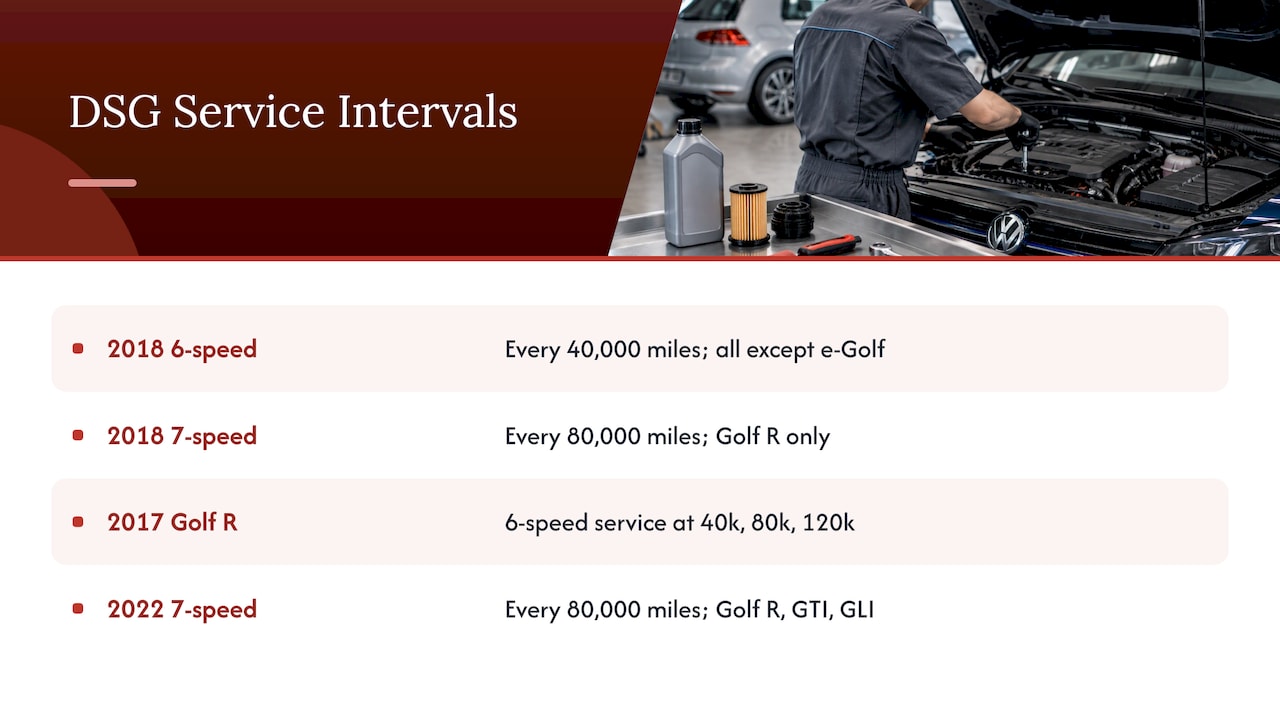
The 2018 VW maintenance schedule for all models except the e-Golf lists a 6-speed DSG fluid and filter change every 40,000 miles. It lists a 7-speed DSG fluid change every 80,000 miles for the Golf R only.
The 2017 Golf R schedule shows the DSG fluid and filter change at 40,000, 80,000 and 120,000 miles. That car used the 6-speed unit.
The 2022 VW maintenance schedule for gasoline models states that the 7-speed DSG fluid is changed every 80,000 miles, and applies that only to the Golf R, Golf GTI and Jetta GLI. A model-by-model summary of the 2022 to 2026 U.S. schedules gives the same 80,000-mile figure for the Mk8 Golf GTI and the Jetta GLI, with no time limit on the GTI.
Two things follow. First, if you drive an older 6-speed car (many Golfs, GTIs, Jettas, Passats, Tiguans and Audi models of roughly 2006 to 2018), 40,000 miles is the number to plan around. Second, if you drive a recent GTI, Golf R or Jetta GLI, the schedule gives you more room, at 80,000 miles.
How to find the interval for your exact car
Don’t rely on a rule of thumb, including ours. Use this order:
- Identify the transmission. The gearbox code is on the transmission’s ID label and in your car’s data sticker or service records. A shop can read it from the VIN. Two cars of the same model and year can carry different gearboxes.
- Look up the VIN. Enter it at VW’s maintenance lookup to pull the owner’s manual and maintenance information for your vehicle.
- Read the maintenance booklet. VW’s own owner’s literature says to contact a Volkswagen dealer or service facility for information, including changes to service intervals for your vehicle.
- Check your service history. If the previous owner never did the service, treat the car as overdue and ask for a fluid condition check, not a guess.
VW parts guidance makes the same point: the safest approach is to identify the transmission first, then match fluid, filter and procedure to the official literature for that vehicle. A service meant for a different gearbox can mean the wrong fluid or a skipped filter.
Why the interval is different from one DSG to the next
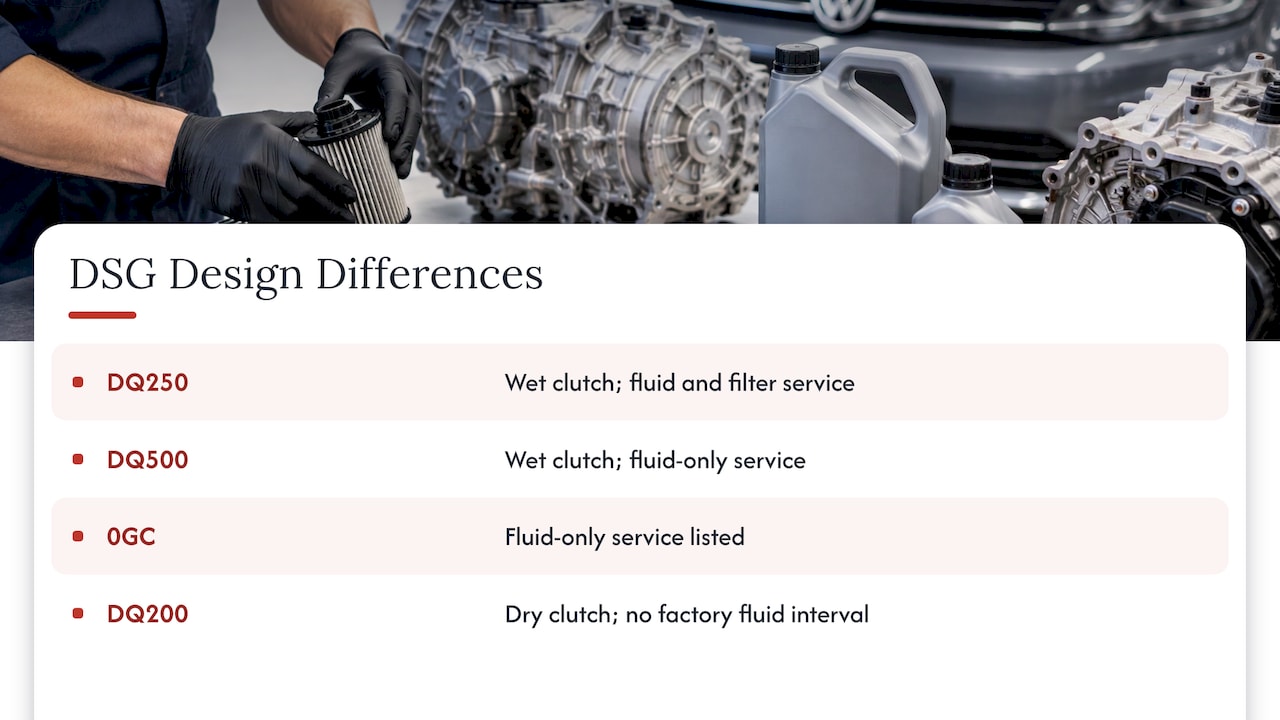
The 6-speed DQ250 and the wet-clutch DQ500 run their clutches in an oil bath. That oil also lubricates the gears and serves as hydraulic fluid for the mechatronic unit, the module that shifts the gearbox. Heat and clutch wear accumulate in that fluid. The 6-speed also has a filter, which is why its service is described as fluid and filter, while the 0GC and DQ500 services are listed as fluid only.
The DQ200 is a dry-clutch design, which is why a service interval is not specified for it in the same way. That doesn’t mean the car needs no attention. It means the factory schedule doesn’t list a fluid service, and you should follow your owner’s literature and any dealer bulletin for that car.
We’d rather you not take a single “40,000 miles” headline and apply it to a DQ381. That would be a service done earlier than the schedule calls for. The opposite mistake is worse: leaving a 6-speed at 80,000 miles because a newer GTI owner told you that was fine.
When to service sooner than the schedule
VW’s schedules assume normal operating conditions. The 2018 schedule says that under severe conditions, such as extremely low temperatures or excessive dust, certain operations must be carried out between the listed intervals.
The severe-duty row is not always written for the DSG. For the 2026 GTI’s 7-speed (0GC), the schedule’s 60,000-mile severe-duty entry names the 09U automatic, not the 0GC. So do not assume a severe-duty number exists for your car. Ask your shop to compare your use against the owner’s literature.
A parts retailer’s DSG guide suggests that people with an aggressive driving style, constant extreme heat, heavy city traffic or trailer pulling may want to replace the fluid sooner. In practice, these situations make sense for a shorter interval:
- Stop-and-go commuting on I-5 or 405, where a dual-clutch spends much of its time slipping its clutches at low speed.
- Steep hills with a loaded car, or towing where your manual allows it.
- Track days or frequent hard launches in a GTI or Golf R.
- Any car whose history is unknown, where nothing in the records shows a fluid change.
If you fit one of these, the sensible move is to service at the earlier end of what your owner’s literature allows and to ask your technician about moving it up. We can walk you through that for your car.
Haldex is a separate service on AWD cars
On all-wheel-drive Volkswagens, the DSG isn’t the only gearbox fluid. The 2018 U.S. schedule lists an AWD clutch fluid change every 3 years on AWD-only vehicles. That Haldex service is on a separate clock from the DSG fluid service. Golf R and Tiguan owners often do the two jobs on the same visit, but a car can be due for one and not the other. An older 2012 Passat schedule also lists a 3-year Haldex oil change for the 3.6L engine, so this has been VW practice for a long time.
Because it’s time-based, the Haldex service can come due before the mileage suggests it. A low-mileage AWD car that is 4 years old with no Haldex service on record is a good example.
Don’t forget the regular service schedule
The DSG fluid service is one item among many. VW’s 2022 U.S. schedule puts the first minor maintenance at 10,000 miles or 1 year after delivery, and standard maintenance at 20,000 miles or every 2 years after the last standard service, whichever comes first. The DSG service lands on top of that cycle, usually coinciding with every second or fourth standard visit on a 6-speed.
It makes sense to bundle the work. If you are having the DSG serviced at 40,000 miles, that is also a good time to handle engine oil, brake fluid and any other items due. For reference, see our guides on oil change intervals, European car maintenance schedules and brake fluid change intervals.
What a DSG service involves
A DSG service is more specific than a conventional automatic transmission fluid change. In general terms, the technician drains the old fluid, replaces the filter where the transmission has one, refills with the fluid specified for that gearbox, and sets the fluid to the correct level at the correct temperature. Fluid level and temperature matter on these units, which is why it is a job for someone who has the procedure for your gearbox code and not just a drain-and-fill.
The point of doing it on schedule is simple: fluid in a dual-clutch ages through heat and clutch wear, and the same fluid works the mechatronic unit. Fresh fluid and a clean filter keep that system working as designed. Our general explainer on the role of transmission fluid covers the basics, and our transmission fluid change interval guide covers other transmission types.
Signs your DSG needs attention now
A schedule is a floor, not a diagnosis. If your car does any of the following, book an inspection before the next interval:
- Jerky or hesitant take-off from a stop.
- Shudder at low speed, particularly in traffic.
- Delayed or harsh shifts, or a gear that won’t engage.
- A transmission warning light or a check engine light with shift complaints.
These symptoms can come from several causes, including fluid condition, clutch wear or the mechatronic unit, so they need a scan and a road test to sort out. Our article on why a transmission slips lists the usual causes, and the role of the transmission solenoid explains one of the parts involved in shifting.
Perspective
Owners ask us for “the” DSG interval, and the honest answer is that it depends on which gearbox is in the car. We service domestic, Asian and European vehicles, and the DSG is a good example of why we start with the VIN and the transmission code rather than a number from a forum.
Our advice is to treat the factory schedule as the baseline and then adjust for how you drive. Puget Sound stop-and-go traffic and hilly routes put real work into a dual-clutch, so if that is your commute, bring it up with us when you book.
Our technicians are ASE-certified, we use professional-grade diagnostics, and we quote upfront before any work starts. Everything we do carries a 24-month / 24,000-mile warranty. A DSG service done on time is one of the simpler ways to look after a car that you want to keep driving.
Shingi
Book your DSG service in Lynnwood
We’re a family-owned shop serving Lynnwood since 1985, and we work on European vehicles as well as domestic and Asian makes. If your Volkswagen is approaching its DSG interval, or you’ve just bought one with no service records, our team can identify the transmission, confirm the interval and carry out the work.
Start with our transmission service page, or see our Volkswagen repair page if you are closer to Meadowdale. Same-day appointments are often available. If you are also due for scheduled maintenance, our 30k 60k 90k service can cover the rest of the visit. Military members, seniors and first responders can ask about our exclusive discounts.
FAQ
How often should DSG fluid be changed?
For the 6-speed DSG, VW’s U.S. schedules call for a fluid and filter change every 40,000 miles. For the 7-speed DSG in the Golf R, GTI and Jetta GLI, the 2022 schedule calls for a fluid change every 80,000 miles. Check your VIN at VW’s maintenance lookup to confirm which applies.
Is the DSG service interval the same on every VW?
No. It varies by transmission code and model year. The DQ250 6-speed and DQ500 7-speed are listed at 40,000 miles, the DQ381 (0GC) at 80,000 miles, and the DQ200 has no interval specified in the supplier’s guide. Identify the gearbox first, then match the interval.
Does the DSG service cover the Haldex AWD fluid?
No, they are separate services. VW’s 2018 U.S. schedule lists AWD clutch fluid every 3 years on AWD-only vehicles, independent of the DSG fluid interval. Many owners have both done in one visit to save time.
Should I service my DSG earlier if I drive in heavy traffic?
VW’s schedules are based on normal conditions and allow for extra service under severe ones. If you commute in heavy stop-and-go traffic, drive hard or tow, ask your technician about moving the service earlier than the listed mileage.
Sources
- 2018 VW Maintenance Schedule, all models except e-Golf
- 2022 VW Maintenance Schedule, all gasoline models
- 2017 Volkswagen Golf R Maintenance Schedule
- 2012 Volkswagen Passat Maintenance Schedule
- VW Maintenance Schedule lookup
- Volkswagen 2024 owner’s literature
- VW Maintenance Schedule: Golf GTI, Tiguan, Atlas, Jetta
- 2026 Volkswagen Golf GTI Maintenance Schedule
- DSG servicing guide, TPS Trade Parts
- VW DSG and Automatic Transmission Service Guide
- How To Change VW DSG Transmission Fluid (6-Speed)
Recommended
- Transmission Fluid Change Interval for Drivers
- Subaru CVT Service, Not Lifetime Fluid
- What Is Transfer Case Service? Your 4WD Guide
Leave a Reply