
Timing Belt Symptoms: Warning Signs and What to Do Next
The most common timing belt symptoms are a ticking noise from the front of the engine, misfires or a rough idle, hard starting, an oil leak near the timing cover, and a check engine light. The catch is that a timing belt can also fail with no warning at all. If you notice any of these signs, stop driving the car hard and have it inspected the same week. If your car is at or past its replacement interval, treat that as the warning.
This guide explains what each symptom feels and sounds like, what causes it, what is normal and what is urgent, and what a proper repair involves. We are Tom’s B & M Auto, a family-owned shop in Lynnwood, WA, and we have been fixing cars here since 1985. Everything below comes from what we see on the lift, backed by published sources where a fact can be checked.
TL;DR
- The classic signs are ticking from the engine, misfires or rough running, trouble starting, oil leaking near the front of the engine, and a check engine light.
- Many belts break without any warning. The manufacturer’s mileage interval, not symptoms, is your real deadline.
- On an interference engine, a snapped belt can bend valves and wreck the engine. A belt that is breaking is not a “drive it until the weekend” problem.
- Replace the belt as a kit with the tensioner, idler pulleys and, if the belt drives it, the water pump.
- Not sure what you have? Our technicians can check your interval, inspect for leaks and tell you what your engine needs.
Table of Contents
- What a timing belt does, and why failure is expensive
- The main timing belt symptoms
- Quick reference: symptom, likely cause, how urgent
- Why many timing belts fail with no warning
- What to do if you notice a symptom
- What a proper timing belt job includes
- What it costs, honestly
- Our perspective: what we tell customers at the counter
- Get it checked in Lynnwood
- FAQ
- Sources
What a timing belt does, and why failure is expensive
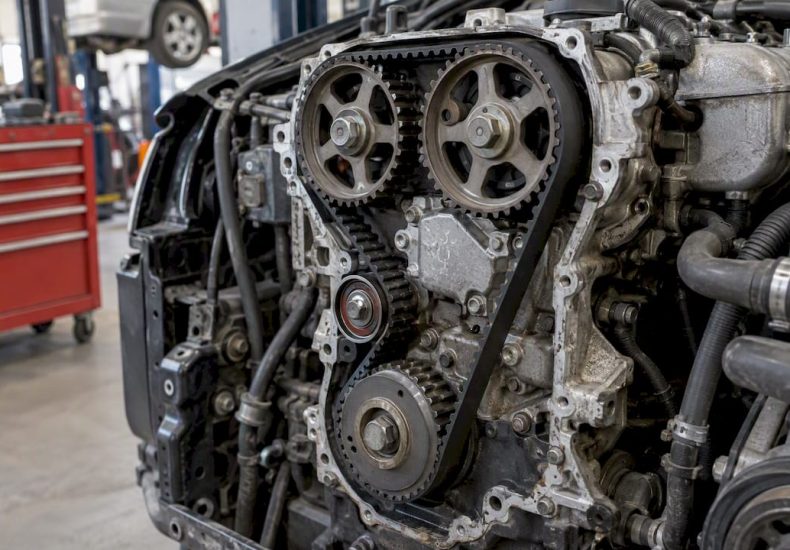
The timing belt connects the crankshaft to the camshaft. According to AAA’s maintenance guide, you cannot see it because it sits behind the front engine cover. It keeps the valves opening and closing in step with the pistons. Gates, a major belt manufacturer, describes it this way: a small disruption in synchronization makes the engine run poorly, and a major one stops it running at all.
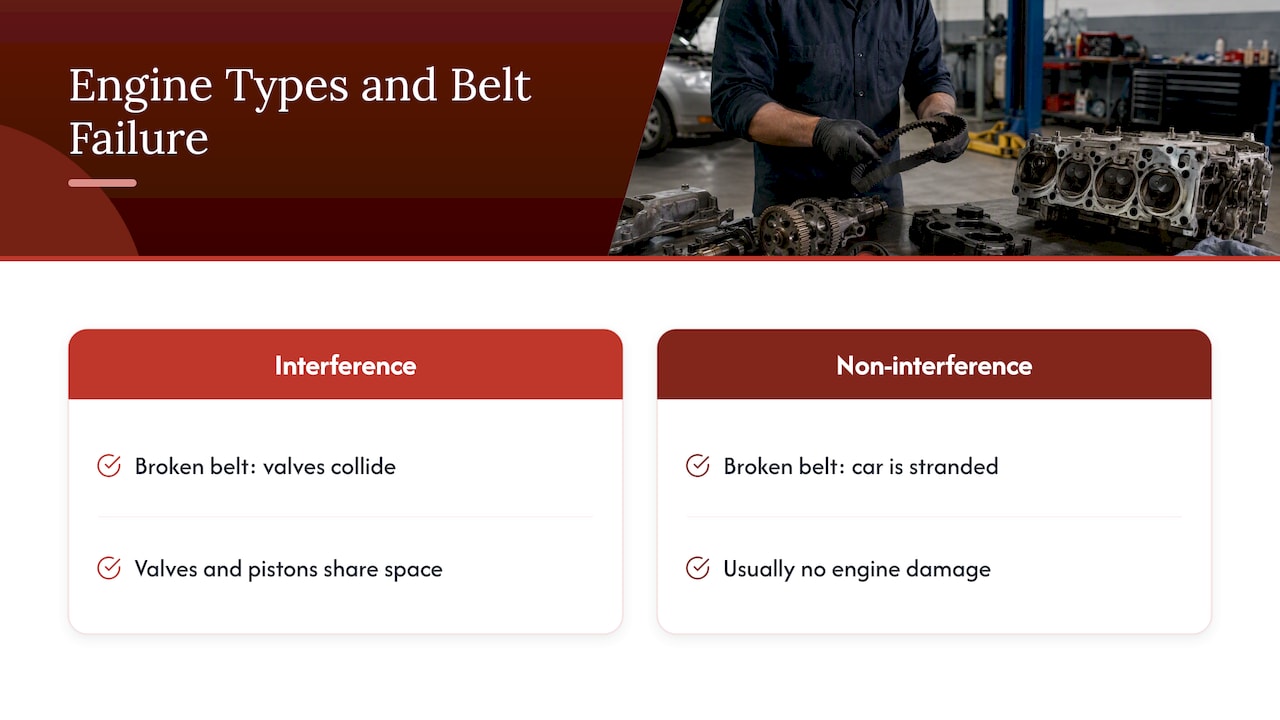
The cost depends on the engine design. In an interference engine, the valves and pistons occupy the same space at different moments. If the belt breaks, they collide. In a non-interference engine, a broken belt strands you but usually does not damage the engine. Mechanics often call the belt a “pay now or pay later” part for exactly this reason. You cannot assume which kind you have from how the car drives, so we look it up by year, make and engine.
The main timing belt symptoms
These are the signs we and the published guides agree on. O’Reilly’s diagnostic guide lists ticking or squealing noises, misfires, hard starting and a lit check engine light. AAA adds that engine performance that varies over time can be an indicator too.
1. A ticking or clicking noise from the engine
This is the symptom people search for most. A ticking sound from the front of the engine, especially one that is louder at idle, is often tied to the timing system. Here is the nuance: the belt itself is rubber and is not usually the noisy part. The ticking more often comes from a worn tensioner, a failing idler pulley or a bearing running dry behind the timing cover. Some owners report a tick on cold starts that fades as the engine warms up. A flapping or slapping sound means the belt has lost tension, which is more serious.
Ticking has other causes too, including low oil level, noisy lifters and exhaust leaks. That is why we do not guess from the sound alone. If the noise is new, check your oil level first, and book an inspection if it is correct.
2. Misfires or a rough idle
If the belt stretches or jumps a tooth, valve timing drifts. You may feel hesitation, a shaky idle, weak acceleration or the car running as though it has a bad spark plug. Because misfires have dozens of possible causes, from plugs and coils to fuel delivery, this symptom alone does not prove a timing belt problem. Combined with high mileage and no belt service on record, though, it becomes a strong suspect.
3. Trouble starting, or an engine that cranks but will not start
Hard starting can mean the belt has slipped out of position. If the belt has broken, the starter will spin the engine freely but it will not fire. CarParts.com notes that a broken belt makes the engine stall and the vehicle coast to a stop, while a belt that merely loses a few teeth may show up as a loss of power.
A car that cranks but will not start after a belt failure should not be cranked repeatedly. On an interference engine, extra cranking can add to the damage. Have it towed.
4. Oil leaking near the front of the engine
Oil on or below the timing cover points to a leaking camshaft or crankshaft seal. Oil is a belt killer: it softens the rubber and lets it slip. A leak at that location is a reason to inspect the belt even if the mileage looks fine. Do not just top off the oil and carry on. Oil-soaked belts are one of the situations where we tell owners to act promptly.
5. A check engine light
The engine computer compares crankshaft and camshaft position. If they disagree, it sets codes and lights the check engine light. Our shop uses professional-grade OBD-II diagnostics to read those codes, and we treat them as a starting point rather than a verdict, since a cam or crank sensor can set similar codes. If your light is on, our check engine light diagnostics are the first step.
6. Coolant leaks or overheating, when the belt drives the water pump
On many engines the timing belt also turns the water pump. A pump bearing that rattles or a coolant leak from the pump can be the first visible sign of a worn timing system. If the temperature gauge climbs, pull over safely and shut the engine off. Overheating on top of a worn belt is a bad combination.
Quick reference: symptom, likely cause, how urgent
| What you notice | Possible cause | Urgency |
|---|---|---|
| Ticking at idle, worse when cold | Tensioner, idler or oil level | Inspect within days |
| Slapping or flapping sound | Loose belt | Stop driving, have it towed or inspected |
| Rough idle, misfires | Belt stretch or jump, or ignition/fuel issue | Inspect this week |
| Cranks, will not start | Broken belt, or unrelated fuel/spark issue | Do not keep cranking; tow |
| Oil near timing cover | Cam or crank seal leak | Inspect soon; oil damages the belt |
| Check engine light, no other signs | Sensor, timing correlation or other | Read codes promptly |
| Coolant leak, overheating | Belt-driven water pump | Pull over, shut off, tow if hot |
Why many timing belts fail with no warning
The uncomfortable part of this topic is that the symptom list is not a safety net. One owner discussion we have seen puts it bluntly: the engine may run rougher only for a moment before the belt goes. A broken tooth, a seized pulley or a failing water pump bearing can end a belt in seconds. Rubber also ages whether or not the car is driven, so a low-mileage car that sat a lot can still be overdue.
That is why the guidance everywhere is to go by the schedule. AAA says manufacturers typically specify replacement between 60,000 and 100,000 miles, and that the interval, not the symptoms, is what protects the engine. Your owner’s manual gives the exact figure and often a time limit in years as well. Some engines use a timing chain instead of a belt and have no scheduled replacement. If you hear rattling and are not sure which you have, our post on timing chain rattle and whether it is safe to drive covers the chain side.
What to do if you notice a symptom
- Check the basics. Confirm the oil level and look under the car for fresh oil or coolant.
- Look up your interval. Find the timing belt line in your manual or maintenance schedule. Compare it with your mileage and with the service records.
- Reduce risk. Avoid hard acceleration and high rpm. If the engine runs rough, ticks loudly or flaps, do not drive it.
- Do not keep cranking a car that turns over but does not start.
- Get it inspected. A technician can read codes, check for leaks and, on many engines, inspect the belt through the inspection area or after removing the cover.
- Decide on replacement, not repair. A worn belt is not patched. It is replaced with its supporting parts.
If you are shopping for a used car, ask for proof of the last timing belt service. A buyer inspection before you sign can tell you whether the belt is due. A big maintenance bill hiding behind a good test drive is common on cars near the interval.
What a proper timing belt job includes
The belt is the cheap part. Most of the bill is labor, because the technician has to take apart the front of the engine to reach it. That is the main reason to do everything in one visit.
- Tensioner and idler pulleys. Gates explains that a new belt on a worn pulley or tensioner is not properly supported, which can lead to early failure.
- Water pump, if belt-driven. The same source says belt-driven water pumps should always be replaced with the belt, which cuts comebacks. If you are curious about the pump itself, see our water pump replacement walkthrough.
- Seals. If the cam or crank seals are leaking, they are replaced while access is open, since oil would ruin the new belt.
- Verification. Timing marks are set to specification and the engine is turned over by hand before it is started.
A belt-only job saves money on paper and invites a second repair. We do not recommend it.
What it costs, honestly
Timing belt prices vary by engine and by shop. As one reference point, AAA’s repair estimator shows roughly $1,410 to $1,958 for a 2017 Ford Focus, parts and labor, as of September 2026. That is one car, and a V6 with a belt-driven pump can cost more. We do not publish a flat timing belt price because it depends on your engine, so we quote your exact vehicle before any work starts, with the kit parts and labor itemized.
For perspective, the same AAA guidance warns that a failure on the wrong engine can cost more than the planned replacement would have. Spending on schedule is almost always cheaper than waiting for a symptom.
Our perspective: what we tell customers at the counter
We get two kinds of calls about timing belts. The first is from owners who heard a tick and want to know if it is the belt. The second, much harder one, is from owners whose car died on I-5 or Highway 99 and now cranks with no compression. We would rather have the first conversation.
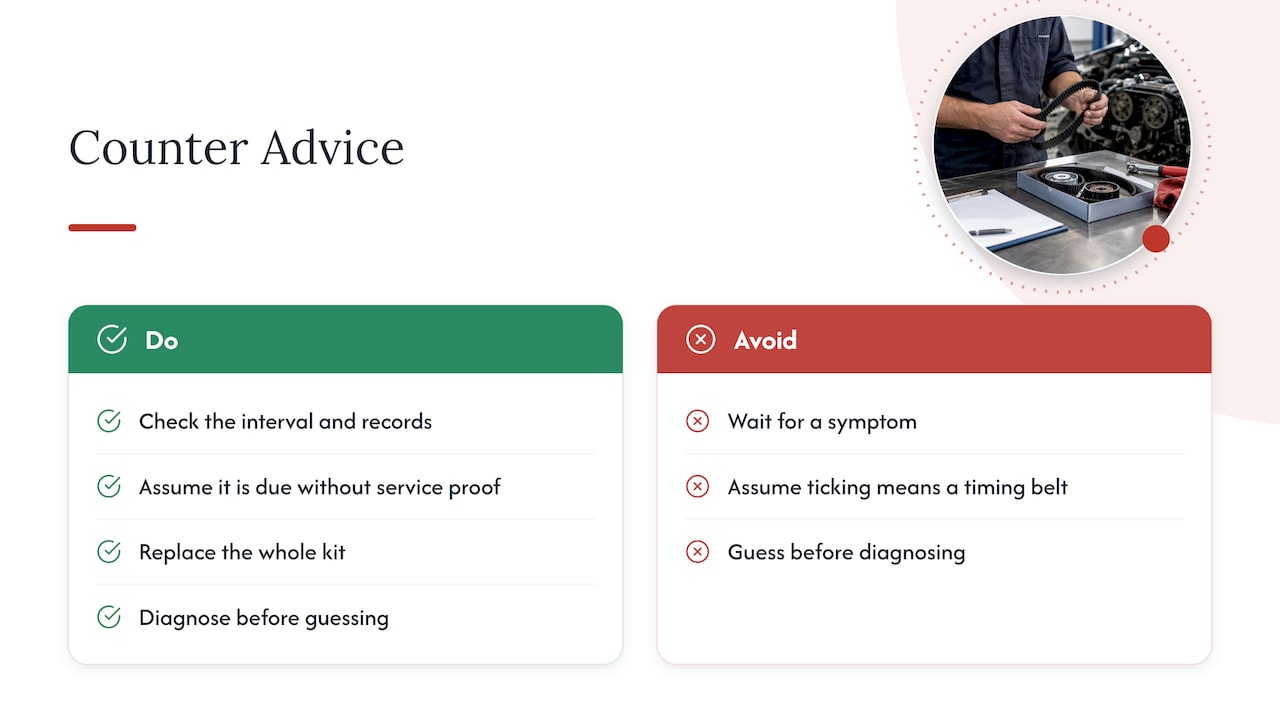
Our advice is simple. Do not wait for a symptom. Look at your interval, look at your records and, if there is no proof of a belt service on a car with real miles, assume it is due. When we replace one, we do the whole kit, because the tensioner, pulleys and pump share the belt’s lifespan and the labor is already paid for. Our technicians are ASE-certified, we work on domestic, Asian and European vehicles including hybrids, and the work carries a 24-month / 24,000-mile warranty. We use digital inspections so you can see what we see before you decide.
The other thing we say often: a ticking engine is not always a timing belt, and we will not sell you one if the evidence points elsewhere. Diagnosing first is cheaper than guessing.
— Shingi
Get it checked in Lynnwood
If your car shows any of the signs above, or you are near the interval and have no service record, we can inspect it, confirm your engine type and quote the job before we start. Same-day appointments are often available. See our timing belt replacement in Lynnwood page to book, or visit our home page for the rest of our services. We also serve nearby drivers in Edmonds, Mountlake Terrace, Shoreline, Kenmore and Mukilteo. Military members, seniors and first responders can ask about our discounts.
If you are already due for scheduled maintenance, our 30k, 60k, 90k service is a good time to have the belt’s condition and interval checked alongside everything else.
FAQ
Are there warning signs before a timing belt breaks?
Sometimes. Ticking, misfires, hard starting, an oil leak at the front of the engine and a check engine light can all appear first. Many belts, however, break with no warning, so the replacement interval is the dependable signal. Do not wait for a symptom.
What does a bad timing belt sound like?
Usually a ticking or clicking from the front of the engine, often from a worn tensioner or pulley rather than the belt itself. A loose belt can slap or flap. Squealing can come from a belt-driven accessory too, so the sound needs to be checked in person.
Can I drive with a bad timing belt?
We advise against it. If the belt breaks while you drive, the engine stops, and on an interference engine the valves and pistons can collide. If you suspect a problem, limit driving to getting the car to a shop, or have it towed if it flaps, will not start or overheats.
How often should a timing belt be replaced?
AAA reports that manufacturers typically call for replacement between 60,000 and 100,000 miles. Your owner’s manual has the figure for your car. Some engines use a chain with no scheduled replacement.
Should the water pump be replaced with the timing belt?
If the belt drives the water pump, yes. Gates advises replacing it at the same time, because the labor overlaps and an old pump can fail soon after and force the engine to be opened again.
Sources
- When Should Timing Belts Be Replaced? | AAA Club Alliance
- AAA: Car Maintenance Guide
- AAA estimate: 2017 Ford Focus timing belt replacement
- Timing Belt Drive Systems | Gates
- Timing Belt Component Kits w/ Water Pumps | Gates
- Timing Belt Failure Symptoms and Diagnosis | O’Reilly Auto Parts
Recommended
- Serpentine Belt Noise: Quick Triage and Fix for DIYers
- The Role of Serpentine Belt: What Every Driver Should Know
- Timing Chain Rattle: Is It Safe to Drive Right Now?
- Timing Belt Replacement in Kenmore, WA
Leave a Reply