
Radiator Leak Symptoms: How to Spot One Early
A leaking radiator usually announces itself in four ways: a puddle of bright, slippery fluid under the front of the car, a sweet smell from the engine bay, a coolant level that keeps dropping, and a temperature gauge that creeps above normal. If you see any of them, treat it as urgent. An engine that runs low on coolant can overheat quickly, and overheating is how a $1,000 repair turns into an engine repair.
This guide covers what a radiator leak looks, smells and feels like, how to tell it from harmless air conditioner water, what pinhole and seam leaks are, what to do on the roadside, and what a fix tends to cost.
TL;DR
- The classic signs are colored fluid under the front of the car, a sweet syrupy smell, falling coolant levels, and overheating or temperature spikes.
- Clear, odorless water under the car after running the AC is normal condensation. Coolant is colored, slippery and sweet-smelling.
- Pinhole leaks usually come from corrosion. Seam leaks appear where the radiator’s tanks join the core, often on plastic-tank radiators as they age.
- Stop-leak additives are a short-term limp-home measure at best. Don’t drive an overheating engine.
- A radiator that keeps failing may be a symptom: a bad cap, stuck thermostat or failing water pump can all overload it. Get the cause diagnosed, not just the part replaced.
Table of Contents
- The signs of a radiator leak, in the order you usually notice them
- Is it coolant or just AC water?
- Pinhole leaks and seam leaks: two different failures
- Not always the radiator
- What to do when you suspect a radiator leak
- What does a radiator leak repair cost?
- Our perspective: fix the cause, not just the leak
- Get a leak checked near Lynnwood
- FAQ
- Sources
The signs of a radiator leak, in the order you usually notice them
Small leaks are quiet. Large ones are obvious. Most people meet the problem somewhere in between, so here is what to watch for, roughly from earliest to latest.
Coolant that keeps disappearing
The cooling system is sealed. According to AAA, if coolant is low, there is a leak somewhere in the system. That is the single most useful fact in this article. If you top off the reservoir every few weeks, the coolant is going somewhere, even if you never see a drip.
Check the overflow reservoir when the engine is cold, and compare it with the min and max marks. A level that falls week after week is a leak until proven otherwise. (If it falls and you find no leak at all, our post on coolant loss with no visible leak explains pressure tests and what else can be going on.)
A puddle under the front of the car
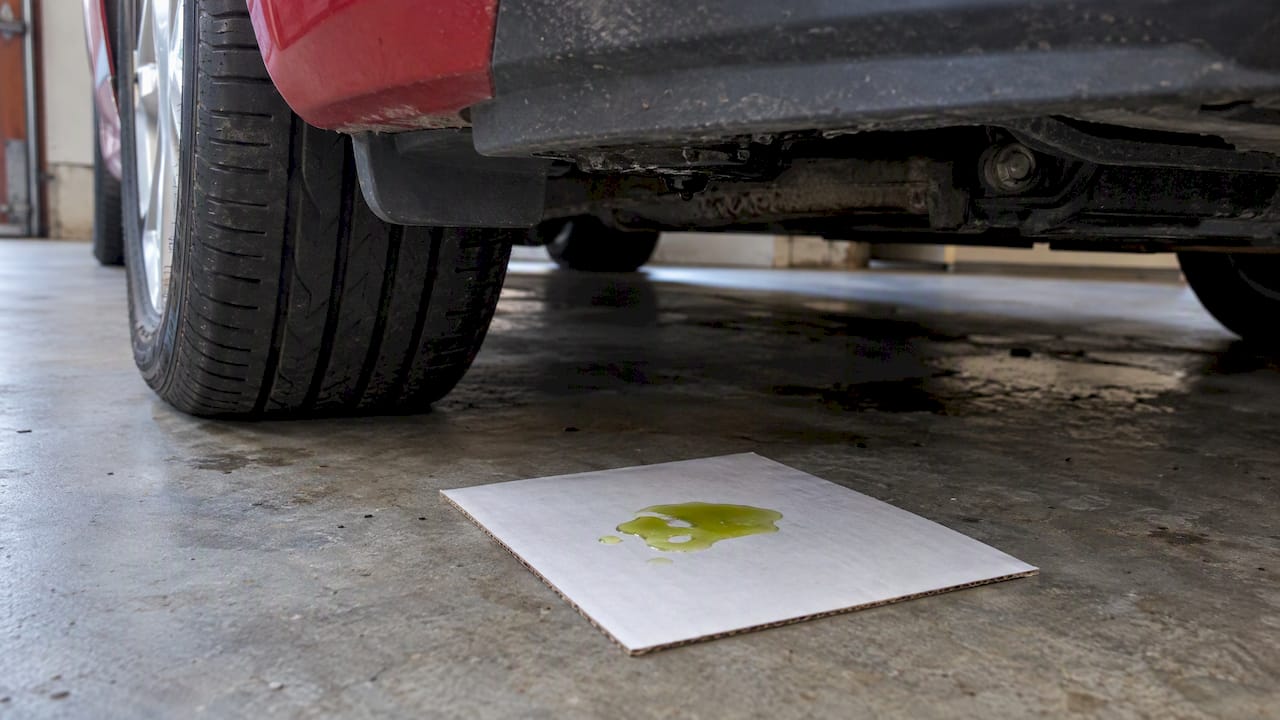
Coolant is usually green, orange, pink, blue or violet. Look under the front of the car after it has been parked overnight. A thin, slightly slippery puddle toward the front, under or just behind the bumper, points at the radiator, its hoses or the water pump. AutoZone notes that when a radiator has a hole, you may notice the leak at the front of the engine.
Slide a white piece of cardboard under the car overnight. It shows the color, the size of the drip and exactly where it lands.
A sweet, syrupy smell
Coolant has a distinctly sweet smell, and How a Car Works describes coolant as slippery and sticky on the skin. You often smell it at a stoplight, or right after shutting off a hot engine, when a small leak drips onto hot metal and vaporizes. A leak you cannot see may still be one you can smell.
Crusty residue on the radiator or hoses
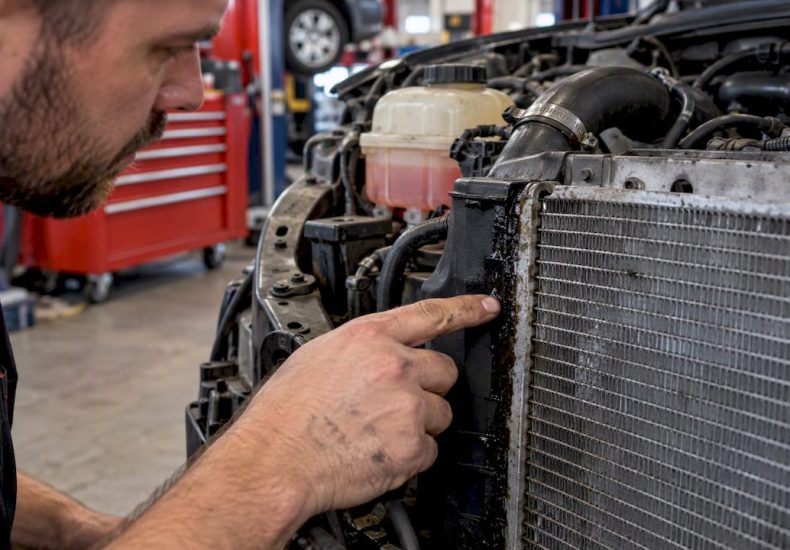
A slow leak often leaves dried coolant behind: white, green or rusty crust around the radiator seams, the cap neck, or the hose connections. Use a flashlight and look from above and from below. Rusty or discolored coolant in the reservoir is another sign that corrosion has started inside the system.
Temperature gauge creeping up
Less coolant means less heat carried away from the engine. The gauge may sit a little higher than normal in summer traffic, or climb on long hills. AAA’s overheating guidance notes that overheating is more common in high temperatures, but it can also happen in the cold if a component fails. In the Puget Sound area that means a stuck-in-traffic afternoon on I-5 is when a marginal radiator tends to show itself.
Steam, a heater that blows cool air, or a warning light
Steam from under the hood means the engine is already overheating. Pull over safely and shut it off. A heater that suddenly blows cool air can also mean low coolant, because the heater core is starved of hot fluid. A coolant warning light or a rising gauge should be treated as a stop-driving signal, not a reminder for next week’s errands.
Is it coolant or just AC water?
This is the most common false alarm. On a warm day, the air conditioner drains condensation under the car, usually near the passenger side of the firewall. It is clear and has no smell.
Coolant is different in three ways:
| Check | AC condensation | Coolant leak |
|---|---|---|
| Color | Clear | Green, orange, pink, blue or violet |
| Smell | None | Sweet, syrupy |
| Feel | Like water | Slippery, sticky residue |
| Location | Near the middle or passenger side, only when AC runs | Front of the car, often after parking |
The color-and-smell test is described by How a Car Works. Coolant is not something to taste or leave on your skin or around pets, so wipe a drop with a paper towel rather than a bare finger, and wash your hands afterward.
Other fluids also drip: engine oil is brown or black and slick, transmission fluid is red or reddish brown, and brake fluid is clear to yellowish and feels oily. If you can’t tell which one you have, take a photo of the cardboard and bring it in.
Pinhole leaks and seam leaks: two different failures
People search for both terms because they point to different causes and, sometimes, different repairs.
Pinhole radiator leaks
A pinhole leak is a tiny opening, often in the metal core, that weeps or sprays a fine mist when the system is hot and pressurized. It usually comes from corrosion. AutoZone notes that modern coolant carries anti-corrosion additives, yet radiators can still develop holes. Old, neglected coolant loses those additives over time, which is why coolant changes matter. Our explainer on what engine coolant is and why your car needs it goes through it.
Pinhole leaks are sneaky. They may only show up when the engine is hot, and the drip can evaporate off the hot engine before it reaches the ground. You see the symptoms (low level, sweet smell) but not the puddle.
Radiator seam leaks
A seam leak appears where the plastic end tanks meet the aluminum core, or at crimped joints. Years of heating and cooling cycles stress that joint. The sealing gasket can harden, and plastic can crack. These tend to leave a wet or crusty line along the tank edge and can get worse suddenly. A seam that is starting to give up rarely heals itself.
Either way, the practical question is the same: can it be repaired, or does the radiator need replacing? A shop makes that call after pressure testing and a visual inspection. For most modern radiators with plastic tanks, replacement is the lasting fix.
Not always the radiator
Here is where many repairs go wrong. A leak at the radiator can be the symptom rather than the cause.
AAA’s car care guide on belts and hoses is a good reminder that hose failures matter, and that the radiator sits in a system with many other parts. The leak you see can come from:
- A radiator cap that no longer holds pressure. The cap sets the system’s pressure. A weak one lets coolant boil over or escape.
- A stuck thermostat. If it doesn’t open, heat and pressure build with nowhere to go.
- A failing water pump. It leaks at the weep hole or its seal and can drip near the front of the engine, easy to mistake for a radiator. See our water pump replacement walkthrough for what failure looks like.
- Cracked or soft hoses and loose clamps. Hoses fail by leaking or bursting, and a coolant hose failure can leave you stranded fast.
- A head gasket. Coolant loss with white exhaust smoke, or milky oil, points inside the engine instead of to the radiator. If that is your diagnosis on an older car, you may be weighing repair against selling a car with a blown head gasket, which is a decision to make with a written estimate in hand.
Replace a radiator without finding out why it failed, and the new one may fail early. Our overview of what the radiator does in the cooling system is a good primer, and the post on why engines overheat covers related causes.
What to do when you suspect a radiator leak
- Check the gauge first. If it is in the red or you see steam, pull over somewhere safe and turn the engine off. Do not keep driving to “make it home.”
- Let the engine cool completely. Never open the radiator cap or reservoir cap on a hot engine. The system is pressurized, and scalding coolant can spray out.
- Look and smell. Check under the car, around the radiator and hoses, and in the reservoir.
- Top up only if you must. AAA’s overheating guidance treats plain water as an emergency measure: it lacks the corrosion protection of coolant and has a lower boiling point than a proper 50:50 mix. If you add water to reach a shop, plan to have the system drained and refilled correctly afterward.
- Skip the stop-leak as a permanent plan. AAA’s belts and hoses guide cautions against treating additives as repairs. They may help you limp to a shop, but they can clog narrow passages in radiators and heater cores.
- Get it tested. A pressure test finds leaks you can’t see, including pinholes that only open up under pressure.
If the car is undrivable, have it towed. A tow is cheaper than a warped cylinder head.
What does a radiator leak repair cost?
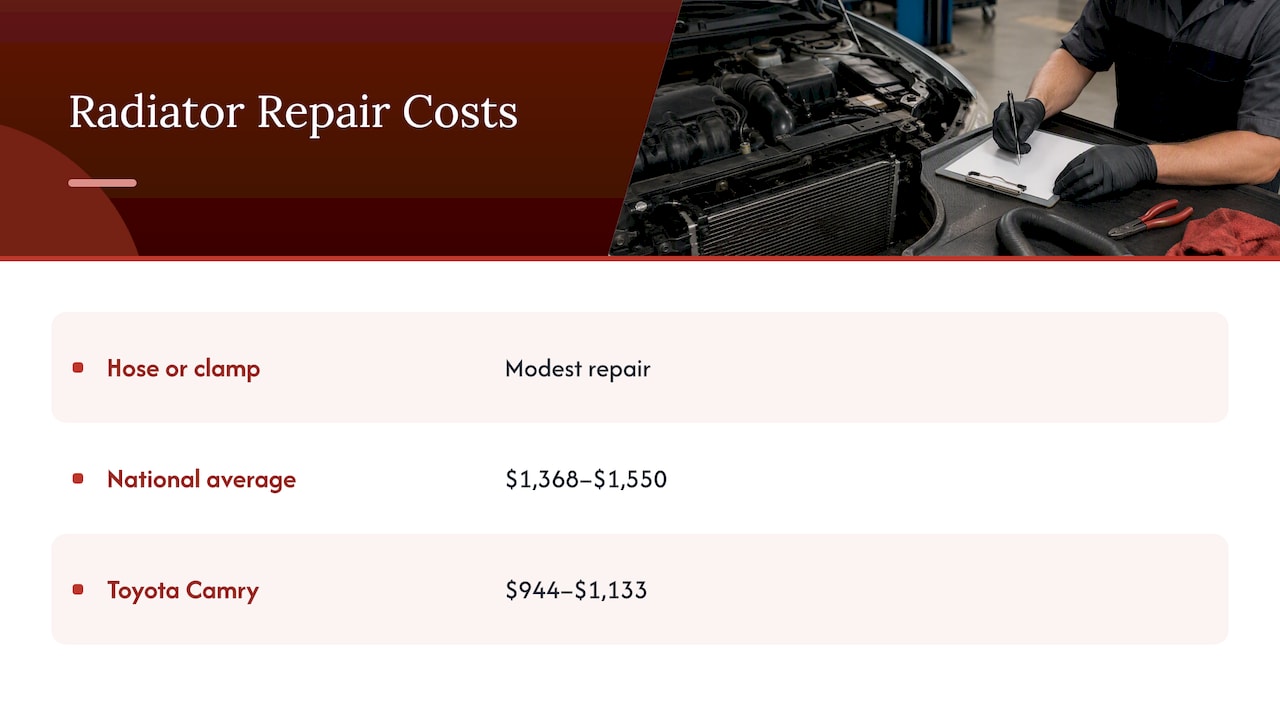
It depends on the vehicle and on what failed. A hose or clamp is a modest repair. A radiator replacement is larger. RepairPal’s estimator lists an average radiator replacement between $1,368 and $1,550 (as of its September 2026 update), excluding taxes and fees, with many popular models falling lower, for example a Toyota Camry at $944 to $1,133. Treat those as national averages, not a quote.
We don’t publish a flat radiator price, because the right quote depends on your exact vehicle, whether the radiator is the whole problem, and which related parts (hoses, cap, thermostat, coolant) need attention. What we can promise is that you get the price up front before work begins.
Is it worth fixing? Almost always, yes, if the engine hasn’t been overheated badly. A radiator repair costs far less than what overheating can do to an engine. If the car is already old and has other major problems, ask for the full list so you can compare the total with the vehicle’s value.
Our perspective: fix the cause, not just the leak
We’ve been repairing cars in Lynnwood since 1985, and the radiator jobs that come back are almost always the ones where only the visible part was swapped. Coolant systems are connected. A tired cap, an old thermostat, brittle hoses and neglected coolant all age together, so we look at the whole system when a radiator comes in.
Our technicians are ASE-certified and we work on all makes, including hybrid and European vehicles, which matter here because their cooling systems are often more complicated, with extra pumps and sensors. We use digital inspections so you can see what we see, and we use OEM-quality parts.
Our advice is plain: if the level drops, don’t wait for a puddle. A small leak caught at a pressure test is a short visit. The same leak found on the shoulder of I-5 is not.
— Shingi
Get a leak checked near Lynnwood
If you’re seeing any of the signs above, we can pressure test the system, find the source and quote the repair before we start. Same-day appointments are often available, and our repair work carries a 24-month / 24,000-mile warranty. Book a cooling system check with Tom’s B & M Auto in Lynnwood, or, if you’re closer to a neighboring city, see our radiator repair pages for Edmonds, Mountlake Terrace and Kenmore. Military members, seniors and first responders can ask about our discounts.
Prevention is cheaper than repair. If your car is due for scheduled service, our 30k, 60k, 90k service is a good time to have coolant condition and hoses inspected.
FAQ
Can I drive with a radiator leak?
Only a short distance, and only if the temperature gauge stays normal. A leak can worsen suddenly, and an overheated engine can be damaged within minutes. If the gauge climbs or you see steam, stop and shut the engine off.
How can I tell a radiator leak from a water pump leak?
Both drip coolant near the front of the car. A radiator leak tends to show at the radiator’s tanks, core or hoses. A water pump leak comes from the pump housing or weep hole on the engine, and may come with a whining or grinding noise. A pressure test and a visual check settle it.
Will stop-leak fix a radiator leak?
It can slow a small leak enough to get you to a shop, but it isn’t a permanent fix. AAA warns that additives can clog internal passages in modern radiators and heater cores, so use one only as an emergency step.
Why does my coolant level drop but I see no puddle?
Small pinhole leaks often evaporate on hot engine parts before they drip. Coolant can also be lost internally, for example through a head gasket. A cooling system pressure test is how a shop finds out which one it is.
How long does a radiator last?
There is no fixed mileage. Corrosion from old coolant, heat cycles and overall vehicle age all play a part. Regular coolant service and inspections are the best way to catch trouble before it becomes a leak.
Sources
- Car Overheating: 8 Causes and Solutions, AAA Automotive
- How To Find and Fix Coolant Leaks, AutoZone
- Checking for coolant leaks, How a Car Works
- What to do if your car is overheating, AAA Via
- AAA Car Care: Belts & Hoses
- Radiator Replacement Cost Estimate, RepairPal
Recommended
- Coolant Loss With No Leak? Pressure Tests and Safe Home Checks
- 5 Head Gasket Symptoms Car Owners Must Treat Now
- Power Steering Fluid Leak: EPS vs Hydraulic Checks and $15–$200 Costs
Leave a Reply