

Start at 60,000 Miles: Subaru CVT Service, Not Lifetime Fluid
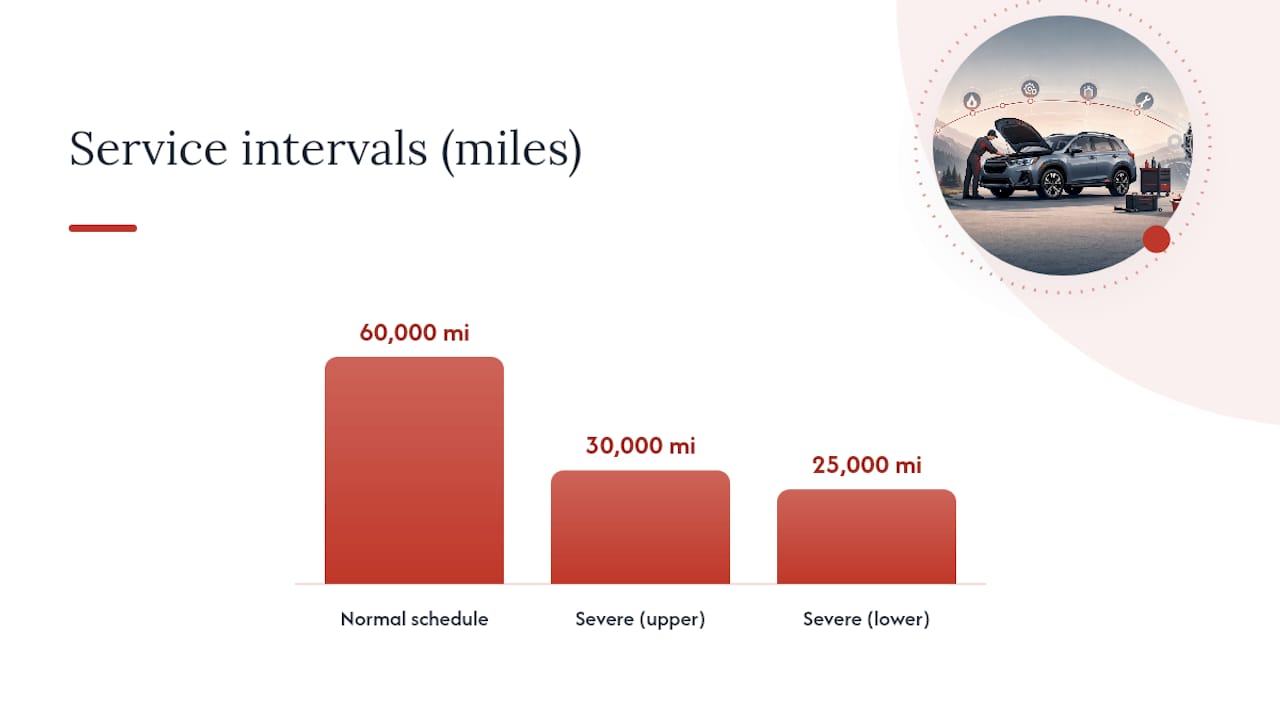
For long-term reliability, plan on a Subaru CVT fluid service every 60,000 miles under normal driving, dropping to roughly 25,000 to 30,000 miles if you tow, haul, or do a lot of stop-and-go driving. Subaru’s factory paperwork lists no scheduled change for normal service; this reflects warranty framing, not a maintenance recommendation. The sections below explain the gap between the two and walk through what a real service involves.
TL;DR:
- Subaru recommends a CVT fluid service every 60,000 miles for normal driving, with shorter intervals of about 25,000 to 30,000 miles if towing or in severe conditions.
- A drain-and-fill only replaces part of the fluid; repeated services are necessary to effectively refresh the transmission’s fluid and maintain reliability.
- Severe-service conditions such as towing, mountainous terrain, or frequent short trips reduce the recommended interval to roughly 25,000 miles.
- CVT service involves partial fluid drains, using specific Subaru oil, and precise level checks at the correct temperature to avoid damage.
- Most Subaru owners should plan their first CVT fluid change at 60,000 miles, followed by routine maintenance every 30,000 miles or sooner if conditions are severe.
Table of Contents
- What is the recommended Subaru CVT fluid change interval?
- Does your driving count as severe service for CVT maintenance?
- What does a Subaru CVT service actually involve?
- What are the warning signs of a failing Subaru CVT?
- How much does CVT service cost, and should you do it yourself?
- Our take at Tom’s B & M Auto on Subaru CVT care
- How Tom’s B & M Auto handles your Subaru’s CVT service
- Reconciling the “lifetime fluid” myth with what actually protects your CVT
- Sources
What is the recommended Subaru CVT fluid change interval?
Owners chasing maximum protection tend to choose a roughly 30,000 mile interval for CVT fluid service. It costs more over the life of the car, but it keeps the fluid younger and reduces the odds of the transmission ever running on badly oxidized fluid.
The more common pattern, though, looks different. Many owners and independent shops do a first CVT service at approximately 60,000 miles, then follow up roughly every 30,000 miles after that. That staggered approach exists for a practical reason: a standard drain-and-fill only removes part of the fluid in the system, often around 4 to 6 quarts out of a larger total capacity. One service never fully refreshes the fluid. Doing it again later displaces more of the old fluid, and repeating that cycle is what actually keeps the transmission running on relatively clean CVTF over extended mileage.
Subaru of America’s own maintenance documentation doesn’t list a scheduled CVT fluid change for normal service; it reserves shorter intervals for severe-service driving. That’s not universal. Markets outside the US, including Canada and parts of Europe, often publish a straightforward 60,000 mile CVT service interval in their owner’s manuals, no severe-service caveat required. The engineering is the same car; the paperwork just differs by region.
Where does that leave a normal-use Subaru owner in the US? A few working rules of thumb:
- If you want the lowest-maintenance path that still protects the transmission, follow the 60k-then-30k pattern.
- If you’re the type who keeps a car past 150,000 miles and wants to hedge every bet, go with 30,000 mile intervals from the start.
- If your driving is light commuting on flat roads with no towing, a first service near 60,000 miles can be a reasonable starting point.
None of these numbers are arbitrary. They’re the practical compromise between what a partial fluid change can accomplish and what independent shops see hold up over time.
Does your driving count as severe service for CVT maintenance?
Subaru’s severe-service classification isn’t about how hard you drive on a Saturday. It’s about sustained conditions that heat and stress the transmission fluid faster than normal commuting does.
Severe-service examples include:
- Regular towing or hauling heavy loads, even occasionally
- Driving in mountainous or hilly terrain most of the week
- Frequent short trips where the transmission never reaches full operating temperature
- Heavy stop-and-go traffic, the kind most commuters in a congested metro area deal with daily
- Sustained high-RPM driving, including off-road use or spirited backroad driving
Under these conditions, the recommended window tightens to roughly 25,000 to 30,000 miles between services. That’s not a small drop from 60k. It reflects how much faster fluid breaks down when it’s constantly hot.
Pro Tip: If you’re not sure which category you fall into, count your commute. More than 20 minutes of daily stop-and-go traffic, or towing a trailer even a handful of weekends a year, is enough to justify the severe-service schedule rather than the normal one.
Run through this quick checklist: Do you tow anything, even a small trailer? Do you live somewhere with real elevation changes? Is most of your driving under 10 minutes per trip? A single “yes” is reason enough to shorten your interval.
What does a Subaru CVT service actually involve?
A CVT service is not the same procedure as a traditional automatic transmission flush, and that difference matters more than most owners realize.
- Draining the pan and cooler lines. A technician removes a set portion of fluid, typically a few quarts, instead of forcing fluid through the entire system under pressure the way a flush machine does. Full flushes are uncommon on Subaru CVTs because the process risks dislodging debris into tight clearances the transmission wasn’t designed to filter out.
- Refilling with the correct spec. Subaru CVTs require Subaru Lineartronic CVTF or an approved equivalent. This isn’t a place to substitute a generic CVT fluid off the shelf. The friction modifiers and viscosity profile are tuned specifically for the belt-and-pulley design, and using the wrong fluid can cause shudder or premature wear.
- Setting the level via the fill bung. Subaru CVTs don’t have a dipstick. Level is checked and set through a fill/overflow bung, and the fluid needs to be at a specific temperature for the reading to mean anything. Check it cold or check it too hot, and you’ll get a false level, either underfilling or overfilling the system.
The math on partial fluid changes: a typical drain-and-fill removes roughly half the total fluid volume in the system. That means after one service, the transmission is still running on a 50/50 mix of new and old fluid. Two services in, that ratio improves substantially. This is the entire logic behind the 60k-then-30k pattern: it’s not one perfect flush, it’s incremental dilution of degraded fluid over multiple visits.
What are the warning signs of a failing Subaru CVT?
A CVT under stress rarely fails without warning first. The transmission tends to announce trouble well before it leaves you stranded, if you know what to listen and feel for.
Watch for:
- A shudder or vibration, especially at low speeds or light acceleration
- Slipping sensations, where the engine revs but the car doesn’t accelerate proportionally
- Jerky or hesitant response when pulling away from a stop
- Whining, humming, or grinding noises that change with vehicle speed
- A check-engine or transmission warning light
Left unaddressed, these symptoms point to real component wear: the steel drive belt or chain, the pulleys it rides on, valve body wear, or bearing damage. The mileage window matters here. Neglected CVTs, ones that never see a fluid service, commonly show serious failure symptoms between 80,000 and 120,000 miles. Vehicles that get periodic fluid changes routinely push well past 200,000 miles without major transmission work.
If you notice any of these symptoms, don’t wait for the next scheduled oil change. Get the transmission scanned and inspected. Catching early-stage shudder or slip before it progresses to chain or pulley damage is the difference between a fluid service and a transmission rebuild.
How much does CVT service cost, and should you do it yourself?
A standard drain-and-fill service typically runs in the range most owners budget for routine transmission maintenance, with parts (the correct Lineartronic CVTF) and labor both factored in. Full CVT service work involving pan removal, filter access, or more extensive fluid exchange runs higher, largely due to added labor time and the volume of fluid required.
DIY is possible in theory, but several factors make it a poor fit for most home mechanics:
- No dipstick means level-setting depends on the bung procedure and hitting a specific fluid temperature, which is hard to nail without a lift and a thermometer probe.
- Using the wrong fluid, even a CVT fluid meant for a different manufacturer, can cause long-term shudder or accelerated wear that won’t show up immediately.
- Overfilling or underfilling through the bung is a common mistake that leads to foaming or fluid starvation.
Pro Tip: If you’re set on doing your own oil changes and brake pads, that’s fine. CVT service is the one job worth handing to a shop with the right fluid on hand and a lift, because the failure mode for getting it wrong is a transmission repair, not a quick redo.
Getting the fluid spec wrong or the level wrong can also complicate warranty claims down the road, since Subaru dealers can and do ask for service records when a transmission issue comes up.
Our take at Tom’s B & M Auto on Subaru CVT care
Our recommendation is the 60,000 mile first service, then every 30,000 miles after that, for the vast majority of normal-use Subaru drivers. If you’re towing, driving in the mountains regularly, or logging a lot of short trips in traffic, we’ll walk you toward the tighter 25,000 to 30,000 mile schedule instead.
Every CVT service starts with a diagnostic check, not just a drain and refill. Technicians verify fluid condition, check for early shudder or slip codes with professional-grade OBD-II diagnostics, and set the fill level correctly using the bung and temperature procedure specified rather than guessing. We use the specified Lineartronic CVTF, not a generic substitute, because the wrong fluid is a common cause of comeback complaints on cars that had cheaper service elsewhere.
All CVT work is backed by a 24 month, 24,000 mile warranty. If you’re not sure which schedule fits your driving, bring it in for a quick inspection before committing to a service plan.
How Tom’s B & M Auto handles your Subaru’s CVT service
This shop has serviced Subarus since 1985; the technicians have watched the Lineartronic CVT evolve across multiple model generations and know where these transmissions tend to run into trouble.
Every CVT visit starts with a real diagnostic check, not a guess. Our ASE-certified technicians pull codes with professional-grade OBD-II tools, confirm fluid condition, and set the fill level using the correct bung and temperature procedure, so you’re not paying for a service that was done wrong the first time. We stock the OEM-specified Lineartronic CVTF rather than substituting a cheaper generic, and every job carries our 24 month, 24,000 mile warranty. If cost is a concern on a larger repair, financing is available, and new customers can take advantage of our free digital vehicle inspection to see exactly where your CVT stands before committing to a service interval. Visit our Subaru repair page or our transmission service page to see what’s included, then book an appointment. Same-day slots are often available.
Reconciling the “lifetime fluid” myth with what actually protects your CVT
Here’s the part that trips up most Subaru owners: “lifetime fill” doesn’t mean the fluid lasts the life of the car. It means Subaru of America’s warranty language doesn’t obligate a change under normal service, which is a legal and marketing distinction, not an engineering one. The independent shops that have serviced hundreds of these transmissions treat the fluid as a wear item precisely because they see what happens when it never gets touched.
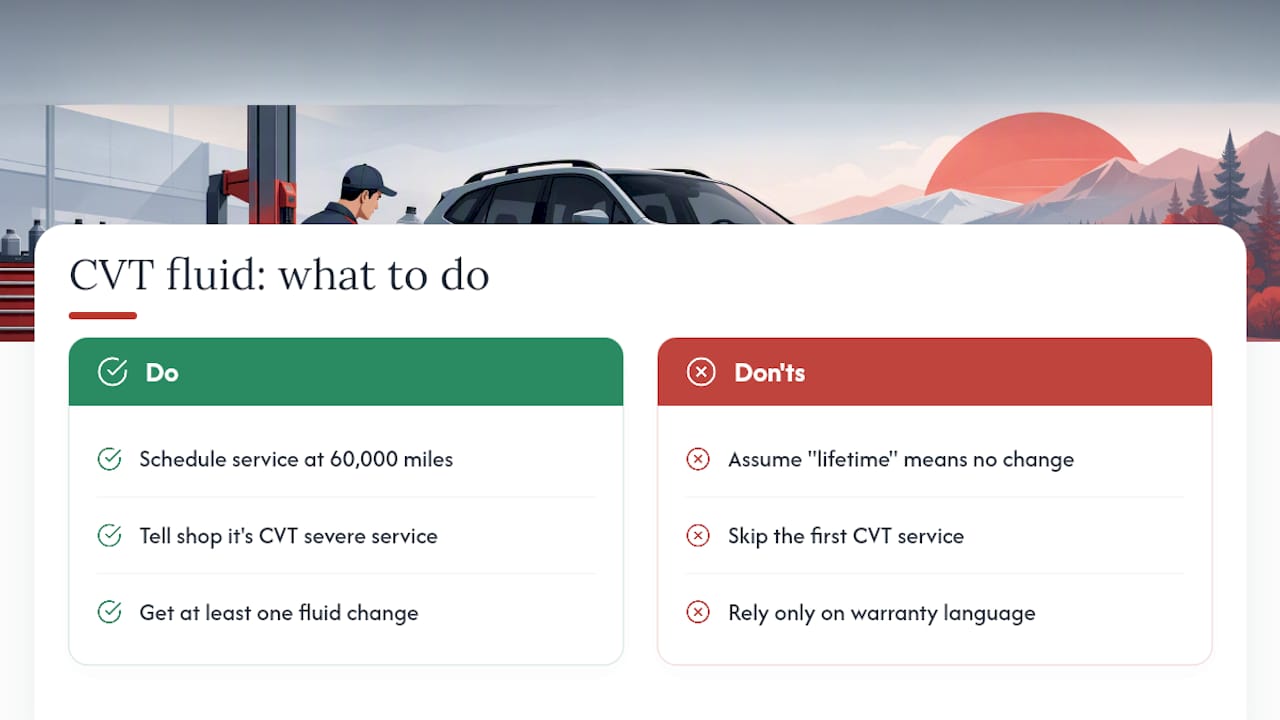
The conventional advice fails owners in one specific way: it treats “no scheduled change” as “no change needed,” when the real story is that Subaru built in a severe-service exception because it knows fluid degrades under stress. Most American commutes, with traffic lights and short trips, land closer to severe service than owners assume.
If you take one thing from this, prioritize the first service at 60,000 miles over debating the exact interval afterward. Getting even one round of fresh fluid into a high-mileage CVT does more good than arguing about whether 25k or 30k is technically correct.
— Shingi
Sources
This guidance draws on Subaru owner forum threads, independent shop procedural writeups, and Subaru parts documentation on fluid-level checks. For related maintenance guidance, see Tom’s B & M Auto’s breakdown of transmission fluid’s role in your vehicle and its 60k service checklist for interval-based maintenance planning. For a broader look at Subaru reliability trends across markets, see this independent overview.
- The Lineartronic CVT Service Interval Reality — Tedious Repairs
- Subaru CVT Fluid Change: The Complete Guide to Doing It Right — CartipsDaily
- How to check transmission fluid — Subaru Parts Plus
Recommended
- Verify Any Estimate: Toyota 60K Service Checklist from an ASE Shop
- High Mileage Vehicle Maintenance Tips That Work
Leave a Reply