
Parasitic Battery Drain Symptoms: How to Spot Them
The classic sign of a parasitic drain is a car that starts fine at night and is dead or sluggish in the morning, then dies again a day or two after you jump it. Something is pulling current from the battery while the engine is off. But a weak battery or a failing alternator can look almost identical, so the symptoms alone cannot prove a drain. This guide covers what to watch for, what else can cause it, and how a shop finds the real culprit.
TL;DR
- A parasitic drain is current the vehicle keeps drawing after the engine is off. The usual result is a battery that is weak or dead after sitting, slow cranking, and repeated jump-starts.
- A bad battery, a weak alternator, or corroded terminals can cause the same complaint. Rule those out first.
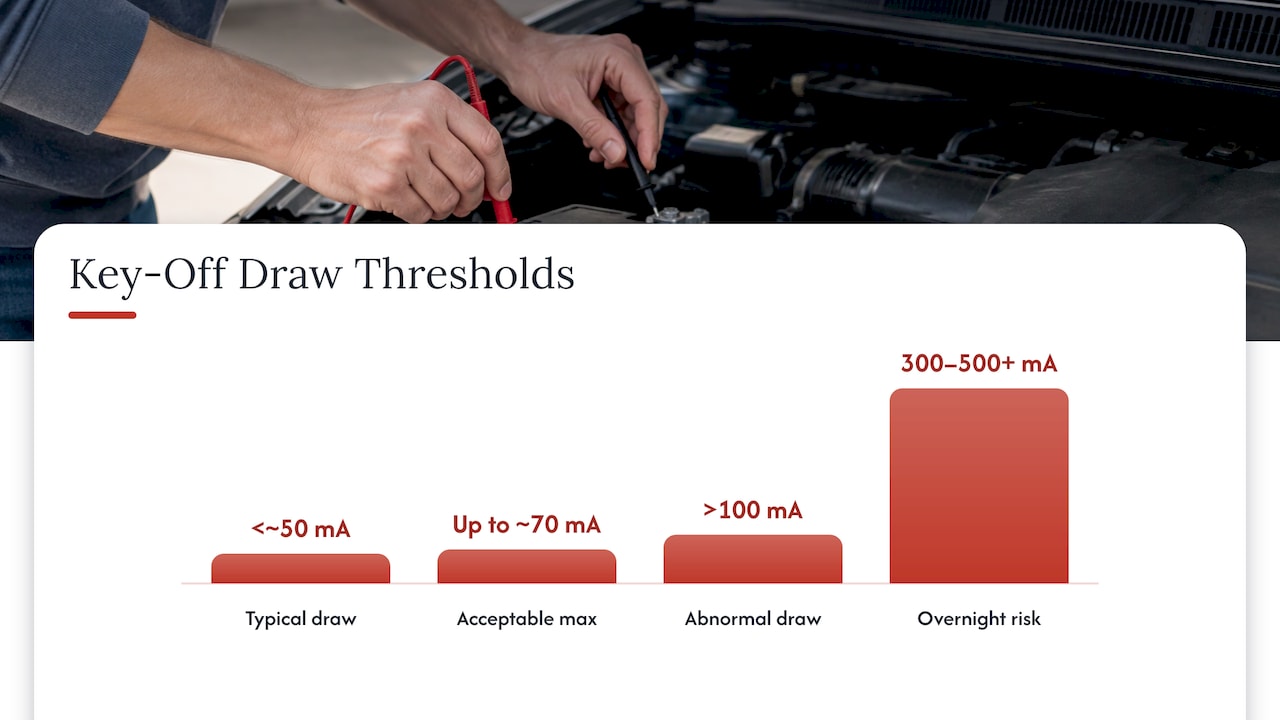
- Normal key-off draw is small, roughly 50 to 70 milliamps on many modern vehicles, and the exact figure depends on the vehicle. Over 100 mA after the modules go to sleep is suspect.
- Jump-starting only gets you moving. A drain can kill even a new battery until the source is found.
- If the battery keeps dying, have the battery, charging system and key-off draw tested in that order.
Table of Contents
- What a parasitic drain actually is
- Parasitic battery drain symptoms to watch for
- Why your car battery drains overnight
- Is it really a drain? Battery and charging problems that mimic it
- What to check yourself before calling a shop
- How a parasitic draw is diagnosed and fixed
- Perspective: why we start with the whole electrical system
- When to bring the car in
- Get it diagnosed in Lynnwood
- FAQ
- Sources
What a parasitic drain actually is
Even with the key out, a modern car is never completely off. Clocks, alarm systems, keyless entry and control modules take a small trickle of power. A parasitic drain is when the vehicle keeps drawing current from the battery after the engine is off at a level higher than it should.
The typical culprits, according to a 2025 NHTSA service information bulletin, include:
- A control module that fails to go to sleep
- A stuck light or relay
- Aftermarket electronics that stay powered, such as alarms, remote starters, dash cameras or GPS trackers
- A dome light left on or a door that is slightly ajar
Trade reporting adds that battery drains are typically caused by a module that stays awake or keeps waking other modules on the vehicle network. That is why a drain can be intermittent: the car may sleep properly some nights and not others.
Parasitic battery drain symptoms to watch for
No single sign confirms a drain, but these patterns point toward one:
- A dead or weak battery after the car sits. Fine at night, flat in the morning, or dead after a weekend or a week at the airport.
- Slow cranking in the morning. The engine turns over lazily on the first start, then behaves once it is running.
- Repeated jump-starts. You jump it, drive, and it is dead again a day or two later.
- Dim lights or sluggish accessories. Interior lights, the dash or power windows act weak or erratic on a cold start. Common indicators like these are listed in AutoZone’s overnight-drain guidance.
- A new battery that dies anyway. A drain can repeatedly kill even a new battery until it is identified and fixed.
- Something odd that started after an install. A new stereo, alarm, remote start or tracker, or a recent repair that disturbed wiring, is a strong clue.
A car that fails to start only when it is very cold is a different story. Our guide on why a car won’t start in cold weather covers that pattern.
Why your car battery drains overnight
How fast a drain empties a battery depends on how big the draw is and how healthy the battery is. Vehicle Service Pros says a drain under 1 amp commonly takes a couple of days to flatten a battery, while a draw near or above 1 amp can cause an overnight failure.
Here is the range in practice:
| Key-off draw (after modules sleep) | What it usually means |
|---|---|
| Under about 50 mA | Typical for many vehicles |
| Up to about 70 mA | Acceptable on many modern vehicles, but the exact service information for your car controls |
| Above 100 mA | Abnormal after modules sleep |
| 300 to 500 mA or more | Can flatten a battery overnight or within a day or two |
The thresholds come from Fluke, Snap-on and the NHTSA bulletin, and they differ slightly by source. That is the point: normal depends on the vehicle.
A small draw is slower than most people expect. Pico Technology’s worked example uses a fully charged 75-Ah battery and a 45 mA average draw, which takes about 333 hours, or 14 days, to lose 20% of its charge. Their caution applies to everyone: it is an illustration, and battery health changes the result. An older battery with less capacity runs down far sooner.
Why modules take time to sleep
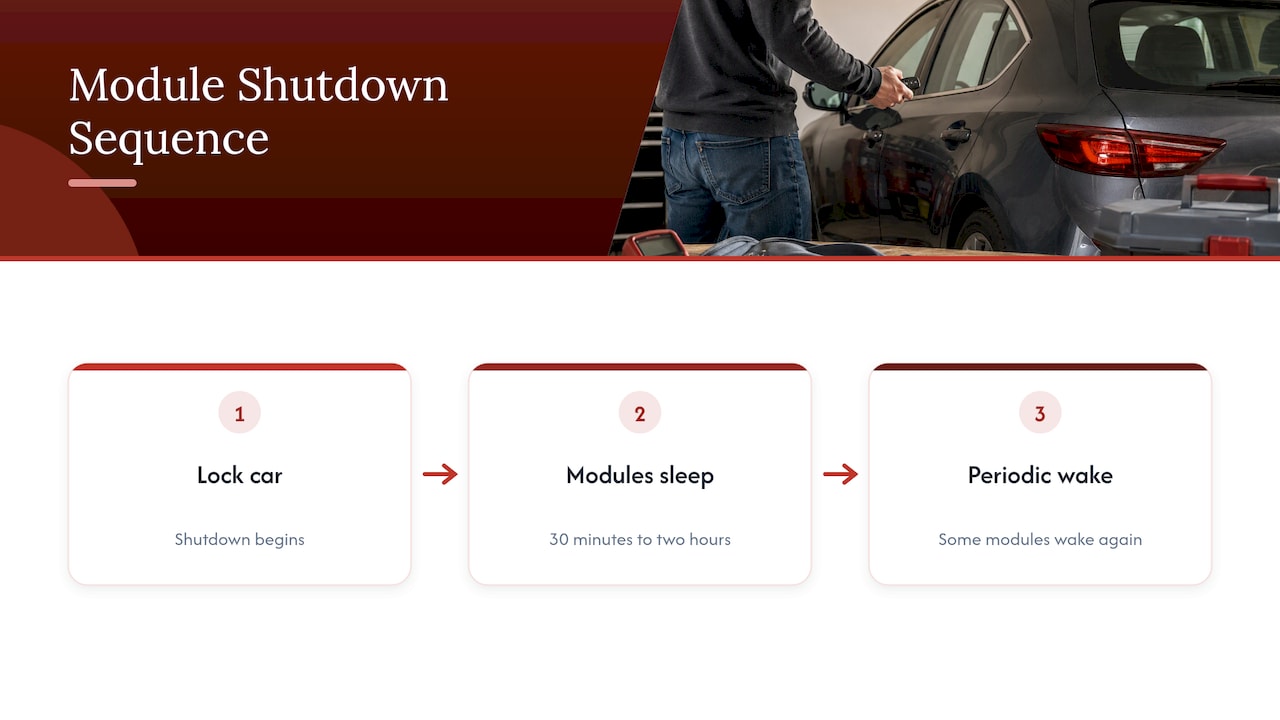
After you lock the car, modules do not shut down at once. Pico notes shutdown periods can range from 30 minutes to two hours depending on the manufacturer, and some modules wake periodically to monitor conditions. Snap-on also points out that vehicles may wake again after shutting down, which makes normal behavior harder to tell from a real drain. This is why a quick check right after locking the doors can mislead.
Is it really a drain? Battery and charging problems that mimic it
This is the step most people skip. A repeatedly dead battery does not prove a parasitic drain. Midtronics says a failing alternator, corroded terminals, starter problems, or the drain itself can all produce similar slow-cranking and no-start symptoms.
The trade press says the same. FenderBender’s diagnostic guidance stresses that a faulty battery or charging system can be mistaken for a parasitic drain. It even describes an intermittent shorted cell that masks itself as a phantom drain. An underperforming charging system can also cause false assumptions. That includes a faulty or incorrect alternator, poor connections, an undersized alternator or a slipping drive pulley.
Signs it leans toward the battery
- The battery is several years old and cranks slowly even after a full charge.
- Voltage looks fine at rest but the engine struggles under starting load. Haynes notes a resting reading around 12.6 V indicates a fully charged battery, but voltage alone cannot establish battery health.
- The battery case is cracked or the terminals look wet. Interstate advises that cracks, wetness at the terminal or bubbling liquid may indicate a leak. If you see that, take the car to a mechanic with the battery still in it rather than handling it yourself.
Signs it leans toward the alternator or connections
- The battery light comes on, or headlights dim and brighten with engine speed. Our article on headlights that dim at idle walks through that.
- The car dies while driving or the battery is low even after long drives.
- A charging-system test falls outside the expected range. Midtronics gives roughly 13.8 V at idle as a lower reference and 14.7 V as an upper one, outside of which undercharging or overcharging may be indicated.
If the alternator is the suspect, this walkthrough on testing an alternator that drains your battery explains what to look at.
Other reasons a battery dies after sitting
Not every dead-after-sitting battery is a drain. The NHTSA bulletin notes that short, infrequent trips may not fully recharge the battery after each start. If your car mostly makes five-minute hops, the battery can run down with nothing wrong electrically. A starter that clicks without cranking is another look-alike. See starter clicks but the engine won’t crank and our no crank, no start checklist.
What to check yourself before calling a shop
These are safe, simple checks that need no tools:
- Walk around the car at night. Look for a glowing dome, trunk, glove box or vanity light, and make sure every door and the trunk are fully latched.
- Unplug aftermarket devices. Dash cameras, phone chargers, GPS trackers and plug-in OBD dongles keep drawing power when plugged in. Unplug them for a few days and see whether the pattern changes.
- Note when it started. Write down any recent install, repair, battery change or new accessory. This is the most useful clue you can give a technician.
- Look at the terminals. Check for loose clamps or crusty white or green buildup. Do not touch a battery that is cracked or leaking.
- Track your driving. If every trip is short, mention it. It changes the diagnosis.
Please leave the multimeter work to someone with the right service information unless you are experienced. Fluke warns not to crank the engine or run high-current devices while a meter is in current mode, which can damage the meter and blow its fuse. Opening a door or switching on a light mid-test also corrupts the reading.
How a parasitic draw is diagnosed and fixed
The process a professional follows is methodical, and the order matters. The NHTSA bulletin says a parasitic-draw test should happen only after the battery is confirmed good, the charging system works correctly, obvious causes are ruled out, and repeated dead-battery incidents after sitting are verified.
- Test the battery and charging system. This catches the look-alikes before any time is spent chasing a drain.
- Prepare the vehicle. Doors and lights off, keys moved well away from the car, then wait for the specified sleep period. Fluke suggests waiting 10 to 45 minutes for modules to sleep.
- Measure key-off current. The meter goes in series with the battery. Compare the number to the vehicle’s own specification, since normal is vehicle-specific.
- Isolate the circuit. Pulling fuses one at a time, or measuring voltage drop across each fuse, shows which circuit holds the drain.
- Trace and repair. The technician follows that circuit to the component: a module that will not sleep, a stuck relay, a short, or an aftermarket accessory wired the wrong way.
- Retest. The draw is measured again to confirm it now falls in the normal range.
That is also why diagnostics beat guessing. Replacing batteries or alternators without a measured draw is how people end up paying for parts they did not need. Our guide to the types of car diagnostic tests explains what each test tells you, and our piece on hidden car repair costs shows why getting a clear diagnosis first saves money.
Can a parts store check for a drain?
Many parts stores will load-test a battery and check the charging system. That covers the first step above, and it can tell you whether the battery or alternator is the problem. Finding a parasitic draw takes more: a key-off current measurement, a sleep-time wait and circuit-by-circuit isolation with the vehicle’s service information. That is shop work, and it is what we do when the simple tests come back clean.
Perspective: why we start with the whole electrical system
Most customers who come in say the same thing: “I replaced the battery and it died again.” We understand the frustration. A battery that keeps dying has several possible causes, and the fix depends entirely on finding the right one.
At Tom’s B & M Auto, we have worked on Lynnwood vehicles since 1985. Our ASE-certified technicians start with the battery and charging system, then move to a measured key-off draw if the complaint still points that way. We would rather show you a number than guess at a part.
Modern cars, including hybrid and European models, have many networked modules, and any one of them can keep the car awake. Professional-grade OBD-II diagnostics let us see more than a basic battery tester can. Our digital inspections and upfront pricing mean you know what we found and what it takes to fix before we start.
If your car is dead after sitting, do not keep jumping it and hoping. Bring it in, tell us what changed before the trouble began, and we will trace it.
Shingi
When to bring the car in
Get the car looked at if any of these apply:
- The battery has died more than once after sitting, even after a jump or a new battery.
- You have unplugged add-on devices and the problem remains.
- The battery case is swollen, cracked or leaking, or you see bubbling at the terminals.
- The battery light comes on while driving, or the car stalls.
- A recent repair or accessory install was followed by the first dead battery.
The tricky cases are the intermittent ones, where the car starts fine for a week and then dies. A shop can monitor the draw and see when modules wake, which you cannot do from the driver’s seat.
Get it diagnosed in Lynnwood
Tom’s B & M Auto is a family-owned shop in Lynnwood, WA, serving drivers since 1985. We service all makes, including European and hybrid vehicles, with ASE-certified technicians, professional-grade OBD-II diagnostics and upfront pricing. Same-day appointments are often available, and all work carries a 24-month / 24,000-mile warranty.
If your battery keeps dying, we will test the battery and charging system, then track down any draw. Our check engine light and electrical diagnostics are a good place to begin, and you can book through our site.

Car owners who are military, seniors or first responders can ask us about our discounts.
FAQ
What is the most common cause of parasitic battery drain?
There is no single cause. Official guidance lists a module that fails to sleep, a stuck light or relay, and continuously powered aftermarket electronics such as alarms, remote starters, dash cameras and trackers. Circuit testing identifies which one it is on your car.
How long does it take a parasitic draw to drain a battery?
It depends on the size of the draw and the battery’s condition. A draw under 1 amp commonly takes a couple of days, while a draw around 1 amp or more can leave you stranded overnight. A small draw on a healthy battery can take weeks to matter.
Why does my car battery die after sitting, even with a new battery?
A new battery does not fix the cause. If something keeps drawing current, or the alternator is not charging properly, the new battery will go flat too. Short trips that never fully recharge the battery can also do it. Testing the charging system and measuring the key-off draw separates these.
Can I just keep jump-starting it?
It will get you moving, but it does not solve the underlying problem. Repeated deep discharges also shorten battery life, and you risk being stranded. Have the battery, alternator and draw tested instead.
How much current is a normal draw?
It is vehicle-specific. Guides give under 50 mA as typical, and the 2025 NHTSA bulletin says many modern vehicles commonly have an acceptable draw below 70 mA, with the exact service information for the car controlling. A reading above 100 mA after the modules sleep is considered suspect.
Sources
- SERVICE INFORMATION BULLETIN, NHTSA (2025)
- How to Find Parasitic Battery Drain with a Multimeter, Fluke
- Parasitic battery drain is a bandit, Vehicle Service Pros
- Why Does My Car Battery Keep Dying?, AutoZone
- Symptoms That Can Look Like a Bad Battery, Midtronics
- Advanced battery drain diagnostics, FenderBender
- Parasitic Battery Drain: How to Find What’s Killing Your Battery, Bumper
- Parasitic Draw Diagnosis, Snap-on
- Parasitic battery drain (clamp method), Pico Technology
- Battery Testing: Steps for Reliable Car Battery Diagnosis, Haynes
- How to maintain a car battery, Interstate Batteries
Recommended
- Starter Solenoid Symptoms: How to Tell It’s the Solenoid
- Headlights Dim at Idle? Causes and What to Check
- Hybrid Battery Service Explained: 2026 Owner’s Guide
- Starter Clicks but Engine Won’t Crank: What to Check
Leave a Reply