
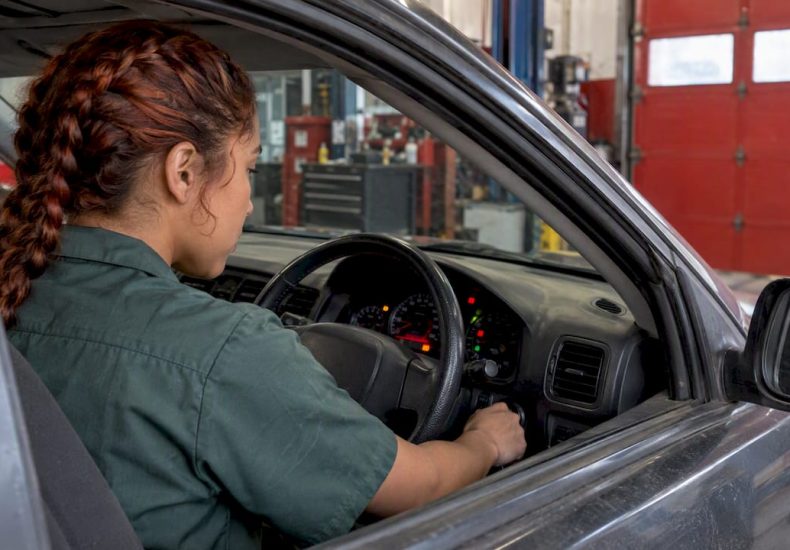
Starter Clicks but Engine Won’t Crank: What to Check
If your car clicks and the engine does not turn over, the cause is almost always electrical. A weak or dead battery is the most common culprit, followed by corroded or loose connections and a failing starter or starter solenoid. The sound tells you where to start: rapid clicking usually means the battery, while one heavy click points toward the starter or a badly discharged battery. This guide walks you through the checks you can do safely in a parking lot or driveway, and tells you when to stop and call a shop.
TL;DR
- Rapid clicking (several clicks per second) usually means the battery can’t deliver enough power. A single solid click usually points to the starter or solenoid, or a battery that is nearly flat.
- Start with the cheap checks: battery voltage, clean and tight terminals, and the gear selector in Park or Neutral.
- A solenoid can click and still be bad. A click proves the solenoid got a signal, not that the starter motor can spin.
- Don’t jump the solenoid terminals with a screwdriver. If you test at all, use a proper insulated wire, in Park or Neutral with the parking brake set.
- If the battery and cables test fine and it still clicks, the starter circuit needs proper testing. That is where a shop saves you from buying the wrong part.
Table of Contents
- What the clicking actually means
- Single click versus rapid clicking
- Safe checks to run before you call anyone
- Can a solenoid click and still be bad?
- Starter, battery or alternator: how to tell them apart
- Should you bypass the solenoid?
- What we see in the shop
- When to call a mechanic
- How we can help in Lynnwood
- Preventing the next click
- FAQ
- Sources
What the clicking actually means
When you turn the key or press the button, a small current goes to the starter solenoid. The solenoid does two jobs: it closes a heavy switch that sends battery power to the starter motor, and it pushes the starter gear into the engine’s flywheel. The click you hear is that switch trying to work.
If the heavy current can’t flow, the engine doesn’t turn. Either the battery has too little power, the connection is poor, or the starter motor itself can’t use the power it gets. AutoZone’s guide to clicking no-starts notes that clicking during a no-start is almost always an electrical issue, most often a weak or dead battery, corroded connections, or a failing starter motor.
That is why the same symptom ends up with three different fixes. The goal is to work out which one you have before you spend money.
Single click versus rapid clicking
Listen closely on the next attempt, ideally with the radio and fan off.
| What you hear | Most likely cause | What to check first |
|---|---|---|
| Rapid clicking, several per second | Battery too weak to hold the solenoid closed | Battery voltage, terminals, jump start |
| One solid click, then silence | Starter motor or solenoid fault, or a very discharged battery | Voltage at the small solenoid terminal, cable connections |
| Faint single click, dash lights dim or go out | Poor connection or very low battery | Terminals and ground cable |
| No click, no sound | Not a click-no-crank problem: ignition switch, safety switch, relay or fuse | Gear selector, fuses, relay |
Rapid clicking
A rapid clicking sound, with multiple clicks per second, means the battery has insufficient power to engage the starter motor and crank the engine, according to AutoZone. The solenoid pulls in, the battery voltage collapses under the load, the solenoid drops out, and the cycle repeats. It sounds like a machine gun, and it is the classic sign of a drained battery or a bad terminal connection.
A single click
A single heavy click typically points to a faulty starter motor, or to a badly discharged battery that can trigger the solenoid once but cannot spin the motor, per the same AutoZone guide. So a single click is not a verdict on the starter. It narrows the field, and you still need a battery test to rule out the simple answer.
Safe checks to run before you call anyone
These steps need no special skill. Work in a safe spot, away from traffic, with the parking brake on.
1. Check the gear selector
Make sure the car is fully in Park. Then try Neutral and attempt a start again. A shifter that isn’t seated properly, or a worn neutral safety switch, can stop the starter from getting its signal. Hagerty’s no-crank triage guide lists trying Neutral or resetting the shifter among the safe checks.
2. Look at the battery terminals
Pop the hood and look for white, green or blue crusty buildup on the posts and cable ends. Check that both cables are tight by hand: if you can twist a terminal on the post, that alone can cause click-no-crank. Clean the posts and clamps with a wire brush and a baking soda and water mix, then reconnect, positive first when reattaching.
Bosch’s starting-systems guide says battery cable connections must be clean, tight and free of corrosion. It also says that if a cable end is corroded, the entire cable should be replaced rather than just the end (Bosch Starting Systems). A cable that looks fine outside can be corroded inside the insulation, so if cleaning doesn’t help, don’t assume the cable is good.
3. Measure battery voltage
A basic multimeter set to DC volts, across the battery posts with the engine off, gives you a quick read. Per Bosch, a maintenance-free battery should show 12.6 volts open circuit at a full charge, and at least 12.4 volts at 75% charge to be ready for proper system testing (Bosch Starting Systems).
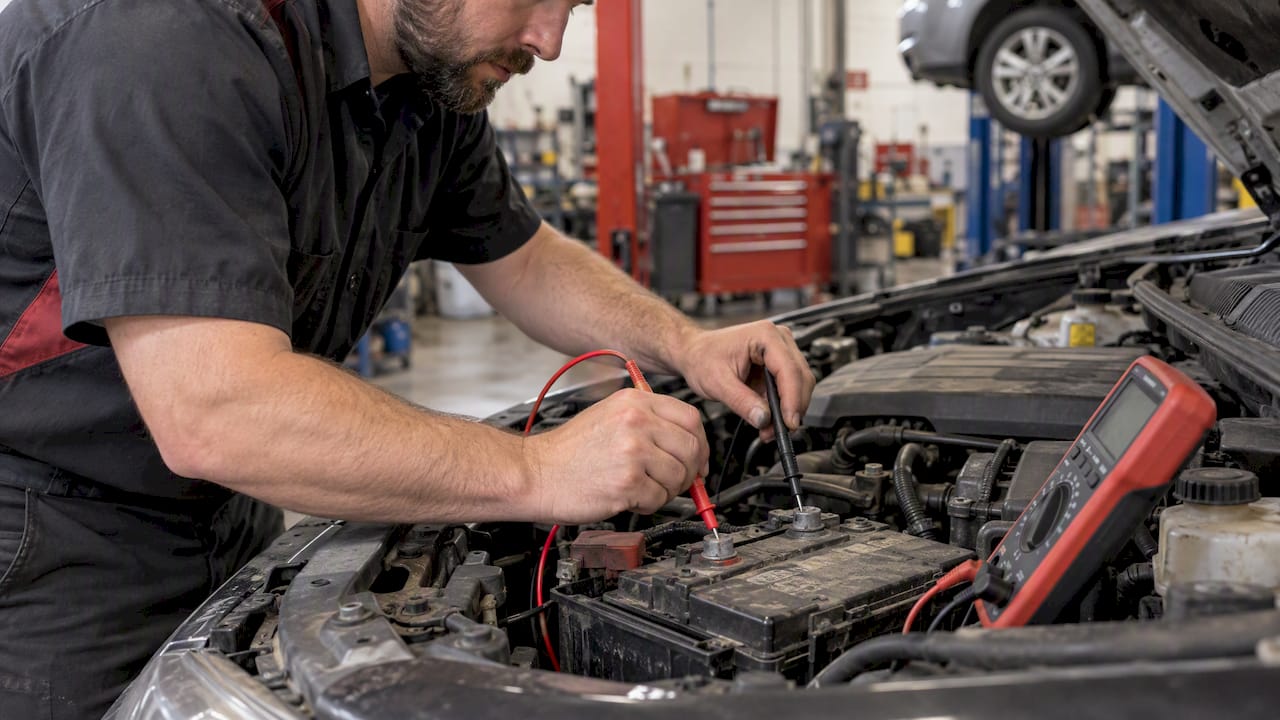
If you read well under that, the battery is discharged. That could mean it is old, or it could mean something drained it overnight. Either way, a jump start or a charge will tell you a lot: if the car cranks right away with a jump, the starter is probably fine and the battery or connection is the problem.
4. Consider the battery’s age
AutoZone puts the average lifespan of a standard car battery at three to five years, and notes that a worn battery can lack the cold cranking amps it needs, especially in cold weather (AutoZone). If yours is in that range and it surprised you on a cold, wet morning, it’s the leading suspect. Our write-up on why a car won’t start in cold weather covers that pattern in more detail.
5. Check for voltage at the small solenoid terminal
This one is for people comfortable with a multimeter. When the key is turned to start, 12 volts should be present at the small solenoid terminal. If it isn’t there, the problem is upstream: the ignition switch, an interlock, or related wiring, as Hagerty explains. If 12 volts is there and the starter only clicks, the solenoid or starter is the likely fault.
An assistant is useful here: one person turns the key while the other reads the meter. Keep hands, loose clothing and the meter leads away from belts and the fan.
Can a solenoid click and still be bad?
Yes. The solenoid is a switch with a plunger, and it can click or clack without actually passing the heavy current or engaging the gear properly. Hella’s technical guide says a starter can clack without engaging if the solenoid switch is stiff or faulty (Hella Techworld).
The starter motor itself can also be the problem. The same source lists worn carbon brushes, contaminated or burned collectors, and electrical faults in the armature or field windings as possible causes. These can’t be seen from outside the car, which is why the click alone doesn’t confirm what failed. For more on this, see our guide to starter solenoid symptoms.
Starter, battery or alternator: how to tell them apart
The alternator doesn’t crank the engine. It recharges the battery once the engine runs. But a failing alternator can leave you with a flat battery, which then produces rapid clicking. So the question to ask is what drained the battery.
- The car cranks fine after a jump but dies again soon after: think charging system.
- The car starts after a jump and keeps running, then clicks the next morning: think a battery that no longer holds a charge, or something drawing power overnight.
- A jump start makes no difference and you get one click: think starter, solenoid or a bad cable connection.
- Headlights stay bright while you turn the key, but you hear one click: the battery is probably healthy, which points toward the starter circuit.
The professional sequence is a bit different from guesswork. Delco Remy’s tech tip says to start with a battery charge and load test, then run a voltage drop test on the starter’s main cables, and for click-no-crank to check the control circuit (Delco Remy, 2023). It also gives a benchmark: total voltage drop across the cranking circuit should be under 0.5 volts while cranking.
That voltage drop test is what separates a good diagnosis from a parts swap. A starter can be perfectly healthy and still click because a cable or ground has too much resistance. Replace the starter in that case and the new one clicks too. If you’re curious how this plays out step by step, our guide on mapping the clicks in a no-crank, no-start goes further.
Should you bypass the solenoid?
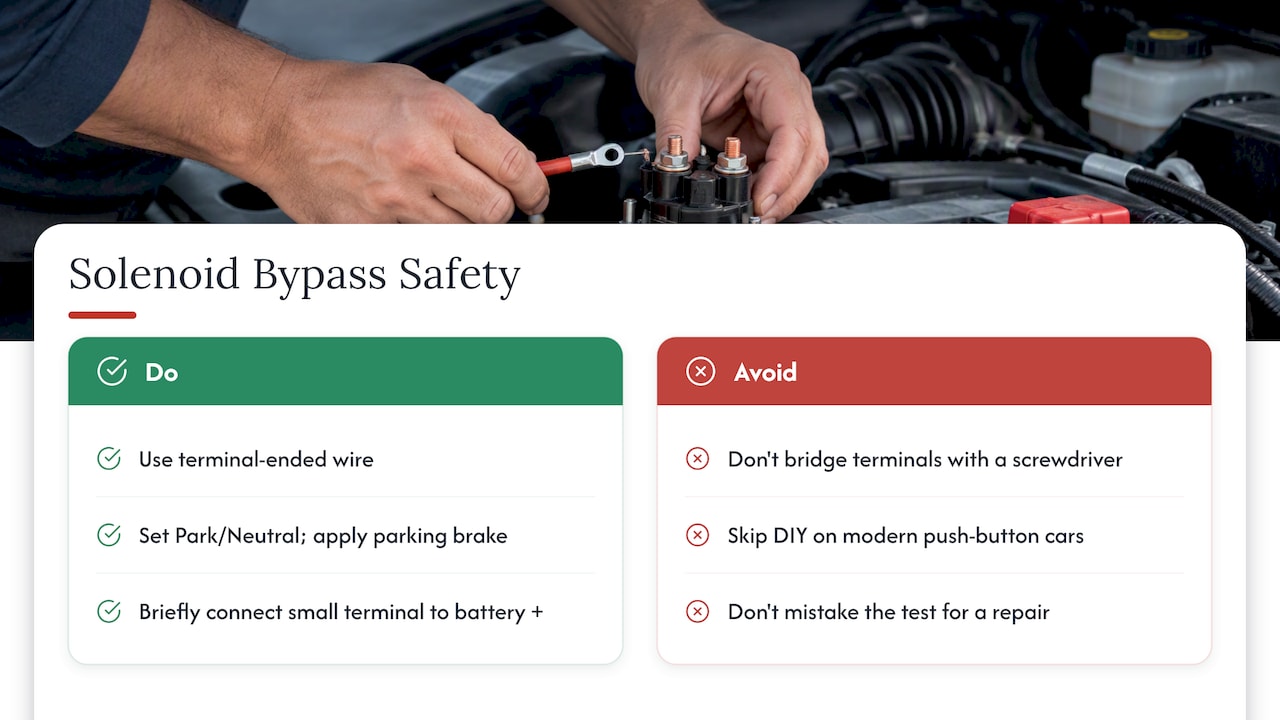
You’ll see videos of people tapping a screwdriver across the solenoid terminals to force the starter to spin. We’d steer you away from it. A screwdriver can slip and short against the engine, the body or the battery cable, and that means sparks, burns, and sometimes damage to the wiring or electronics.
Hagerty’s Rob Siegel recommends a length of wire with a terminal instead of a screwdriver, to avoid an accidental short against engine components. His method connects the small solenoid terminal to battery positive, briefly, with the car in Park or Neutral and the parking brake applied first (Hagerty).
Even done properly, this is a test and not a repair. If the engine turns when you do it, the starter is likely good and the fault is in the control circuit. If it still just clicks, the starter or its power supply is the problem. Either way, you’ve learned something, but it doesn’t fix the car. On modern vehicles with push-button start, anti-theft systems and tightly packed engine bays, we’d skip the DIY bypass and have it tested.
What we see in the shop
We’ve been repairing cars in Lynnwood since 1985, and click-no-crank is one of the calls where the right order of testing matters more than the part. Our view comes down to three points.
First, test the cheap things first. A battery and cable check takes a short time, and it rules out the most common causes before anyone talks about replacing a starter.
Second, don’t trust the click. A click tells you the solenoid received a signal. It doesn’t tell you the battery is healthy, the cables are clean inside, or the starter motor can turn. We’d rather confirm with a load test and a voltage drop reading than guess.
Third, the cost of a wrong guess is real. A new starter on a car with a corroded ground cable is money spent for nothing, and you’re still stranded. We work on Toyota, Honda, Subaru, domestic, European and hybrid vehicles, and the principle is the same on all of them: measure, then replace.
— Shingi
When to call a mechanic
The checks above are worth five or ten minutes. Stop and get professional help when:
- The battery tests healthy and the terminals are clean, but the car still clicks or does nothing.
- You get 12 volts at the small solenoid terminal but the starter only clicks.
- You find a cable that is corroded under the insulation, swollen or hot to the touch.
- The battery keeps going flat for no clear reason, which can point to a charging problem or a parasitic drain.
- You smell burning, see smoke, or notice melted insulation near the battery or starter.
- Your vehicle is a hybrid. Hybrids have a high-voltage system with its own safety rules, and the 12-volt battery that fails to wake the car is only part of the picture.
- You are in a place where working under the hood isn’t safe, such as a busy lot or roadside.
A shop can do a battery load test, a charging system test and a voltage drop test across the cranking circuit in one visit. That tells you which part to replace, and which to leave alone.
How we can help in Lynnwood
If your car clicks and won’t start, you don’t have to guess between a battery, cables and a starter. Tom’s B & M Auto offers diagnostics, battery replacement, starter motor replacement and alternator replacement for all makes and models, backed by ASE-certified technicians, upfront pricing and a 24-month / 24,000-mile warranty on all work. Same-day appointments are often available, so call early if you can’t leave the car stuck.
While you’re here, a few published starting prices for routine services: an oil change starts from $100, AC repair from $150, and brake repair from $280 per axle. Starter and battery work isn’t priced online, so we’ll give you the cost upfront once we’ve confirmed the fault.
Book your starter diagnosis with us, or if you’re closer to Shoreline, see our starter motor replacement in Shoreline. We also offer discounts for military, seniors and first responders.
Preventing the next click
Most click-no-crank calls start with a battery or connection that gave warning signs first.
- Know your battery’s age. With a typical lifespan of three to five years, a battery in its fourth year deserves a test before winter, not after a stranding.
- Watch for slow cranking. If the engine sounded lazy for a few days before it failed, that is the battery or a connection getting worse.
- Keep terminals clean and tight. A quick look under the hood at every oil change catches buildup early.
- Don’t ignore dimming lights. Headlights that dip hard when you start the car are a sign of weak supply or high resistance.
- Limit short trips and accessories off the engine. Repeated short trips and listening to the radio with the engine off leave a battery short of charge.
If you are due for scheduled maintenance, our 30k, 60k, 90k service is a good time to have the battery and charging system looked at along with everything else.
FAQ
Will a bad starter make a clicking sound?
Yes. A failing starter or solenoid often produces a single click, or a clack, without turning the engine. Hella notes that a starter can clack without engaging when the solenoid switch is stiff or faulty. Because a flat battery makes similar noises, test the battery first.
How can I tell if my starter is bad or my alternator?
The starter turns the engine over, and the alternator recharges the battery once it’s running. A bad starter gives you a click or silence with a healthy battery. A bad alternator usually shows up as a battery that goes flat, so the car clicks rapidly or won’t crank, but starts after a jump and then dies again later. A charging system test settles it.
Can a solenoid click and still be bad?
Yes. The click means the solenoid received a signal and moved, but its internal contacts can be worn or stiff, so the heavy current never reaches the starter motor. That is why a click alone is not proof that the part is good. A voltage test at the solenoid and a cable voltage drop test show where the current is lost.
Is it safe to bypass the starter solenoid to start the car?
It carries risk, so we wouldn’t recommend it as a regular fix. If you test, use an insulated wire with a terminal, never a screwdriver, with the car in Park or Neutral and the parking brake on. Treat it as a diagnostic step only, and have the actual fault repaired.
Why does my car click once and not start in cold weather?
Cold reduces what a battery can deliver, and a battery near the end of its life may have just enough power to trigger the solenoid once but not turn the engine. Cleaning the terminals and having the battery load tested usually answers it. See our guide on cold-weather no-starts for more.
Sources
- AutoZone: Car Won’t Start, Clicking Noises
- Hella Techworld: Checking the starter, causes of failure and troubleshooting
- Delco Remy: Tech Tip, Diagnosing Starter Cranking Problems (2023)
- Bosch Auto Parts: Starting Systems
- Hagerty: Triaging a no-crank condition and testing a starter motor
Recommended
- Starter Solenoid Symptoms: How to Tell It’s the Solenoid
- Why Your Car Won’t Start in Cold Weather
- Fix Engine Misfires Step by Step: A Car Owner’s Guide
- What Is Engine Misfiring? Causes, Signs, and Fixes
Leave a Reply