
Starter Solenoid Symptoms: How to Tell It’s the Solenoid
A bad starter solenoid usually shows up in one of four ways: a single loud click with no cranking, complete silence when you turn the key, slow or intermittent cranking, or a starter that keeps running after the engine fires. The catch is that a weak battery or a corroded cable can imitate almost every one of these. Below, we walk through each symptom, what else could be behind it, and how to decide whether you need a new solenoid or just a cleaner connection.
TL;DR
- A failing solenoid typically causes a no-crank with no sound, a single click, slow cranking, or a starter that stays engaged after you release the key.
- Rapid, machine-gun clicking is almost always low voltage from a weak battery or bad cable ends, not a dead solenoid.
- Sort the problem into click-no-crank, no-click-no-crank or slow-crank first. That tells you whether to look at the control circuit or the heavy-current circuit.
- Do not bridge the solenoid terminals with a screwdriver. It can arc, weld metal and start a fire.
- If the battery tests good and the symptoms persist, a shop can load-test the whole cranking circuit and tell you which part to replace.
Table of Contents
- What the starter solenoid actually does
- The main starter solenoid symptoms
- Rapid clicking is usually not the solenoid
- Quick symptom guide
- How to narrow it down before you call anyone
- Can you bypass a bad solenoid?
- Solenoid or starter: does it matter?
- Our perspective
- When to have it looked at
- Starting-system diagnosis at Tom’s B & M Auto
- FAQ
- Sources
What the starter solenoid actually does
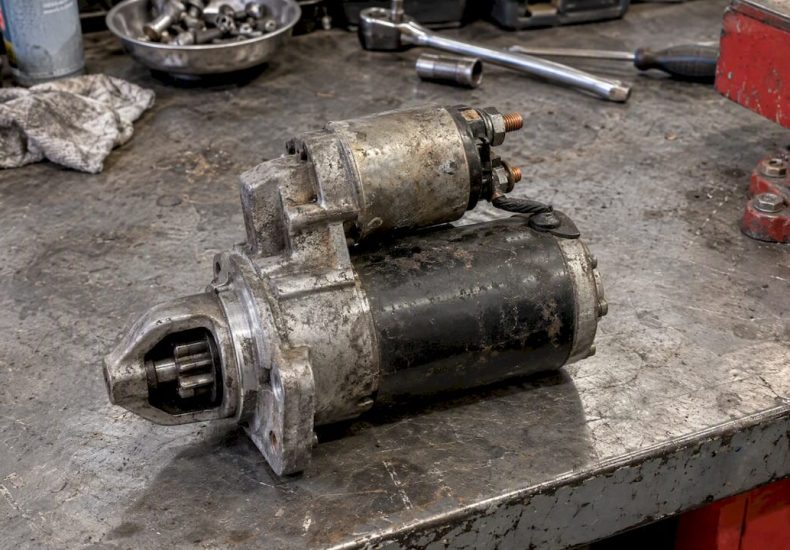
The solenoid is an electromechanical switch bolted to or built into the starter motor. When you turn the key or press the start button, a small current energizes it. It then does two jobs: it pushes the starter gear toward the flywheel, and it closes a heavy contact that sends battery power to the starter motor.
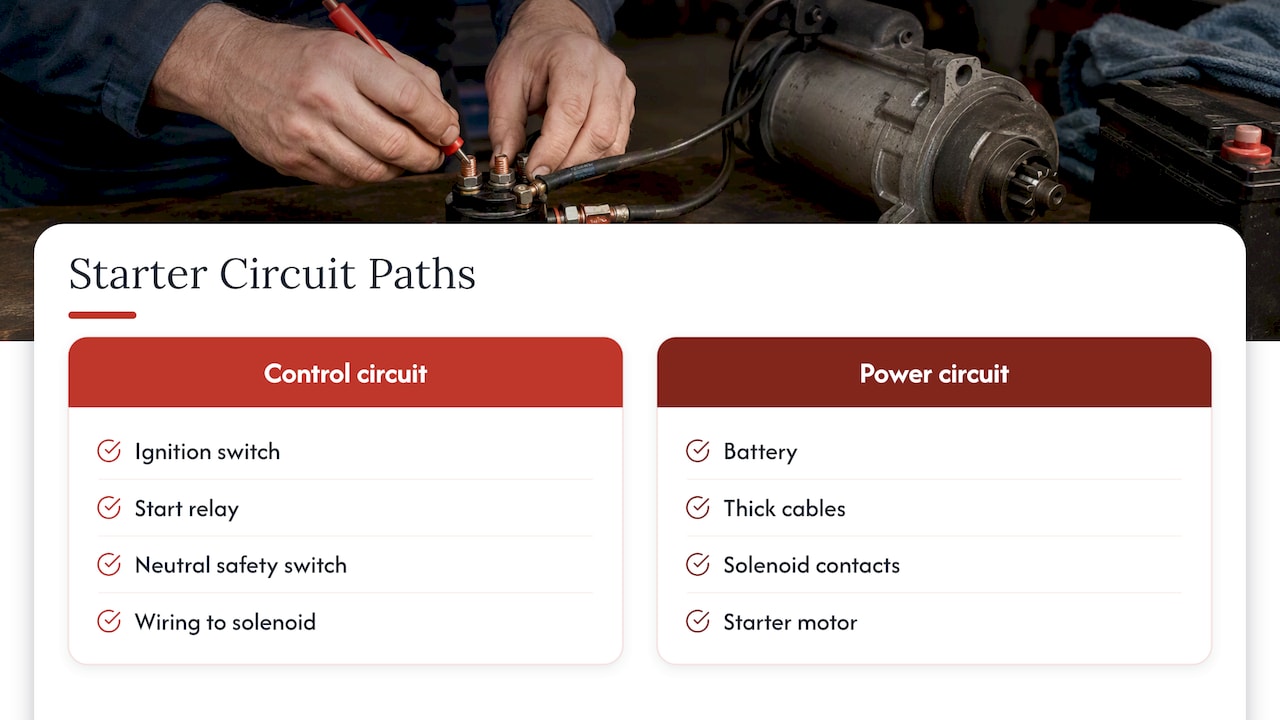
That is why one small part can produce so many different symptoms. The solenoid sits between two circuits. On one side is the light-duty control circuit: ignition switch, start relay, neutral safety switch and wiring. On the other is the heavy power circuit: battery, thick cables, solenoid contacts, starter motor and ground. A fault in either one can look like a bad solenoid from the driver’s seat.
The main starter solenoid symptoms
One loud click, then nothing
This is the classic. You turn the key, hear a single solid click from under the hood, and the engine does not turn. The solenoid is receiving the signal and moving, but either its internal contacts are burned and cannot pass current, or the starter motor behind it cannot turn.
The Delco Remy diagnostic framework calls this click-no-crank. It points toward the power side of the system: the solenoid contacts, the starter motor, or high resistance in the battery cables. A click does not by itself prove the solenoid is bad.
No sound at all
You turn the key and get silence. No click, no crank, though the dash lights may come on normally. One of the common signs of a failing solenoid is a no-crank condition with no noise. The same framework labels it no-click-no-crank, and it usually points to the control circuit: the ignition switch, start relay, neutral safety switch, or a wiring fault. It can also be a solenoid coil that has failed open.
If you drive an automatic, try shifting to Neutral and starting again. If it fires, the neutral safety switch or shifter linkage is a better suspect than the solenoid.
Slow cranking
The engine turns over, but sluggishly, as if the battery were nearly flat. Worn solenoid contacts can add resistance, so less current reaches the motor. Slow cranking is also what a tired battery, corroded terminals, a bad ground strap or a worn starter motor feel like. Mechanical trouble in the engine itself can do it too, which is why a diagnosis matters before parts get replaced.
Intermittent starting
The car starts fine five mornings and refuses on the sixth. Experts note that intermittent starting frequently points to a solenoid that is wearing out gradually. Contacts that are partly burned work when warm or freshly cleaned and fail when they are not. Many drivers report that a second or third try works. That pattern is a warning, not a fix. The part will eventually stop working, usually at the worst time.
Starter keeps running after the engine starts
You release the key, the engine is running, and you still hear a grinding or whining from the starter. This happens when the solenoid contacts weld together or the plunger sticks, so the starter stays energized. Shut the engine off right away. Letting the starter spin against a running engine can destroy the starter and chew up the flywheel teeth. This one should not wait.
Starter spins but the engine does not turn
You hear the motor whir freely, yet the engine does not crank. The solenoid is closing the electrical contact, but the gear is not meshing with the flywheel. A spinning starter without an engaged flywheel is listed among the signs of solenoid trouble. A worn drive gear or damaged flywheel teeth can produce the same noise, so a visual inspection is the way to separate them.
Rapid clicking is usually not the solenoid
This is the most common misdiagnosis. If you hear fast, repeated clicking, like a ticking typewriter, the solenoid is working fine. It is being starved. Rapid clicking is almost always a sign of insufficient voltage reaching the solenoid. The solenoid pulls in, voltage collapses under the load, it releases, voltage recovers, and the cycle repeats many times a second.
The usual culprits:
- A weak or discharged battery
- Corroded or loose battery terminals
- Damaged or corroded cables
- A poor engine or body ground
One cause of a dead battery is a parasitic drain, where something keeps pulling power after the engine is off. If your battery keeps going flat, replacing the solenoid will not solve the root problem.
Heat and cold both stress batteries and connections. If you are seeing these symptoms mainly on cold mornings, our guide on why your car won’t start in cold weather covers that pattern. For a seasonal checkup routine, these seasonal vehicle safety checks are a good habit to build around battery, cables and fluids.
Quick symptom guide
| What you notice | Likely area | Common look-alikes |
|---|---|---|
| Single loud click, no crank | Solenoid contacts or starter motor | High cable resistance, seized engine |
| Silence, dash lights on | Control circuit or solenoid coil | Ignition switch, start relay, neutral safety switch |
| Rapid clicking | Low voltage at the solenoid | Weak battery, corroded terminals, bad ground |
| Slow cranking | High resistance or worn starter | Tired battery, loose cables, engine drag |
| Starts only some days | Worn solenoid contacts | Loose connection, failing relay |
| Starter runs after start | Stuck or welded solenoid contacts | Rarely anything else |
| Whirring without turning engine | Gear not engaging flywheel | Worn drive gear, damaged flywheel |
How to narrow it down before you call anyone
You do not need tools for the first few steps. Our walkthrough on mapping the clicks when a car will not crank goes deeper, but here is the short version.
- Listen and categorize. Is it a single click, rapid clicks, or silence? Does the engine turn slowly? Use the three categories above.
- Check the dash and headlights. If the lights dim hard or go out while you try to start, think battery or cable first.
- Look at the battery terminals. White or green crust, or a clamp you can twist by hand, is reason enough to clean and tighten before anything else.
- Try Neutral (automatic transmissions). A start in Neutral points at the neutral safety switch.
- Test or charge the battery. Never replace a solenoid before verifying battery health. A voltage drop test on the cables comes next.
- Note whether the problem is intermittent. Tell the technician. It is useful information.
Why voltage drop testing matters
This test finds hidden resistance. It has to be done under load, while the engine is being cranked, because testing with the engine off hides the problem. Manufacturers note that this is why starting faults are often written up as no fault found. A drop of more than 0.5 volts across the whole cranking circuit, or more than 0.2 volts across a single connection, indicates high resistance that will hurt starter performance and life.
The starter circuit runs battery, cable, solenoid, motor, ground, and measuring each segment identifies the weak link. That is the procedure a good technician follows, and it is the reason a parts-swapping approach wastes money.
Current draw is a clue, not a verdict
A healthy starter typically draws 150 to 250 amps on a four-cylinder and 200 to 350 amps on a V8. Excessive draw may indicate mechanical problems such as worn bearings or a seized engine rather than an electrical solenoid fault. In other words, a reading that looks like a starter problem can be an engine problem.
Can you bypass a bad solenoid?
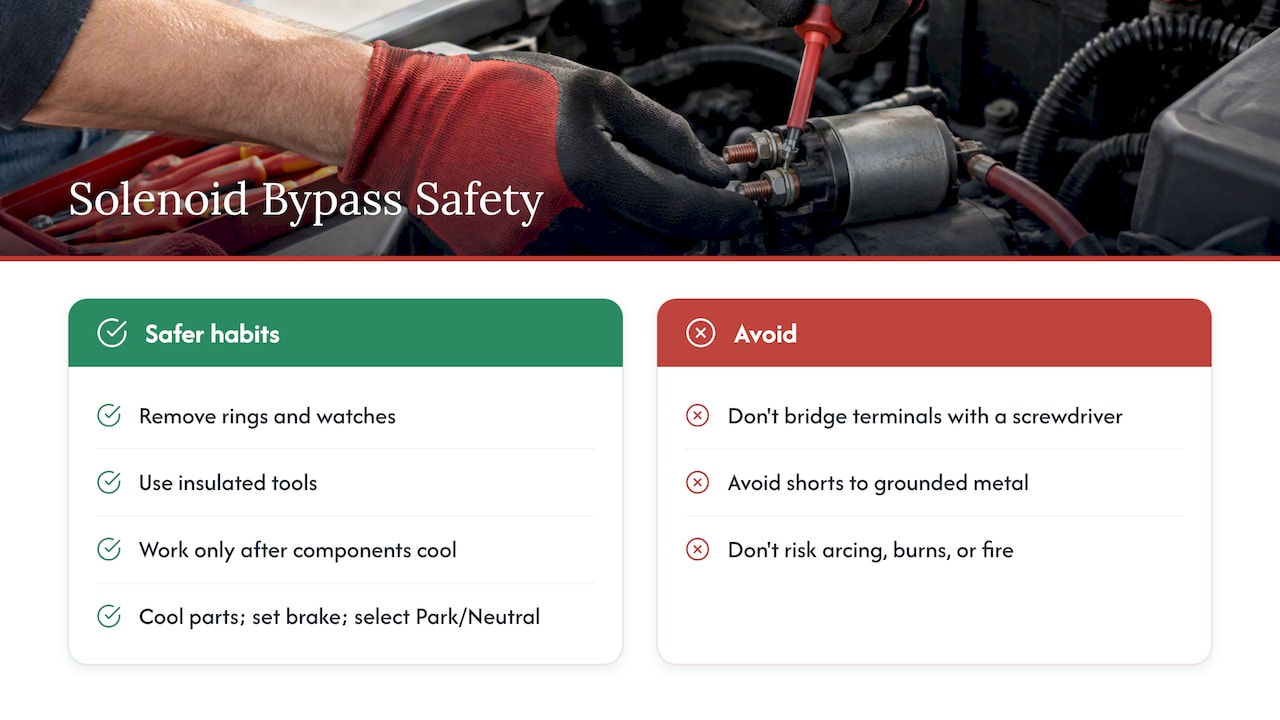
People search for this because they are stranded. The field trick is to bridge the two large solenoid terminals with a screwdriver to make the starter spin. We do not recommend it. It is dangerous and can cause severe arcing, metal welding or fire, and an accidental short to grounded metal can destroy electronics.
The circuits involved carry 150 to 300 amps or more. That is enough to cause severe burns. If you ever see this test done, the safe habits are to remove rings and watches, use insulated tools, work only when components have cooled, set the parking brake, and make sure the transmission is in Park (or Neutral on a manual).
There is also a diagnostic lesson. If the starter cranks during a bypass but not from the key, the problem is in the control circuit, such as the ignition switch, neutral safety switch or wiring, not in the solenoid. But with modern vehicles full of electronics, we would rather you tow the car than try it. If you are not sure what you are touching, the specific person to call is a certified technician.
Solenoid or starter: does it matter?
On many vehicles the solenoid is part of the starter assembly, and the repair is to replace the whole starter. On some, the solenoid can be replaced on its own. A bad solenoid can still leave a starter that works partly, and a starter motor with worn brushes or bearings can look like a solenoid fault. If the starter is older, replacing only the solenoid may mean paying for the labor twice. Ask your technician which makes sense for your vehicle and its mileage.
Hybrids are different in one respect: the engine may not crank every time the car is switched on, because the hybrid system can start it by other means. If your hybrid shows warning lights or a no-start, have a shop with hybrid experience look at it before you replace parts.
Our perspective
We have been fixing cars in Lynnwood since 1985, and the starting system is a place where we see the same mistake over and over: someone replaces a starter because it clicked, and the car still will not start the next morning. The cause was a corroded cable end or a battery that tested fine at rest and collapsed under load.
Our approach is simple. We test the battery, then the cables and grounds under cranking load, then the control circuit, and only then do we condemn the solenoid or starter. Our ASE-certified technicians use professional-grade OBD-II diagnostics and digital inspections, so you see what we found before you approve work. The price is quoted upfront, and the repair carries our 24-month / 24,000-mile warranty on all work.
If your car clicks, hesitates or sometimes will not start, do not wait for it to fail completely. An intermittent solenoid is easier to diagnose while it still works some of the time, and it is a lot cheaper than a tow.
— Shingi
When to have it looked at
Get a professional diagnosis if any of these apply:
- The battery tests good but the car still clicks or will not crank.
- The starter keeps running after the engine starts. Stop driving it and shut the engine off.
- The problem comes and goes.
- You smell burning near the starter, or see smoke.
- You are unsure whether the fault is the starter, the battery or the engine.
No-start problems can also overlap with other faults. If the engine cranks but will not fire, that is a different set of causes, and our guide to types of car diagnostic tests explains what a shop can run to find them.
Starting-system diagnosis at Tom’s B & M Auto
If you are in Lynnwood and your car clicks, stalls on start or will not crank, we can trace the fault through the battery, cables, relay, solenoid and starter before replacing anything. We work on all makes, including Toyota, Honda, Subaru, domestic, European and hybrid vehicles, and same-day appointments are often available. Starter motor, alternator and battery replacement are all part of what we do. Book through our main site or ask about the engine repair page if you suspect a deeper problem. We also offer discounts for military, seniors and first responders.
FAQ
Can a starter still work with a bad solenoid?
Sometimes, for a while. A solenoid with worn contacts may work intermittently, especially after a few tries, because the contacts occasionally make a good connection. The starter motor itself may be fine. But an intermittent solenoid will eventually fail completely, so it is worth fixing before it strands you.
How do you know if you have a bad starter or a bad solenoid?
The symptoms overlap, which is why testing matters. A single click often points at the solenoid contacts or the starter motor, and silence points at the control circuit or a failed solenoid coil. A voltage drop test under load, plus checking battery health, shows whether the starter assembly itself is at fault. On many vehicles the solenoid is part of the starter, so the repair is often the same.
What are the two main causes of solenoid failure?
Wear and electrical problems are the usual ones. Over time, the internal contacts burn and pit from the heavy current they switch, and the plunger or coil wears out. Low voltage from a weak battery or high-resistance cables can speed this up, because the solenoid chatters and arcs instead of closing cleanly.
Is rapid clicking a bad solenoid?
Usually not. Fast repeated clicking is typically a sign that not enough voltage is reaching the solenoid, most often from a weak battery, corroded terminals or loose cables. Charge or test the battery and inspect the connections first.
Sources
- Symptoms of a Bad Starter Solenoid, AutoZone
- Tech Tip: Diagnosing Starter Cranking Problems, Delco Remy
- Is Your Car Clicking Instead of Cranking? Auto Veteran
- How to Test a Starter Motor Solenoid, Fab Heavy Parts
- ASE A6 Electrical/Electronic Systems Study Guide
- How Parasitic Battery Drain Happens, UTI
Leave a Reply