

Diagnose P0300 in 1–3 Hours: Lynnwood Mechanics’ Data First Fix
P0300 means the engine control module detected misfires that aren’t tied to one specific cylinder. If your check engine light is flashing, stop driving now. If it’s steady, you can drive carefully to a shop, but don’t put it off. Left alone, random misfires can wreck your catalytic converter fast.
TL;DR:
- Most P0300 misfires are caused by ignition or fuel delivery issues, which are usually diagnosed and fixed faster than mechanical problems.
- A flashing check engine light indicates severe misfire that can quickly damage the catalytic converter, requiring immediate stopping and towing.
- Diagnosing P0300 accurately relies on live misfire counters, fuel trims, and specific data rather than just reading the code alone.
- Correct repairs can range from simple spark plug or coil replacement to more costly timing or internal engine work, depending on the root cause.
- Proper diagnostic procedures prevent unnecessary parts replacement, saving money and ensuring the problem is genuinely fixed on the first visit.
Table of Contents
- What Does P0300 Actually Mean on a Diagnostic Scan?
- What Symptoms Come With a P0300 Code?
- What Causes a Random Multiple Cylinder Misfire?
- Is P0300 Serious, and Can You Keep Driving?
- How Do Mechanics Diagnose a P0300 Misfire?
- What Does a P0300 Repair Typically Cost?
- Why a Professional Diagnostic Actually Matters Here
- A Mechanic’s View: Stop Replacing Parts and Start Reading Data
- Get Your P0300 Diagnosed Before It Costs More
- Sources
What Does P0300 Actually Mean on a Diagnostic Scan?
The P0300 code explanation comes down to how the powertrain control module (PCM) tracks engine smoothness. It monitors crankshaft acceleration and deceleration between firing pulses. When a cylinder misfires, the crank briefly slows down in a pattern the computer recognizes, and it logs that event in a misfire counter.
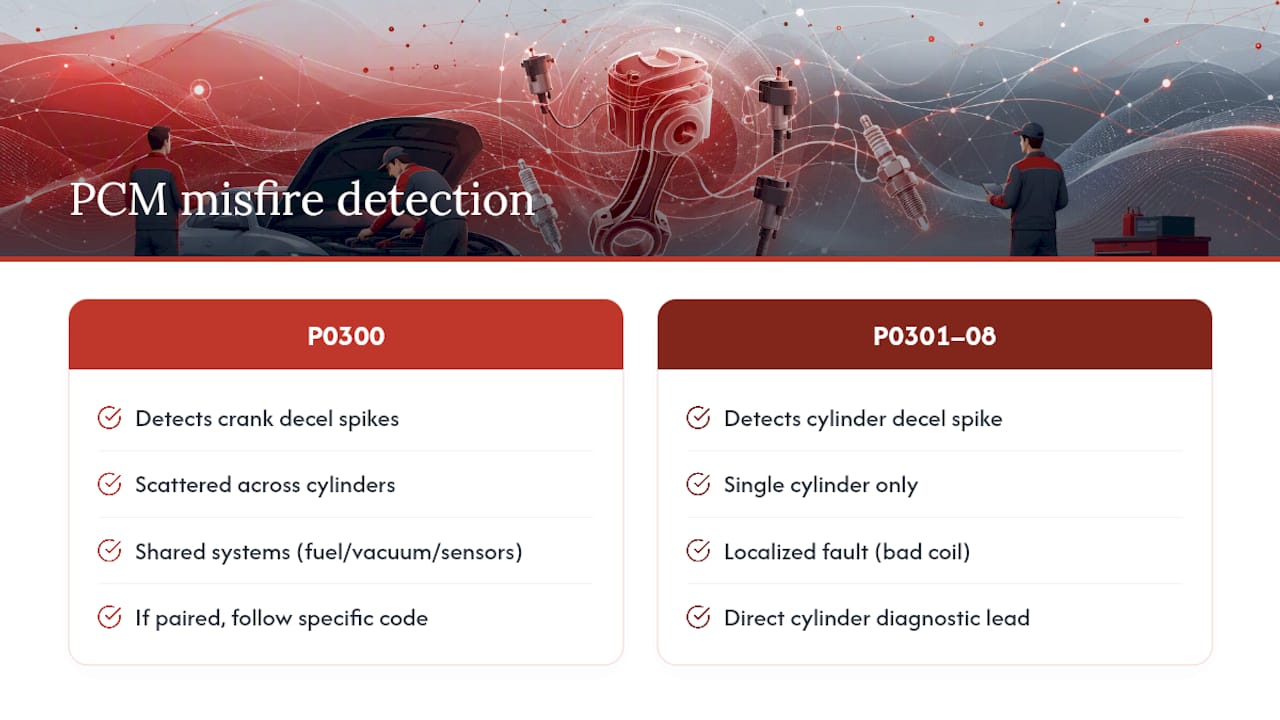
Codes P0301 through P0308 point to one specific cylinder. P0300 is different: it fires when misfires are scattered across multiple cylinders, or when the PCM can’t pin the pattern to a single one. That distinction matters for diagnosis. A P0301 usually means a localized problem, like one bad coil. A random multiple cylinder misfire detected code usually means something shared across the whole engine is off, like fuel pressure, a vacuum leak, or a sensor feeding bad data to every cylinder at once. It’s also common to see P0300 alongside a cylinder-specific code, and when that happens, the specific code is often your best lead.
What Symptoms Come With a P0300 Code?
You’ll usually feel a P0300 misfire before you ever plug in a scanner. The engine won’t run smoothly, and depending on severity, it can range from a mild shudder to something that feels like the car is trying to shake itself apart.
- Rough idle or noticeable engine vibration, especially at stoplights
- Hesitation, stumbling, or a stutter when you press the gas
- Reduced fuel economy and a noticeable loss of power
- Stalling, or the engine dropping into a protective “limp” mode
- A check engine light that’s either steady or flashing
That last point is the one to pay attention to. A steady light means the PCM is tracking a misfire pattern but it hasn’t reached a severity threshold that risks immediate damage. A flashing light means active, severe misfiring is happening right now, and it’s dumping unburned fuel into the exhaust system.
What Causes a Random Multiple Cylinder Misfire?
P0300 causes tend to fall into five categories, and mechanics usually check them in roughly this order because it matches how often each one turns out to be the culprit.
- Ignition system: worn spark plugs, failing ignition coils, or high-resistance plug wiring. High-mileage plugs often start this chain reaction by demanding more firing voltage, which stresses the coils until one starts to fail under load.
- Fuel delivery: clogged injectors, low fuel pressure from a weak pump, or contaminated fuel.
- Intake and vacuum: a vacuum leak, a dirty or failing mass airflow (MAF) sensor, or a stuck EGR valve.
- Sensors and timing: a faulty crankshaft or camshaft position sensor, or a timing belt/chain that’s skipped a tooth.
- Mechanical: low compression across multiple cylinders, a blown head gasket, or severe carbon buildup.
Pro Tip: If P0300 shows up next to a cylinder-specific code like P0302, address that cylinder first. It resolves the random misfire more often than any other single fix.
Most shops start with ignition and fuel before touching anything mechanical, since those two categories cause the large majority of misfire complaints.

Is P0300 Serious, and Can You Keep Driving?
Treat a flashing check engine light as a hard stop. Pull over safely and arrange a tow. A flashing light means the misfire is severe enough that raw fuel is reaching the exhaust, and that fuel can overheat and physically melt the catalytic converter within a short drive. The misfire monitor tracks these events over rolling windows of 200 and 1,000 engine revolutions specifically to catch this kind of catalyst-damaging pattern.
A steady light is less urgent but not something to ignore. You can usually drive to a shop, but keep RPMs low, avoid heavy acceleration, and skip long highway trips. Watch for a change: rotten-egg smell, new overheating signs, or a sudden loss of power. Any of those means it’s time to stop and call for a tow instead of pushing on.
How Do Mechanics Diagnose a P0300 Misfire?
A disciplined diagnostic sequence is what separates a $200 fix from a $2,000 parts-replacement spree. Roughly 70% of misfire diagnostics that use live misfire counters get resolved in under an hour, compared to hours of guesswork with a basic code reader alone.
- Pull live data. Read the P0300 code, freeze-frame data, and misfire counters per cylinder. Note any accompanying codes.
- Check fuel trims. Codes like P0171 or P0174 alongside P0300 point toward a lean condition, often a vacuum leak or weak fuel delivery.
- Inspect ignition components. If one cylinder shows a higher misfire count, swap that coil or plug with a neighboring cylinder and rescan to confirm.
- Test the fuel system. Check fuel pressure against spec, test injector resistance and pulse (a noid light test), and rule out bad fuel.
- Check for vacuum leaks and clean the MAF sensor, since a dirty sensor skews the air-fuel calculation for every cylinder.
- Run a compression test or check timing marks if the pattern suggests a mechanical issue rather than ignition or fuel.
- Verify the fix under matching conditions. OEM guided fault-finding procedures call for reproducing the same engine load, coolant temperature, and RPM range recorded in the freeze-frame data, then clearing codes and running two full drive cycles before calling the job done.
Skipping that last step is why some misfires “come back” days after a repair. If you want a broader walkthrough of this process, our guide to fixing engine misfires step by step covers it in more depth. Our compression testing guide is worth a look if step six is where your diagnosis lands.
What Does a P0300 Repair Typically Cost?
Cost depends entirely on which cause turns out to be correct, and that’s the whole reason the diagnostic sequence above matters more than guessing.
- Spark plugs or coils: usually the least expensive fix, often resolved same-day.
- Injector cleaning or replacement, vacuum leak repair, or a fuel pump/pressure regulator: moderate cost, typically finished within a day.
- Timing component repair or internal engine work (head gasket, low compression): the most expensive category, and can take multiple days depending on the vehicle.
Labor rates and engine layout (a V6 with hard-to-reach rear cylinders costs more in labor than an inline-four) both push cost up or down. Diagnostic time alone usually runs one to three hours before any repair even begins. A Volkswagen or other European engine repair job with tighter access to rear cylinders will run longer than a straightforward domestic four-cylinder.
Why a Professional Diagnostic Actually Matters Here
Tom’s B & M Auto has been repairing Lynnwood-area vehicles since 1985, working on everything from Toyota, Honda, and Subaru to domestic, European, and hybrid engines. Our ASE-certified technicians use professional-grade OBD-II diagnostics with live misfire counters, not just a generic code reader that tells you “P0300” and nothing else.
That distinction shows up in the invoice. Reading freeze-frame data, fuel trims, and per-cylinder misfire counts before touching a wrench is what keeps a repair bill from ballooning into a full parts swap. Every repair comes with upfront pricing and a 24 month / 24,000 mile warranty, and same-day appointments are often available.
A Mechanic’s View: Stop Replacing Parts and Start Reading Data
The single biggest mistake with P0300 is what techs call parts-cannoning: replacing every plug, coil, and injector hoping something sticks. It’s expensive, and it usually doesn’t fix anything, because random misfire codes rarely mean every cylinder is bad at once.
The better approach uses misfire counters and fuel trim data to narrow the search before any part gets swapped. A shop that swaps one coil between cylinders and watches the misfire count follow it has found the actual problem in minutes, not hours. That’s the difference between guided diagnosis and expensive guesswork.
— Shingi
Get Your P0300 Diagnosed Before It Costs More
Tom’s B & M Auto runs a free check engine light review for exactly this situation. Instead of paying for guesswork or replacing parts one at a time, you get a professional-grade OBD-II scan that reads live misfire data and freeze-frame conditions the same way our ASE-certified technicians do on every job.
Most diagnostic appointments take one to three hours, and financing is available if the repair turns out to be bigger than a plug or coil swap. Every job carries our 24 month / 24,000 mile warranty, so a fix stays fixed. If you’re dealing with a rough idle, a stumble on acceleration, or a check engine light you can’t ignore, schedule your free check engine light review and get a straight answer instead of a guess.
Sources
For related reading, see what causes engine misfiring and diagnostic code basics across vehicle types.
- P0300 Code – Random/Multiple Cylinder Misfire Detected
- P0300 Code — the guide to diagnostics and repair (Identifix)
- P0300: Random/Multiple Cylinder Misfire – ApexTech
- V011528 Engine, Misfire Diagnostic Aid (gas engine only) — OEM guidance
Leave a Reply