
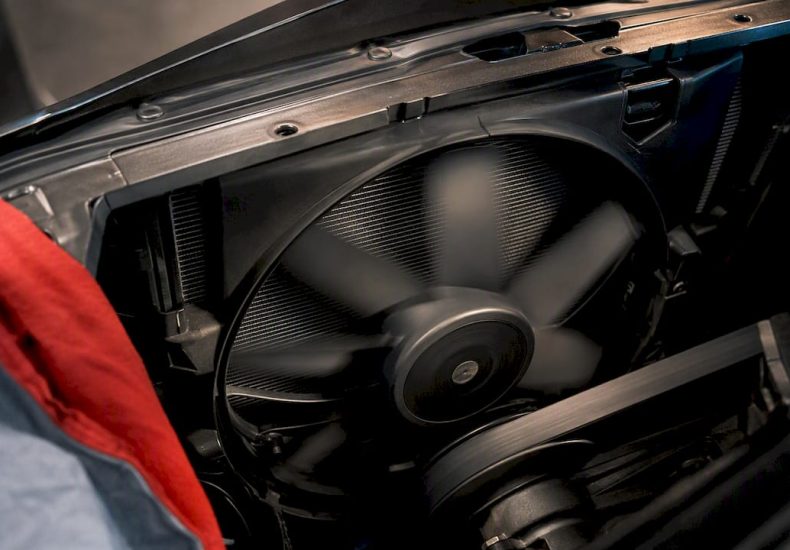
Diagnose Overheating at Idle in 60 Seconds With a Fan Test
If your car only overheats while idling, the cause is almost always airflow or weak coolant circulation, not the engine itself. Suspect the cooling fan, fan clutch, thermostat, water pump, or a low/airlocked coolant system first. If the gauge is climbing now, pull over safely, shut the engine off, and wait 15 to 30 minutes before touching the hood.
TL;DR:
- Most idle-only overheating issues are caused by cooling fan failure, fan clutch problems, low coolant, or airlocks, not the engine itself.
- Running the A/C at idle or waiting 15 to 30 minutes before opening the radiator cap are key safety steps to prevent burns and diagnose effectively.
- Testing fan operation with the A/C ON and feeling the upper radiator hose after the engine cools are quick checks that help identify circulation problems.
- Cheaper fixes, like replacing a fuse, relay, or coolant sensor, account for about half of the cases, making proper diagnosis essential to avoid unnecessary parts replacement.
- Summoning ASE-certified technicians for systematic diagnostics ensures accurate repairs and avoids costly damage caused by repeated overheating or improper fixes.
Table of Contents
- Why Overheating at Idle Happens and What to Do First
- What’s Actually Causing Idle-Only Overheating?
- How Do You Test the Fan and Cooling System Yourself?
- How Serious Is This, and What Will It Cost to Fix?
- Preventing Idle Overheating Before It Starts
- What Happens When You Bring It to a Shop Like Tom’s B & M Auto
- What Repeated Overheating Does to Your Engine Over Time
- Does Weather or Traffic Make Idle Overheating Worse?
- Can Idle Speed Settings Cause or Prevent Overheating?
- The Fastest Way to Diagnose This Without Guessing
- Get an ASE-Certified Diagnosis Instead of Guessing at Parts
- Sources
Why Overheating at Idle Happens and What to Do First
The moment you’re rolling at 40 mph, air rams through the grille and does half the cooling fan’s job for it. Sitting at a red light, that free airflow disappears, and the fan has to work alone. A car that runs cool on the highway but climbs into the red at a stoplight is telling you something specific: the parts responsible for moving air or coolant at low speed aren’t pulling their weight. Idle-only overheating typically points to a cooling fan or airflow problem, and that single fact should shape everything you check next.
Before diagnosing anything, get the car out of danger.
- Pull over as soon as it’s safe — shoulder, parking lot, anywhere out of traffic. Don’t keep driving hoping it’ll cool down; that’s how a warm engine becomes an expensive one.
- Shut off the engine. A hot engine that isn’t running stops generating new heat, which is the fastest way to stop the climb.
- Wait 15 to 30 minutes before opening the hood. Coolant under pressure can exceed 230°F, and cracking a radiator cap early can cause severe steam burns. Medical guidance on thermal burns from engine coolant is blunt about this: give it time, no exceptions.
- If you must keep the car running to get somewhere, turn the heater to full blast and shut off the A/C. GEICO’s guidance on overheating notes this pulls heat out of the engine and dumps it into the cabin instead of the radiator. Uncomfortable, but it buys you time.
- Only add coolant once the engine has fully cooled, and only if you’re confident you know what type your car takes.
- If the gauge is pinned in the red, or you see steam or a coolant puddle forming, stop and call a tow. Limping another mile isn’t worth a warped head or a blown gasket.
Pro Tip: Keep a jug of the correct coolant type in your trunk. Guessing wrong (or mixing types) can cause its own problems down the road, so check your owner’s manual before you’re stuck on the shoulder trying to remember.
What’s Actually Causing Idle-Only Overheating?
Six components show up again and again when a car overheats sitting still but runs cool at speed. Repair data on idle-only overheating ranks the cooling fan system as the single most common culprit, with fan clutches, clogged radiators, low coolant, water pumps, and thermostats filling out the list.
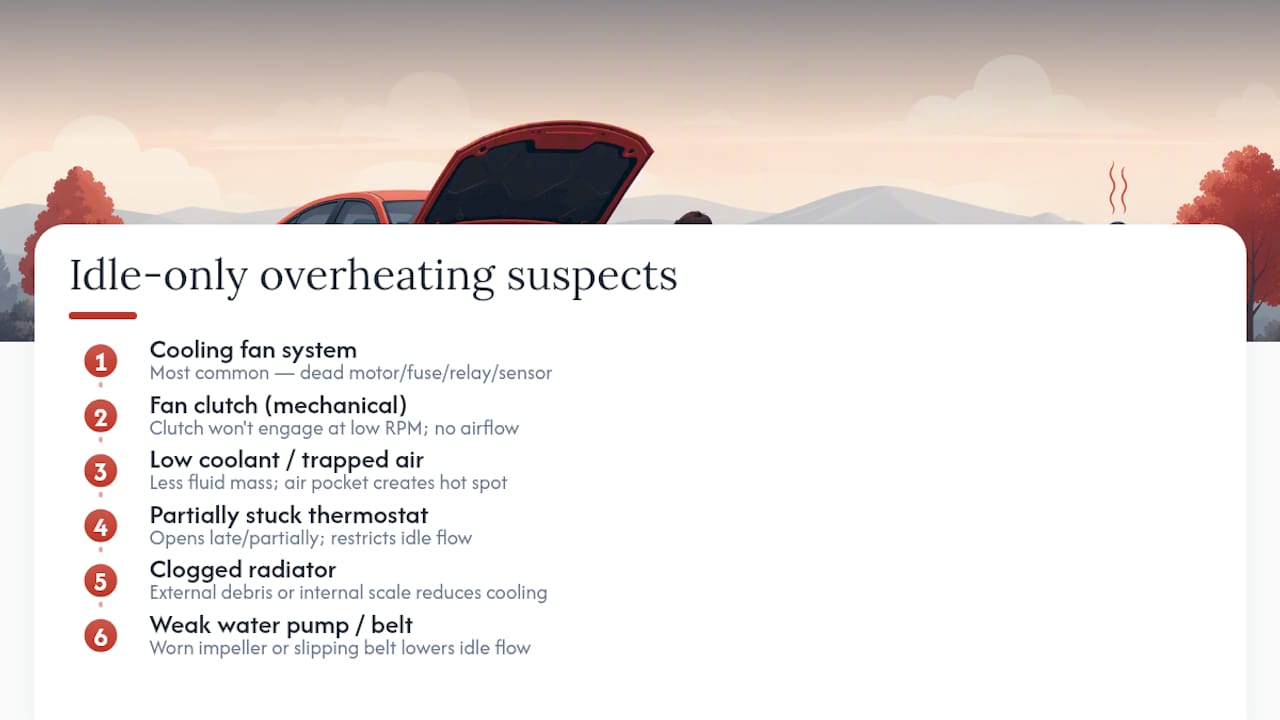
Cooling fan system failure. This is the number one suspect, and for good reason. The fan (or fans, on many modern vehicles) exists specifically to move air through the radiator when the car isn’t moving fast enough to do it naturally. A dead fan motor, a blown fuse, a failed relay, or a bad coolant temperature sensor feeding the fan control module can all produce the exact same symptom: fine on the freeway, cooking at the light. Highway ram-air can fully mask a weak or dead fan, which is exactly why this fault hides so well until you’re sitting in traffic.
Fan clutch problems (trucks and SUVs). If you drive something with a mechanical, belt-driven fan rather than an electric one, a viscous fan clutch that won’t engage at low RPM causes near-identical symptoms. These clutches use a thermal spring and silicone fluid to lock the fan blades to the pulley when they’re needed. When the clutch fails in the disengaged position, you get plenty of blade spin but almost no airflow, and it gets worse the longer you idle.
Low coolant and trapped air pockets. A system that’s a quart low, or one with an air pocket from a recent hose replacement or a slow leak, has less liquid mass to absorb and carry heat away. At speed, decent flow rate can partially compensate. At idle, when flow is already at its weakest, an air pocket can create a hot spot right where you need circulation most.
A partially stuck thermostat. Thermostats fail in two directions: stuck open (car never gets warm enough) or stuck closed/partially closed (car overheats because coolant can’t reach the radiator). A thermostat that’s opening late or not fully restricts flow precisely when the water pump’s own output is already lowest, which is at idle.
A clogged or externally blocked radiator. Years of road grime, cottonwood fluff, bugs, and leaves packed into the radiator fins choke off airflow from the outside, while internal scale buildup or old, degraded coolant chokes flow from the inside. Either way, the radiator loses its ability to shed heat exactly when it’s under the most stress with the least help from moving air.
A weak water pump or a slipping belt. This is the sneaky one. A worn or slipping impeller inside the water pump can push enough coolant through the system at highway RPM to get by, but fall short at idle speed, when the pump itself is turning slowest. The same goes for a belt that’s glazed or slightly loose. It grips fine under load, then slips just enough at idle to starve the pump.
By the numbers: cheap fixes solve roughly half of idle-only overheating cases. According to repair-cost data on idle overheating, a bad fuse, relay, or coolant temperature sensor accounts for about half of all diagnosed cases, with the pricier parts (fan motors, water pumps, radiators) making up the rest.
That statistic matters because it means most idle-only overheating problems are cheaper than owners fear, but only if the shop diagnoses the actual failure instead of throwing parts at it. For more on the mechanics of heat rejection, how a radiator moves heat out of your engine is worth a read, as is how the thermostat regulates flow.
How Do You Test the Fan and Cooling System Yourself?
You can run several checks without opening anything hot or risking a burn, and they’ll tell you a lot about whether you’re dealing with an airflow problem or a circulation problem.
- The A/C fan test. Let the engine warm up to normal operating temperature, then turn the A/C on full at idle. A reliable diagnostic shortcut is watching whether the fan or fans kick on within a minute or so. If they stay dead, you’re likely looking at the fan motor, a fuse, a relay, or the control circuit, not the coolant itself.
- Feel the upper radiator hose (carefully, with gloves, only after the engine has cooled from any overheating event). It should get hot once the thermostat opens, usually a few minutes after startup. A hose that stays cool while the temperature gauge climbs points to a thermostat stuck shut or a pump that isn’t moving coolant.
- Look at the coolant reservoir. Bubbling, a reservoir that’s boiling over, or coolant that seems to be foaming instead of flowing smoothly can indicate trapped air or a weak radiator cap that isn’t holding pressure correctly.
- Listen for the water pump. A grinding, growling, or whining noise near the front of the engine, especially one that changes with RPM, often means a failing pump bearing.
- Check your heater. If the engine is running hot but the heater is blowing cold or lukewarm air, that’s a strong sign coolant simply isn’t circulating, which usually points at the pump, a stuck thermostat, or serious air in the system rather than a fan issue.
Pro Tip: If the A/C fan test passes (fans spin up fine) but you’re still overheating at idle, don’t waste money replacing fan parts. That result rules the fan system out and shifts suspicion to circulation: coolant level, the thermostat, or the pump.
Never open a radiator cap while the engine is warm or hot, and skip any test that requires touching metal near the radiator or exhaust until things have cooled. None of these checks are worth a burn.
How Serious Is This, and What Will It Cost to Fix?
Idle-only overheating feels less scary than overheating everywhere, but it isn’t. If the temperature gauge climbs into the red zone or a warning light comes on, engine damage can happen in minutes, not miles. Warped cylinder heads, a blown head gasket, and cracked blocks are all real outcomes of ignoring “it’s just at stoplights” overheating for too many trips in a row.
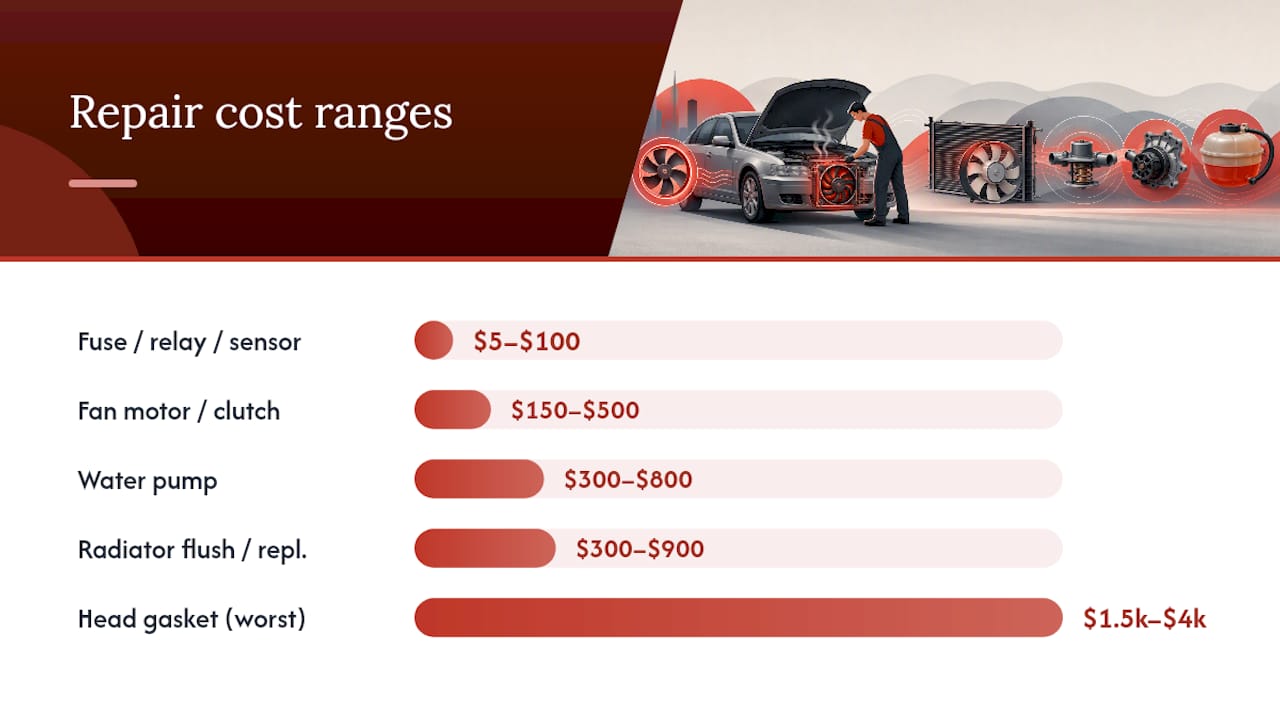
Repair costs vary by vehicle and region, but rough bands look like this:
- Fuse, relay, or coolant temperature sensor: $5 to $100 in parts, often a quick fix once diagnosed correctly.
- Fan motor or fan clutch replacement: roughly $150 to $500 depending on the vehicle and whether it’s an electric or mechanical fan.
- Water pump replacement: typically $300 to $800, since labor often includes draining and refilling the whole system.
- Radiator flush or full radiator replacement: around $300 to $900, with a flush at the low end and a full replacement at the high end.
- Head gasket repair (worst case, from prolonged overheating): $1,500 to $4,000 or more, and sometimes a sign of deeper engine damage.
If the gauge is climbing fast, the car is stalling, or you smell coolant or see steam, a tow to a shop is the safer call over trying to nurse it home. A short tow bill beats a $3,000 head gasket every time. For repairs beyond fan and hose work, a step-by-step look at water pump replacement shows what’s involved, though this is one job most owners are better off leaving to a shop given how much coolant system draining and bleeding it requires.
Preventing Idle Overheating Before It Starts
Most idle-only overheating problems don’t appear overnight. They build slowly through skipped maintenance, and a handful of habits keep the whole system working the way it’s supposed to.
- Check coolant level and condition every few months, not just when the light comes on, and follow the manufacturer’s flush interval rather than waiting for a problem.
- Use the coolant type specified for your vehicle. Mixing types or topping off with the wrong formula can cause internal corrosion that clogs passages over time.
- Keep the radiator and, if equipped, the A/C condenser in front of it free of leaves, bugs, and road debris. A visual check for bent fins or packed grime takes thirty seconds and catches problems early.
- Have the fan system, thermostat, belts, hoses, and water pump inspected at routine service, not just replaced reactively after a breakdown.
- Insist on real diagnostics for intermittent problems. A shop using ASE-recommended systematic testing rather than guess-and-replace will find the actual fault faster and usually cheaper.
Pro Tip: If leaves or bug debris are packed into the radiator fins from the outside, a proper engine bay cleaning, like the detailed engine bay service some detail shops offer, can restore airflow without any mechanical repair at all.
What Happens When You Bring It to a Shop Like Tom’s B & M Auto
A proper diagnosis doesn’t start with swapping parts and hoping. At Tom’s B & M Auto, the process for idle-only overheating typically runs through:
- An OBD-II scan to pull coolant temperature sensor data and any fan-control fault codes.
- An active fan test, running the fan motor directly to confirm it responds to command.
- A cooling system pressure test to catch leaks, weak caps, or a compromised head gasket.
- Thermostat and water pump inspection, checking for proper opening temperature and pump flow.
- Radiator inspection and cleaning where external blockage is contributing to the problem.
- A road test to confirm the fix holds under real driving conditions, not just at idle in the bay.
| What You Get | Why It Matters |
|---|---|
| ASE-certified technicians | Systematic diagnosis instead of guess-and-replace parts swapping |
| Full-service for all makes | Toyota, Honda, Subaru, domestic, hybrid, and European vehicles all covered |
| 24-month / 24,000-mile warranty | Repairs are backed, not a one-time gamble |
| Free check-engine-light review | A no-cost first look before committing to a repair |
| Same-day appointments often available | Get a hot-running car looked at without a long wait |
Lynnwood drivers have trusted this shop with their Toyotas, Hondas, Subarus, and domestic vehicles for more than 40 years, and every estimate is written up before any work begins. If financing is a factor for a larger repair like a water pump or radiator, financing options are available to spread out the cost.
What Repeated Overheating Does to Your Engine Over Time
A single overheating event that you catch quickly usually causes no lasting harm. The damage comes from repetition, or from riding it out too long on any single occasion. Every time coolant temperature spikes past its normal range, metal components expand unevenly, and gasket materials get stressed in ways they weren’t designed for.
Cylinder heads can warp, which throws off the flat sealing surface the head gasket depends on. Once that surface is compromised, you start losing compression, burning coolant, or mixing coolant and oil, none of which are cheap fixes. Repeated heat cycles also accelerate wear on rubber hoses and seals throughout the engine bay, making future leaks more likely even after the original fan or pump problem gets fixed.
There’s a quieter cost too: engine oil breaks down faster under sustained high heat, losing lubricating properties sooner than its rated interval suggests. A car that’s been quietly running hot at every red light for months, even without ever throwing a warning light, may be due for more frequent oil changes than the sticker on the windshield says. Treating idle overheating as a one-time nuisance rather than a repeated stress test on the engine is the mistake that turns a $200 fan repair into a $3,000 head gasket job down the line.
Does Weather or Traffic Make Idle Overheating Worse?
Ambient temperature and traffic density both raise the odds of overheating at idle, and they compound each other. On a 90-degree day, the air the radiator is trying to dump heat into is already hot, which shrinks the temperature difference the whole cooling system depends on to work efficiently. Add stop-and-go traffic, where the engine spends long stretches at idle instead of moving, and you’ve stacked the two worst conditions for a marginal cooling system on top of each other.
AAA’s guidance on overheating causes points out that running the A/C in this scenario adds even more heat load, since the A/C condenser sits in front of the radiator and both are trying to reject heat into the same limited airflow. A fan or water pump that’s borderline in March might be perfectly fine on the highway all winter, then start overheating in July traffic the moment ambient heat and idle time both spike.
That seasonal pattern is a genuinely useful diagnostic clue. A cooling system that’s operating at the edge of its capacity often only reveals itself when summer heat and stop-and-go driving push it past the margin it’s been running on all year. If your car started overheating at idle right as temperatures climbed, that’s not a coincidence. It’s the system telling you it was already weak and just found the conditions to expose it.
Can Idle Speed Settings Cause or Prevent Overheating?
Idle speed calibration plays a smaller but real role in overheating at idle. Most modern engines run idle speed control through the engine control module, targeting somewhere around 600 to 900 RPM depending on the vehicle and whether accessories like A/C are drawing extra load. If idle speed is set too low, or an idle air control valve is malfunctioning and letting RPM sag, the water pump and mechanical fan (on vehicles that use one) both turn slower than they’re designed to at that condition, which reduces both coolant flow and fan airflow at the exact moment you need both.
On vehicles with a mechanical, belt-driven fan and pump, a low or unstable idle can meaningfully cut cooling performance, since both components are directly tied to engine RPM. On vehicles with electric fans and electric idle control, the fan doesn’t care about RPM directly, since it runs off its own motor. Instead, an unstable idle here is more often a symptom of something else, like a vacuum leak or dirty throttle body, rather than a direct cause of overheating.
If your idle feels rough, surges, or hunts up and down while the temperature gauge climbs, that’s worth mentioning specifically to whoever diagnoses the car. It’s a detail that helps narrow whether you’re looking at a pure cooling fault or an idle calibration issue riding alongside it.
The Fastest Way to Diagnose This Without Guessing
Most advice on car overheating treats every cause as equally likely, which wastes a driver’s time and money. Idle-only overheating isn’t a mystery grab bag. It’s a narrow diagnostic window that points almost entirely at airflow and low-speed circulation, and treating it that way is what separates a $40 fix from a $500 one.
The conventional advice to “just check your coolant” undersells the problem. Coolant level matters, but the A/C fan test tells you more in sixty seconds than most owners learn from a week of topping off fluid and hoping. If the fans don’t spin when the A/C kicks on, stop looking at the radiator and start looking at the fan circuit. If they do spin and you’re still overheating at idle, the fan is innocent. That single test reorganizes the entire diagnostic path.
What readers should prioritize first isn’t a repair. It’s the fifteen minutes of cooling time before touching anything, followed by the A/C fan test the moment it’s safe. Everything after that, thermostat, water pump, radiator condition, is easier to pin down once you know whether air or circulation is the weak link.
— Shingi
Get an ASE-Certified Diagnosis Instead of Guessing at Parts
Overheating at idle usually comes down to two or three real suspects, but figuring out which one without proper testing means paying for parts you might not need. Tom’s B & M Auto runs the fan test, pressure test, and radiator inspection in one visit, so you get an answer instead of a guess, backed by a 24-month, 24,000-mile warranty on the repair.
Every estimate is written up before any work starts, and the shop’s ASE-certified technicians work on Toyotas, Hondas, Subarus, domestic vehicles, and hybrids alike, which matters if your idle overheating problem is tangled up with a check-engine light. That’s worth using: a free check-engine-light review costs nothing and often narrows the fan-versus-circulation question before you even book a full diagnostic. Same-day appointments are frequently available for drivers who’d rather not keep nursing a car that’s running hot at every stoplight. If a bigger repair like a water pump or radiator turns out to be the fix, financing options can spread out the cost. Book your diagnostic now and get a straight answer on what’s actually causing the heat.
Sources
- Management of thermal burns and guidelines for safe handling of overheated engines — PMC
- ASE automobile study guide — ASE
- Electric cooling fan diagnosis and behavior — AA1Car
- What to do if your car overheats — GEICO (2026-03-19)
- Car Overheating at Idle: Causes & Fixes 2026 — AmpAuto
Recommended
- Why Your Engine Overheats and How to Stop It
- The Role of Thermostat in Engine: Owner’s Guide
- Diagnose P0300 in 1–3 Hours: Lynnwood Mechanics’ Data First Fix
- Fix Engine Misfires Step by Step: A Car Owner’s Guide
Leave a Reply