
Mechanic Labor Rate Explained: What You Pay For
A mechanic’s labor rate is the hourly price a shop charges for its technicians’ time. It is not the technician’s wage. The rate also pays for the bay, the tools, the software, the insurance and the people who answer your phone. Your labor charge is that rate multiplied by the hours the shop bills, and those hours usually come from a published time guide, not a stopwatch. Once you know those two numbers, you can read any quote.
Below: what is normal in the U.S., what is inside the rate, how billed hours work, a worked example, and what to check on a written estimate.
TL;DR
- Labor cost = hourly rate × billed hours. Compare both numbers, not just the rate.
- In a September 2025 survey of nearly 700 U.S. shops, the most common average rate was $100–$119 an hour, and nearly half of shops sat between $100 and $139.
- The rate covers wages plus payroll costs, equipment, rent, insurance and profit. A technician’s wage is only a fraction of it.
- Billed hours usually follow a standard time guide (“book time”), so a job can be billed for more or less than the clock time it took.
- In Washington, you are entitled to a written estimate for repairs over $100 when you deal with the shop face to face, and the shop may not exceed it by more than 10% without your approval.
Table of Contents
- What a labor rate is, and what is normal
- Why the rate is higher than a mechanic’s wage
- How billed hours are calculated
- Reading a repair quote line by line
- Why a higher rate can cost less overall
- What typical jobs cost in labor and total
- Questions to ask before you approve any repair
- Our view on labor rates
- Get a clear quote from a Lynnwood shop
- FAQ
- Sources
What a labor rate is, and what is normal
The labor rate is the shop’s price for one hour of technician work. Shops post it on the counter, on the website or on the estimate. It applies whether the job is a brake replacement or an electrical diagnosis, although some shops set different rates for diagnostics, European models or specialty work.
The most useful recent snapshot comes from a PartsTech survey of nearly 700 U.S. shops, reported by Ratchet and Wrench in August 2026. The most common average rate was $100–$119 an hour, and nearly 50% of shops charged between $100 and $139. The rest of the spread looked like this:
| Hourly labor rate | Share of shops surveyed |
|---|---|
| Under $100 | 7% |
| $100–$139 | Nearly 50% |
| $140–$159 | 19% |
| $160–$179 | 12% |
| $180–$200 | 9% |
| Over $200 | 3% |
That answers the question people often type: is $100 an hour fair? In that survey, $100 sits at the low end of the most common band, so it is squarely within the normal range. Rates vary by region, shop type and the vehicles serviced. Averages move as new surveys come out, so treat any figure as a snapshot of its survey period and not as a price you will be quoted.
One comparison to keep straight: the hourly rate is not what the technician takes home. Wage data from the Bureau of Labor Statistics runs far below shop rates, which is why a $120 rate does not mean $120 goes to the person under your car.
Why the rate is higher than a mechanic’s wage
It helps to see the arithmetic a shop owner does. Kathleen Callahan, writing in Ratchet and Wrench, walks through the math behind a labor rate with an example:
- A technician paid $35 an hour with a 1.4 load factor (payroll taxes, paid time off, insurance, benefits) costs the shop $49 an hour.
- Add a third of a service advisor’s loaded pay, and one billed hour costs about $63 before rent, utilities and other fixed expenses.
- Using a restaurant-style 30% cost ratio, the effective labor rate has to be $210.
- If the shop collects only 90% of its posted rate because of discounts and adjustments, the posted rate needs to be about $233.33.
Those are one columnist’s example numbers, not a standard, but the structure holds for any shop. The rate is built from four layers.
Technician pay and payroll costs
The wage is the base. On top of it sit payroll taxes, paid time off, workers’ compensation, health coverage and training time. A technician who holds ASE certifications and keeps up with new vehicle systems costs more to employ than one who does not, and that cost lives in the rate.
Shop overhead
Rent or mortgage, utilities, lifts, scan tools, alignment and A/C equipment, shop software, insurance and compliance all have to be paid whether or not a bay is full. Professional-grade diagnostic equipment is a real expense, and it is the reason a shop with proper tools can find a fault in one visit that would otherwise take three guesses.
Non-billable people and time
Someone writes up your estimate, orders parts, calls you with an update and handles warranty questions. Technicians also spend hours waiting on parts, cleaning up and rechecking work. None of that time is billed directly, so it is recovered through the hours that are.
Profit and reinvestment
A shop that never earns a margin cannot replace its equipment, train its staff or honor a warranty. A fair rate includes a margin, and a shop that prices far below its costs is usually cutting something you cannot see.
What is usually not in the rate
Parts, fluids, shop supplies, disposal fees and sublet work (such as a specialty part machined elsewhere) normally appear as their own lines on the invoice. When you compare two quotes, compare labor with labor and parts with parts.
How billed hours are calculated
This is where most confusion starts. The hours on your bill are usually not the hours the technician spent. Most non-dealer shops use a labor-time guide, often called book time, that lists a standard allowance for a defined job on a specific vehicle. A 2004 Los Angeles Times report explains that tens of thousands of non-dealer shops buy these estimates from two commercial publishers and combine them with their hourly rate to calculate bills. Dealerships rely mostly on manufacturer repair data.
The shop’s software multiplies the allowed hours by the rate. The point of the system is consistency: a customer should not pay more because a particular technician was slow that day. The same report quotes a spokesman for a large chain arguing that independent time estimates protect consumers from a shop billing several hours for a one-hour job. It also quotes an industry association representative who said many small shops use the guides only as guidelines and charge for time actually worked. Both approaches exist, so ask which one your shop uses.
The repair-software company ARI separates several kinds of time:
- Book time: the standard allowance for the operation.
- Actual technician time: the hours the technician logs on the job.
- Elapsed shop time: how long your car sat in the shop, including waiting.
- Diagnostic time: the time spent finding the problem, often billed separately from the repair.
- Billed labor: what shows up on your invoice.
In ARI’s example, a job with 2.4 book hours at $135 an hour is still billed at the book figure when the technician logs 1.9 hours. If corrosion pushes the job to 3.3 hours, the extra work should be inspected, documented, explained and authorized before it is billed. That last part is what protects you: extra time should come with an explanation and your approval.
A worked example
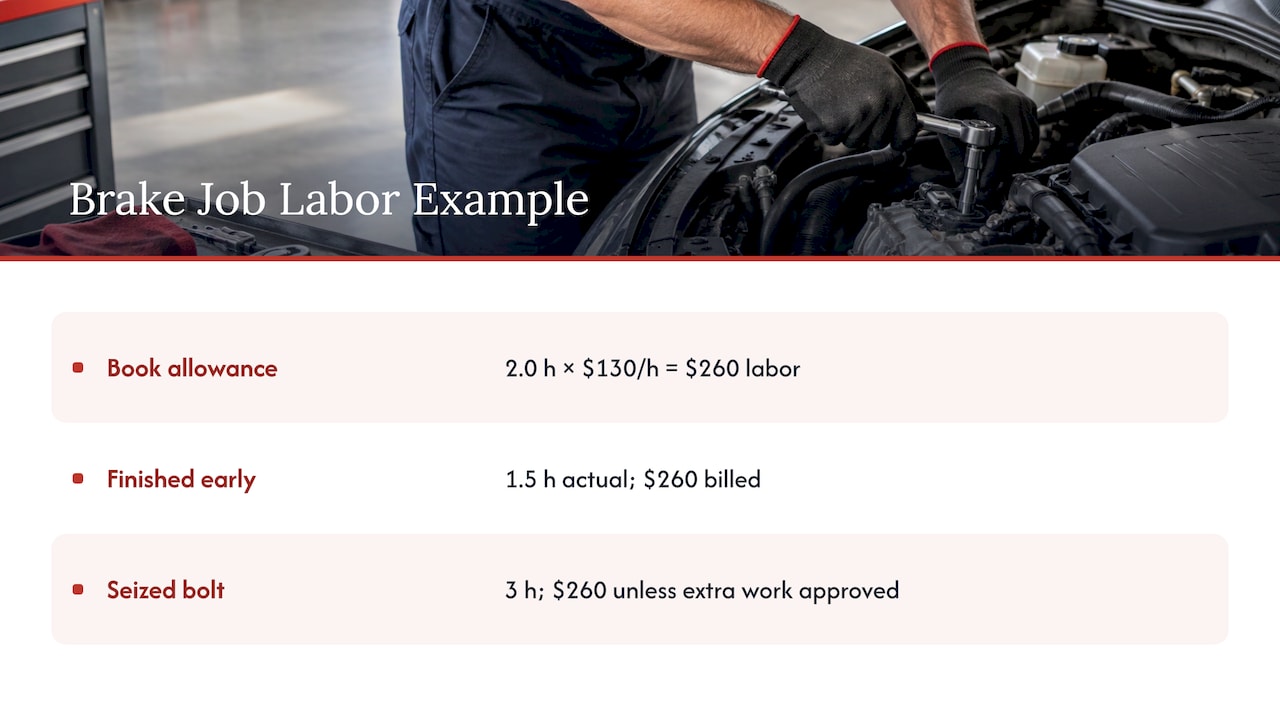
Suppose a quote lists 2.0 book hours for a rear brake job at $130 an hour. Labor is $260. If the technician finishes in 1.5 hours, you still pay $260, because the allowance is 2.0 hours. If a seized caliper bolt makes it take 3 hours, you should still pay $260 unless the shop called you, explained the extra work and got your approval first. The numbers here are an illustration, not a quote.
This also explains why two shops quoting the same repair differ. They may use different hourly rates, different labor-time guides, or add time for rust, tight access or extra parts that must come off first.
Why the hours on your quote can look odd
Shops often bill in tenths of an hour, and diagnostics may be charged as a flat fee or a block of time. If you see 4.3 hours on an invoice where you expected 4.1, ask which line items are included and whether any approved extra work was added. A good shop can answer in a sentence.
Reading a repair quote line by line
A clear estimate separates the pieces. Use this order when you read one:
- Labor rate and hours for each job. You should see both, not just a lump sum.
- Diagnostic charge. Find out whether it is applied toward the repair if you approve the work.
- Parts. Check whether they are OEM-quality, aftermarket or used, and the warranty on them.
- Fees and supplies. Shop supplies and disposal fees should be itemized or explained.
- Tax and total. Confirm the total matches the sum of the lines.
- Warranty. Labor and parts coverage, in months and miles.
Washington gives drivers specific protections here. According to the Washington Attorney General’s auto repair guidance, you are entitled to a written estimate for repairs expected to cost more than $100 when you deal face to face with the shop. Once you have an estimate, the shop may not charge more than 10% above it without your prior approval. You can also ask for your replaced parts back if you request it when you authorize the repair. Those rules are Washington’s, so check your own state’s consumer protection office if you live elsewhere.
For a longer walkthrough, see our guide on getting an accurate repair shop estimate in Lynnwood, and if you want to understand how shops explain a bill, how to explain repair costs clearly shows what a good explanation looks like.
Why a higher rate can cost less overall
The cheapest hourly rate does not always produce the cheapest bill. Three things decide the total.
Diagnosis accuracy. A shop with the right scan tools and trained technicians pinpoints a fault faster. A check engine light can come from dozens of causes, and replacing parts by guesswork costs you parts and hours. Our post on check engine diagnosis costs and the one on types of car diagnostic tests explain what the different tests involve.
Efficiency on the job. A technician who does a repair regularly, with the right tools, works to the book time or better. For a sense of how that looks from the shop floor, read about flat-rate efficiency.
Doing it once. Work backed by a solid warranty means a comeback costs you nothing. A lower rate with no coverage can end up costing more when the same repair is done twice.
Dealer, independent and specialty rates
Dealerships often charge more per hour because of their overhead and manufacturer-specific tooling. Independent shops are usually lower, and specialty work on European, hybrid or electric vehicles can carry a higher rate because of the equipment and training involved. If you are weighing the two, dealership versus independent shop lays out when each makes sense.
What typical jobs cost in labor and total
Published price ranges give a sense of how rate and hours combine. A guide from Zarla, citing RepairPal data from September 2026, lists typical U.S. prices: two billed labor hours at $240–$320, diagnostic fees of $80–$150 and brake pad replacement at $335–$394. These are national ranges across shops, so your local quote will differ.
Here are our published starting prices in Lynnwood:
| Service | Our listed price |
|---|---|
| Oil change | from $100 |
| Brake repair | from $280 per axle |
| AC repair | from $150 |
Other services, such as transmission service, timing belts, alternators and suspension work, are quoted for your specific vehicle. Brake time varies by car, and how long a brake job takes gives realistic ranges.
Questions to ask before you approve any repair
- What is your hourly labor rate, and does it differ for diagnostics or my type of vehicle?
- How many hours are you billing for this job, and where does that number come from?
- If the work takes longer than expected, will you call me before adding time?
- Is the diagnostic fee credited toward the repair?
- What warranty covers the parts and the labor?
- Can I see or keep the replaced parts?
A shop that answers these plainly is one you can work with. If a price still seems high, our piece on negotiating auto repair costs covers reasonable ways to bring it down, such as phasing non-urgent work. Keeping records helps too: documenting your repair history gives you something to point to when a shop proposes work you recently had done.
Our view on labor rates
Most arguments about labor rates are really arguments about trust. A customer sees a number per hour and cannot see the diagnostic tools, the training, the insurance, or the hours a technician spends on a job that does not go to plan. So we think the honest answer is to show the work.
That is why we use digital inspections and give upfront pricing before we start. You should know what is being done, what it costs and why. Our technicians are ASE-certified, we use professional-grade OBD-II diagnostics, and we back all our work with a 24-month / 24,000-mile warranty. Those things cost money to maintain, and they are what you are paying for when you pay for labor.
We have been family-owned and operated in Lynnwood since 1985. We work on Toyota, Honda, Subaru and domestic vehicles as well as European and hybrid models, and we would rather you understand your invoice than simply accept it. If a line does not make sense, ask us.
Shingi
Get a clear quote from a Lynnwood shop
If you want to see how a transparent estimate reads, we can walk you through ours. We offer upfront pricing, same-day appointments are often available, and every repair carries our 24-month / 24,000-mile warranty. We also offer discounts for military, seniors and first responders.
Start with the service you need, such as brake repair, an oil change or AC repair, or see everything we do on our main site.
FAQ
What is a normal labor rate for a mechanic?
In a September 2025 survey of nearly 700 U.S. shops, the most common average rate was $100–$119 an hour, and nearly half of shops charged $100–$139. About 3% charged over $200. Your local rate depends on your region, the type of shop and the vehicle.
Is $100 an hour fair for mechanic labor?
Yes, it falls inside the most common range reported in that survey. What matters more is the number of hours billed, the quality of the diagnosis and the warranty. Compare the whole quote, not just the hourly figure.
Why are mechanic labor rates so high?
The rate pays for far more than the technician’s wage. It covers payroll costs, training, diagnostic equipment, rent, insurance, software, service staff and a profit margin. In one published example, a $35 technician wage works out to a required rate of $210 once all of those costs are included.
Why did my bill show more hours than the repair took?
Many shops bill from a standard labor-time guide, so you pay the book allowance for the job whether the technician finishes early or late. If extra work was needed, the shop should have explained it and asked for your approval first. Ask to see the hours listed for each line.
Can a shop charge more than its estimate?
In Washington, once you receive an estimate, the shop may not charge more than 10% above it without your prior approval. Ask for the estimate in writing before work begins on anything over $100.
Sources
- Industry Insights: U.S. Auto Repair Shops and Labor Rate Trends, Ratchet and Wrench
- Callahan: The Math Behind Your Labor Rate, Ratchet and Wrench
- Lawsuit Shines Light on Little-Known Guidelines for Auto Repair, Los Angeles Times
- Book Time vs. Actual Time for Auto Repair Shops, ARI
- Auto Repair, Washington State Attorney General
- How Much Do Mechanics Charge per Hour in 2026?, Zarla
Recommended
- Mechanic Flat Rate Efficiency Tips to Maximize Pay
- How to Explain Repair Costs to Customers Clearly
- Hidden Car Repair Costs: Real Examples and How to Avoid Them
- How to Negotiate Auto Repair Costs and Pay Less
Leave a Reply