
3 Maintenance Buckets That Decide Hybrid vs Gas Costs, Plus Shop Tips
Routine maintenance on a hybrid and a gas car looks almost identical for the first several years, but the two diverge hard once you factor in brakes, high-voltage components, and what happens after the warranty runs out. A hybrid typically saves you money on brake wear and fuel, while carrying a smaller but real chance of an expensive electronics or battery repair down the line. Which one wins for you depends on your driving pattern and how long the manufacturer backs the battery. Keep reading for cost breakdowns, an inspection checklist, and buying advice.
TL;DR:
- Regular maintenance for hybrids and gas cars is largely the same, including oil changes, tire rotations, and filter replacements, regardless of drivetrain differences.
- Hybrids benefit from longer brake pad life due to regenerative braking but still require inspection of brakes, batteries, and electronics to prevent costly failures after warranty expiration.
- Maintenance costs for hybrids are generally similar or slightly lower, but high-voltage battery or inverter replacements outside warranty can cost thousands, making warranty length crucial.
- Severe usage conditions such as frequent short trips, towing, or extreme climates demand more frequent service for both hybrid and gas vehicles to prevent accelerated wear.
- Hybrid-specific repairs involve specialized diagnostics and equipment, often leading to higher labor rates, but such failures are rare and usually occur after the warranty period.
Table of Contents
- What Routine Maintenance Do Hybrids and Gas Cars Share?
- How Do Hybrid Brakes, Batteries, and Electronics Differ From Gas Systems?
- Is Hybrid Maintenance More Expensive Than Gas Maintenance?
- When Should You Follow the Severe-Usage Maintenance Schedule?
- Should You Buy a Hybrid or Gas Car Based on Maintenance?
- How Do Software Updates Affect Hybrid Maintenance?
- Does Cooling System Maintenance Differ Between Hybrid and Gas Vehicles?
- What Does Servicing Specialized Hybrid Components Actually Cost?
- How Do Climate and Driving Conditions Affect Hybrid vs Gas Upkeep?
- What Our Shop Sees: Tom’s B & M Auto’s Real-World Take
- How Tom’s B & M Auto Handles Hybrid and Gas Maintenance
- Sources
- FAQ
What Routine Maintenance Do Hybrids and Gas Cars Share?
Most hybrids on the road today, specifically standard hybrid electric vehicles (HEVs) and plug-in hybrids (PHEVs), still run a gasoline engine alongside the electric motor. That engine needs the same care any gas engine needs. The U.S. Department of Energy’s Alternative Fuels Data Center notes that PHEVs and HEVs require essentially the same general maintenance as conventional vehicles, since the electrical systems themselves typically need very little scheduled attention.
That means a hybrid owner isn’t skipping oil changes, and this is where a lot of new hybrid buyers get surprised. Here’s what stays on the calendar regardless of what’s under the hood:
- Engine oil and filter changes on the manufacturer’s interval, since the gas engine in an HEV or PHEV still burns oil the same way any four-cylinder does.
- Tire rotation and alignment, usually every 5,000 to 7,500 miles, unaffected by drivetrain type.
- Cabin and engine air filters, checked at each major service and replaced as needed.
- Coolant service, though hybrids often run a second cooling loop (more on that below).
- Transaxle or transmission fluid checks, particularly on continuously variable transmission (CVT) equipped hybrids.
- Suspension and steering inspections, since hybrid battery packs add weight that can accelerate bushing and strut wear.
The practical takeaway: don’t assume a hybrid badge means fewer trips to the shop. It mostly means the same trips, plus a few extra items specific to the electric side.
How Do Hybrid Brakes, Batteries, and Electronics Differ From Gas Systems?
The biggest mechanical difference is under the pedal, not under the hood. Regenerative braking uses the electric motor to slow the car and recharge the battery, which means the friction brakes do less work. The Department of Energy confirms that regenerative braking reduces wear on traditional friction brakes, and USA Today reports hybrid owners often see noticeably longer brake pad life, especially in stop-and-go city driving.
That doesn’t mean brakes get ignored. The full braking system, calipers, rotors, brake fluid, and the regenerative system’s software integration, still needs periodic inspection. Longer pad life is a savings, not a pass.
The traction battery is the part buyers worry about most, and it deserves a more measured view. Scheduled maintenance on the battery pack itself is minimal; there’s no fluid to top off or filter to swap on most systems. The risk isn’t routine cost, it’s a rare, expensive failure once the manufacturer’s battery warranty expires. Power electronics, including the inverter that converts battery DC power to the AC the motor uses, add another layer of diagnostic complexity that requires specialized scan tools and trained technicians rather than a wrench and a torque spec.
Some hybrids also use a belt-driven hybrid starter generator (HSG) that follows its own inspection interval, separate from a standard serpentine belt.
- Ask for a battery state-of-health scan during a pre-purchase inspection or test drive.
- Request a full brake system check, not just a pad-thickness measurement.
- Confirm the shop has hybrid-specific diagnostic equipment before assuming any general repair shop can handle an inverter fault.
Pro Tip: A battery health scan takes a technician a few minutes with the right scan tool, and it’s the single best way to catch a degrading hybrid battery before it becomes a five-figure surprise.
Is Hybrid Maintenance More Expensive Than Gas Maintenance?
Routine costs generally run about the same, sometimes lower. Cars that regular maintenance and normal wear and tear on a hybrid generally does not cost more than on a comparable gas vehicle. Add in the brake-life advantage and better fuel economy, and many hybrid owners spend less on the maintenance items they see every year.
Hybrid repair risk concentrates in the high-voltage battery and electronics, and that risk becomes financially serious once the vehicle is out of warranty, according to Cars.com.
That’s the whole story in one sentence: cheap and predictable most years, then potentially one large bill later. A battery pack or inverter replacement outside of warranty can run into the thousands, which is why the length of the manufacturer’s battery warranty matters more than almost any other spec sheet number when you’re comparing hybrid models.
Insurance adds a smaller wrinkle. Hybrid premiums can run modestly higher, largely because the vehicles themselves cost more to buy and their parts cost more to repair or replace after a collision.
The smartest way to think about hybrid ownership costs is in three separate buckets:
- Scheduled maintenance: oil, filters, tires, fluids. Predictable and often on par with or cheaper than gas.
- Ordinary wear and tear: brakes, belts, suspension components. Often cheaper for hybrids thanks to regenerative braking.
- Rare major failures: battery pack, inverter, power electronics. Low probability, high cost, and the reason warranty coverage matters so much.
If you’re the type who keeps a spreadsheet, that’s the spreadsheet. Budget for the first two buckets like you would with any car, and treat the third bucket as a warranty question, not a monthly expense. Unexpected repair bills aren’t unique to hybrids, either. Any vehicle can throw a curveball, which is worth remembering when you read about hidden repair costs that catch owners of gas cars off guard too.
When Should You Follow the Severe-Usage Maintenance Schedule?
Every owner’s manual, hybrid or gas, contains two maintenance schedules: normal and severe. Most drivers assume they qualify for “normal” without checking, and that assumption costs them. Kia’s owner manual guidance lays out specific intervals for both categories, including items like the HSG belt that need earlier inspection under tougher conditions.
Severe usage typically includes:
- Frequent short trips under five miles, especially in cold weather.
- Extended idling or stop-and-go traffic, common in dense city commutes.
- Driving on salted, dusty, or unpaved roads regularly.
- Towing or carrying heavy loads.
- Sustained high-heat or high-humidity climates.
If two or more of those describe your daily drive, check oil, HSG belt condition, spark plugs, drive axle boots, and brakes more often than the standard interval suggests. This applies whether you’re driving a hybrid or a gas car. The engine doesn’t care which fuel system feeds it when it’s idling in traffic for 40 minutes a day.
Pro Tip: Keep every service receipt and digital inspection report in one folder. Warranty claims and resale value both depend on proving the car was maintained on schedule, and a gap in your records can cost you leverage in both situations.
Should You Buy a Hybrid or Gas Car Based on Maintenance?
Run the three-bucket framework from earlier against your own driving habits before you decide. A hybrid tends to make the most financial sense for drivers who spend a lot of time in city traffic, where regenerative braking and better fuel economy do the most work, and who have access to a shop that actually handles hybrid diagnostics locally.
If you’re shopping used, the inspection list changes slightly from a standard gas car’s pre-purchase check:
- Request a battery health report, not just a visual inspection.
- Confirm whether the battery warranty transfers to a second owner and how many miles or years remain.
- Review the full service history, especially brake and coolant service intervals.
- Ask directly whether the battery warranty length and common failure points for that specific model, since these vary widely by manufacturer and model year.
Ask the seller or shop one more question before you sign anything: can a local shop actually diagnose this hybrid’s electronics, or does every issue require a dealer visit? That answer affects your long-term ownership costs more than almost anything else on this list.
How Do Software Updates Affect Hybrid Maintenance?
Hybrids run more onboard software than gas cars do, largely because the powertrain control module has to manage the handoff between the electric motor, the battery, and the internal combustion engine in real time. That software occasionally needs updating, and it’s becoming a routine part of hybrid ownership rather than an afterthought.
A firmware update can adjust how the regenerative braking system blends with the friction brakes, recalibrate battery state-of-charge readings, or fix a software bug tied to an unexpected warning light. Some manufacturers push these updates automatically over a cellular connection; others require a visit to a dealer or independent shop with the right diagnostic tools to flash the update manually.
Skipping a software update isn’t the same as skipping an oil change, but it isn’t harmless either. An outdated control module can misread battery health, trigger false warning lights, or fail to optimize the regenerative braking blend, which slowly increases wear on the friction brakes you were supposed to be saving. If your hybrid throws a warning light that clears itself after a restart, that’s often a sign a pending software update is worth checking into rather than ignoring.
This is one more reason hybrid-capable shops matter. A general repair shop can change your oil just fine, but not every shop has the manufacturer-level software access needed to check for and install a powertrain control update.
Does Cooling System Maintenance Differ Between Hybrid and Gas Vehicles?
Most hybrids run two separate cooling systems where a gas car only needs one. The first loop cools the internal combustion engine exactly like it would in any conventional car. The second loop cools the battery pack, inverter, and power electronics, components that generate their own heat and degrade faster when they run hot.
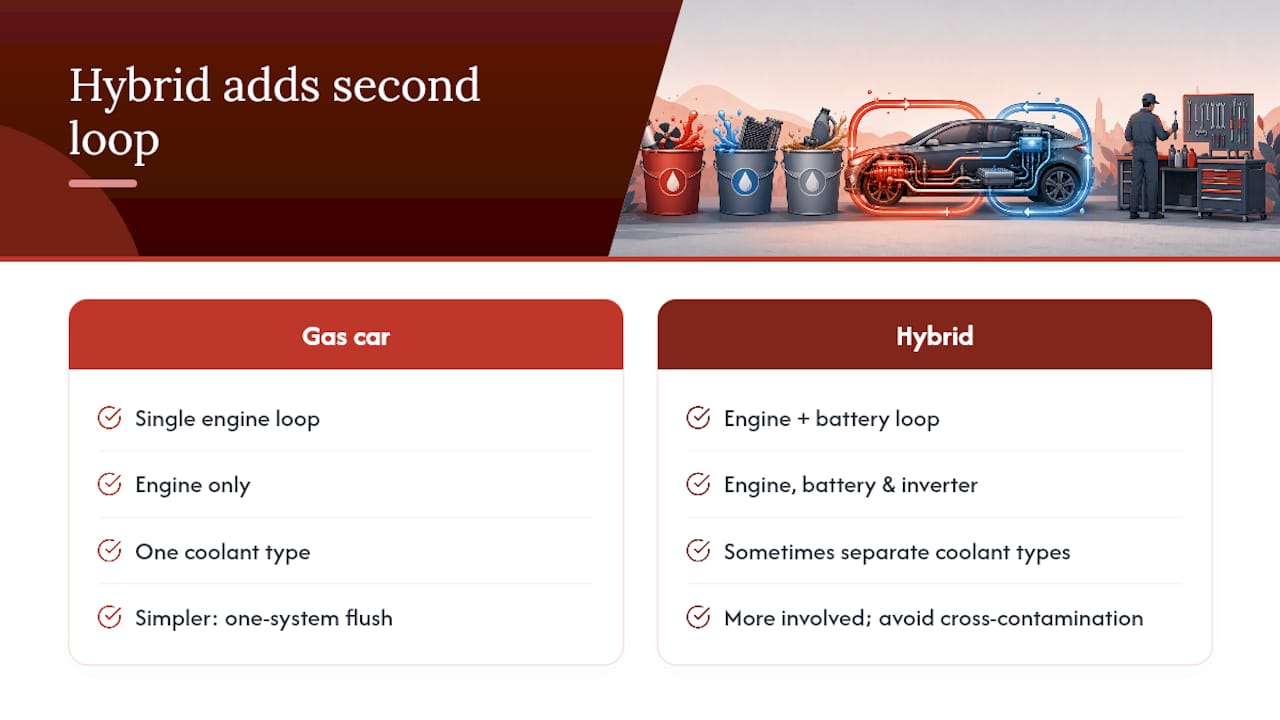
That second loop means more coolant to check, more hoses that can fail, and, in some cases, a completely separate coolant type that shouldn’t be mixed with the engine coolant. Topping off the wrong loop with the wrong fluid is a mistake even experienced do-it-yourself owners make, since the reservoirs can look similar under the hood.
Gas car cooling maintenance is simpler by comparison: one radiator, one thermostat, one coolant type, flushed on the interval your manual specifies. A cooling system flush matters on both vehicle types, but hybrid owners need a technician who knows which loop is which and won’t cross-contaminate the two systems during service.
The extra loop doesn’t necessarily mean extra scheduled visits. It means a slightly more involved job each time coolant service comes up, and it’s another reason hybrid-specific technician training matters more than it does for a basic gas engine flush.
What Does Servicing Specialized Hybrid Components Actually Cost?
Routine hybrid maintenance rarely costs more than gas car upkeep, but specialized components carry a different cost structure entirely. Diagnosing an inverter fault or a battery module issue takes specialized scan tools, manufacturer-specific training, and often more labor time than a comparable gas engine diagnosis, simply because there are more systems talking to each other.
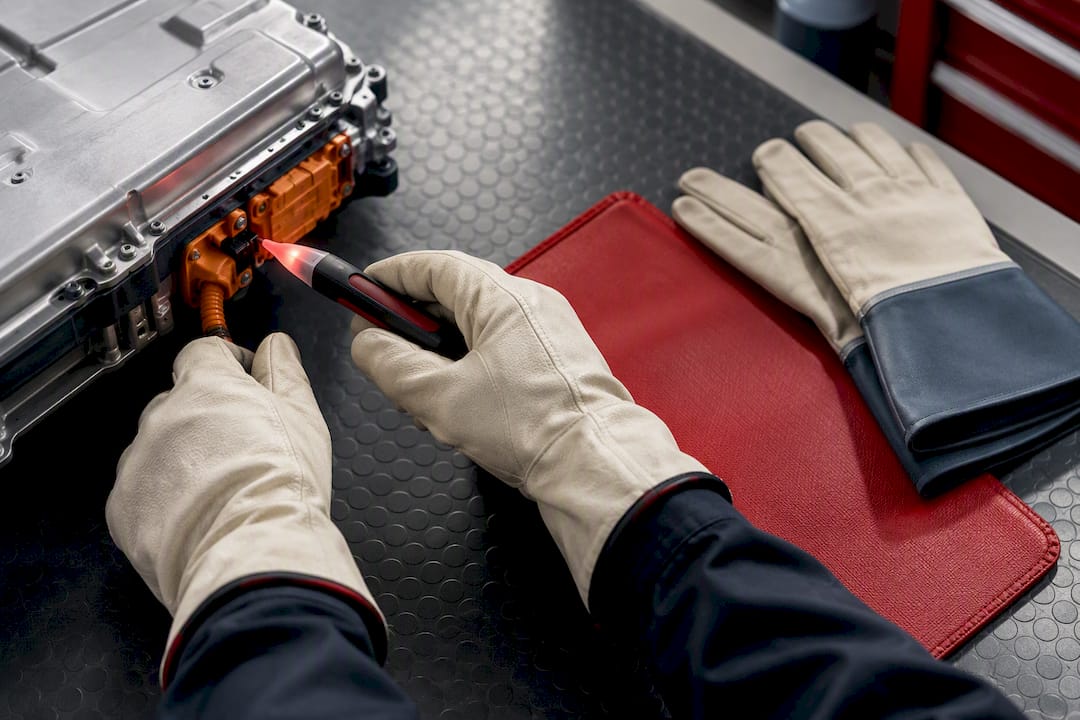
Labor rates for hybrid-specific work tend to run higher at shops that have invested in the equipment and ASE-certified technician training needed to work on high-voltage systems safely. That’s not a markup for the sake of it. High-voltage work requires specific safety protocols most general-service bays aren’t equipped to follow, and that training and equipment cost gets reflected in the labor rate.
The good news: most of these specialized costs are rare, not routine. A hybrid battery module or inverter replacement is the kind of expense that shows up once, if ever, over the life of the car, not every service interval. The bad news is that when it does happen out of warranty, the bill can be substantial, which circles back to why checking the manufacturer’s battery warranty length before you buy matters more than comparing sticker prices between two similar hybrid models.
How Do Climate and Driving Conditions Affect Hybrid vs Gas Upkeep?
Environment changes the maintenance math for both vehicle types, but it hits hybrids and gas cars a little differently. Extreme cold reduces battery efficiency in any hybrid, forcing the gas engine to run more often to generate heat and maintain battery temperature, which erodes some of the fuel savings and adds engine hours in weather where a gas car would run normally anyway.
Extreme heat is arguably tougher on hybrid components than cold. Sustained high temperatures accelerate degradation in the high-voltage battery pack and stress the power electronics cooling loop mentioned earlier. Owners in hot climates should pay closer attention to that second cooling system and shouldn’t skip battery health checks just because the car “feels fine.”
Salted roads, gravel, and dusty rural driving hit both vehicle types the same way: accelerated corrosion, more frequent filter changes, and earlier brake system inspections. Coastal humidity adds another layer of corrosion risk to electrical connectors, and that’s true whether the connector belongs to a gas car’s alternator or a hybrid’s power electronics module.
None of this means climate should dictate whether you buy a hybrid. It means your maintenance schedule should account for your actual environment, not the generic interval printed in the manual, which is exactly why the severe-usage schedule exists in the first place.
What Our Shop Sees: Tom’s B & M Auto’s Real-World Take
In our bays, hybrids show up more often for brake inspections early on and occasional electrical diagnostics later, but serious high-voltage failures stay rare and usually land after the factory warranty ends. Most routine work fits a general shop; battery or inverter concerns are when a specialty-capable shop earns its keep.
— Shingi
How Tom’s B & M Auto Handles Hybrid and Gas Maintenance
Whether you’re driving a hybrid or a straight gas car, the maintenance basics land in the same shop bay: oil changes, brake inspections, and scheduled service intervals. The shop has served local Toyota, Honda, Subaru, and domestic vehicle owners for many years, including hybrids alongside European and traditional gas engines.
Technicians run professional-grade OBD-II diagnostics on hybrid electronics and traction batteries, not just standard engine codes, and every job comes with upfront pricing before work begins. A 30k/60k/90k service covers the manufacturer-recommended checkpoints that keep both hybrid and gas warranties intact, and if your brakes need a look after years of regenerative braking, a brake repair inspection starts from $280 per axle. Routine oil changes start from $100 for the gas engine every hybrid still carries under the hood. Work is backed by warranty coverage, and discounts may be available for military, senior, and first-responder customers. Appointments may be available on the same day. Customers can book inspections or service online and receive clear information on needed repairs or maintenance.
Sources
Verify battery warranty terms in your owner’s manual, maintenance equivalence via DOE/AFDC guidance, and reliability data through Consumer Reports and Cars.com cost analysis.
- U.S. Department of Energy / AFDC guidance (via regulations.gov attachment)
- Cars
- Kia owner manual — maintenance under normal and severe usage
FAQ
Can a Hybrid Car Go Through a Carwash?
Yes, hybrids are sealed and engineered to handle rain, car washes, and normal water exposure without risk to the high-voltage system. Owners should still follow model-specific handling instructions and avoid probing or opening battery or electronic housings themselves.
Do Hybrids Have More Problems Than Gas Cars?
It depends on the type. Consumer Reports found that traditional hybrids tend to have fewer problems than gas-only cars, while plug-in hybrids and EVs together report more problems on average, so it matters which category you’re comparing.
What’s the Downside of Owning a Hybrid Car?
The main downside is concentrated risk in the high-voltage battery and power electronics, which can be expensive to replace once the vehicle is out of manufacturer warranty. Routine maintenance costs and fuel economy usually favor the hybrid; the risk shows up rarely, but when it does, it’s a large bill rather than a small one.
Which Car Lasts Longer, Hybrid or Gas?
Reliability varies significantly by model year and manufacturer rather than by drivetrain type alone. Non-plug-in hybrids have shown strong reliability records in Consumer Reports surveys, and a well-maintained hybrid or gas car from a reputable shop like Tom’s B & M Auto can both reach high mileage with proper scheduled care.
Recommended
- Common Hybrid Vehicle Service Needs: 2026 Owner’s Guide
- Hybrid Battery Service Explained: 2026 Owner’s Guide
- High Mileage Vehicle Maintenance Tips That Work
- Hidden Car Repair Costs: Real Examples and How to Avoid Them
Leave a Reply