
Fleet Maintenance Checklist: Turn 4 Clocks Into Closed Work Orders
A fleet maintenance checklist is an interval and system based inspection plan that only works if every line item connects to a recurring work order and a named owner. Skip that link, and the checklist becomes a form nobody follows. Done right, it covers daily driver checks, weekly and monthly mechanic reviews, and the deeper annual service that keeps trucks legal, safe, and on the road.
TL;DR:
- Linking each maintenance checklist item to specific work orders and owners ensures tasks are completed and documented effectively.
- Regularly updating defect severity logs with color codes helps prioritize repairs and prevents overlooked issues before they escalate.
- Converting checklists into automated work orders based on mileage, time, or usage triggers reduces human error and guarantees timely servicing.
- Proper parts inventory management with minimum stock levels and usage tracking prevents delays caused by unavailable parts on the shop floor.
- Tracking key performance indicators such as PM completion rate and mean time between failures provides real insight into the program’s effectiveness and necessary adjustments.
Table of Contents
- Fleet Maintenance Checklist Structure: Daily, Weekly, Monthly, Annual
- The System-by-System Master Checklist Technicians Actually Use
- How to Turn Your Checklist Into Real Work Orders
- Parts and Inventory Practices That Cut Turnaround Time
- The KPIs That Tell You Whether Your Program Is Working
- What This Looks Like on Tom’s B & M Auto’s Floor
- What Actually Breaks Fleet Maintenance Programs
- Get Your Fleet’s Maintenance Handled by a Shop That Documents Everything
- Sources
Fleet Maintenance Checklist Structure: Daily, Weekly, Monthly, Annual
The strongest fleet preventive maintenance checklist runs on four overlapping clocks, each with a different owner and a different level of scrutiny. Downloadable templates almost universally follow this same daily/weekly/monthly/annual grouping, paired with defect logs, severity ratings, and a signature field so nothing gets lost between shifts, according to the free fleet maintenance checklist model from MapTrack.
- Daily driver pre-trip checks. The driver inspects tires, lights, mirrors, wipers, fluid levels, horn, and brakes before the key turns, following a detailed semi truck inspection checklist to ensure safety and compliance. Any critical defect (bad brakes, missing lights, steering play) grounds the vehicle immediately. Every driver signs a Driver’s Vehicle Inspection Report, which doubles as your audit trail if a regulator or insurer ever asks.
- Weekly supervisor checks. A shift lead or dispatcher spot-checks fluid top-offs, tire pressure trends, and any defect the driver flagged but didn’t require immediate grounding. The supervisor signs off, closing the loop between what the driver saw and what got fixed.
- Monthly mechanic checks. A technician measures brake pad depth, tread wear in 32nds, battery voltage, and belt tension, then logs the actual numbers, not just pass or fail. Numbers reveal a slope; a checkbox only shows a snapshot.
- Quarterly and annual deep service. This is where you rotate fluids, replace filters on schedule, and run the state or DOT inspection paperwork. Build a field for the inspector’s signature and certification number directly into the record, since that’s what an auditor will ask for first.
Pro Tip: Color-code the severity of any logged defect (green, yellow, red) so a supervisor scanning ten DVIRs in thirty seconds knows exactly which vehicle needs attention before the next dispatch.
The System-by-System Master Checklist Technicians Actually Use
Interval schedules tell you when to look. This is what to look at once the vehicle is on the lift. A thorough vehicle maintenance guide for technicians groups checks by system, not by calendar, because that’s how a mechanic actually diagnoses a truck.
- Engine and oil: oil level and condition, filter status, belt and hose cracking, visible leaks under the vehicle, and a full diagnostic trouble code scan with an OBD-II reader.
- Brakes: pad and rotor thickness against manufacturer minimums, air chamber function on air-brake trucks, and confirmation the ABS warning light behaves correctly on startup. This is one of the few systems where a marginal reading today becomes a grounded vehicle next week, so detailed brake component checks deserve more time than a glance.
- Tires and wheel ends: cold PSI against the door-jamb spec, tread depth, irregular wear patterns that hint at alignment problems, lug nut torque to spec, and a hand check on hub temperature for bearing wear.
- Electrical and lighting: battery terminals and voltage under load, alternator output, and every exterior light, from headlamps to marker lights to brake lights.
- Safety equipment: fire extinguisher charge, reflective triangles, first aid kit contents, and seatbelt function.
- Exhaust and aftertreatment: visible smoke color, DEF fluid level on diesel units, and any check-engine code tied to emissions components, since the EPA’s inspection and maintenance program guidance increasingly ties emissions compliance to routine service, not a once-a-year test.
Cross-reference active recalls against your VIN list during any system check; the NHTSA recalls database catches issues a visual inspection never will. Fleets running European models should also budget extra diagnostic time, since European brake systems often use different bleeding procedures and sensor logic than domestic trucks.
How to Turn Your Checklist Into Real Work Orders
A checklist sitting in a binder doesn’t fix anything. The gap between fleets that run smoothly and fleets that don’t usually comes down to whether checks get converted into tracked, closed work orders, and that’s the biggest mistake shops make when they treat maintenance as paperwork rather than an execution system, according to MapTrack’s fleet checklist guidance.
- Map every line item to a PM tier. PM-A covers light, frequent checks (fluids, tires, lights). PM-B adds intermediate service (brake inspection, filter changes). PM-C is the comprehensive annual overhaul, according to FleetService365’s PM guide.
- Set triggers by mileage, engine hours, or date, whichever comes first. A delivery van and a long-haul truck wear out on completely different clocks, and a one-size-fits-all interval fails the moment your fleet mixes duty cycles.
- Generate the work order automatically when a trigger fires. No PM should depend on someone remembering; the system should push it.
- Close the loop with a named approver. Someone signs that the work happened, the parts got recorded, and the vehicle is cleared.
- Layer in telematics for the gaps between scheduled service. Usage-based PM combined with digital DVIRs measurably cuts unplanned breakdowns, and telematics can auto-generate a work order the moment a fault code fires between scheduled intervals, according to UpKeep’s fleet maintenance research. Scheduled PM handles predictable wear; telematics catches what the calendar can’t.
A CMMS ties all five steps into one auditable record, which is exactly what you want on hand if a lease company, insurer, or regulator ever asks how a specific vehicle has been maintained.
Parts and Inventory Practices That Cut Turnaround Time
Nothing kills a maintenance schedule faster than a truck sitting on a lift waiting for a part that should have been in the bin. Fleets that classify their most frequent SKUs (filters, brake pads, belts, bulbs) and set minimum stock levels based on actual usage and vendor lead time avoid that entirely.
- Tie inventory to the work order system so parts reserve automatically the moment a PM gets scheduled, not the day the technician shows up.
- Track purchase history and turnaround KPIs together; a rising average repair time often signals a stocking gap before anyone notices it in the parts room.
- Keeping adequate stock of frequently used parts, organized by system, meaningfully cuts vehicle turnaround time compared to ordering reactively, according to Chevin Fleet’s preventive maintenance research.
- Log invoice numbers and part serials on every OEM or warranty-covered replacement; that record is the only thing that gets a warranty claim approved months later.
The KPIs That Tell You Whether Your Program Is Working
A checklist without metrics is a guess dressed up as a process. Fleet managers should track five numbers, ideally on a rolling trend line rather than a single month’s snapshot, since one bad week doesn’t mean the program failed.
- PM completion rate: the share of scheduled PMs actually finished on time.
- Preventive versus reactive ratio: industry guidance often points toward a high preventive-to-reactive split as a healthy target, though the right ratio shifts with vehicle age and duty cycle, according to UpKeep’s benchmark data.
- Mean time between failures (MTBF): a falling MTBF on a specific vehicle usually means it’s approaching a replacement decision, not another repair.
- Maintenance cost per mile: the number that actually justifies a fleet’s budget to ownership.
- Turnaround time: how long a vehicle sits out of service per repair event.
Minimum record fields for every service event: vehicle ID, date, mileage or hours, technician name, parts used with serials, and defect severity. That’s the bare set an auditor or insurer will expect to see.
What This Looks Like on Tom’s B & M Auto’s Floor
A daily check on a shop fleet truck last month flagged a yellow-severity brake pad reading at 4mm. The PM-A work order that followed caught it before it became a roadside failure. That’s the whole point of the system: small numbers logged consistently catch problems while they’re still cheap to fix.
The technicians run every inspection with OBD-II diagnostics and back the work with a warranty, so fleet owners get a documented record, not just a verbal “it’s fine.” For readers building out their own driver-facing checklist, our car safety inspection guide covers the same daily items in plain language for non-mechanics.
What Actually Breaks Fleet Maintenance Programs
Most checklists fail from neglect, not design. Drivers rush pre-trips, supervisors skim signatures, and defects get logged but never routed to a work order. The fix is boring but effective: nobody dispatches a vehicle with an unresolved red-severity item, no exceptions, ever.
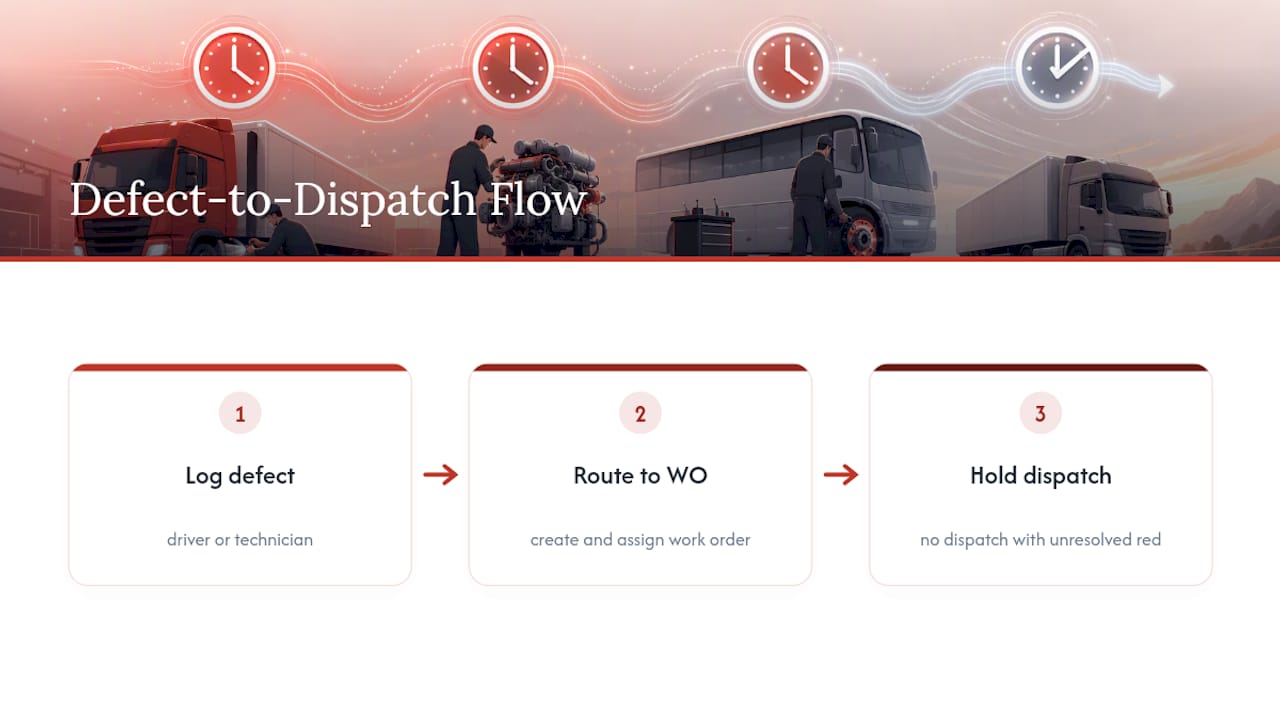
We once caught a leaking wheel seal during a routine PM-B that a driver’s pre-trip missed entirely. It got parked that afternoon instead of stranding a route the next morning.
Pro Tip: Tie a small, visible incentive to zero-defect pre-trip streaks. Drivers comply with checklists they feel ownership over, not ones that just feel like extra paperwork.
— Shingi
Get Your Fleet’s Maintenance Handled by a Shop That Documents Everything
Running this system in-house takes real discipline. If your team doesn’t have the bandwidth to chase down PM schedules, log defect severity, and keep parts inventory synced with work orders, a trusted auto repair shop can handle that entire operational layer for local fleets, backed by a documented warranty on every repair.
Our technicians already run the diagnostics and recordkeeping this guide describes, including fleet auto repair support for local businesses that would rather hand off PM scheduling than manage it themselves. Same-day appointments are often available when a vehicle can’t wait, and we work on domestic, hybrid, and European makes alike. Larger fleet projects, like planned engine work or multi-vehicle overhauls, can also be financed through our financing options rather than hitting your budget all at once.
Start with a free digital vehicle inspection on one truck and see the documentation for yourself before committing your whole fleet to a new process.
Sources
- Fleet maintenance best practices to reduce downtime — UpKeep
- Free fleet maintenance checklist — MapTrack
- Driver’s Vehicle Inspection Report — FMCSA (DVIR form)
Recommended
- Shop Safety Checklist for Mechanics: 2026 Guide
- Mechanic Flat Rate Efficiency Tips to Maximize Pay
- Seasonal Car Maintenance Checklist for Every Season
- How to Write Accurate Repair Order Notes That Work
Leave a Reply