
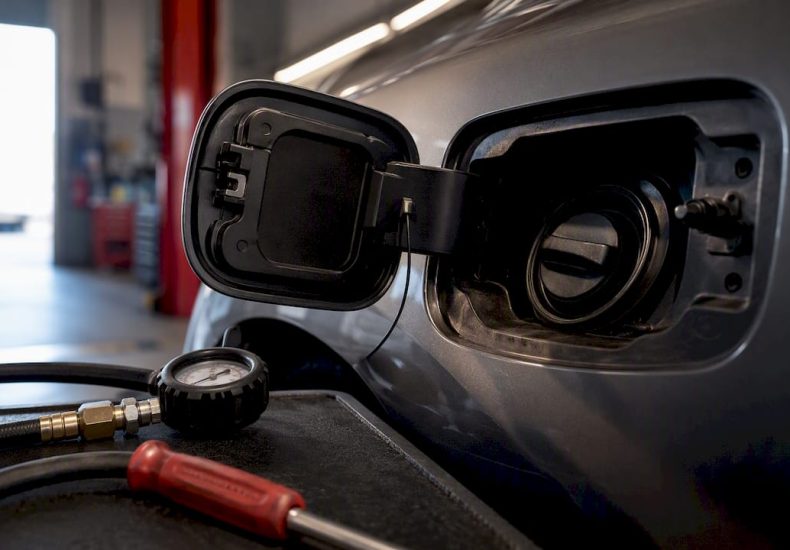
Most EVAP Leaks Fix for $5–$15, Symptoms and Shop Steps for Drivers
A steady check engine light plus a faint fuel smell near the gas cap is the classic EVAP-system leak presentation. Start by tightening or replacing the gas cap, then scan for OBD-II codes before you do anything else. A strong gasoline smell is different: stop driving, ventilate the car, and get it inspected. If the scan returns P0442 or P0455, you’re ready to move into targeted diagnostics rather than guessing at parts.
TL;DR:
- Most EVAP leaks are caused by worn gas caps, with cracked or hardened seals being the primary culprit for small leaks.
- A persistent strong fuel smell indicates a large leak and requires immediate attention, while a faint smell often signals a minor issue.
- Diagnosing EVAP system leaks involves checking the gas cap, reading OBD-II codes, testing purge and vent valves, and performing a smoke test if needed.
- Repair costs are typically low for gas cap replacements but can escalate for hose, valve, or canister replacements, with a smoke test costing around $80 to $120.
- Ignoring small leaks generally doesn’t affect driveability but will cause emissions test failures and gas odors, so prompt diagnosis is advised.
Table of Contents
- Evap Leak Symptoms: What Drivers Actually Notice
- What Causes an EVAP Leak in the First Place
- EVAP Codes Explained: What P0442 and P0455 Really Mean
- How to Diagnose an EVAP Leak, Step by Step
- Is It Safe to Drive With an EVAP Leak?
- When to See a Mechanic: Costs, Time, and What to Ask
- Why Tom’s B & M Auto Runs Every EVAP Diagnostic the Same Way
- What Most EVAP Advice Gets Wrong
- Get Your EVAP System Diagnosed the Right Way
- Sources
- FAQ
Evap Leak Symptoms: What Drivers Actually Notice
The trouble with EVAP leak symptoms is that most of them are quiet. You won’t feel a shudder or hear a knock. The car mostly drives the same, which is exactly why so many owners ignore the warning light for weeks.
The check engine light is the primary tell, and how it behaves matters. A steady light usually means the computer detected a fault that isn’t an immediate danger. A flashing light means something else entirely, often a misfire, and calls for prompt attention regardless of EVAP status. Some newer dashboards go a step further and display a “check fuel cap” message directly, which is about as close to a diagnosis as your car will ever hand you for free.
Fuel odor is the second big signal, and its intensity roughly tracks leak size. A faint whiff near the fuel door after fueling up often points to a small leak, maybe a worn cap seal or a hairline crack in a vapor hose. A strong, persistent gasoline smell inside or around the car is a different animal and should be treated as a safety issue, not a curiosity.
Beyond the light and the smell, a few smaller clues tend to show up:
- A minor drop in fuel economy, since the system isn’t managing vapor recovery the way it’s designed to.
- The fuel pump nozzle clicking off early or repeatedly when you’re filling the tank, a sign the tank isn’t venting correctly.
- An outright failure at the emissions or smog inspection station, sometimes the first time an owner learns anything is wrong.
- A gas cap that no longer clicks tight or that you can turn indefinitely without resistance.
Which of these need action today? A strong fuel odor, always. A steady light with a faint smell can usually wait a few days for a scheduled diagnostic, though there’s no upside to waiting long. If you’re only seeing a fuel-economy dip with no light at all, that’s worth watching rather than panicking over.
What Causes an EVAP Leak in the First Place
Small evap leak causes and large ones tend to start in different places, which is useful to know before anyone starts throwing parts at the problem. The system runs on rubber, plastic, and rubber seals, and all three age differently.
The gas cap is the most common offender by a wide margin. The rubber O-ring hardens and cracks with age and heat cycling, and it stops sealing against the filler neck. Non-OEM replacement caps are a frequent repeat offender here too, since some aftermarket caps don’t seal to spec. Replacing a cap degraded by a cracked or hardened O-ring costs about $5 to $15 and fixes a surprising share of small-leak codes on its own.
Past the cap, the usual suspects are:
- Vapor hoses that crack, harden, or chafe against brackets and heat shields over time.
- Quick-connect fittings that lose their seal, especially on vehicles that have seen a lot of heat cycles.
- A purge valve that sticks open when it should be closed, or a vent valve that won’t seal, both of which need to hold vacuum reliably to pass the monitor.
- A charcoal canister that develops hairline cracks in its housing.
- Filler neck corrosion, common on older vehicles that see a lot of road salt.
- Fuel tank seams or seals that degrade, which is rarer but shows up on higher-mileage vehicles.
The pattern worth remembering: rubber and gaskets fail first, then valves, then metal and plastic housings. That order is also roughly how a good technician works through the inspection.
EVAP Codes Explained: What P0442 and P0455 Really Mean
The two codes drivers see most often describe leak size, not leak location, and that distinction trips up a lot of people trying to self-diagnose.
P0442 means a small leak has been detected. It’s the evap system’s way of flagging something as minor as a degraded gas cap, a cracked hose, or a marginal purge or vent valve. Modern EVAP monitors are sensitive enough that an opening as small as 0.020 inches, about half a millimeter, can trip the code. That’s why P0442 symptoms are usually limited to the light itself, at most a faint odor, with no real drivability impact.
P0455 is the opposite end of the scale: a large leak. This usually traces back to something more obvious, like a torn hose, a cracked canister, or damage to the filler neck itself. P0455 symptoms tend to include a stronger, more noticeable fuel smell, and the leak is typically easy to find once you get a smoke machine on the system. If you’re wondering how to fix P0455, the honest answer is that the fix depends entirely on what the smoke test reveals, since the code only tells you the leak is big, not where it lives.
A few related codes are worth knowing:
- P0446 points to a vent path restriction, often a stuck or clogged vent valve.
- P0443 flags a purge control valve circuit fault, an electrical issue rather than a leak itself.
- Various sensor codes can mimic EVAP symptoms when a fuel level sensor or pressure sensor reports bad data to the computer.
Freeze-frame data (what the engine was doing when the code set) and readiness monitor status both matter here. A tech pulling that data can often narrow the search before a wrench ever touches the car.
How to Diagnose an EVAP Leak, Step by Step
This is the order a shop actually works in, and it’s worth following at home before you assume the worst.
- Check and replace the gas cap first. It’s the cheapest possible fix and the most common cause, so ruling it out costs you next to nothing. Make sure it clicks fully and inspect the rubber seal for cracking or hardness.
- Read the codes with an OBD-II scanner. Note the exact code, plus freeze-frame data like fuel level and engine temperature at the time the fault set. This is also where you’ll see if the monitor itself hasn’t completed a full test cycle, which changes the diagnostic approach.
- Test the purge and vent valves. A technician can command these open and closed with a scan tool and watch for the expected vacuum response. A valve that won’t seal, or won’t open, is a common culprit and usually means replacement rather than repair.
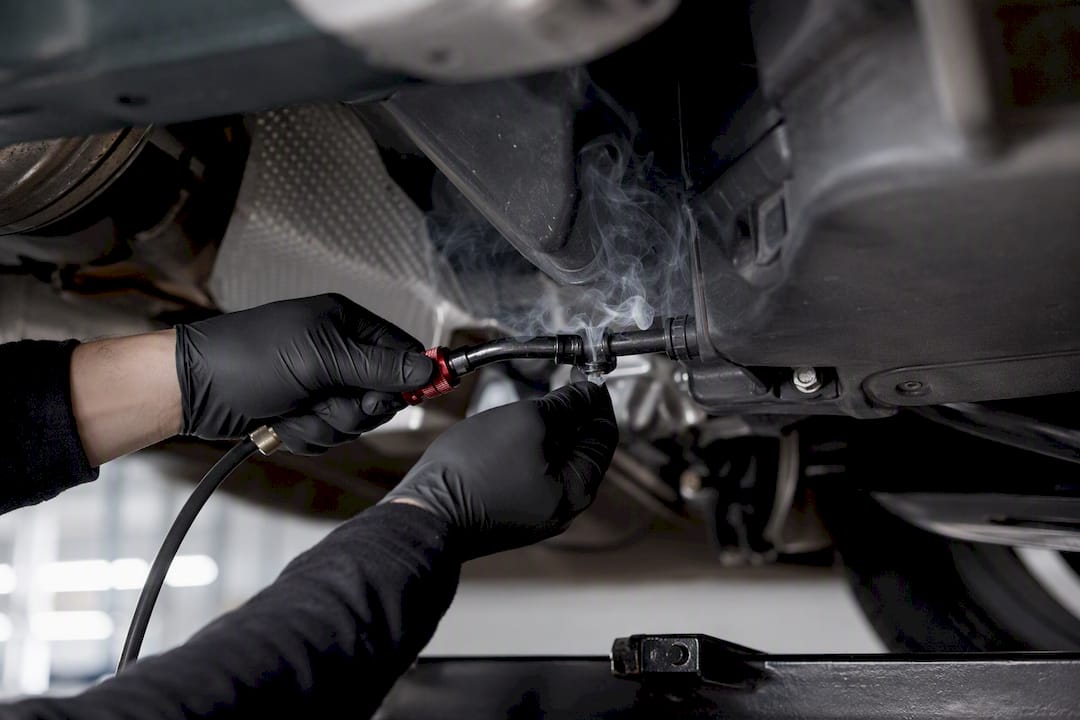
- Run a smoke test if the leak still isn’t obvious. This is the only reliable way to catch pinhole leaks that hide from visual inspection and simple component tests. The system gets pressurized with a visible smoke, and any leak point shows up as a stream escaping from a hose, seam, or connector. Shops typically charge $80 to $120 for a smoke test, while DIY smoke machines run $50 to $150 if you want to try it yourself.
Pro Tip: Note your fuel level before a smoke test. Some EVAP monitors only run reliably within a certain fuel range, and a tank that’s too full or too empty can produce a false pass or a false leak reading.
Some points genuinely call for a shop rather than a driveway. Tank removal, canister replacement, and any repair requiring access behind the fuel tank or welded fittings fall outside what most home mechanics should attempt, both for safety and because the labor to remove and reinstall those components is not trivial.
Is It Safe to Drive With an EVAP Leak?
Small leaks are generally driveable. The engine runs the same, fuel delivery isn’t affected, and there’s no mechanical risk to continuing your commute. What you will run into is a failed emissions or smog inspection, since the readiness monitor won’t clear until the leak is fixed and the system completes its test cycle.
A strong fuel smell is a different matter entirely. Gasoline vapor is flammable, and a persistent strong odor means you should stop driving, ventilate the car, and get it looked at rather than hoping it clears up.
A few quick reference points:
- Faint smell, steady light, normal drivability: schedule a diagnostic soon, no emergency.
- Strong smell at any point: stop driving and ventilate immediately.
- “Monitor not complete” on a scan tool means the system hasn’t finished its self-check yet, which can delay confirming a repair worked, even after the fix is done.
When to See a Mechanic: Costs, Time, and What to Ask
Diagnostic fees for an EVAP concern typically start with a scan, then move to a smoke test if the source isn’t obvious, running roughly $80 to $120 for that test alone. From there, repair costs vary widely depending on what’s actually broken:
- Gas cap replacement: $5 to $15 in parts, often done on the spot.
- Purge or vent valve replacement: moderate parts cost plus labor, usually a same-day job.
- Hose replacement: inexpensive parts, though labor time depends on how buried the hose is.
- Charcoal canister replacement: pricier than a hose or valve, and access varies by vehicle.
Most EVAP repairs are same-day work once the leak is identified. What stretches a job into multiple days is usually parts availability, not labor complexity, particularly on older or less common vehicles where a canister or filler neck has to be ordered in.
Before you approve any repair, ask for three things: a documented smoke-test result showing exactly where the leak was found, the specific part numbers being replaced, and the warranty terms on both parts and labor. A shop that can’t produce a smoke-test result probably didn’t run one, and that matters if the code comes back a month later.
Why Tom’s B & M Auto Runs Every EVAP Diagnostic the Same Way
Tom’s B & M Auto has been diagnosing drivability and emissions issues in Lynnwood since 1985, and EVAP faults follow a consistent workflow rather than guesswork.
- Family-owned and operated since 1985, with ASE-certified technicians running the diagnostics.
- Professional-grade OBD-II scanning to pull the exact code, freeze-frame data, and monitor status before anything gets touched.
- A digital inspection process, followed by component function tests on the purge and vent valves, then a smoke test only when the leak isn’t already obvious.
- Every repair backed by a 24-month/24,000-mile warranty, regardless of make or model.
Shingi, who writes the shop’s repair guides, covers this workflow because it reflects how the shop actually approaches every EVAP case that comes through the bay.
What Most EVAP Advice Gets Wrong
The internet’s default advice on EVAP leaks is “replace the gas cap and see what happens.” That’s not wrong exactly, since the cap really is the most common cause, but treating it as a universal fix ignores how often the real problem is a valve that’s failed intermittently. A vent valve that seals fine at idle but leaks under thermal cycling won’t show up on a five-minute driveway check.
The bigger gap is how casually people treat the “just drive it” answer. Yes, most EVAP leaks are safe to keep driving on. But that advice quietly skips two things: the emissions test you’ll fail with the light on, and the possibility that a code labeled “small leak” is actually masking a valve that’s about to fail completely.
If you take one thing from this: don’t skip straight to parts. Scan first, test components second, smoke test third. That order saves money and actually finds the leak instead of guessing at it.
— Shingi
Get Your EVAP System Diagnosed the Right Way
Tom’s B & M Auto is the practical alternative to guessing at parts or living with a lit check engine light: a documented scan, valve testing, and a smoke test if needed, all under one visit with upfront pricing before any work starts.
Appointments may be available the same day, and repairs typically include a warranty on parts and labor. If you’re seeing a steady check engine light or catching a faint fuel smell after fill-ups, bring it in for a proper diagnostic and written estimate before the emissions test catches it for you. Our team will run the scan, check the valves, and only recommend a smoke test if the leak isn’t already obvious, so you know exactly what you’re paying for before you approve a single repair.
Sources
- Risky EVAP leak — FoxwellDiag
- P0442 – Evaporative Emission System Leak Detected (small leak) — RepairPal
- P0442 — Meaning, Causes & Fix (Expert-Reviewed) | OBDadvisor
- P0442 – Evaporative Emission System Leak Detected (small leak) — AutoDTCs
FAQ
Is It Expensive to Fix an EVAP Leak?
Not usually. Many EVAP leak symptoms trace back to the gas cap, which costs $5 to $15 to replace. More involved repairs like a purge valve or canister cost more in parts and labor, but a diagnostic smoke test itself typically runs $80 to $120 at a shop.
What Is the Most Common Cause of an EVAP Leak?
A worn or cracked gas cap seal is by far the most frequent cause of EVAP leak codes, including P0442. Cracked vapor hoses and failing purge or vent valves are the next most common culprits.
Can I Still Drive With an EVAP Leak?
Yes, in most cases. Small leaks generally don’t affect drivability, though the vehicle will fail an emissions inspection until it’s fixed. A strong, persistent fuel smell is different and means you should stop driving and have it checked right away.
Where Is the Most Common Spot for an EVAP Leak?
The gas cap and its seal are the single most common leak point, since the rubber degrades with age and heat. Cracked hoses near the fuel tank and worn purge or vent valve seals are the next most likely spots technicians check.
Recommended
- Scan First: VW EPC Light Causes and $15–$50 Fixes
- Car Owners: 5 AC Refrigerant Leak Symptoms That Require a Shop Visit
- Power Steering Fluid Leak: EPS vs Hydraulic Checks and $15–$200 Costs
- $160–$700 to Fix? Valve Cover Gasket Leak Checks for Car Owners
Leave a Reply