
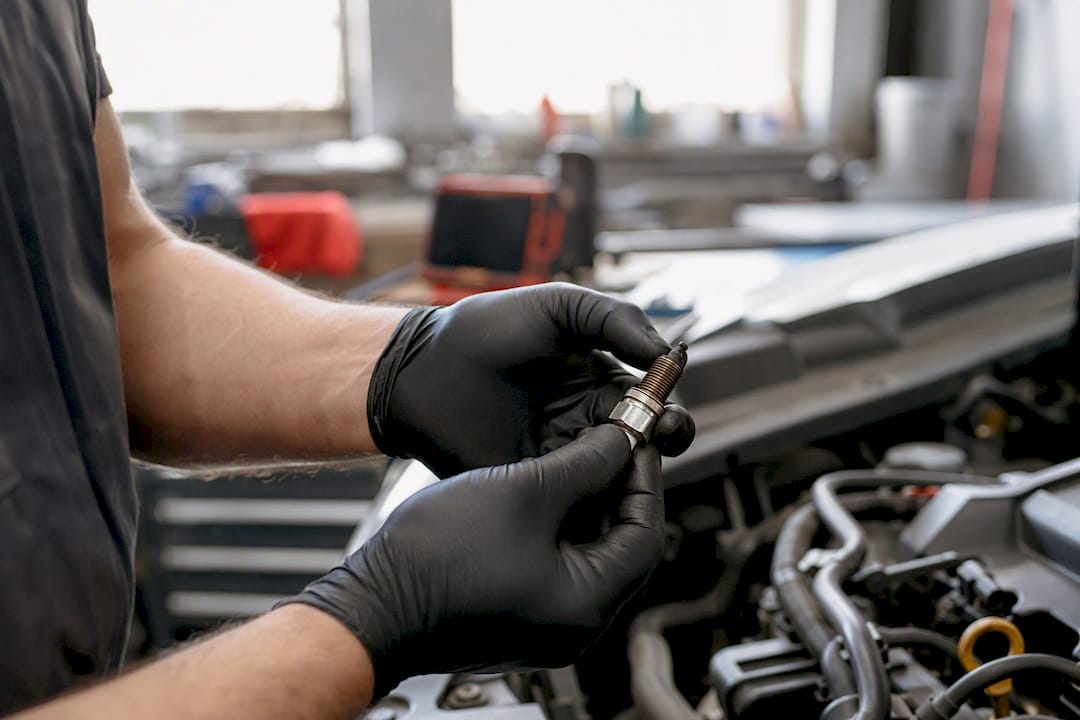
Engine Misfire Repair Cost: What You’ll Actually Pay in 2026
Most ignition-related misfires cost $150 to $500 to fix in the United States. That covers the majority of cases: worn spark plugs, a failed ignition coil, or a loose vacuum hose. Fuel injector problems, vacuum leaks that reach deep into the intake, or mechanical failures like a timing chain or head gasket push the bill much higher, often $600 to $2,500 or more.
The first move should never be guessing at parts. A proper diagnostic scan typically runs $60 to $180 and tells a technician which cylinder is misfiring and why, before anyone replaces a single component.
- Ignition-related fixes (plugs, coils): $150–$500
- Fuel or vacuum-related fixes: $300–$900
- Mechanical failures (head gasket, timing): $800–$2,500+
- Diagnostic fee before any repair: $60–$180
A flashing check-engine light means the misfire is active and severe enough to risk destroying your catalytic converter quickly. If that light is flashing, get the car looked at immediately rather than driving on it.
Key Takeaways
Fixing an engine misfire correctly starts with a diagnostic scan, not a parts purchase, and that single step determines whether your total bill lands in the hundreds or the thousands.
| Point | Details |
|---|---|
| Typical ignition-related cost | Most spark plug or single-coil misfires cost $150 to $500 total, parts and labor. |
| Diagnostics come first | A scan costs $60 to $180 and identifies the exact cylinder and likely cause before parts are ordered. |
| Mechanical failures cost more | Head gasket or timing chain repairs commonly run $800 to $2,500 or higher. |
| Delay is the real cost multiplier | Ignoring an active misfire can destroy a catalytic converter, adding $1,500 to $3,000 to the bill. |
| Where to get it checked | Tom’s B & M Auto uses ASE-certified technicians and OBD-II diagnostics, backed by a 24-month, 24,000-mile warranty on repairs. |
Table of Contents
- What Determines Your Engine Misfire Repair Cost
- How Much Does a Misfire Diagnosis Cost?
- Real Repair Scenarios and What They Cost
- Can You Drive With an Engine Misfire?
- What to Expect From a Reputable Repair Shop
- Ways to Lower Your Repair Bill
- What Most Cost Guides Get Wrong
- Get a Clear Diagnosis Before You Pay for Parts
- Sources
What Determines Your Engine Misfire Repair Cost
The cause of the misfire matters more than the symptom. A rough idle from worn plugs and a rough idle from a cracked fuel injector can feel identical to the driver, but the repair bills sit at opposite ends of the scale. Here’s how the major causes break down.
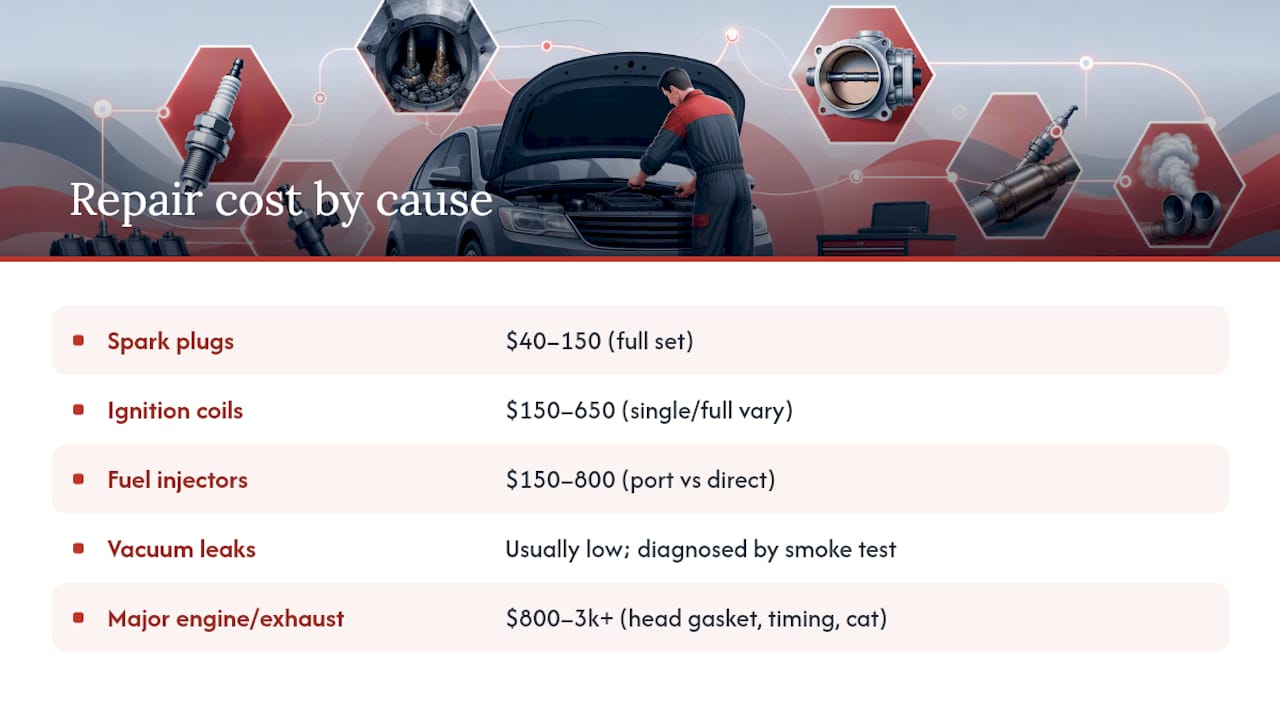
Spark plugs are the cheapest and most common fix. A full set typically runs $40 to $150, depending on plug type and engine size. Copper plugs are the least expensive but wear fastest. Iridium and platinum plugs cost more per plug, sometimes double, but last 60,000 to 100,000 miles instead of 20,000 to 30,000, which makes them the better long-term buy on most modern engines.
Ignition coils are where cost ranges get wide fast. Replacing a single coil typically costs $150 to $450 at an independent shop and $260 to $650 at a dealership, parts and labor combined. Full-set replacements, common on V6 and V8 engines where multiple coils may need replacement, can be substantially more expensive depending on engine complexity and accessibility. Labor is the real swing factor here: an easily accessible inline-4 coil pack takes twenty minutes to swap, while a transverse-mounted V6 with the rear bank tucked against the firewall can eat an hour or more of labor at $120 to $180 per hour at independent shops or $170 to $250 at dealerships.

Fuel injectors split into two repair paths. Injector cleaning, when deposits are the issue rather than failure, often costs a moderate amount for a full set. Actual replacement runs $150 to $500 per injector on port-injected engines, but direct-injection systems, standard on most 2015-and-newer Hondas, Subarus, and European models, use higher-pressure components that push per-injector costs toward $300 to $800.
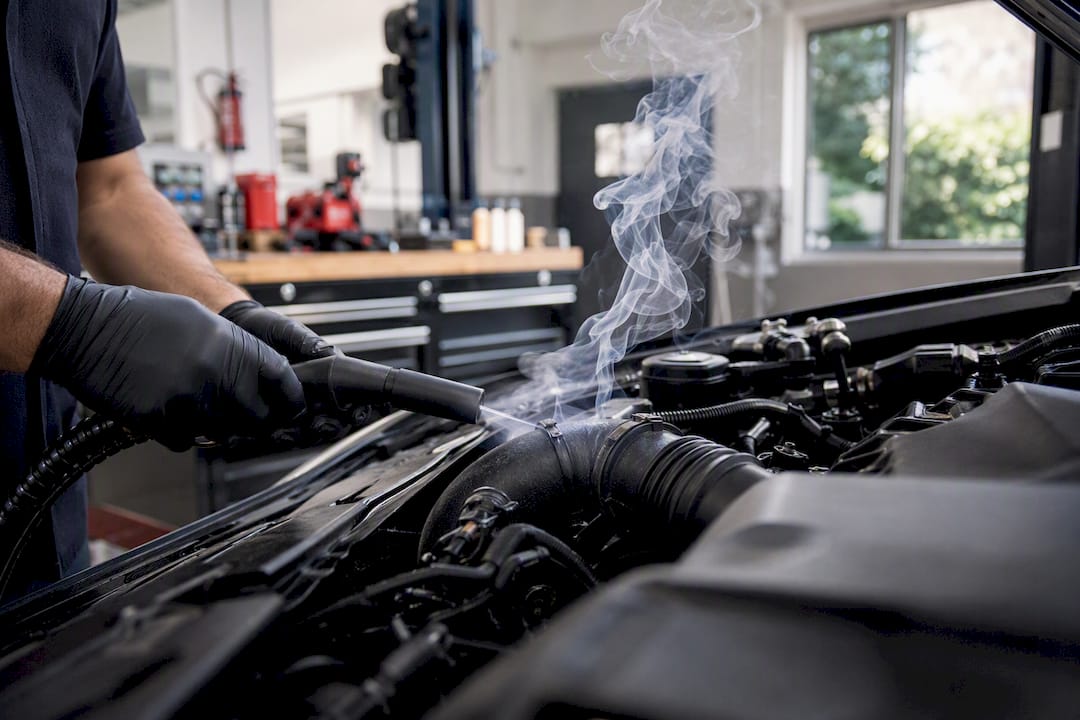
Vacuum leaks get diagnosed with a smoke test, where a shop pumps visible smoke through the intake system to spot where air is leaking in. Repair costs for vacuum leaks are generally low unless major components like the intake manifold need replacement, which raises cost substantially.
Head gasket and timing problems are the expensive end of the spectrum. These commonly land in the $800 to $2,500-plus range, driven almost entirely by labor hours since the engine often has to come partially or fully apart to reach the components.
Catalytic converter damage deserves its own line because it’s usually a consequence, not a cause. A misfire that’s ignored dumps raw, unburned fuel into the exhaust, which overheats and melts the converter’s internal substrate. Replacement typically runs $1,500 to $3,000, turning what could have been a $100 spark plug job into a five-figure-adjacent repair.
How Much Does a Misfire Diagnosis Cost?
A misfire diagnosis follows a sequence, and that sequence is what keeps your bill from ballooning. Skip it, and you’re paying to replace parts on a guess.
- OBD-II scan and code reading. The scan tool pulls a cylinder-specific misfire code (P0301, P0302, and so on), which tells the technician exactly which cylinder is acting up.
- Visual and cylinder-specific isolation. Techs check plug condition, coil connections, and wiring on the flagged cylinder before touching anything else.
- Follow-up testing if needed. A compression test rules out valve or piston ring problems. A fuel pressure test checks the injector and pump system. A smoke test finds vacuum leaks that don’t show up any other way.
Diagnostic fees typically run $85 to $160 as a flat scan fee, though some shops bill hourly instead. Labor rates vary by region and shop type, which is why the same diagnostic work can cost noticeably more at a dealership than an independent shop.
The reason shops check plugs and coils before fuel injectors or mechanical components isn’t habit, it’s math. A diagnosis-first approach that starts with the cheap, high-probability causes can turn a potential several-hundred-dollar guess into a $40 spark plug fix.
Pro Tip: Ask your shop for a written estimate that separates diagnostic time, parts, and labor into distinct line items before any work begins. If a shop won’t itemize before you approve the repair, that’s a red flag worth taking seriously.
Real Repair Scenarios and What They Cost
Numbers in the abstract don’t help much when you’re staring at an invoice. Here’s how four common misfire situations actually play out.
- Worn spark plugs on a four-cylinder sedan. Parts run $50 to $90 for an iridium set, labor adds another $60 to $120 depending on shop rate, and the whole job wraps in under an hour. Total: roughly $110 to $210.
- Single failed coil plus new plugs. A coil pack that dies often takes the adjacent plug down with it from repeated arcing. Expect $180 to $350 for one coil and a full plug set on an accessible engine. Some shops recommend replacing all coils at once on a car past 100,000 miles, since the remaining coils are usually close behind and a second visit costs more in labor than doing it once.
- Clogged or failed fuel injector. A single injector replacement on a direct-injection engine runs $300 to $700 including labor. If the whole rail needs service, that climbs toward $800 to $1,200.
- Head gasket or timing chain failure. This is where estimates hit $1,500 to $2,500-plus, and it’s also where you face a real decision: repair, or evaluate whether the car is worth keeping. On a vehicle already showing 150,000-plus miles, a compression test result showing multiple weak cylinders is often the signal to weigh trade-in value against repair cost.
A few things consistently push these numbers upward: V6 and V8 engines with rear-bank cylinders buried against the firewall, European makes with proprietary parts and higher dealer labor rates, and hybrid systems where the misfire diagnosis has to account for the electric drivetrain’s interaction with the combustion engine.
Can You Drive With an Engine Misfire?
A steady check-engine light that isn’t flashing usually means you can drive carefully for a short distance, a few miles to a shop, without immediate damage. A flashing check-engine light is a different situation entirely: it signals an active misfire severe enough to dump unburned fuel into the exhaust in real time.
- Flashing light: stop driving as soon as it’s safe to do so.
- Steady light with mild symptoms: a short drive to a shop is usually fine, but don’t put it off for days.
- Rough idle plus noticeable power loss: tow it rather than risk highway driving.
Delay carries a real cost multiplier. Letting a misfire run for even a few weeks can destroy a catalytic converter, converting a $100 spark plug job into a $2,500 exhaust repair. In California and other strict-emissions states, converter replacement often requires OEM-certified parts to stay smog-compliant, which adds to the replacement cost compared to states with looser aftermarket rules.
What to Expect From a Reputable Repair Shop
Since 1985, Tom’s B & M Auto has been diagnosing engine problems for Lynnwood-area drivers, and the diagnostic sequence matters more than most owners realize when it comes to controlling cost. ASE-certified technicians and professional-grade OBD-II diagnostics mean the plugs-to-coils-to-injectors-to-mechanical sequence gets followed in order, not skipped for a guess.
That documented, stepwise approach is what keeps a shop from replacing a $400 coil pack when a $50 spark plug set would’ve solved it. It also means the invoice you get back should show exactly which tests were run and why each part was recommended.
- Ask for the specific diagnostic trouble code, not just “a misfire.”
- Request that parts and labor appear as separate line items.
- Confirm what warranty applies to both the part and the labor.
Every repair at Tom’s B & M Auto carries a 24-month, 24,000-mile warranty, so if a coil or injector fails again within that window, you’re not paying for the same fix twice.
Pro Tip: Keep your itemized invoice. If a repaired component fails again, that documentation is what gets the fix covered under warranty instead of billed as a new job.
Ways to Lower Your Repair Bill
Not every dollar of a misfire repair is fixed. A few decisions genuinely move the number.
DIY makes sense for straightforward jobs: replacing plugs or a top-mounted coil pack on an engine with easy access is within reach for an owner with basic tools and a torque wrench. The most common mistake is over-tightening plugs or cross-threading them into an aluminum head, which turns a $60 job into a much costlier one. Injector work, vacuum diagnostics, and anything involving timing components belong with a shop.
When you do use a shop, a few questions change your total:
- Ask whether OEM or aftermarket parts are being quoted, and what the price difference is.
- Ask if a used or professionally rebuilt part is a reasonable option for your situation.
- Request the old parts back, both for peace of mind and to confirm the failure diagnosis matched what was replaced.
- Ask about bundling, since combining a coil replacement with an already-scheduled service can reduce total labor billed.
Financing is also worth asking about upfront rather than after the estimate lands. Tom’s B & M Auto offers financing options for larger repairs, which matters most on the higher end of the mechanical-failure range.
What Most Cost Guides Get Wrong
Most misfire cost articles hand you a price table and stop there, treating the number as the whole answer. The real leverage point isn’t the price of a coil or an injector, it’s whether the diagnosis happened in the right order before anyone bought a part.
Skip that sequence and you’re gambling with your own money. I’ve seen the framing elsewhere that a misfire is basically a coin flip between “cheap plug fix” and “expensive engine problem,” as if there’s no way to narrow it down in advance. That’s backwards. A cylinder-specific code plus a compression check tells you which category you’re in before a wrench turns.
The other overlooked point: urgency is a cost variable, not just a safety one. Owners who treat a steady check-engine light as something to deal with next month are the ones who turn a $150 plug job into a $2,500 catalytic converter replacement. If you take one thing from this guide, let it be that the diagnostic step is the cheapest insurance you’ll ever buy against a five-figure-adjacent repair bill.
— Shingi
Get a Clear Diagnosis Before You Pay for Parts
Guessing at engine repairs is how a $150 fix turns into an $800 one. Tom’s B & M Auto runs the diagnostic sequence properly, plugs, coils, injectors, mechanical, using professional-grade OBD-II tools, so you only pay for the part that’s actually broken.
ASE-certified technicians handle the diagnosis, same-day appointments are often available, and every repair comes backed by a 24-month, 24,000-mile warranty. If your check-engine light is flashing or your engine’s been running rough, the smart first step is a real scan, not a parts swap. Tom’s B & M Auto’s free digital vehicle inspection is a low-risk way to find out exactly what’s going on before committing to a repair. If the estimate involves a bigger mechanical fix, financing options can spread the cost instead of forcing a lump-sum decision on the spot.
Call the shop, book online, or bring your vehicle by for engine repair in the Lynnwood area and get a documented diagnosis before you spend a dollar on parts.
Sources
- Engine Misfire Symptoms: How to Diagnose the Cause Before Replacing Parts | Bumper
- Ignition Coil Replacement Cost 2026 | Empire Auto Protect
- Engineerskill
- Engine Misfire Repair Cost Guide – Cost Insider
Recommended
- Fix Engine Misfires Step by Step: A Car Owner’s Guide – Tom’s B & M Auto Blog
- What Is Engine Misfiring? Causes, Signs, and Fixes – Tom’s B & M Auto Blog
- Hidden Car Repair Costs: Real Examples and How to Avoid Them – Tom’s B & M Auto Blog
- European Car Repair Challenges: What Owners Must Know – Tom’s B & M Auto Blog
Leave a Reply