
Car Owners: 5 AC Refrigerant Leak Symptoms That Require a Shop Visit
If your AC blows warm air, leaves oily residue around the fittings, or the compressor hisses and clicks on and off, you’re almost certainly dealing with a refrigerant leak. Don’t just recharge it and hope. Get the leak located and repaired, because a low charge always means refrigerant is escaping somewhere in the system.
TL;DR:
- Refrigerant leaks often cause warm air, oily residue, frost, and compressor cycling issues, especially when multiple symptoms occur simultaneously.
- Low refrigerant levels always indicate a leak since refrigerant is a sealed system and does not evaporate or burn off naturally.
- Checking for oil residue, frost, and listening for hissing sounds can help identify leaks before professional diagnosis.
- Leak detection methods include UV dye, electronic sniffers, and pressure testing, with the most complex leaks in evaporator cores typically costing more to repair.
- DIY recharge kits are insufficient for fixing leaks, and proper repairs usually involve repair or replacement of damaged components with warranties lasting up to 24 months.
Table of Contents
- AC refrigerant leak symptoms: a quick checklist
- Why low refrigerant always means a leak
- How to check for leak symptoms before your appointment
- How shops actually find refrigerant leaks
- What to do next: DIY limits, repair costs, and warranty
- What a real diagnostic visit should include
- Book an AC leak diagnostic with Tom’s B & M Auto
- Sources
AC refrigerant leak symptoms: a quick checklist
Before you book a shop visit, run through what you’ve actually noticed. A refrigerant leak rarely announces itself with just one clue. It usually shows up as a cluster of small annoyances that add up to a clear pattern.
Here’s what to look for:
- Warm or lukewarm air, especially at idle, that turns colder once you’re driving faster
- Weak airflow from the vents, or windows that fog up and won’t clear even with the defroster on
- Oily or greasy film around AC fittings, hose connections, the compressor, or the condenser in front of the radiator
- Frost or ice forming on the evaporator lines or around the compressor while the system runs
- Hissing sounds from under the dash or engine bay, or a compressor that clicks and cycles on and off rapidly
One symptom alone might mean something minor. Warm air by itself, for instance, could point to a bad blend door or a failing blower motor. But when you’re seeing two or more of these together, especially oily residue paired with weak cooling, refrigerant loss is the likely explanation. If you notice frost on the lines and hissing, treat that as a same-week appointment, not a someday errand. That combination often points to a leak severe enough to strain the compressor fast.
Why low refrigerant always means a leak
Here’s something a lot of drivers don’t realize: refrigerant doesn’t burn off, evaporate, or wear out the way engine oil does. It’s a sealed loop. If your system is low, refrigerant had to go somewhere, and that somewhere is a leak point in a hose, seal, o-ring, or component. The EPA is direct about this: recharging without finding the leak first is a temporary patch, not a fix.
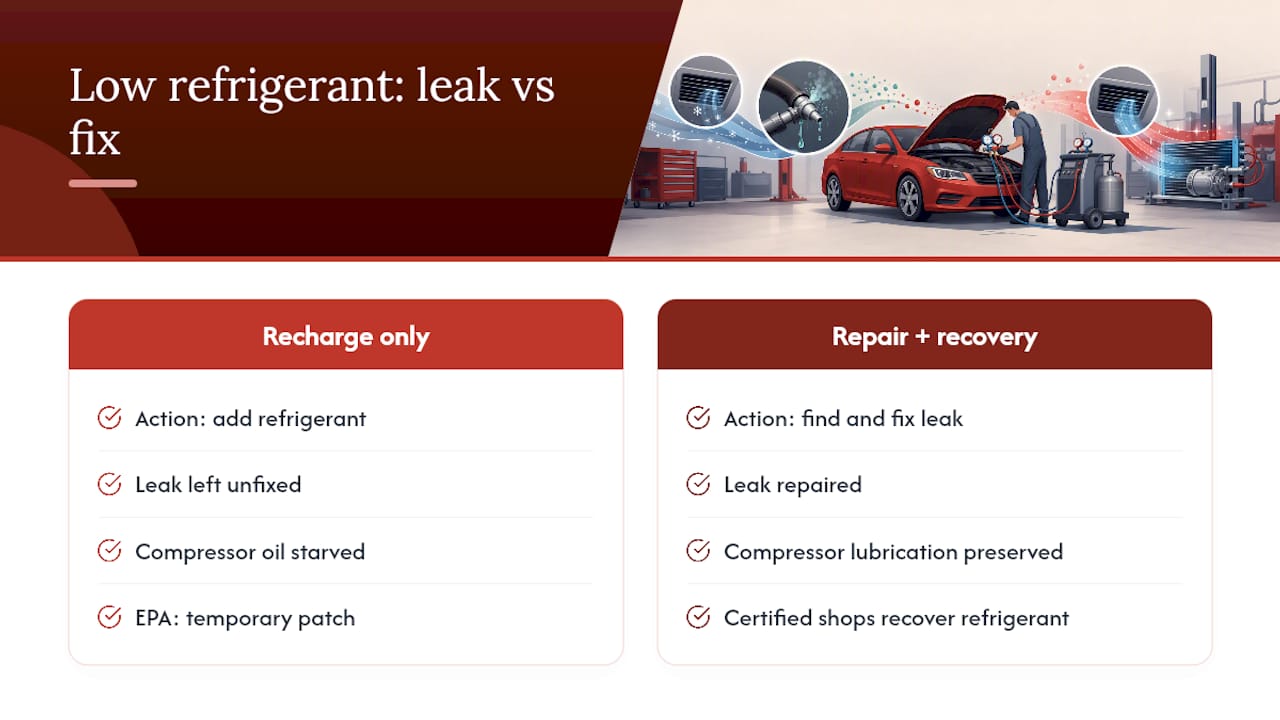
That matters beyond comfort. Refrigerant carries the oil that lubricates your AC compressor. Run the system low for weeks or months and you’re not just losing cold air, you’re starving the compressor of lubrication, which shortens its life and turns a $150 hose repair into a $900 compressor replacement. There’s also a legal angle worth knowing: refrigerant can’t legally be vented to the atmosphere. Certified shops recover it with dedicated equipment during service, which is one more reason a DIY top-off kit isn’t the long-term answer.
How to check for leak symptoms before your appointment
You can gather useful information yourself without opening anything up. Here’s a safe sequence to run through:
- Check vent temperature. Start the engine, set AC to max cold, and let it idle for two or three minutes. Healthy systems drop to noticeably cold air within that window. If it stays lukewarm or only cools once you rev the engine, that’s a red flag.
- Inspect for oily residue. Pop the hood and look at the compressor, the hose fittings, and the condenser (the thin radiator right behind the grille). Refrigerant itself is usually colorless and odorless, so what you’re actually spotting is the oil that travels with it, which leaves a greasy film. Don’t confuse this with plain water condensation dripping from the AC drain tube under the car. That’s normal and has nothing to do with refrigerant.
- Look for frost or ice. Frost on the low pressure line or around the compressor while the AC runs usually points to a low charge or a restricted expansion valve, not a healthy system.
- Listen closely. A steady hiss near hose connections or the compressor is often refrigerant escaping under pressure. A compressor that clicks on for a few seconds, shuts off, and repeats is short-cycling, a classic low-charge symptom.
Pro Tip: Don’t touch the AC service ports or try to add refrigerant yourself if you can hear hissing. Opening a pressurized line without the right gauges and recovery equipment can cause frostbite injuries and release refrigerant illegally. Leave that step to a shop with the right tools.
How shops actually find refrigerant leaks
Finding a leak by eye only catches the obvious ones. Most shops layer two or three detection methods depending on where the leak seems to be hiding.
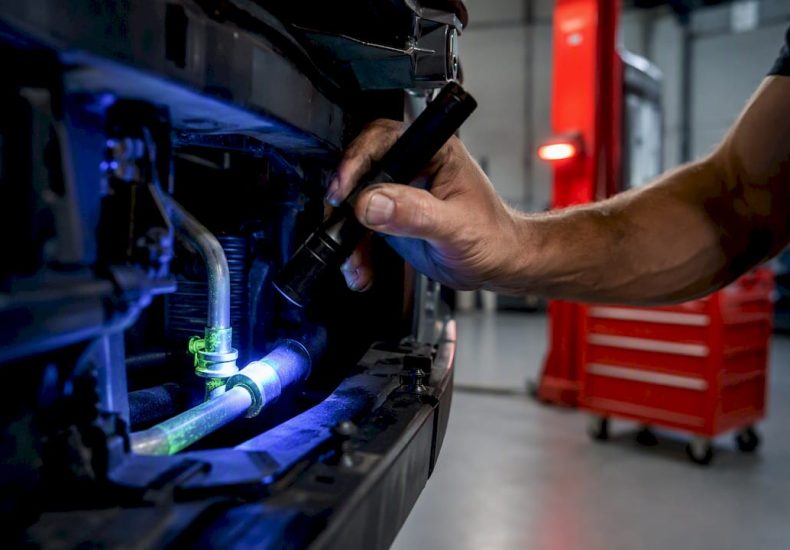
- UV dye or contrast agent: A fluorescent dye gets added to the system, circulates with the oil, and glows under a UV lamp at the leak point. This works well for external leaks at hoses and fittings but takes some driving time to circulate fully.
- Electronic halogen detectors: These sniff for refrigerant molecules in the air and can catch leaks too small to see or smell, including ones buried deep in the dash near the evaporator core.
- Pressure testing with nitrogen or forming gas: Technicians pressurize the empty system with an inert gas, then check for pressure drop or listen for the hiss at the exact leak point. This confirms system integrity even when dye and electronic sniffers come up empty.
Some leaks are genuinely tricky. A dye test can miss an evaporator leak that only shows up under a forming-gas test, which is why technicians often combine methods rather than stopping at the first one that seems convenient. That combination approach costs more diagnostic time, which is exactly why evaporator leaks tend to run higher on labor than a leaking hose you can see from across the shop. Once the leak site is confirmed, the system gets fully evacuated under vacuum before any recharge, a step that removes air and moisture that would otherwise contaminate the new refrigerant charge.
What to do next: DIY limits, repair costs, and warranty
If the leak seems minor and the car still cools decently, driving to a shop is fine. If you smell a sweet chemical odor, see the engine temperature climbing, or hear grinding from the compressor, stop and get it towed instead. A seized compressor can shred its own clutch and shed metal into the lines.
A few things worth knowing before you decide how to handle it:
- Store-bought recharge kits are cheap, but repeated use without fixing the leak just masks the problem while the compressor keeps losing lubrication.
- A typical shop visit includes leak detection, repair or replacement of the failed part, full evacuation, and a recharge to the manufacturer-specified refrigerant, either R-134a or the newer R-1234yf depending on your vehicle’s year and model.
- Cost depends heavily on what failed. A leaking hose or o-ring is a modest repair. A failed compressor or evaporator core, buried deep in the dash, runs considerably higher because of the labor involved in reaching it.
Pro Tip: Ask any shop upfront whether their recharge uses the refrigerant your specific vehicle calls for. Using the wrong type damages seals and voids the fix fast.
Tom’s B & M Auto backs AC repairs with a 24 month, 24,000 mile warranty and often offers same-day diagnostic appointments, so you’re not left guessing whether the fix will hold.
What a real diagnostic visit should include

Forty years of working on Lynnwood’s cars has taught our shop one thing: guessing at AC problems wastes everyone’s money. Our ASE-certified technicians run a visual inspection, apply the appropriate leak-detection method for what they’re seeing, and use professional-grade OBD-II diagnostics to rule out electrical causes before touching the refrigerant system at all.
You should walk away from any diagnostic appointment with a written estimate, not a verbal guess. That’s what protects you from repeat visits and surprise charges down the line, and it’s the standard we hold every AC job to.
— Shingi
Book an AC leak diagnostic with Tom’s B & M Auto
Tom’s B & M Auto is the direct route to an actual fix instead of another can of recharge that wears off in a month. We run full leak detection, from UV dye to electronic sniffers to pressure testing, then hand you a written repair estimate before any work starts.

If your AC is showing any of the symptoms above, start with our free digital vehicle inspection to get the leak located without committing to a repair yet. Larger jobs, like a failed compressor, qualify for $150 off any repair over $1,000, and every repair carries our 24 month, 24,000 mile warranty. Same-day diagnostic appointments are often available for Lynnwood area drivers. Call or book online, and we’ll inspect, diagnose, quote, and repair, all with parts matched to your vehicle’s specified refrigerant.
Sources
- EPA — Options for Recharging Your Air Conditioner
- Kelley Blue Book — Freon: Signs Your Car Needs It
- HELLA TechWorld — Car air conditioning leak detection
- RepairPal — Signs your A/C system is low on refrigerant
Recommended
- Car AC System Checklist: A Quick Diagnostic Guide
- Car AC Leak Repair Cost: What Lynnwood Drivers Should Know
- Why Car AC Blows Warm Air: Causes and Fixes
- What Is an AC Compressor? A Car Owner’s Guide
Leave a Reply