
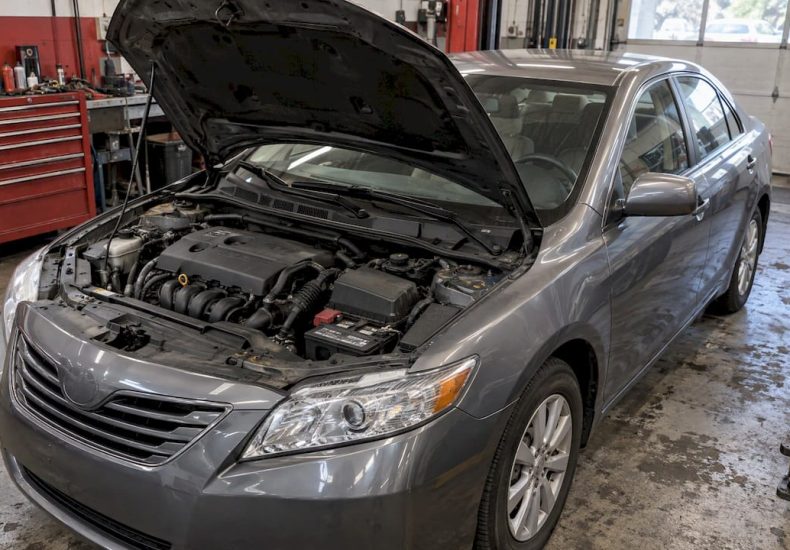
Rough Idle Causes: Why Your Car Shakes and What to Do
A rough idle almost always comes from a problem with spark, fuel or air. A worn spark plug, a failing ignition coil, a vacuum leak, a dirty throttle body or a clogged injector is the usual culprit. The symptom alone can’t tell you which one, because several faults feel the same from the driver’s seat. At our Lynnwood shop, we read the trouble codes and live engine data first, then test the likely cause, so you pay to fix the right part once.
TL;DR
- Rough idle means the engine can’t hold a steady speed at a stop. The usual causes are spark, fuel or airflow faults.
- Worn spark plugs, bad ignition coils, vacuum leaks, dirty throttle bodies, dirty injectors and airflow sensor problems top the list.
- When it happens (cold, warm, in gear, at a stoplight) narrows the cause quickly, so note it before you call a shop.
- A flashing check engine light, severe shaking, a raw fuel smell or power loss means stop driving and get the car looked at.
- Don’t swap parts by guesswork. A scan and a proper test cost less than replacing the wrong sensor.
Table of Contents
- What a rough idle actually is
- The most common rough idle causes
- Why the car shakes at a stop but smooths out when driving
- Rough idle when the engine is warm
- Can a bad oxygen sensor cause a rough idle?
- When a rough idle means stop driving
- How a shop diagnoses rough idle
- What to note before you call
- Our view on rough idle
- Get your rough idle diagnosed in Lynnwood
- FAQ
- Sources
What a rough idle actually is
At idle, your engine runs with the throttle nearly closed. It breathes through a small gap, and the engine computer adjusts fuel, spark timing and idle air many times a second based on engine speed, airflow, coolant temperature and oxygen sensor readings. When any one of those inputs is wrong, the balance slips and you feel it.
A rough idle shows up as one or more of these:
- A steady shake or a rhythmic stumble you feel through the seat or steering wheel
- RPM that hunts up and down, or a tachometer needle that jumps
- An uneven engine sound
- Near-stalling when you stop
Some idle variation is normal. Most fuel-injected engines idle a little faster for the first minute after a cold start, then settle down. A raised idle on a cold morning is fine. A needle that jumps around or a shake you can feel is not.
Rough idle, misfire and hesitation are different things
People use these words interchangeably, and mechanics don’t. A rough idle happens while the car is stopped and your foot is off the gas. Hesitation is a delay or stumble when you press the accelerator. A misfire is more specific: one or more cylinders aren’t burning their air-fuel mixture properly. A misfire can cause a rough idle, but a rough idle doesn’t always mean a misfire. Airflow, throttle or idle-control problems can feel the same.
If your car mostly stumbles when you accelerate, our guide to why a car hesitates during acceleration is the better starting point. If it shakes at a stop, keep reading.
The most common rough idle causes
No single cause tops the list for every engine. Vehicle design, mileage, maintenance history and recent work all change where testing should start. Still, the same handful of faults account for most rough idles.
1. Worn or fouled spark plugs
Spark plugs wear down over time. A weak or inconsistent spark leaves fuel partly unburned in one cylinder, and the engine stumbles. This is the first thing many technicians check, because plugs are a maintenance item with a known service interval. Our list of worn spark plug symptoms shows what to look for. If your car is overdue for its 30,000, 60,000 or 90,000-mile service, plugs are often part of it.
2. Failing ignition coils
The coil turns battery voltage into the spark. When one weakens, its cylinder misfires, usually most noticeably at idle where there’s little engine speed to smooth things out. Coils can also fail only when hot, which is why some cars run fine for a cold start and shake later.
3. Vacuum leaks
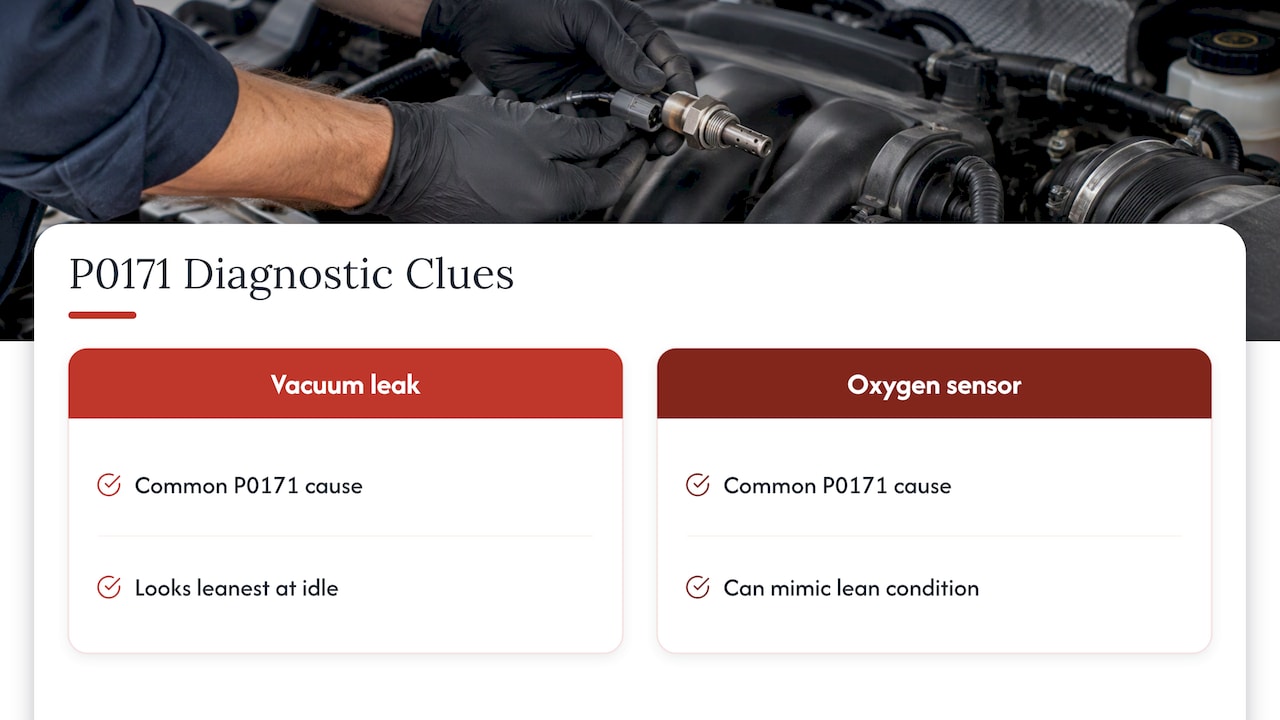
A cracked hose, a loose intake connection or a failed gasket lets unmetered air into the engine. The computer doesn’t know about that extra air, so the mixture runs lean. A vacuum leak often looks leanest at idle, because the leak is large compared with the small amount of air the engine is drawing in. Leaks can also worsen over time and eventually cause stalling or lean running that stresses other parts.
4. A dirty throttle body
Carbon builds up around the throttle plate. At idle the plate is almost closed, so even a thin layer changes how much air gets through. The result is a low, hunting or uneven idle that often improves once the airway is cleaned.
5. Dirty or clogged fuel injectors
An injector that sprays poorly starves one cylinder and gives you an unbalanced idle. Rough running after the engine warms can be associated with carbon buildup, a weak coil, dirty injectors or a variable valve timing issue, according to one repair-cost guide.
6. Airflow sensor problems
The mass airflow sensor tells the computer how much air is entering. If its reading is off, fueling is off too. Rough idle alone doesn’t prove the sensor is bad, because vacuum leaks, ignition problems and throttle body issues cause the same symptom. We cover that below.
7. Other contributors
A weak fuel pump, low compression, a stuck EGR valve and worn motor mounts also show up. The mounts matter for one specific complaint, covered next.
Why the car shakes at a stop but smooths out when driving
This is the most common version of the complaint, and it has two explanations that often overlap.
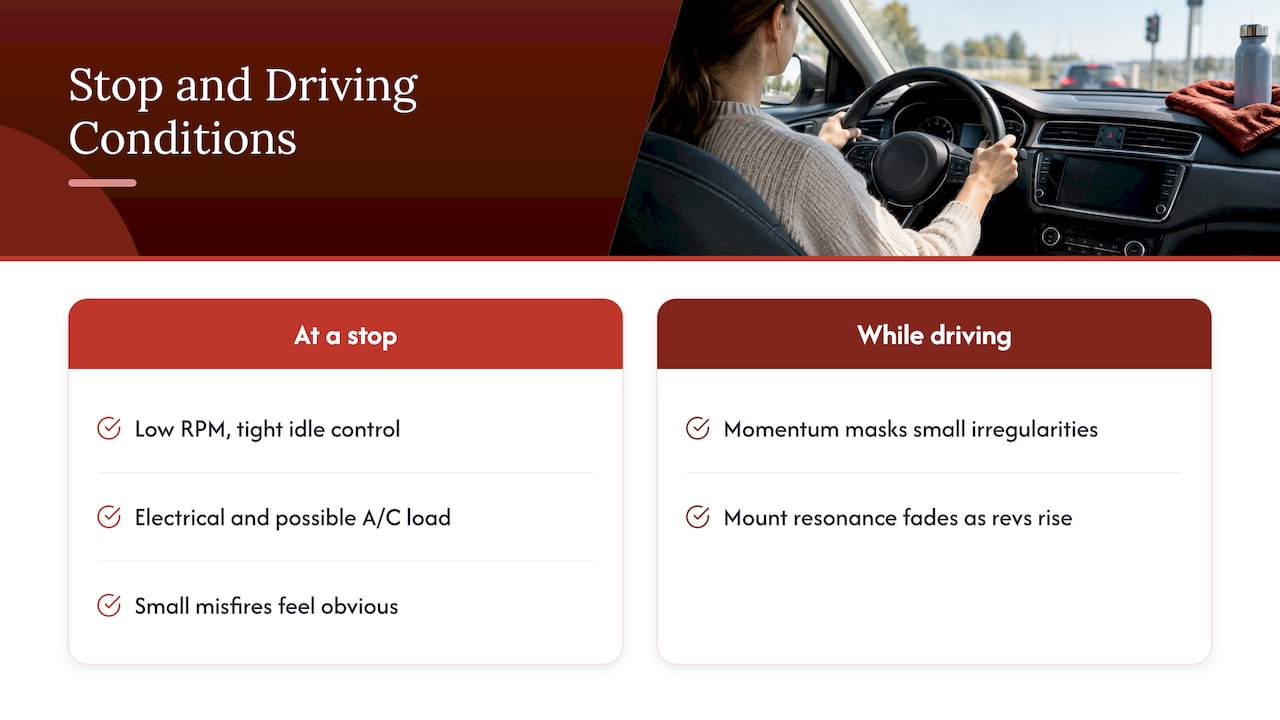
Engine load and idle control. A stoplight is a demanding condition: low RPM, little momentum to mask an imbalance, electrical load from lights and fans, possible A/C compressor load, and tight idle control. At cruising speed, momentum hides small irregularities. A minor misfire or air leak that you can’t feel at 40 mph can be obvious at a red light.
Engine mounts. The engine and transmission sit on rubber mounts. At idle, the engine’s vibration frequency can line up with the resonant frequency of the mounted assembly. As revs climb, the frequency moves away from that point and the shaking fades, as this mechanics Q&A explains. Worn mounts make that vibration worse by passing more of it into the body.
A quick self-check: does the shake change when you shift from Drive to Neutral, or when you switch the A/C on? A change points toward load or mount issues. If the engine sounds uneven in addition to shaking, suspect a misfire.
If the car also stalls, see our guide to a car that stalls at idle. If the RPM rises and falls rhythmically, read about engine surging at idle.
Rough idle when the engine is warm
Timing is a strong clue. A rough idle that appears only once the engine is warm tends to rule out cold-start causes such as enrichment faults, the idle air control valve and the coolant temperature sensor. It points instead to systems that only become active, or only start failing, at operating temperature, according to a diagnostic guide on warm rough idle. The usual suspects:
- EGR valve. It opens only at warm operating temperature. A valve that sticks open or flows incorrectly causes a rough idle that doesn’t exist when the engine is cold, because the EGR system isn’t active yet.
- EVAP purge valve. If it leaks or sticks open, extra fuel vapor reaches the intake.
- Thermal vacuum leaks. Hoses and gaskets can expand with heat and open a leak that isn’t there cold.
- Heat-sensitive ignition coils. A coil can work cold and misfire as it heats up.
Carbon buildup, dirty injectors and variable valve timing faults can also show up after warm-up. Because so many causes overlap, scan data at operating temperature is far faster than replacing parts one at a time.
If the roughness started right after you filled the tank, our article on rough idle after refueling covers the checks that apply.
Can a bad oxygen sensor cause a rough idle?
Yes, but it’s rarely the whole story. An oxygen sensor gives the computer feedback about the mixture. When the sensor degrades, the computer loses accurate feedback, and one possible result is a rough idle or stalling. Other possible signs include hesitation, worse fuel economy and a check engine light.
The tricky part is that a failing sensor can mimic a lean condition. Code P0171 means the fuel system is running lean on bank 1. Its common causes include vacuum leaks, a faulty oxygen sensor, a clogged fuel filter, a malfunctioning mass airflow sensor and injector issues, according to a code reference. The sensible order is to rule out vacuum leaks and air or fuel delivery problems first, then replace the sensor if the data still points to it. On Subarus especially, guidance on P0171 is to rule those out before replacing the sensor.
The same logic applies to the airflow sensor. A bad one can make the engine hunt, shake or struggle to hold idle, but the difference between a vacuum leak and a sensor fault is usually in the data pattern, as this diagnostic guide describes: a leak looks leanest at idle, while a sensor problem makes airflow and fueling look wrong together. Reading that pattern takes a scan tool and experience, which is why guessing at the part usually costs more.
When a rough idle means stop driving
Don’t ignore a rough-running engine just because the car still moves. Misfires can increase emissions, reduce efficiency and create excessive exhaust heat, and vacuum leaks can worsen over time, as one diagnostic guide notes.
Stop driving, or limit it sharply, and have the car looked at promptly if you notice:
- A flashing check engine light
- Severe shaking or bucking
- Substantial power loss
- A strong raw fuel smell
- Smoke, overheating or backfiring
- Repeated stalling
That same guide also lists misfire codes that return right after clearing, lean codes on both banks with no obvious hose damage, low compression, coolant loss and oil contamination as reasons to get professional help. A steady check engine light with a mild shake is less urgent, but it still deserves a scan soon. A flashing light usually signals a misfire severe enough to overheat the catalytic converter, which is a far more expensive repair than the plug or coil that started it.
How a shop diagnoses rough idle
Good diagnosis starts with a question: when exactly does it happen? Cold or warm, in Park or in gear, with the A/C on or off, at a stoplight only. Those answers keep a technician from treating every shake as an ignition fault or every hesitation as a fuel problem.
From there, the process generally looks like this:
- Scan for codes and freeze-frame data. Misfire codes name the cylinder. Fuel trim codes such as P0171 point to air or fuel.
- Watch live data. Short- and long-term fuel trims, airflow readings and sensor behavior at idle and at higher RPM show whether the fault is a leak, a sensor or a delivery problem.
- Test the likely causes. That can mean inspecting plugs and coils, smoke testing for vacuum leaks, checking the throttle body, and fuel pressure testing. Fuel pressure is compared with manufacturer specifications at key-on, at idle, under load and after shutdown.
- Check compression when the other tests don’t explain the shake.
- Repair, then confirm the idle is stable and codes stay clear.
Smoke testing, fuel-pressure testing and compression testing need equipment most owners don’t have, which is the main reason a stubborn rough idle ends up at a shop. For the cost side of a misfire, see what engine misfire repair costs. For a deeper walk-through, our guides on what engine misfiring is and how to fix engine misfires step by step go further.
What to note before you call
A few details make the first visit faster:
- Does it happen cold, warm or both?
- Is the shake at a stop only, or also while driving?
- Does the check engine light come on, and does it flash?
- Did it start after fueling, a repair, or a stretch of short trips?
- Does turning on the A/C or shifting to Neutral change it?
You don’t need technical terms. Describing what you feel in the seat, hear from the engine and see on the tachometer is enough to point a technician in the right direction.
Our view on rough idle
Every rough idle is a clue, not a verdict. The same shake can come from a $20 hose or a failing coil, and the symptom doesn’t tell you which. That’s why we start with the data instead of a parts list.
Our technicians are ASE-certified and use professional-grade OBD-II diagnostics, so we can see what the engine computer is seeing before anyone picks up a wrench. We do this on all makes, including Toyota, Honda, Subaru, domestic, European and hybrid vehicles, and we’ve been family-owned and operated in Lynnwood since 1985.
Our digital inspections and upfront pricing mean you see what we found and what it costs before work starts. Whatever we repair carries our 24-month / 24,000-mile warranty. If your car is shaking at a stop, bring it in before a small misfire becomes a catalytic converter job.
Shingi
Get your rough idle diagnosed in Lynnwood
If your car is shaking at stoplights or the check engine light is on, we can find the cause. Our shop offers check engine light diagnostics and engine repair for all makes, with same-day appointments often available. The work is backed by a 24-month / 24,000-mile warranty. If the cause turns out to be routine wear, we also handle the 30k, 60k and 90k service, where plugs and other maintenance items are addressed on schedule.

You can also see our full list of services at Tom’s B & M Auto.
FAQ
Why does my car idle rough when stopped?
At a stop the engine is at its lowest speed with the least momentum to hide a problem. Misfires, vacuum leaks, dirty throttle components, weak mounts and electrical or A/C load all show up there first. Note whether it changes when you shift to Neutral or turn on the A/C, then have the codes read.
Can a bad oxygen sensor cause a rough idle?
It can, because the computer relies on the sensor’s feedback to set the mixture. But vacuum leaks, airflow sensor faults and injector problems can trigger similar codes. A technician should check those first and confirm with live data before replacing the sensor.
Why does my car shake at idle but smooth out while driving?
At idle the engine’s vibration can line up with the resonance of the mounted engine and transmission, and little momentum is there to mask a misfire. As RPM rises, the frequency shifts away and momentum smooths things out. Worn engine mounts and mild misfires are the most common reasons.
Is a rough idle when warm different from one at cold start?
Yes. A rough idle that appears only when warm points toward the EGR valve, EVAP purge valve, thermal vacuum leaks or heat-sensitive ignition coils, rather than cold-start enrichment or temperature sensor faults. Telling your technician which one you have shortens the diagnosis.
Is it safe to drive with a rough idle?
A mild, steady roughness with no warning lights can usually get you to a shop, but don’t put it off. If the check engine light is flashing, the car shakes severely, loses power or smells of raw fuel, stop driving and have it looked at promptly.
Sources
- Mechanics Stack Exchange: why bad motor mounts cause shaking at idle
- Rough Idle When Warm: Causes and Diagnosis
- Rough Idle in Park: Causes, Fixes and Repair Costs
- P0171 Code Meaning, Causes and Symptoms
- P0171 Subaru Forester Causes and Fixes
- Bad MAF Sensor Symptoms, Testing and Diagnosis
- Vacuum Leak vs Misfire: Signs, OBD Codes and Fixes
Recommended
- Rough Idle After Refueling: Causes, Checks and Fixes
- Car Stalls at Idle: Causes, Diagnosis, and Fixes
- Engine Surging at Idle in Lynnwood? Diagnose Before Buying Parts
- Headlights Dim at Idle? Causes and What to Check
Leave a Reply