

Fuel Trim Explained: What STFT and LTFT Numbers Mean
Fuel trim is the correction your engine computer makes to the amount of fuel it injects, so the air-fuel mixture stays close to the ideal ratio. Short-term fuel trim (STFT) is the quick correction made right now. Long-term fuel trim (LTFT) is the learned correction the computer stores over time. Positive numbers mean the computer is adding fuel, negative numbers mean it is taking fuel away, and totals beyond roughly 10% in either direction tell a technician something is off.
This guide walks through how the two trims work together, what normal readings look like, and how a technician turns a few percentages into a diagnosis.
TL;DR
- Fuel trim is the engine computer’s fuel correction, shown in percent on a scan tool. STFT reacts instantly, LTFT is the stored adjustment.
- Positive trim means the computer is adding fuel because it sees a lean mixture. Negative trim means it is removing fuel because it sees a rich one.
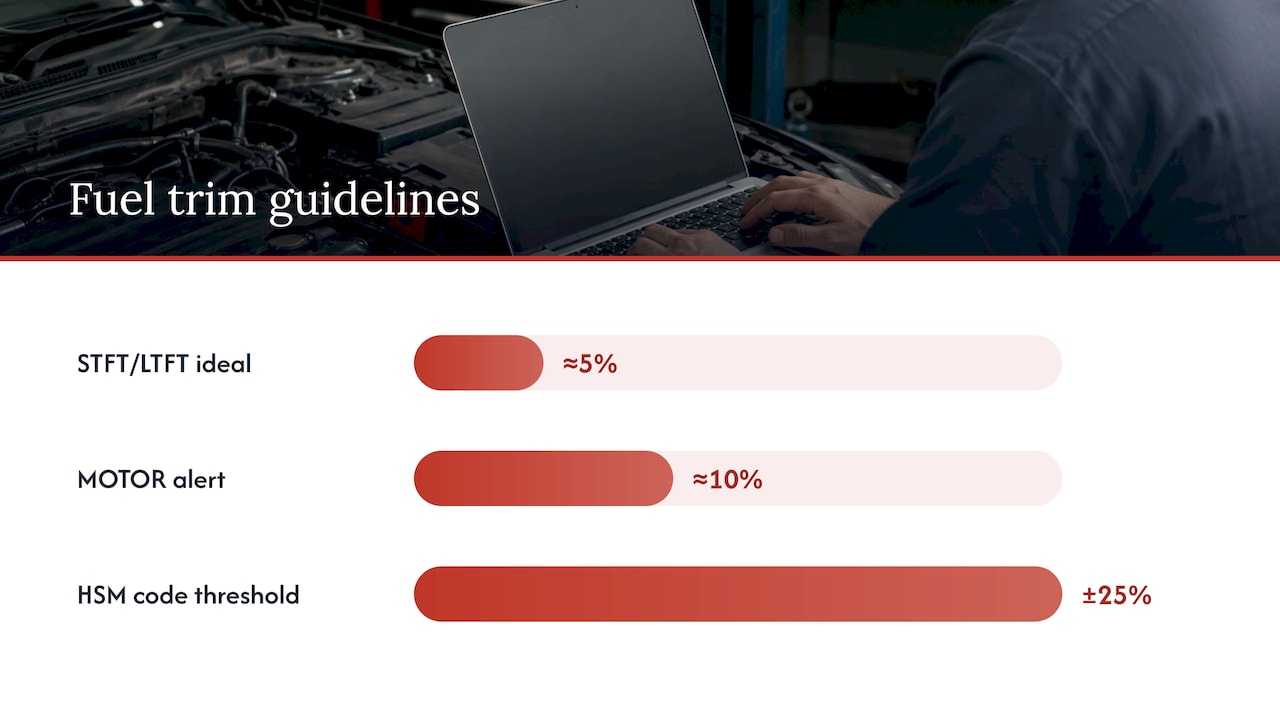
- Combined trims within about 10% are generally treated as healthy. Trims that keep climbing toward 25% can set a lean or rich code such as P0171.
- The pattern matters more than the number: high at idle only points one direction, high at every speed points another.
- Fuel trim tells you where to look. It does not name the failed part, so confirm with further tests before spending money.
Table of Contents
- What fuel trim is and why your engine needs it
- Short-term vs. long-term fuel trim
- Positive and negative trim: what each direction means
- Normal fuel trim values
- How technicians read the pattern
- Fuel trim, lean codes and P0171
- Confirming the cause before replacing parts
- Our perspective on fuel trim
- Get your fuel trim checked in Lynnwood
- FAQ
- Sources
What fuel trim is and why your engine needs it
An engine runs cleanest when it burns air and fuel in a very specific balance, known as the stoichiometric ratio. The engine control module (also called the PCM) aims for that balance all the time. It watches the oxygen sensors in the exhaust, and when the sensors report too much or too little oxygen, it lengthens or shortens the time the fuel injectors stay open. That adjustment is fuel trim, as Vehicle Service Pros explains.
There is a practical reason for the effort. Fuel trim control exists so the exhaust stays close to the ideal mixture, which is the condition the catalytic converter needs to work efficiently. A mixture that drifts too far hurts fuel economy, emissions and drivability, and it can shorten the life of expensive exhaust parts.
The computer starts with a base calculation from airflow, engine speed and temperature. Real engines never match that calculation perfectly. Injectors age, sensors drift, air sneaks in through a cracked hose. Fuel trim is how the computer quietly fills the gap between the calculation and reality.
Short-term vs. long-term fuel trim
Think of the two trims as a fast hand and a slow hand.
Short-term fuel trim is the immediate correction. On a scan tool it appears as a percentage that moves constantly, and it resets each time the engine stops. A reading of +10% means the computer is adding 10% more fuel than its base calculation because the sensor reports lean. A reading of -10% means it is removing fuel because the sensor reports rich. A reading near 0% means the base calculation is about right.
Long-term fuel trim is the learned correction stored in memory for different engine speeds and loads. When STFT keeps leaning the same way, the computer moves that correction into LTFT so STFT can go back to hovering around zero. Snap-on’s technical write-up describes LTFT as the value that accounts for longer-term changes such as engine wear.
The two add together. The same source notes that STFT plus LTFT gives the total fuel correction, often called total fuel trim. That total is the number most technicians look at first.
A quick worked example
Say a scan tool shows LTFT at +6% and STFT bouncing around +3%. Total trim is about +9%. The computer is adding a little fuel, which is common on an older engine, and the total is inside the usual comfort zone. Now say LTFT sits at +18% and STFT swings near +8%. The total is about +26%. The computer has nearly run out of correction, and a lean code is likely.
Positive and negative trim: what each direction means
The sign tells you which way the computer is pushing.
| Reading | What the computer sees | What it does | Typical areas to look at |
|---|---|---|---|
| Positive trim (+) | A lean mixture, too much air or too little fuel | Adds fuel | Vacuum leaks, weak fuel delivery, skewed airflow sensor data |
| Negative trim (-) | A rich mixture, too much fuel or too little air | Removes fuel | Leaking injectors, excess fuel pressure, contaminated sensor readings |
| Near zero | Mixture matches the base calculation | Little correction | Normal operation |
Autodata’s breakdown states it plainly: positive trim means the computer is adding fuel because it has decided the engine runs lean, and negative trim means it is subtracting fuel because it has decided the engine runs rich.
Notice the wording: the computer decided. It relies on sensor data. If an oxygen sensor or airflow sensor reports wrongly, the computer can correct a problem that does not exist. That is why a trim number is a clue, not a verdict. Our guide to O2 sensor symptoms and live data checks covers how to tell a bad sensor from a real mixture problem.
Normal fuel trim values
There is no single number that fits every engine, but widely used guidelines agree on the neighborhood.
| Source | Guideline |
|---|---|
| MOTOR | Ideal STFT and LTFT are within about 5%. Beyond about 10% should alert you to a possible problem. |
| Vehicle Service Pros | Under stable conditions, each trim and the total should be no greater than about 10%. Example: LTFT 4% plus STFT 4% is 8%, acceptable. |
| HSM University training lesson | Total trim within about plus or minus 10% is normal. Past that, the computer is working hard, and many computers set lean or rich codes near plus or minus 25% if it persists. |
Two caveats help you read these numbers sensibly.
Age and mileage. The Vehicle Service Pros article notes that older engines may show somewhat higher LTFT as the computer compensates for normal wear. A 150,000-mile engine sitting at +7% is a very different story from a 20,000-mile engine at +7%.
Operating condition. Trims are judged under stable, warmed-up conditions. MOTOR notes that trim values can be high at idle and then clean up at higher operating ranges, and that slightly elevated values can occur without a fault. A reading taken during a cold start or a hard acceleration is not a fair measurement.
If your numbers are inside these ranges, the fueling system is almost certainly doing its job, even if a different symptom is bothering you.
How technicians read the pattern
A single number rarely solves anything. The useful question is: when is the trim off?
The Vehicle Service Pros guide describes checking fuel trim for at least 30 seconds at idle, at 1,500 rpm and at 2,500 rpm, or recording it during a drive to see how it changes with load. The pattern narrows the suspects quickly.
High at idle, better at higher rpm
When LTFT is high at idle and drops at higher speeds, the diagnosis should focus on causes that matter most at idle. MOTOR gives an example where LTFT is high at idle but corrects to about 4% at 1,500 and 2,500 rpm, which points toward a vacuum leak. Unmetered air makes up a larger share of the total airflow when the engine is barely breathing, so the leak shows up strongly at idle and fades as airflow increases. If your car also surges or stumbles at a stop, our article on engine surging at idle explains the diagnostic order we follow.
High at every speed
If the trim stays elevated across all ranges, MOTOR notes that a fuel supply cause becomes more likely. Vehicle Service Pros adds that fuel flow problems may not show up at idle at all, which is why checking at 2,500 rpm matters. A weak pump, a restricted filter or a failing regulator tends to show when the engine demands more fuel. Our post on power loss while accelerating looks at live fuel pressure for exactly this reason.
High on one bank only
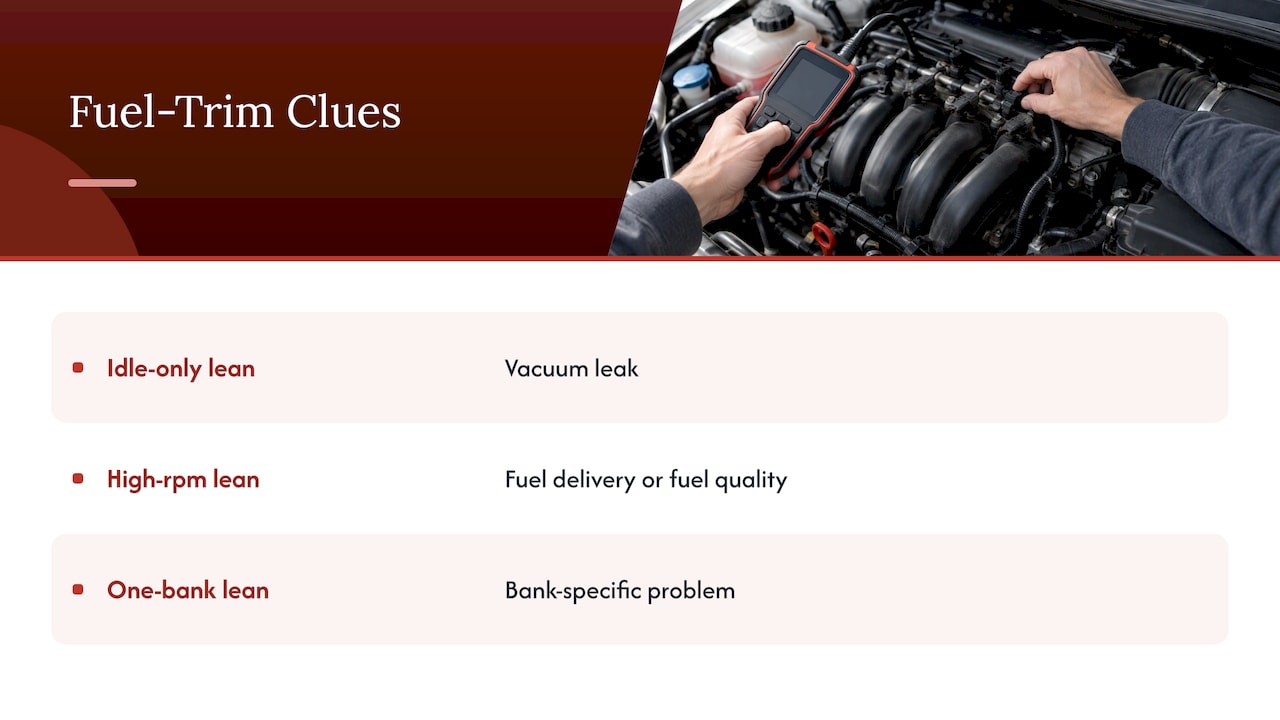
V6 and V8 engines have two banks of cylinders, each with its own trim values. A Mitsubishi training manual on fuel trim diagnosis recommends checking LTFT for both banks from freeze-frame data, then watching live data at idle and at 2,500 rpm. In that procedure, lean at idle only suggests a vacuum leak, lean at higher rpm only suggests fuel delivery or fuel quality, and lean on only one bank suggests a problem specific to that side of the engine.
Finding a vacuum leak with trims
The same manual describes isolating suspect vacuum components, such as the brake booster hose or PCV valve, while watching fuel trims to see which one changes the reading. That is the kind of controlled test a shop performs with the engine running. It is not a guess-and-replace routine.
Trims and misfires
Fuel trim also helps with intermittent misfires. A training article from Vehicle Service Pros reports that on a known-good car, short-term trim typically switches within plus or minus 4%, while fuel-related misfires commonly show STFT more than 15% positive and downstream oxygen sensor voltage under 350 mV. For a broader look at that problem, see our step-by-step misfire guide.
Fuel trim, lean codes and P0171
The computer is allowed only so much correction. When it needs to push both trims toward their limits to hold the mixture, it records a fault. Vehicle Service Pros says that when LTFT reaches plus or minus 25%, the check engine light comes on and a code such as P0171 (system too lean, bank 1) may be set. HSM University’s lesson puts the same idea in terms of total trim near plus or minus 25% for long enough.
This is why a lean code often arrives after weeks of slowly rising LTFT that nobody noticed. The computer hid the problem until it ran out of room.
A few practical notes:
- Can you keep driving with P0171? A lean condition can raise combustion temperatures and may lead to misfires or damage to exhaust parts over time. If the car runs rough, hesitates badly or flashes the check engine light, stop driving it and have it inspected. For a steady light with normal driveability, book a diagnosis soon rather than waiting.
- Is rich or lean worse? Neither is acceptable for long. The computer tries to hold the middle, and the goal of a diagnosis is to find why it cannot.
- Why did the light come on with no obvious symptom? Because trims can absorb a problem for a long time before the limit is reached.
Our overview of the types of car diagnostic tests shows where a fuel trim review fits among the checks a shop runs for a warning light.
Confirming the cause before replacing parts
Fuel trim narrows the field. It does not hand you a part number. Reasonable next steps depend on what the pattern showed:
- Fuel pressure. Technicians combine fuel pressure readings with scan data, injector testing and visual inspection. One training source explains that low pressure throughout can indicate a weak pump, restricted filter or regulator issue, while normal pressure with one misfiring cylinder can point to an injector.
- Smoke or visual inspection for air leaks when trims are worst at idle.
- Airflow and oxygen sensor data to make sure the computer is not reacting to a bad reading.
- Mechanical tests when misfires are involved. The Ross-Tech misfire resource stresses avoiding unnecessary parts replacement and confirming root causes with a checklist that includes freeze-frame review, compression and leak-down testing, and factory repair information.
There is also a cost angle. California’s Bureau of Automotive Repair publishes a diagnostic data form that says not to replace a catalytic converter when the vehicle is not in fuel control, and to record that the vehicle is in fuel control. In plain terms: fix the fueling problem first, or the new converter can be damaged by the same cause that killed the old one. Our write-up on the P0420 waveform test follows the same logic.
A sudden drop in mileage is another common reason to look at trims. See what to check when fuel economy drops suddenly for the full list.
Our perspective on fuel trim
We have been repairing cars in Lynnwood since 1985, and fuel trim is one of the first things we want to see when a driver says the car “just doesn’t feel right.” It is the computer’s own account of what it has been fighting.
The mistake we see most often is chasing the code instead of the pattern. A P0171 does not mean “replace the oxygen sensor” or “replace the mass airflow sensor.” It means the computer ran out of room to add fuel. The reason could be a cracked intake hose, a tired fuel pump or a sensor reading wrong, and the trim pattern across idle and higher rpm is what tells those apart.
That is why our ASE-certified technicians start with professional-grade OBD-II diagnostics and live data, then confirm with pressure, leak and sensor checks before recommending a repair. You get an upfront price for the work that is actually needed, and the repair is backed by our 24-month / 24,000-mile warranty. We work on all makes, including European and hybrid vehicles, because fuel trim logic applies across all of them even though the numbers and strategies differ.
If you have a check engine light, a rough idle or a mileage drop you cannot explain, bring the car in. Bring the code too if you have it, but we will test the whole picture.
Shingi
Get your fuel trim checked in Lynnwood
If your check engine light is on, or your car idles rough, hesitates or burns more fuel than it used to, a diagnosis that includes live fuel trim data is the right first step. Our team works on Toyota, Honda, Subaru, domestic, European and hybrid vehicles, and same-day appointments are often available. Start with our check engine light diagnostics or call ahead to book.
If the diagnosis turns up routine needs along the way, we can handle them in the same visit. Our oil change service starts at $100, AC repair starts at $150, and brake repair starts at $280 per axle. Military members, seniors and first responders qualify for exclusive discounts. For mixture problems that trace back to the engine itself, see our engine repair service.
FAQ
What is a normal fuel trim reading?
Most guidelines treat STFT and LTFT within about 5% as ideal, and total trim within about 10% as normal. Readings past 10% suggest the computer is working hard to correct something. Older engines can run a little higher because of normal wear, so mileage and conditions matter.
What does long-term fuel trim tell me that short-term trim does not?
Short-term trim shows what the computer is correcting this second, and it resets when the engine stops. Long-term trim shows the correction it has learned and stored over time. A steady, high LTFT points to a lasting condition such as a vacuum leak or a fuel delivery problem, rather than a momentary fluctuation.
Can I still drive with a P0171 code?
If the car drives normally and the light is steady, short trips to a shop are usually reasonable. A lean condition can lead to misfires and heat damage over time, though, so do not put off the diagnosis. If the engine runs rough, hesitates badly or the check engine light flashes, stop driving and get it inspected.
Can I read fuel trim myself?
Many OBD-II scan tools and apps display STFT and LTFT as live data, and freeze-frame data can show the trims at the moment a code was set. The harder part is interpretation: checking idle, 1,500 rpm and 2,500 rpm, and comparing banks. That is where a technician’s experience saves time and prevents replacing the wrong part.
Sources
- Fuel trim: How it works and how to make it work for you, Vehicle Service Pros
- Fuel Trim Adaptation, Snap-on Technical Focus
- Fuel trims and closed-loop control, HSM University AUTO-230 Lesson 5
- Fuel trims: the breakdown from Autodata
- Interpreting Generic Scan Data, MOTOR
- Mitsubishi fuel trim training manual TT-156-13-001
- Using fuel trims and downstream O2s to analyze intermittent misfire concerns, Vehicle Service Pros
- Fuel Pressure Test: Diagnosing Pumps, Injectors and More
- Appendix I Diagnostic Data Form, California Bureau of Automotive Repair
- Misfire Diagnosis, Ross-Tech Wiki
Recommended
- Fuel Economy Dropped Suddenly? Causes and What to Check
- Drivers: Start With Live Fuel Pressure If Power Drops Accelerating
- Rough Idle After Refueling: Causes, Checks and Fixes
- Engine Compression Test: What Car Owners Need to Know
Leave a Reply