
When to Replace a Timing Belt: Mileage, Age and Your Engine
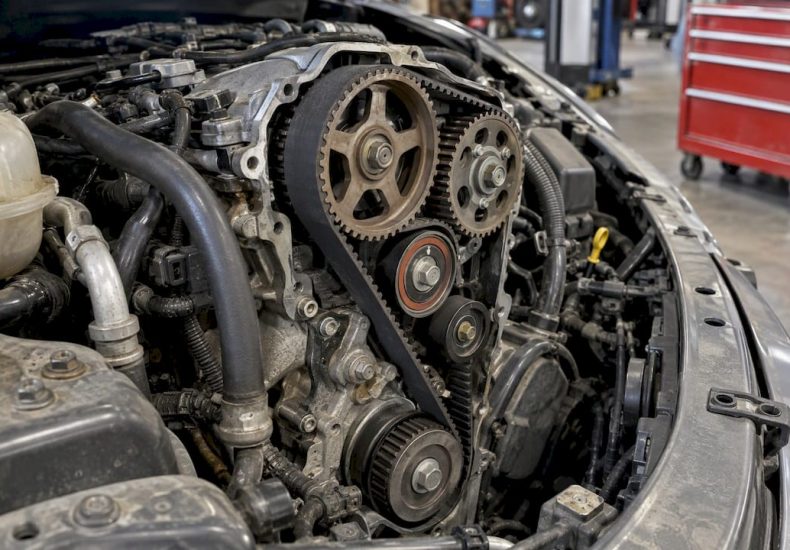
Replace your timing belt at the interval in your maintenance schedule, at whichever comes first: the mileage or the age limit. For most engines that means somewhere between 60,000 and 100,000 miles, or about six to ten years. The exact number depends on your engine, not just your car’s name. If you can’t say when the belt was last changed, treat it as due and have a technician look at it. Our team at Tom’s B & M Auto in Lynnwood, WA, handles timing belt replacement on all makes, including European and hybrid models.
TL;DR
- Most manufacturers set a timing belt interval between 60,000 and 100,000 miles. Some engines go to 150,000 miles, and some carry an age limit of 6 years or less.
- The mileage or the age limit applies, whichever you reach first. A low-mileage car can still be overdue.
- Your engine’s own line in the maintenance schedule is the number that counts. Two engines in the same model can have different intervals.
- Extreme heat or cold can shorten the interval. Honda, for one, publishes a 60,000-mile interval for those conditions.
- If the belt’s history is unknown, replace it. On many engines a snapped belt means major engine damage.
Table of Contents
- The short answer: mileage and age, whichever comes first
- Why the age limit matters as much as the miles
- How to find the interval for your engine
- Why a recall or a design problem can change the number
- Severe conditions can shorten the interval
- Warning signs, and why they are not a schedule
- What a broken belt can cost you
- What a thorough replacement looks like
- When the belt’s history is unknown
- Planning the job around your calendar
- How we think about timing belts
- Book your timing belt service in Lynnwood
- FAQ
- Sources
The short answer: mileage and age, whichever comes first
A timing belt is a toothed rubber belt that keeps the crankshaft (the shaft the pistons turn) and the camshaft (the shaft that opens and closes the valves) turning in step. If that sync is lost, the valves open at the wrong moment. Because the belt is reinforced rubber, it wears with miles and also ages with time and heat.
That is why manufacturers publish two limits. Here are a few published examples, so you can see how much the numbers vary:
| Engine / condition | Published interval | Source |
|---|---|---|
| Ford 1.0L engine | 100,000 miles or 6 years, whichever occurs first | Ford scheduled maintenance |
| Ford 1.6L engine | 150,000 miles | Ford scheduled maintenance |
| Honda, very hot or very cold climates | 60,000 miles | Honda owner’s manual |
| Lexus GS 300 (OE interval) | 6 years or 90,000 miles | Brake & Frontend |
Notice that the Ford 1.0L and 1.6L, both from one maker, sit 50,000 miles apart. A rule of thumb like “every 100,000 miles” is a starting point only. Your owner’s manual or the maintenance schedule for your exact engine is the answer.
Why the age limit matters as much as the miles
Many drivers look at the odometer and stop there. That is the most common way a belt ends up overdue.
Intervals are generally worked out on the assumption of about 10,000 to 12,000 miles a year. According to a trade publication on timing belts, a belt with only 40,000 miles that is 10 years old may need replacing after six years rather than waiting for the mileage limit. The rubber hardens, the cords inside age, and the teeth can crack even when the car sits most of the time.
A few examples of who gets caught by this:
- A second car driven 4,000 miles a year. At that rate a 100,000-mile interval takes 25 years to reach, but the age limit arrives long before.
- A used car bought with a clean-looking history. A low odometer reading says little about when the belt was installed.
- A retired commuter vehicle. Highway miles pile up fast on a daily commute, so the mileage limit may arrive first. Once the car is parked more, the age limit takes over.
Both limits are real. Treat the earlier one as your deadline.
How to find the interval for your engine
You don’t need to guess. Work through these steps in order.
- Confirm the belt exists. Not every engine has one. Many engines use a timing chain, which has no scheduled replacement interval in most maintenance schedules. Your owner’s manual engine specifications say how the camshaft is driven.
- Find your engine, not just your model. Many models offer several engines. The maintenance schedule line that reads “replace timing belt” should name your engine, for example a 1.0L versus a 1.6L, or a V6 versus a four-cylinder.
- Read both limits. Write down the mileage and the number of years or months. The first one you reach is your deadline.
- Check the severe-use notes. Many schedules list a shorter interval for extreme temperatures, towing, or heavy stop-and-go use. Honda’s manual, for instance, gives a 60,000-mile interval for very high or very low temperatures, and defines those as over 110°F or under -20°F.
- Look for a Maintenance Minder or service reminder. Some Honda and Acura models use a dash system that calls for the belt around the scheduled mileage. Treat that as a prompt to book, not a suggestion to wait.
- Find the last replacement. Look for an invoice, a sticker in the engine bay or on the timing cover, or a service record. No record means no proof.
If the manual is missing, a technician can look up the schedule for your VIN (vehicle identification number) in professional service data. We do this as part of our 30k, 60k and 90k service visits, since the timing belt often falls at one of those milestones.
Why a recall or a design problem can change the number
Sometimes the published interval itself proves too long. Coverage of a federal investigation reports that Ford is looking at roughly 135,000 Fiesta, Focus and EcoSport vehicles with 1.0L engines from model years 2014 to 2021 over timing belt material deterioration. Reported failures averaged around 70,000 miles, and about 98% happened before the earlier 150,000-mile interval. Ford plans to cut the recommended interval to 100,000 miles or six years.
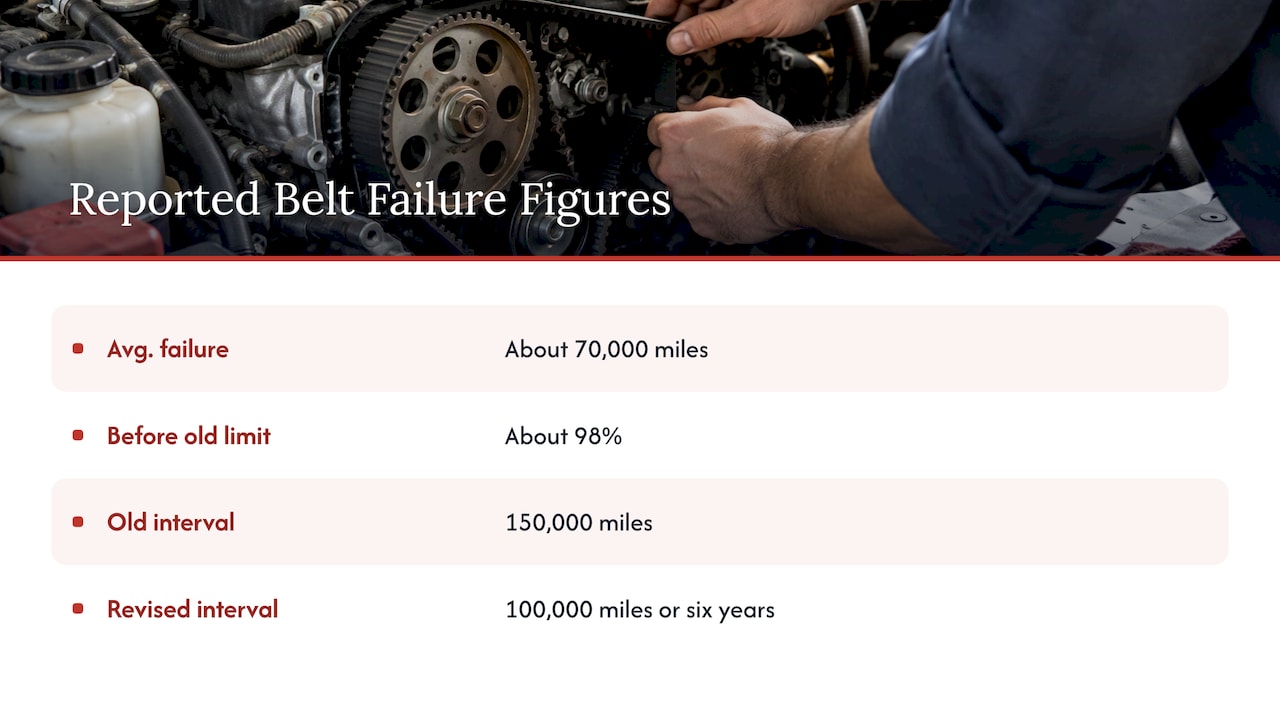
The lesson for any owner is simple: check your manual again every few years, because intervals get revised. An older printed manual may carry a number that the maker has since shortened.
Severe conditions can shorten the interval
We work in the Puget Sound area, where winters are wet and cold but rarely extreme. The conditions that make manufacturers shorten an interval are more specific:
- Sustained temperatures above 110°F or below -20°F
- Frequent short trips and heavy stop-and-go driving
- Towing, hauling or heavy loads
- Dusty or unpaved roads
- Oil or coolant leaking onto the belt from a nearby seal
That last item is the one most owners miss. Timing belts are designed to run dry. When oil or coolant reaches the rubber, it softens and weakens, and a belt that is only halfway through its interval can fail early. A leaking camshaft seal, crankshaft seal, water pump or valve cover gasket should be fixed when the belt is replaced, or the new belt faces the same risk.
If you are already planning seasonal care for the car, such as ceramic coating in cold weather, put the timing belt on the same list. Doing it before winter driving, rather than during it, avoids a breakdown in poor conditions.
Warning signs, and why they are not a schedule
Some belts give hints before they fail. Common signs include:
- Engine misfires or rough running
- Difficulty starting
- A ticking noise from the front of the engine
- Smoke or fumes
- Uneven performance as RPM changes
We cover these in detail in our guide to timing belt symptoms.
Treat the signs as a reason to book an inspection right away, never as a way to decide when to replace. A belt can look acceptable from the outside and still be past its rated life, because the cords inside age with time and heat. Many belts fail with no warning at all.
When a technician inspects a belt, the Toyota service manual for the RAV4 gives a good picture of what to look for. It calls for the camshaft timing belt to be inspected at 60,000 miles or 48 months, then every 15,000 miles or 12 months, and says the belt should always be checked on vehicles with more than 50,000 miles. The manual lists these reasons to replace:
- Cracks or tears in the belt surface
- Missing, damaged, cracked or rounded teeth
- Oil contamination
- Damaged or faulty tensioners
- Incorrect tension adjustment
Note that the manual lists tensioners as part of the same inspection. The belt works together with its tensioner and pulleys, and a problem with any of them can end the belt’s life.
What a broken belt can cost you
The reason for all this planning is what happens when a belt snaps. The outcome depends on the engine type.
- Interference engine. The pistons and the open valves share space at different moments. If the belt breaks, the camshaft stops while the crankshaft keeps turning, and the pistons can strike the valves. The result can be bent valves, damaged pistons, and in severe cases a cylinder head replacement or engine rebuild. The repair can run into thousands of dollars and may exceed what an older car is worth.
- Non-interference engine. The engine stops immediately, but internal damage is unlikely. You still get towed, and the belt still has to be replaced.
You can’t tell by looking which kind of engine you have. Don’t assume yours is the forgiving type. Replacing a belt on schedule is a planned repair; replacing an engine is an emergency.
What a thorough replacement looks like
A timing belt job is more than swapping one part. The belt sits behind covers, driven by pulleys and held by a tensioner, and on many engines the water pump runs off the same belt. A sound job covers these points:
- Confirm the interval and the engine so the correct kit is used.
- Inspect the surrounding parts: tensioner, idler pulleys and seals.
- Check for oil or coolant leaks onto the belt area and repair them first.
- Install the belt and set the timing precisely to the manufacturer’s marks.
- Set tension correctly, since incorrect tension shortens belt life.
- Turn the engine over by hand to confirm the marks align before the first start.
At our shop in Lynnwood, we use OEM-quality parts, and we back all repairs with a 24-month / 24,000-mile warranty. Our technicians are ASE-certified, and we do digital inspections, so you can see what we see. We also give upfront pricing before the work starts.
When the belt’s history is unknown
This is the situation most used-car owners face. You bought the car at 85,000 miles, there are no records, and the dash says nothing. What should you do?
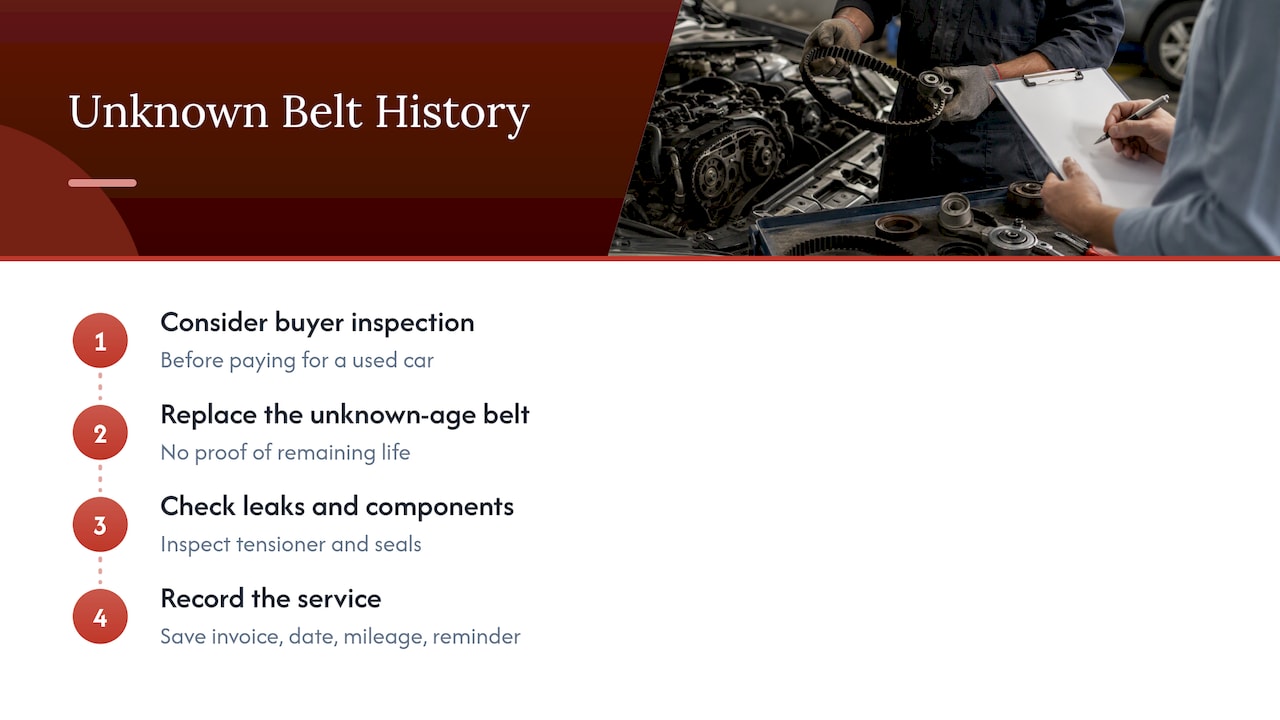
The safe answer is to replace the belt. A belt of unknown age has no proof of any remaining life, and the cost of replacing it is small next to the damage a failure can cause. During the job the technician can also check for leaks and the condition of the tensioner and seals, so you start with a known baseline and a record.
If you are buying a used car and want to know before you pay, a pre-purchase inspection can flag a belt that is due or an engine with oil leaks near the belt cover. We offer buyer inspections for exactly that reason, and you can use the result to negotiate or walk away.
Once the job is done, keep the invoice. Write the date and mileage in your own notes, and put a reminder in your phone for the age limit. Do both limits, not one.
Planning the job around your calendar
A timing belt job is usually scheduled work, so you can plan it. A few practical points:
- Book before the deadline, not on it. If your limit is 100,000 miles, book at 95,000. Leave room for parts and an appointment.
- Combine with other work. A 30k, 60k or 90k service visit is a natural time to handle the belt, since the car is already in and scheduled.
- Ask about the water pump and accessory belts. On engines where they share access, doing them together avoids paying twice for the same labor.
- Ask for the warranty terms in writing. Ours is 24 months / 24,000 miles on all work.
A note on cost. Timing belt jobs vary by engine and how much has to come apart to reach the belt. For that reason we quote the job for your specific car before work starts.
How we think about timing belts
We have been working on Lynnwood cars since 1985, and the timing belt is the job we most want owners to schedule instead of react to. It is a quiet part. It doesn’t announce itself, and you don’t hear it until the day it is too late.
Our advice is the same for every customer: find your engine’s interval, note both the mileage and the age, and book ahead. That is why our digital inspections matter to us. We want you to see the condition of your car, not take our word for it.
We work on all makes, including Toyota, Honda, Subaru, domestic, European and hybrid vehicles, and our ASE-certified technicians do the job with OEM-quality parts. We stand behind it with a 24-month / 24,000-mile warranty. Bring the car in before the interval, and we will make the schedule simple.
Shingi
Book your timing belt service in Lynnwood
If your belt is near its mileage or age limit, or you don’t know when it was last done, we can check it and give you an upfront price. We offer same-day appointments when we have openings, and we work on all makes and models, including European and hybrid vehicles. We also offer discounts for military, seniors and first responders.
Start with our timing belt replacement page for Lynnwood, or see everything we do at Tom’s B & M Auto. If your car needs an oil change first, that is also on our list, starting from $100.
FAQ
How often should a timing belt be replaced?
Most manufacturers set the interval between 60,000 and 100,000 miles, and some engines go as far as 150,000 miles. Many also set an age limit, often six years or more. Your engine’s line in the maintenance schedule is the exact answer.
Is it mileage or age that matters more?
Both matter, and the one you reach first is your deadline. Rubber ages with time and heat even when a car is rarely driven, so a low-mileage car can be overdue. Ford’s 1.0L engine, for example, carries a limit of 100,000 miles or 6 years, whichever occurs first.
Can I drive on a timing belt that looks fine?
A belt can look fine and still be past its rated life, because the cords inside age where you can’t see them. The schedule is a better guide than appearance. If the belt is near or past its limit, book the replacement.
Does every car have a timing belt?
No. Many engines use a timing chain instead, and chains don’t have a scheduled replacement in most maintenance schedules. Your owner’s manual’s engine specifications say how your camshaft is driven. If you are unsure, we can confirm it for your VIN.
What if I just bought a used car with no records?
Treat the belt as due. Without proof of when it was installed, you can’t know how much life is left. Replacing it gives you a clean starting point and a record to keep.
Sources
- Ford scheduled maintenance, normal schedule
- Honda owner’s manual, timing belt interval
- Engine maintenance: timing belt replacement on Lexus GS 300s
- Timing belt tips
- NHTSA escalates Ford timing belt probe
- Toyota RAV4 service manual, maintenance
- Applying ceramic coating in cold weather
Recommended
- Timing Belt Symptoms: Warning Signs and What to Do Next
- High Mileage Vehicle Maintenance Tips That Work
Leave a Reply