
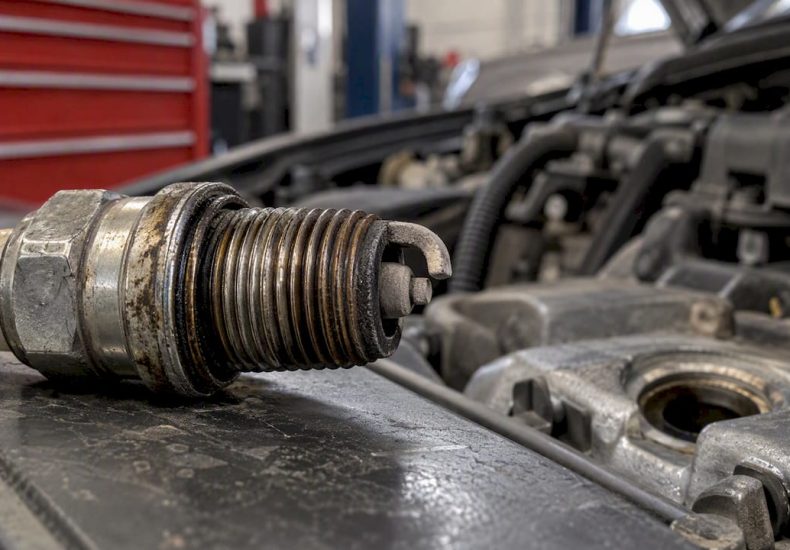
Worn Spark Plug Symptoms: 8 Signs and What to Do
Worn spark plugs usually show up as a rough idle, hard starting, weak acceleration, worse gas mileage, misfires or a check-engine light. The plug’s job is to ignite the air-fuel mixture in each cylinder. When its electrodes round off or its tip gets coated, that spark gets weaker or fails, and you feel it in how the car runs. Toyota lists a check-engine light, difficult starting or stalling, higher fuel consumption, rough idle and poor acceleration as the effects of worn plugs.
The catch is that none of these signs points only to plugs. Below you will find what each symptom feels like, what wears or fouls a plug, what gets mistaken for plug trouble, and how to decide whether to drive on or book a shop visit.
TL;DR
- The classic signs are rough idle, hard starts, sluggish acceleration, lower mileage, misfires and a check-engine light.
- Worn plugs have rounded electrodes and a wide gap. Fouled plugs are coated in carbon, oil or fuel. Both cause similar symptoms.
- Coils, wires, injectors, fuel and sensors can imitate bad plugs, so scan and test before buying parts.
- A flashing check-engine light or a persistent misfire should not wait: unburned fuel can damage the catalytic converter.
- Find your replacement interval in the owner’s manual. Plugs commonly last tens of thousands of miles, but the range is wide.
Table of Contents
- The main worn spark plug symptoms
- Worn plugs versus fouled plugs
- What gets mistaken for bad spark plugs
- Is it okay to drive with worn spark plugs?
- When to replace spark plugs
- What a shop does when you bring in a rough-running car
- Our perspective
- Get it checked in Lynnwood
- FAQ
- Sources
The main worn spark plug symptoms
Plug makers list almost the same set of symptoms. Autolite names misfires, a check-engine light, rough idling, difficult starting, lack of acceleration and poor fuel economy. Here is how each one tends to feel from the driver’s seat.
1. Rough idle
At a stoplight the engine shakes, the steering wheel buzzes, or the tachometer needle wobbles. With a weak spark, one cylinder fires late or not at all, so the engine loses its even rhythm. It is most noticeable at idle because the engine has so little momentum to smooth over a missed firing.
2. Hard starting or stalling
The engine cranks longer than it used to, or catches and then dies. Worn plugs need more voltage to jump a wider gap, and a cold engine makes that harder. If the car cranks normally but will not catch, plugs are one possibility among several. If it will not crank at all or only clicks, you are looking at a different problem, and our no crank, no start guide walks through it.
3. Sluggish acceleration
You press the pedal and the car answers late or weakly, especially when climbing a hill or merging onto I-5. DENSO notes that extreme electrode wear shows up as poor starting and poor acceleration. Power loss under load can also come from fuel delivery, which we cover in our piece on power loss when accelerating.
4. Worse gas mileage
When some of the fuel in a cylinder does not burn properly, you spend more fuel for the same distance. It is a slow change, so track a few tanks before blaming the plugs. A drop that arrives together with any other symptom here is worth a look.
5. Engine misfires
A misfire feels like a stumble, a hiccup or a brief jerk, often under acceleration. NGK explains that carbon deposits can give the spark an easier path over the insulator nose than across the gap, which usually causes a misfire and more fouling. For a deeper look at the mechanics, see our guide on what engine misfiring is and what causes it.
6. Check-engine light
The engine computer watches for misfires and sets a code. A steady light means a fault has been stored. A flashing light means an active, severe misfire, and you should stop driving it hard. Codes in the P0300 family point to misfires; our P0300 diagnosis walkthrough explains how a shop reads them.
7. Unusual noises
People search for what a bad plug sounds like. There is no single sound. A misfire can come across as a sputtering or popping, and a rough-running engine can sound uneven or chugging. Pinging or knocking under load is a different warning and deserves its own diagnosis.
8. Visible wear when the plug is pulled
The most reliable evidence is the plug itself. DENSO describes extreme wear as rounded center and ground electrodes with an excessively wide gap, caused by inadequate maintenance or running past the plug’s service life. A cracked insulator is another failure. DENSO says a crack can short electrically and cause poor idling and misfiring during acceleration, and improper removal, installation or over-tightening can cause it.
Worn plugs versus fouled plugs
People type “worn” and “fouled” interchangeably, but they are different problems with different fixes. Autolite says worn plugs may have cracked insulators or worn electrodes, while fouled plugs are coated by excess fuel, oil or combustion deposits. Its practical point: heavy deposits that do not come off easily mean the plug should be replaced, and a worn or damaged plug generally needs replacing, not cleaning.
Fouling is also a clue about something else going on in the engine. The deposit type tells you where to look.
| What you see on the plug | What it usually means | Typical causes |
|---|---|---|
| Dry black soot | Carbon fouling | Short trips with a cool engine, a rich mixture, a plug heat range that is too cold |
| Black, oily deposits | Oil fouling | Oil reaching the cylinder past worn rings, cylinder walls or valve guides |
| Wet, gasoline-smelling tip | Fuel fouling | A very rich mixture that is not igniting |
| Blisters, melted electrodes, white deposits | Burned plug, running too hot | Overheating conditions, wrong heat range |
The first three rows come from DENSO’s troubleshooting guide, and Champion’s plug-reading guide describes the black dry soot, black oily deposits and the blistered or white burned plug. NGK adds that carbon fouling can also come from continuous low-speed driving, reduced compression, over-retarded timing and a deteriorating ignition system.
This is why replacing fouled plugs without asking why they fouled is a gamble. Oily plugs point to an oil-consumption issue, and new plugs will foul again. Sooty plugs on a car that only does short school-run trips may just need longer drives, but sooty plugs on a car that runs rough at highway speed point to a mixture or ignition problem.
What gets mistaken for bad spark plugs
Rough idle, a misfire and a power drop have a long list of causes. Worn plugs are common because they are a wear item, but the same symptoms can come from:
- Ignition coils or coil boots. Many modern engines have one coil per cylinder, and a failing coil causes a misfire that feels identical to a bad plug.
- Spark plug wires on older engines with a distributor or coil packs.
- Fuel injectors or fuel pressure. A clogged injector starves one cylinder.
- Oxygen sensors and other sensors feeding bad data to the engine computer. Our O2 sensor symptoms guide shows how to separate sensor problems from ignition problems.
- Vacuum leaks and air intake faults, which commonly produce a rough idle. If the idle gets worse after a fill-up, see our rough idle after refueling article.
- Timing or mechanical problems, such as low compression.
If the car stalls when you come to a stop, our guide to why a car stalls at idle lists the usual suspects in order.
The lesson is to diagnose before you replace. A scan for stored misfire codes tells you which cylinder is misfiring, and that narrows the search. A common shop move is to compare plug, coil and injector for that cylinder against a healthy one. Replacing all the plugs on a car whose real problem is a failing coil costs money and leaves the symptom in place.
Is it okay to drive with worn spark plugs?
A mild symptom, such as a slightly rough idle or a small mileage drop, will not strand you tomorrow, but it will not improve either. Champion advises seeing a mechanic if you have reduced mileage, lack of acceleration, hard starts, misfires or rough idling from fouled or bad plugs.
Some situations are not the type to wait out:
- A flashing check-engine light. This signals an active misfire. Reduce load, avoid hard acceleration and get the car inspected as soon as you can.
- A misfire that persists. Toyota’s guidance links continued misfire to possible catalytic converter damage, which is one of the more expensive repairs on a modern car.
- Stalling in traffic or losing power while merging. That is a safety issue, not just an annoyance.
The reasoning is simple. A cylinder that does not fire sends unburned fuel into the exhaust, and that fuel burns inside the catalytic converter. Handling a worn plug early is typically far cheaper than replacing a damaged converter.
When to replace spark plugs
There is no single mileage that fits every car. Toyota recommends replacing plugs according to the manufacturer’s schedule, or sooner when performance calls for it. The schedule lives in your owner’s manual, usually in the maintenance section.

The type of plug matters a lot. Copper plugs wear fastest. Iridium and platinum plugs last longer. NGK says its traditional iridium plugs have a life expectancy of 40,000 to 50,000 miles, and longer-life designs are rated beyond that. Your car may call for a very different interval, so the manual comes first.
A few habits shift the timing:
- Lots of short trips or stop-and-go traffic let carbon build up faster, as the fouling causes above show.
- Oil consumption can foul plugs ahead of schedule.
- Skipped maintenance is the biggest factor. DENSO puts extreme wear down to inadequate maintenance or exceeding the plug’s service life.
On many cars the plugs get checked or replaced as part of a major interval service. If your car is near 30,000, 60,000 or 90,000 miles, ask what that service includes for your make and model.
What a shop does when you bring in a rough-running car
A proper check goes in a sensible order, so you are not paying for parts you do not need:
- Scan for codes. Misfire codes in the P03XX range say whether it is one cylinder or several.
- Look at live data. Fuel trims and misfire counts show whether the problem is ignition, fuel or air.
- Inspect the plugs. Electrode shape, gap, insulator cracks and deposit color say what is happening in each cylinder.
- Test the ignition side. Coils, boots and wires are checked or swapped between cylinders to see whether the misfire follows the part.
- Fix the cause, then the plugs. If oil or fuel fouled the plugs, that gets addressed too, so the new set lasts.
If the check ends in a misfire repair, our guides on fixing engine misfires step by step and what misfire repair costs help you know what to expect.
Our perspective
We see the same pattern most weeks: a car comes in with a rough idle and the owner is sure it is the plugs. Sometimes it is. Often the plugs are only part of the story, and that is why we start with a scan and an inspection instead of a parts list.
Modern engines are tight about ignition. Hybrids and European cars in particular can be fussy about plug type, torque and gap, and a crack from over-tightening is an easy mistake. We work on all makes, including hybrid and European vehicles, and our technicians are ASE-certified.
Our advice is to treat plugs as scheduled maintenance, not an emergency repair. Following the interval in your owner’s manual is cheaper than waiting for a misfire to put your catalytic converter at risk. And if symptoms appear before that interval, bring the car in early. We would rather confirm the cause once than replace parts twice.
Shingi
Get it checked in Lynnwood
If your car idles rough, hesitates or has a check-engine light on, we can find out whether the plugs are the cause. We offer diagnostics with professional-grade OBD-II scanning, upfront pricing, and a 24-month / 24,000-mile warranty on our work. Same-day appointments are often available. We serve Lynnwood drivers of Toyota, Honda, Subaru, domestic, European and hybrid vehicles.

See our engine repair in Lynnwood page, or start from our main site to find check engine light diagnosis and our other services. Military members, seniors and first responders can ask about our discounts.
FAQ
What are four signs a spark plug should be replaced?
The four most common are rough idle, hard starting, sluggish acceleration and worse fuel economy. Misfires and a check-engine light often follow. If you see two or more together, have the car scanned rather than guessing.
What can be mistaken for bad spark plugs?
Failing ignition coils, worn plug wires, dirty or clogged fuel injectors, faulty sensors and vacuum leaks can all cause the same rough running. A code scan that identifies the misfiring cylinder is the quickest way to tell them apart.
Is it okay to drive with worn spark plugs?
Short-term driving with mild symptoms is usually possible, but the problem tends to get worse and can raise fuel use. A flashing check-engine light or a steady misfire should be handled promptly, since continued misfire can damage the catalytic converter.
What does a faulty spark plug sound like?
There is no single sound. Drivers describe sputtering, popping or an uneven, chugging engine note, often with a shake at idle. If you hear knocking or pinging under load, mention it, because that points to a different issue.
Can fouled plugs be cleaned instead of replaced?
Light contamination may sometimes be removed, but Autolite’s guidance is that heavy deposits that do not come off easily call for replacement, and worn or damaged plugs need replacing. Find out what caused the fouling so it does not come back.
Sources
- Signs of Bad and Fouled Spark Plugs, Autolite
- Troubleshooting, Spark Plug Basic Knowledge, DENSO
- How Often to Change Spark Plugs, Toyota
- Spark Plug Basics, NGK Spark Plugs
- Reading Spark Plugs Color, Champion
- Symptoms of Bad Spark Plugs, Champion
- How Long Will My Iridium Spark Plugs Last, NGK
Recommended
- Fix Engine Misfires Step by Step: A Car Owner’s Guide
- O2 Sensor Symptoms: Scan, Live Data, and Wiring Before Replacement
- Ten Minute Pressure Test: Fuel Pump Failure Symptoms to Check First
- What Is Engine Misfiring? Causes, Signs, and Fixes
Leave a Reply