
$160–$700 to Fix? Valve Cover Gasket Leak Checks for Car Owners
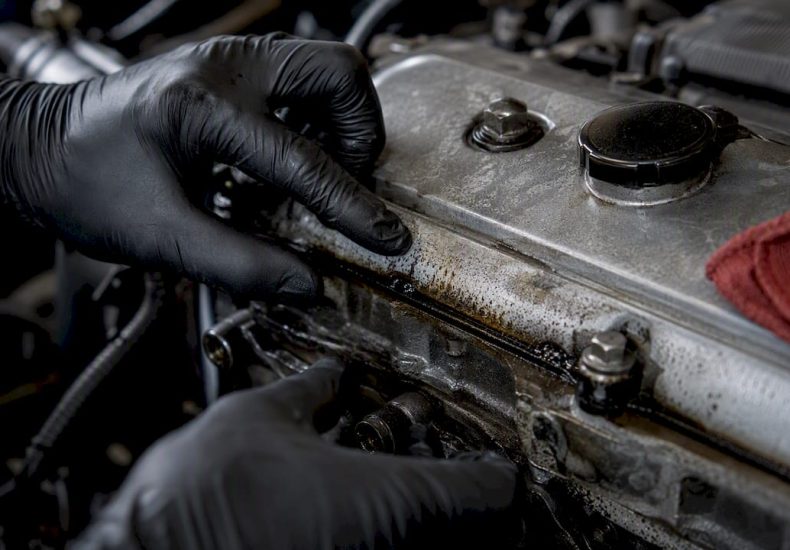
A valve cover gasket leak is rarely a drop-everything emergency, but it can turn into one fast if oil is dripping onto hot exhaust parts or your oil level is falling quickly. Pull the dipstick, check for a burning smell or visible smoke, and if either shows up, stop driving and call a shop. If it’s just a faint seep, you have time. Read on before you decide.
TL;DR:
- Most valve cover gasket leaks are small initially but can develop into major engine damage if oil reaches hot exhaust parts or causes rapid oil loss.
- Confirming the leak requires cleaning the engine, inspecting oil migration paths, and checking spark plug wells for oil pooling, not just a quick visual scan.
- Gasket failure mostly results from aging rubber or cork material, with additional failure points including cracked seals, over-tightened bolts, or clogged PCV valves.
- Replacement costs range from $160 to $700, mostly due to labor, and involves replacing seals, tube grommets, and possibly the entire cover on modern European engines.
- Driving with a mild seep is possible temporarily if no smoke or burning smell appears, but any serious signs such as smoke, misfires, or rapid oil loss demand immediate repair.
Table of Contents
- Valve Cover Gasket Leak Symptoms: How Serious Is Yours?
- How Do You Confirm It’s the Valve Cover Gasket?
- What Causes a Valve Cover Gasket to Fail?
- Valve Cover Gasket Replacement Cost: What to Expect
- Can You Drive With a Valve Cover Gasket Leak?
- Preventing Future Valve Cover Gasket Leaks
- How Tom’s B & M Auto Diagnoses and Fixes This Leak
- What This Leak Actually Tests, and Where Owners Get It Wrong
- Book a Valve Cover Gasket Check With Tom’s B & M Auto
- Sources
- FAQ
Valve Cover Gasket Leak Symptoms: How Serious Is Yours?
Most valve cover gasket leaks start small and stay small for a while. The trouble is telling “small” from “about to get expensive.”
Early-stage leaks show up as a faint burning smell after highway driving, a damp seam along the top edge of the engine, or a light oily film across the valve cover itself. You might notice fresh drops on the driveway that weren’t there last week. None of that demands a tow truck, but it’s your cue to get it looked at soon.
Serious signs mean something different. Oil pooling inside the spark plug wells is a big one, and it often triggers misfires and P030x diagnostic codes because the oil fouls the coil boots and plug tips. Visible smoke from under the hood, or a dipstick that reads noticeably lower every few days, both mean the leak has moved past “annoying” into “damage the engine” territory.
- Faint burning smell after highway driving: monitor, schedule a repair
- Oily film or damp seam on the cover: monitor, schedule soon
- Oil in spark plug wells with misfires: get it diagnosed this week
- Visible smoke or fast-dropping oil level: stop driving, call a shop now
Most of these leaks develop as the rubber or cork gasket material hardens and loses its seal with age and heat cycling. Pro Tip: Check your oil level with a flashlight against the dipstick in daylight, not in a dim garage. A quarter-inch difference is easy to miss under shop lighting but obvious outdoors.
How Do You Confirm It’s the Valve Cover Gasket?
Oil travels. That’s the single biggest reason valve cover gasket leaks get misdiagnosed, and it’s why shops insist on cleaning and re-testing rather than guessing from a quick glance.
- Start cold. Check the dipstick and look at the top of the engine before you drive anywhere that day.
- Clean the suspect area with brake cleaner and a rag, then let the engine run for 10 to 15 minutes.
- Shut it off and trace oil from the highest wet point downward. Oil almost always migrates down and back with airflow, so the top of a trail is closer to the real source than the bottom.
- Pull the coil boots (if you’re comfortable doing it safely) and check inside the spark plug wells for oil pooling.
- If the source still isn’t obvious, a shop can add UV dye to the oil and use a blacklight to spot the exact leak path, or use a mirror and flashlight to check angles you can’t see directly.
That clean-and-run method matters because a valve cover gasket leak can look identical to an oil filter housing leak, a failing rear main seal, or a cam seal weeping from higher up. Technicians routinely find that what looked like a valve cover problem was actually oil traveling down from a different seal entirely.
Pro Tip: If you just changed your oil or topped it off, wait a day before diagnosing. Fresh oil overspill on the engine can mimic a leak and send you chasing a problem that doesn’t exist.
What Causes a Valve Cover Gasket to Fail?
Rubber and cork gaskets harden and shrink with age and heat cycling, which is the root cause behind most leaks that show up past 60,000 miles. That’s normal wear, not a defect, but a handful of related failures often ride along with it.
- Spark plug tube seals crack or shrink at the same rate as the main gasket, since they’re made of the same material and sit in the same heat.
- Bolt grommets compress and lose their seal, letting oil seep around the bolt heads even when the main gasket looks fine.
- A clogged PCV valve builds excess crankcase pressure, which pushes oil past a gasket that would otherwise still be holding.
- Over-tightened cover bolts warp the sealing surface or crack the cover outright. Technicians see this constantly on DIY jobs where someone cranked the bolts down “extra tight for good measure.”
Left unaddressed, oil sitting in the spark plug wells can degrade or destroy the ignition coils, and constant seepage onto a hot exhaust manifold puts oil vapor near your catalytic converter. Neither failure is common on day one of a leak, but both get more likely the longer it’s ignored.
Valve Cover Gasket Replacement Cost: What to Expect
Parts for this job are cheap. Labor is where the bill actually comes from, and that’s true whether you’re at an independent shop or a dealer.
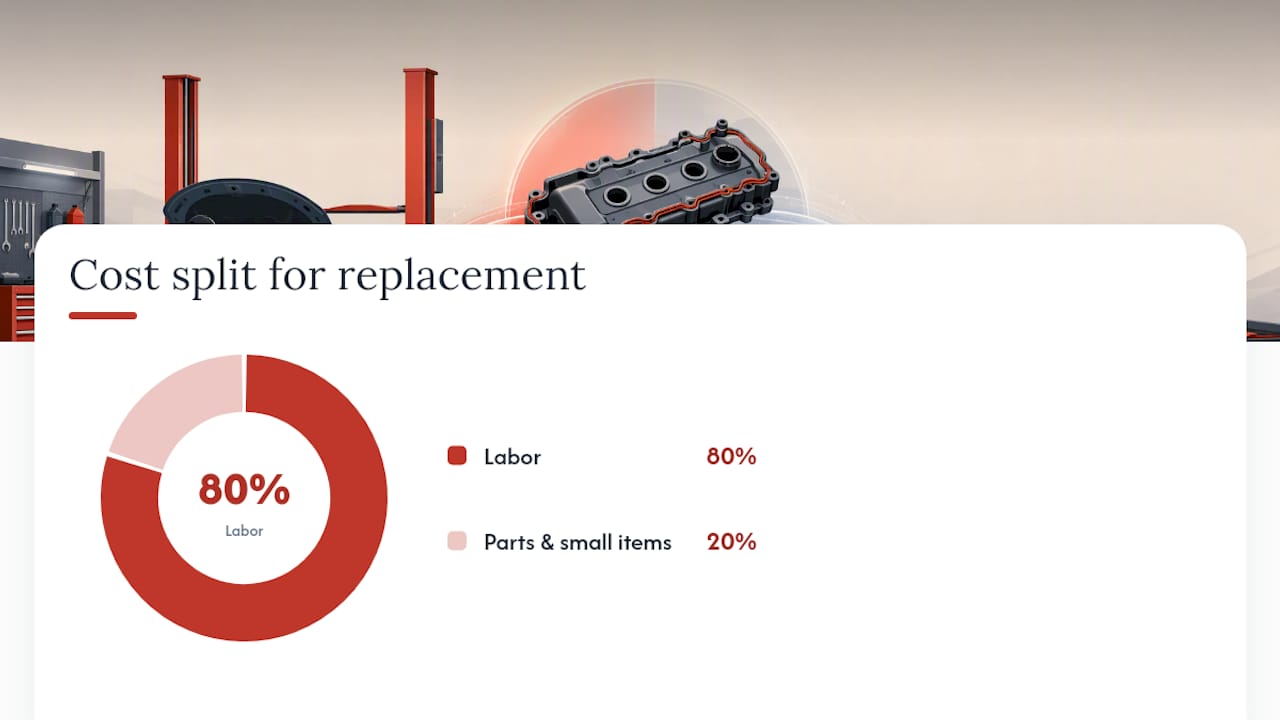
Replacement typically runs $160 to $700, with labor accounting for roughly 80% of that total and parts making up the rest. An inline-4 engine with easy top-end access sits at the low end of that range. Boxer engines, V6 and V8 layouts with tight clearances, and European models with integrated cover assemblies push toward the high end, sometimes past it.
That last category matters more than people expect. A lot of modern European engines use a valve cover with the gasket, PCV components, and sometimes even seals molded into a single unit. When that fails, you’re not replacing a gasket, you’re replacing the whole cover assembly, which is a very different invoice.
A repair done right includes more than the gasket itself:
- Full gasket kit, including new spark plug tube seals and bolt grommets, since skipping these is the most common reason a “fixed” leak comes back within a year
- RTV sealant at specific corners or seams, only where the manufacturer calls for it
- A fresh PCV valve if the old one was clogged and contributing to the leak
- A flatness check on the cover and cylinder head mating surface, especially past 150,000 miles, since warpage over roughly 0.002 inches usually needs machining to stop repeat leaks
DIY is realistic for straightforward inline engines if you have a torque wrench, decent clearance around the cover, and patience. The process itself is fairly linear: clean the area, remove anything blocking cover access, lift the cover, scrape the mating surfaces clean, set the new gasket, and torque the bolts to spec in the correct sequence. Skip that sequence or eyeball the torque and you risk the exact over-tightening problem that caused the original failure. When you call a shop, ask for a flat-rate labor estimate, a line-item parts list, and a written warranty on the work, not just a lump-sum number.
Can You Drive With a Valve Cover Gasket Leak?
Sometimes, but only under specific conditions, and the line between “fine to drive” and “park it now” isn’t fuzzy.
- Stop driving immediately if you see smoke from the engine bay, smell burning oil paired with a dipstick that’s dropping day to day, or feel a rough idle or misfire. Any of those three means oil is likely reaching a hot surface or an ignition component.
- If it’s a mild seep with no smoke, no smell, and a stable oil level, you can keep driving short distances while you schedule a repair, but check the dipstick daily and avoid long highway trips or hard acceleration in the meantime.
- Get it towed rather than driven if you’re seeing all three warning signs together. Oil dripping onto a hot exhaust manifold is a real fire risk, and running an engine low on oil can seize it in minutes, not miles.
Preventing Future Valve Cover Gasket Leaks
A gasket replacement that ignores the reasons the old one failed just buys you a repeat visit in a year or two.
- Replace the PCV valve on schedule and clear the passages around it. A clogged PCV is one of the quieter causes of crankcase pressure that stresses gaskets from the inside.
- Stick to your oil change interval and use the oil grade your manufacturer specifies. Degraded oil and the wrong viscosity both add stress to seals over time.
- Always torque cover bolts with a torque wrench, following the manufacturer’s sequence. Shops that skip repeat leaks generally follow this rule without exception, since guessing at bolt tightness is how covers crack.
- Replace spark plug tube seals and bolt grommets at the same time as the gasket, even if they look okay. They’re cheap now and expensive to redo later.
Pro Tip: Skip the bottle of stop-leak additive some parts stores push for this. The gasket is a static seal, not a moving one, and these additives generally can’t reach or swell it the way they claim, though they can gum up other seals in the process.
How Tom’s B & M Auto Diagnoses and Fixes This Leak
Technicians run a process for valve cover gasket jobs: clean the suspect area, reproduce the leak on a short test run, trace it to its source with OBD-II diagnostics if a misfire occurs, then replace the gasket along with tube seals and bolt grommets rather than the gasket alone. Bolts are torqued to factory specifications. Repairs typically include a 24 month, 24,000 mile warranty. If smoke or a fast-dropping dipstick is observed, customers are advised to get the vehicle towed rather than drive it.
What This Leak Actually Tests, and Where Owners Get It Wrong
The conventional advice on valve cover gasket leaks treats every leak the same: quote a number, replace the gasket, done. That misses the part that actually determines whether you’re back in the shop next year.
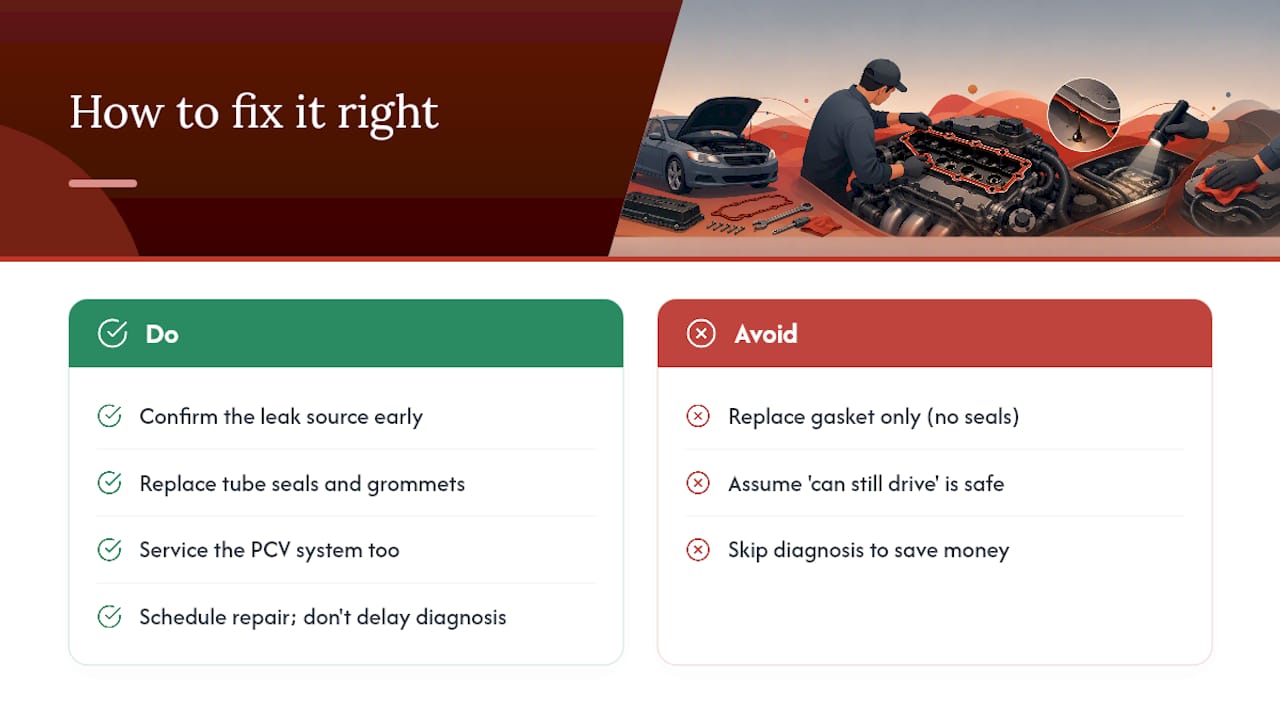
The real test isn’t whether you can afford the $160 to $700 range most jobs fall into. It’s whether the shop (or you, if you’re doing it yourself) treats the tube seals, grommets, and PCV system as part of the job instead of an upsell. Skip those, and you’re not fixing the leak, you’re pausing it.
I’d also push back gently on how much weight owners put on the “can I still drive it” question. The honest answer is that most mild seeps genuinely can wait a week or two for a scheduled appointment. What can’t wait is the diagnosis. Too many owners assume a leak that isn’t smoking yet doesn’t need attention, and that’s how a $300 gasket job turns into a $1,200 job with new ignition coils added in. Confirm the source early. Fix it once, correctly, and the mileage window before you’re back here again stretches out considerably.
— Shingi
Book a Valve Cover Gasket Check With Tom’s B & M Auto
Tom’s B & M Auto is the straightforward alternative to guessing at a leak yourself or gambling on a bottle of stop-leak additive. Bring your car to our Lynnwood shop and you get an actual diagnosis, not just a quote based on a description over the phone.
Same-day appointments are often available, and every estimate is broken down by parts and labor before we touch anything, so you know exactly what a full gasket kit, tube seals, and grommets add up to versus a stripped-down job. If the repair runs bigger than expected, ask about our financing options or check whether our current $50 off repairs over $300 offer applies. Not sure how urgent your leak actually is? Our free digital vehicle inspection will settle that before you commit to anything. When you call, mention what you’re seeing (smell, smoke, oil level, misfires) so we can schedule the right kind of appointment, and every job comes backed by our 24 month, 24,000 mile warranty. Ready to get it looked at? Schedule your valve cover gasket service in Lynnwood today.
Sources
- Symptoms of valve cover gasket leak | Autodiagly
- Valve Cover Gasket Replacement cost guide | AutOwner
- Valve cover gasket replacement guide and cost considerations | RepairPal
- How to replace a valve cover gasket | Mobil
FAQ
How much does it cost to fix a valve cover gasket leak?
Most jobs run $160 to $700, with labor making up roughly 80% of that cost. European engines with integrated cover assemblies often land at the higher end or beyond.
Can I drive a car with a valve cover leak?
Yes, briefly, if it’s a mild seep with no smoke, no burning smell, and a stable oil level. Stop driving and call a shop if you see smoke, smell burning oil alongside a dropping dipstick, or feel a misfire.
Is it worth fixing a leaking valve cover gasket?
Yes. It’s one of the cheaper engine leaks to repair, and delaying it risks oil damaging your spark plugs, ignition coils, or catalytic converter, which turns a few-hundred-dollar fix into a much bigger bill.
How long can you go with a leaky valve cover gasket?
A minor seep can often wait one or two weeks for a scheduled appointment as long as you check the oil level daily. Any sign of smoke, rapid oil loss, or misfires means you shouldn’t wait at all.
Recommended
- Valve Cover Gasket Replacement in Kenmore, WA
- Valve Cover Gasket in Mountlake Terrace, WA
- Valve Cover Gasket Replacement in Edmonds, WA
- Valve Cover Gasket Replacement in Shoreline, WA
Leave a Reply