
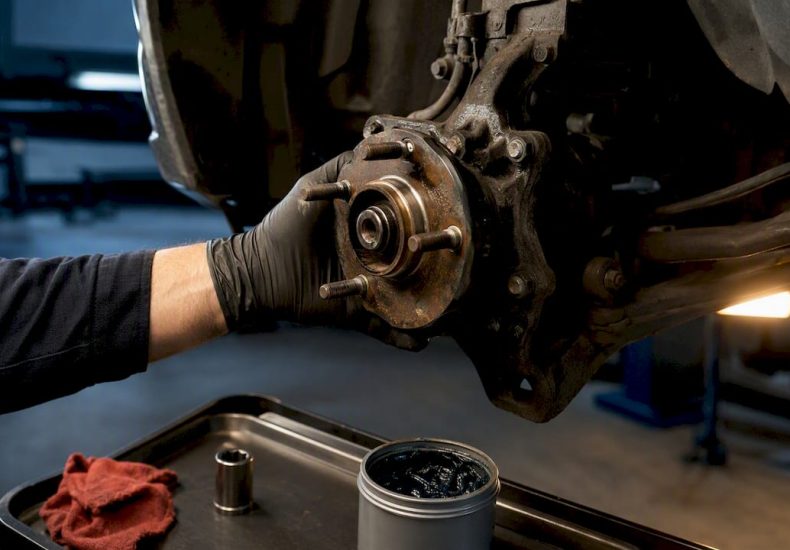
Avoid a $150–$400 Repair: 5 DIY Checks for Wheel Bearing Noise
A humming or growling noise that gets louder as you accelerate and shifts pitch when you turn the wheel almost always points to a failing wheel bearing. It’s safe to drive short distances if the sound is mild and steady, but stop immediately if you hear grinding, feel play in the steering, notice heat at the wheel, or see an ABS warning light. Your first move: try the steering sway test below, or get it looked at.
TL;DR:
- The noise from a failing wheel bearing gets louder with acceleration and shifts pitch when turning, especially if a specific direction makes it worse.
- Symptoms such as wheel wobble, ABS warning lights, uneven tire wear, and changing brake pedal feel indicate urgent repair is needed to prevent wheel separation or bearing seizure.
- Repair costs usually range from $150 to $400 per wheel, depending on whether the bearing is serviceable or sealed, vehicle type, and local labor rates; delaying repairs risks additional damage.
- A proper diagnosis involves a road test with specialized equipment and multiple inspections, as noise can mimic other issues like tire wear or CV joint problems.
Table of Contents
- Wheel Bearing Noise: The Sounds and Signs to Watch For
- How to Diagnose Wheel Noise Yourself Before Calling a Shop
- Wheel Bearing Vs Tire Noise and Other Look-Alikes
- What a Professional Wheel Bearing Inspection Actually Involves
- Is It Safe to Drive With Wheel Bearing Noise, and What Will It Cost?
- What to Do Before You Book the Repair
- Why Trust This Diagnosis
- The Bearing Diagnosis Most Shops Get Backwards
- Sources
Wheel Bearing Noise: The Sounds and Signs to Watch For
A wheel bearing lets your wheel spin freely while carrying the full weight of your car. When it wears out, that friction turns into noise, and the noise tells you a lot before a mechanic ever touches the vehicle.
Most drivers describe the early stage as a low hum or drone, similar to driving on a wet road. As wear progresses, that hum deepens into a growl or rumble, and in advanced cases it turns into a grinding or clicking noise that’s impossible to ignore. The critical clue is speed sensitivity: a failing bearing gets louder as you accelerate, then fades or changes pitch when you ease off the gas. Tire noise, by contrast, tends to stay more constant regardless of load.
Turning adds another layer of information. A sharp left or right turn shifts weight onto one side’s bearings, so if the noise gets louder turning one direction and quieter turning the other, you’ve likely found your problem corner.
Pro Tip: Listen closely the next time you brake gently at low speed. Some drivers notice the hum briefly quiets down when the brakes clamp down, because pedal pressure temporarily reduces play in the hub. That’s not a good sign. It’s the bearing telling you it has room to move that it shouldn’t.
Other clues worth tracking:
- A steering wheel vibration that builds with speed, separate from a wobble you’d feel from an unbalanced tire
- An illuminated ABS or traction control light, since wheel speed sensors sit right next to the bearing
- Uneven or accelerated tire wear on one corner, caused by the wobble a loose bearing introduces
- A change in brake pedal feel, since hub movement can shift the rotor’s position relative to the caliper and mimic a hydraulic issue
How to Diagnose Wheel Noise Yourself Before Calling a Shop
You don’t need a lift to narrow down which corner is making noise. These checks take fifteen minutes and can save you from an unnecessary part swap.
- Run the steering sway test. At a safe, steady highway speed on an empty road, gently sway the wheel left and right without changing lanes. If the hum grows louder loading one side and softer loading the other, that side’s bearing is the likely source. A noise that stays flat no matter which way you steer usually points to tires instead.
- Do the jack-and-wiggle test. With the wheel off the ground, grip the tire at the 12 and 6 o’clock positions and rock it in and out. Any looseness or clunk you feel at that position, but not at 3 and 9 o’clock, points more toward a bearing than a tie rod or ball joint.
- Spin each wheel by hand. A healthy bearing spins smoothly and quietly. Roughness, grinding, or a notchy feel as it rotates means internal damage.
- Use a mechanic’s stethoscope or even a long screwdriver. Press the tip near the hub while a helper slowly rolls the car, and listen for a scraping or grinding sound through the handle. This is a rough substitute for the electronic chassis-ear systems a shop uses, but it can point you in the right direction.
- Rotate the tires if you’re unsure. If the noise follows the tire to its new position, the tire is the culprit. If the sound stays at the same corner regardless of which tire is mounted there, suspect the bearing.
Pro Tip: Record a short video with your phone’s microphone facing down toward the floorboard while a passenger drives at different speeds. Play it back later at low speed. It’s easier to catch pitch changes when you’re not the one behind the wheel.
Wheel Bearing Vs Tire Noise and Other Look-Alikes
Wheel bearings fail for a handful of predictable reasons: dirt and moisture breaking down the grease seal, a pothole or curb strike that cracks the races, corrosion from road salt, or just plain mileage wearing down the rollers. Improper installation, like an over-tightened or under-torqued hub nut, can also shorten a new bearing’s life dramatically.
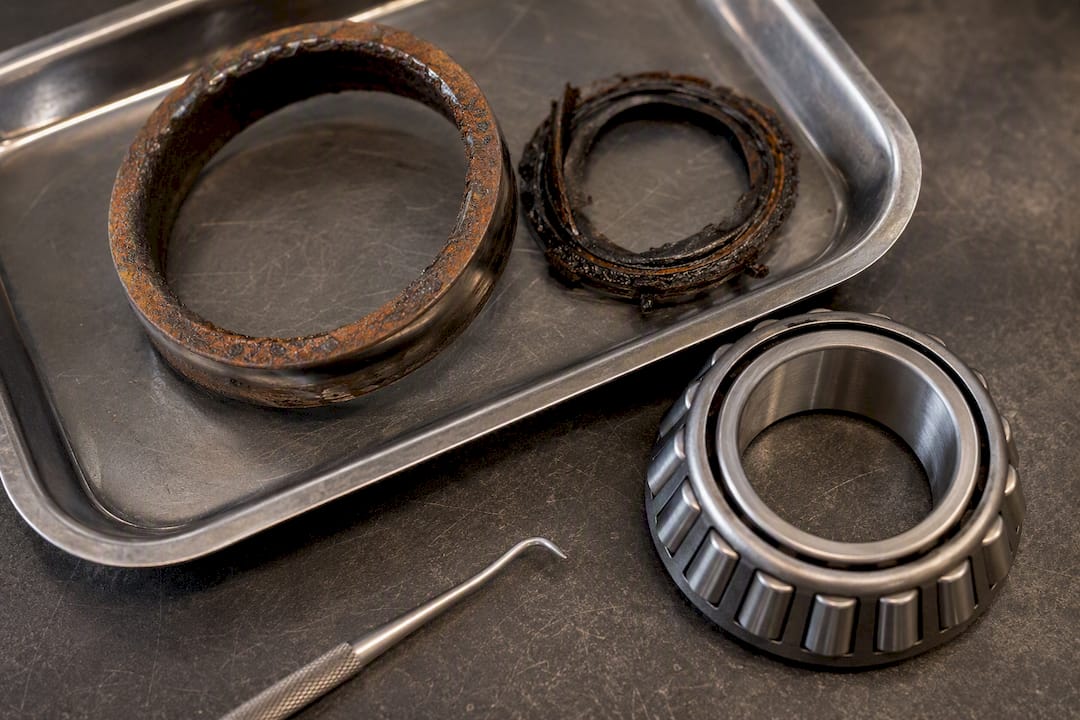
The tricky part is that several other components mimic the exact same drone. Diagnosing bearing noise gets complicated because tire cupping, worn CV joints, and a failing differential all produce a similar hum or roar, and guessing wrong means paying for a part you didn’t need.
Common mimics to rule out:
- Cupped or unevenly worn tires produce a rhythmic thumping that changes with tire rotation, not steering input
- CV joints click or pop specifically during turns, especially at low speed in a parking lot
- A worn differential whines under acceleration and often quiets during coasting
- Warped rotors cause a pulsing brake pedal rather than a steady hum
Here’s the complication nobody mentions enough: these problems often coexist. A bearing that’s been loose for months can cause the uneven tire wear you’re now blaming on alignment, so fixing one without checking the other just brings you back to the shop.
What a Professional Wheel Bearing Inspection Actually Involves
A shop visit isn’t just someone repeating the jack-and-wiggle test with better tools, though that’s part of it. A proper inspection combines a road test with a hands-on hoist check, because no single test is fully definitive on its own.
The most reliable tool for isolating noise is an electronic chassis-ear system. It places small microphones at each wheel, wired to a control box the technician monitors from inside the car during a road test. The loudest channel identifies the failing corner almost instantly, which matters because guessing wrong on a bearing job means paying twice.
Once the car’s on the hoist, a technician typically checks several things:
- Wheel play at 12/6 and 3/9 o’clock positions with the tire off the ground, using a dial indicator for precision your hands can’t match
- Surface temperature at each hub with an infrared thermometer, since a bearing running hot under load is often failing even without audible noise yet
- Rotor and hub runout, watching for wobble that a loose bearing introduces
- ABS wheel speed sensor codes pulled through an OBD-II scanner, since a damaged sensor ring inside the bearing assembly can trigger fault codes before you hear anything unusual
One thing worth knowing before you get quoted a repair: a bearing with no detectable play can still be bad internally. Corrosion or contamination can roughen the rolling surfaces without producing looseness in the hub, which is exactly why the road test and the hoist inspection get used together rather than either alone.
Is It Safe to Drive With Wheel Bearing Noise, and What Will It Cost?
A mild, steady hum that hasn’t changed in weeks is generally safe for short trips while you schedule an inspection. That window closes fast if you notice grinding, a clunk when you turn, visible wheel wobble, a wheel that feels hot to the touch, or a wheel that’s developed detectable play. Any of those means stop driving and arrange a tow rather than risk the bearing seizing or the wheel separating from the hub, which does happen on badly neglected bearings.
Repair costs vary more than most drivers expect. Typical U.S. ranges run roughly $150 to $400 per wheel, depending on a few factors:
- Whether your car uses a serviceable press-fit bearing or a sealed hub assembly, since hub units cost more in parts but less in labor
- Vehicle type, with trucks and SUVs generally landing at the higher end due to heavier-duty components
- Local labor rates and whether the ABS sensor is integrated into the hub assembly, which adds complexity
- Whether one bearing or a pair needs replacement, since bearings on the same axle often wear at a similar rate
Delaying repair rarely saves money. A bearing that’s run hot and rough for months can damage the CV joint, the ABS sensor ring, or even the hub itself, turning a single-part job into a multi-part repair bill.
What to Do Before You Book the Repair
Walking into a shop with a little documentation speeds up the diagnosis and helps you avoid paying for parts you don’t need.
- Note the speed range where the noise starts and whether it gets louder as you go faster.
- Note whether the sound changes when you turn left versus right, and in which direction it’s worse.
- Record a short audio or video clip if you can do it safely, ideally with a passenger driving.
- Write down the results of any test you tried at home, like the jack-and-wiggle or spin test.
- Ask the shop what diagnostics they’ll run, whether they’ll inspect CV joints and tires while they’re in there, and what warranty covers the parts and labor.
If you’re already seeing wheel wobble, grinding, or a hot hub, skip the checklist and arrange a tow instead of driving it in.
Why Trust This Diagnosis
This guide was put together by Shingi, drawing on established diagnostic methods used across the auto repair industry to separate real bearing failure from its many look-alikes.
Tom’s B & M Auto has served Lynnwood’s Toyota, Honda, Subaru, and domestic car owners for over 40 years, with ASE-certified technicians running professional-grade OBD-II diagnostics on every make, including hybrids and European vehicles. Same-day appointments are often available, and all work carries a 24-month/24,000-mile warranty. A proper inspection here means a documented digital report, actual temperature readings off the hub, and test results you can see rather than a technician’s guess.
The Bearing Diagnosis Most Shops Get Backwards
Most advice online treats wheel bearing noise like a coin flip: either it’s obviously the bearing, or it’s obviously something else. That’s backwards. The real skill is holding multiple possibilities open at once and letting the tests narrow the field, because tires, CV joints, and bearings genuinely do sound alike to an untrained ear.
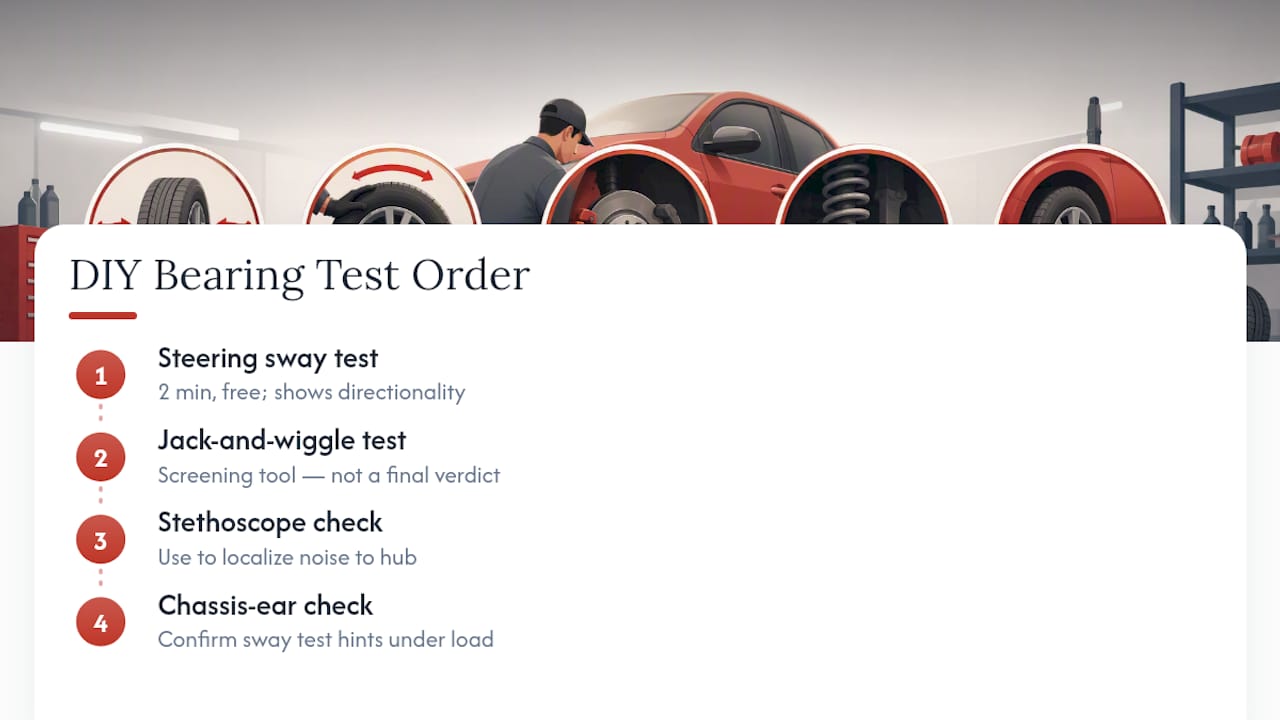
The biggest mistake I see reflected in how this topic gets covered is treating the jack-and-wiggle test as a final verdict rather than a screening tool. A bearing with zero detectable play can still be corroded or roughened internally, which means a clean home test isn’t permission to ignore a persistent hum. It’s permission to keep driving a little longer while you schedule a proper hoist inspection, not a green light to forget about it.
If you take one thing from this guide, prioritize the steering sway test over anything else. It costs nothing, takes two minutes, and tells you more about directionality than any other DIY check available. Everything after that, the jack test, the stethoscope, the chassis-ear, exists to confirm what the sway test already hinted at.
— Shingi
Sources
- Wheel Bearing Noise vs Tire Noise | GMB Blog
- How to Tell Which Wheel Bearing Is Bad in Six Simple Steps – Tire Advise
- How much does it cost to replace wheel bearings – J.D. Power
- How Do I Know If I Have a Bad Wheel Bearing – Ricks Free Auto Repair Advice
Recommended
- How to Diagnose Suspension Noise Before It Gets Worse
- Serpentine Belt Noise: Quick Triage and Fix for DIYers
- Car Problem Sounds: What Each Noise Means and What to Do
- Why Brakes Squeak: Causes, Fixes, and Warning Signs
Leave a Reply